EN
EN  ES
ES  DE
DE  FR
FR  IT
IT  ZH
ZH  JA
JA  PT
PT  TR
TR  KO
KO  PL
PL  AR
AR 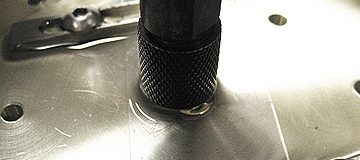
Continuous Stribeck Curve Measurement Using Tribometer
The Stribeck curves were measured using two lubricant oils with different kinetic viscosities for comparison. The Nanovea Pin-On-Disk Tribometer equipped with the lubrication module was used. The rotational speed decreased at an exponential rate from 2000 to 0.01 rpm to showcase the continuous Stribeck Curve measurement and the precise sensitivity of the Tribometer capabilities.
Continuous Stribeck Curve Measurement Using Tribometer
Here are examples of materials we tested this month:
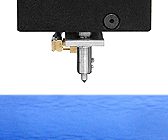
Mechanical:
• Nanoindentation DMA of polymer films
• Nanoindentation compression of micro features
• Nanoindentation creep of composites
• Nano Scratch of micro wire coatings
• Micro Scratch of anodized coatings
• Macroindentation multi cycle failure of micro parts
• Macro Scratch of epoxy coatings
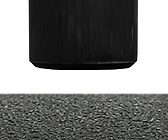
3D Non-Contact Profilometry:
• Roughness of anodized coatings
• Laser micro etching texture measurement
• Flatness of DNA trays
• Step Height of automotive parts
• Dimensions of wafer grid
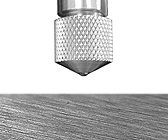
Tribology:
• Wear Testing anodized coatings
• Wear Testing epoxy coatings
• Stribeck Curve analysis of oil samples
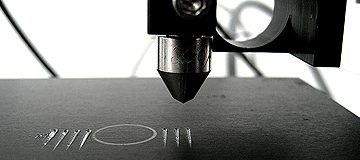
Anodized Coatings Macro Scratch Testing
The process of scratching is simulated in a controlled and monitored manner to observe adhesive or cohesive failures. In this application, the Nanovea Mechanical Tester in its macro scratch testing mode is used to measure the load required to cause failure to anodized coatings produced by different processes.
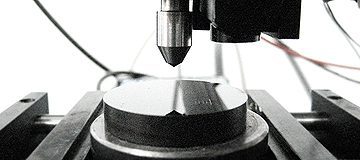
Coating Failure Analysis Using Micro Scratch Testing
We must simulate the process of scratch testing in a controlled and monitored manner to observe coating failure analysis. In this application, the Nanovea Mechanical Tester, in its micro scratch mode, is used to measure the load required to cause the coating failure to three separately processed DLC coatings. A 90° Cone, 20μm diamond tipped stylus is used at a progressive load ranging from 0.01 mN to 15 N to scratch the DLC coating. The point where the coating fails by cracking is taken as the point of failure.
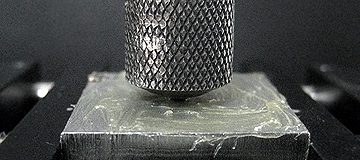
Mechanical Stability of Grease Using Tribometer
The Nanovea Pin-On-Disk Tribometer will be used in rotative mode, linear could have also been used. A steel ball tip will be used against a steel sample coated with lithium complex grease. The load used will be at 5N with a constant speed of 150rpm. Two separately formulated lithium complex greases will be tested for comparative evaluation.
Here are examples of materials we tested this month:
Mechanical:
• Nanoindentation stress strain of steels
• Nanoindentation yield strength of micro parts
• Nanoindentation stiffness of polymers
• Nano Scratch of optical coating
• Micro Scratch of paint coatings
• Macroindentation of dlc coatings
• Macro Scratch of dlc coatings
3D Non-Contact Profilometry:
• Topography of gel surfaces
• Roughness of injection molds
• Texture of silicone samples
• Flatness & Co-Planarity of wafer arrays
• Step Height of photomask
• Dimensions of micro parts
• Submerged Wear Testing of dlc coatings
• Wear Testing silicon coatings
• Friction Testing smart glass samples
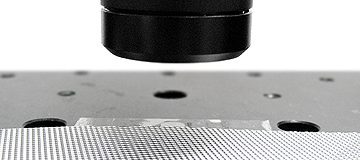
Flatness Measurement of Wafer Using 3D Profilometry
In this application the Nanovea ST400 Profilometer is used to measure the section of a wafer array. The area measured was selected at random, and assumed large enough in that it could be extrapolated to make assumptions about a much larger surface. Surface flatness measurement, planarity & other surface parameters are used to analyze the surface.
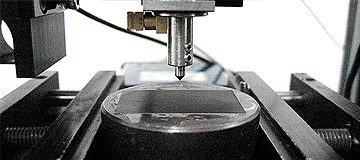
Nanomechanical Testing of Thermal Transfer Print
We must simulate the process of scratching in a controlled and monitored manner to observe sample behavior effects. In this application, the Nanovea Mechanical Tester, in nano scratch testing mode, is used to measure the nanomechanical load required to cause failure to 3 micron wax/resin prints on coated paper. A 2μm 90° cone diamond tip stylus is used at a progressive load ranging from 0.10 mN to 0.20 mN to scratch the printed surface. Points of failure will be reviewed. In addition, we have also used nanoindentation mode to obtain hardness and elastic modulus of the sample prints.
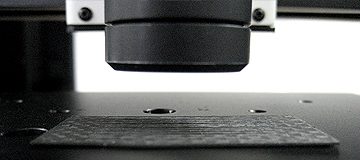
Surface Measurement Using 3D Profilometry
In this application the Nanovea ST400 Profilometer is used for surface measurement of an exposed piece of carbon fiber. The area measured was selected at random, and assumed large enough in that it could be extrapolated to make assumptions about a
much larger surface. Surface roughness, surface area, wavelength, fractal analysis and other surface parameters are used to characterize the surface.
Here are examples of materials we tested this month:
Mechanical:
• Nanoindentation of glass samples
• Nanoindentation compression of micro features
• Nanoscratch of soft films
• Nanowear of biomedical samples
• Microindentation mapping of welds
3D Non-Contact Profilometry:
• Finish of micro seals
• Texture of micro patterns
• Roughness of transparent gel films
• Flatness of glass samples
• Dimensions of lens samples
• Deposited grid Step Height measurement
Tribology:
• High Temp Wear of various spray coatings
• Friction of submerged polymer samples