What nanoindentation DMA tells you
Rubbers, polymers, adhesives, natural materials and many coatings are viscoelastic: part spring, part damper. Their stiffness and energy loss depend on frequency and temperature, and they govern tire grip and rolling resistance, vibration damping, seal performance and impact behaviour. Nanoindentation DMA measures these properties locally, so they can be mapped across layers or compared between small samples.
How the test works
- The indenter is brought into contact and loaded to a set depth or force.
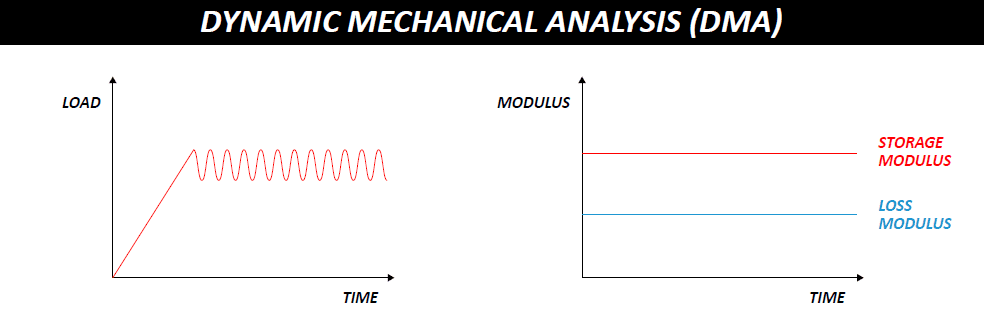
- A small sinusoidal load is superimposed on the static load.
- The depth response is recorded. A purely elastic material responds in phase with the load; a viscous component makes the response lag.
- From the amplitude ratio and phase lag, the software calculates storage modulus, loss modulus, tan δ and complex modulus.
Running the oscillation at several frequencies gives a frequency sweep; repeating it while heating gives the temperature dependence.
Frequency and service conditions
In NANOVEA’s tire frequency sweep on a PB1000, both storage and loss modulus rose steadily from 0.1 to 20 Hz. tan δ was more revealing: it fell from about 0.27 to 0.18 up to 1 Hz, then climbed to about 0.55 at 20 Hz. The study related the test frequencies to road speeds, from about 7 km/h at 1 Hz to 134 km/h at 20 Hz, linking a laboratory measurement to how the rubber behaves on the road.
Locating the glass transition
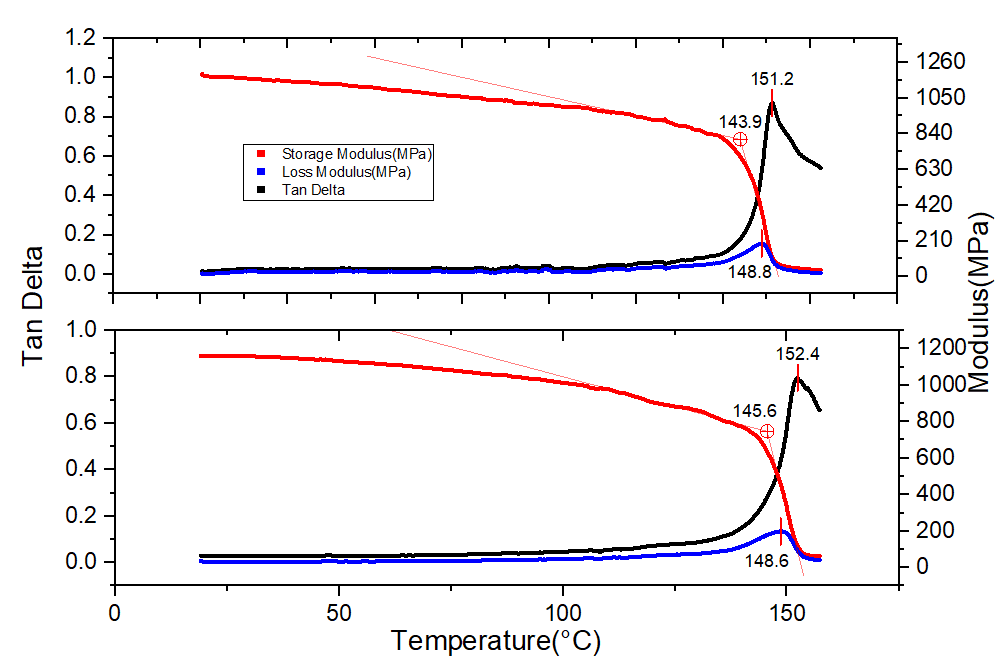
A polymer’s glass transition is where its stiffness drops and damping peaks. With the tip and sample heated together in the high temperature module, periodic indentations at the same target force show depth increasing as the material softens through the transition. Because the measurement is local, the glass transition of a coating, an adhesive layer or a particular region can be found, which a bulk test cannot isolate. See the localized glass transition study.
Local and directional measurement
Natural and composite materials are often anisotropic. NANOVEA’s cork study measured stoppers in the radial and axial directions, finding direction-dependent modulus in two of four samples. The same small-contact approach measures individual layers of laminated or multilayer structures.