Mechanical testing · Instrumented friction

Coefficient of Friction at Nano & Micro Loads

Instrumented friction testing measures the coefficient of friction (the ratio of friction force to normal load) as a counterbody slides over a sample under precisely controlled low load. On a NANOVEA mechanical tester it runs at nano and micro loads, for thin films, soft materials and medical devices where a tribometer's loads would be too high.

Coefficient of friction measured on a NANOVEA mechanical tester

At a glance

Result
Static and kinetic coefficient of friction, recorded continuously along the sliding path.
Load
Constant low normal load held by closed-loop control, e.g. 50 mN with the nano module in a published study.
Counterbodies
Balls, styli and custom geometries in a variety of materials.
Samples
Coatings, films, polymers, elastomers, medical devices and other low-load contacts.
Environments
Dry or in liquid (e.g. Hanks' solution), with temperature and humidity modules.
Combined testing
Friction on the same platform as nanoindentation and scratch tests.

What instrumented friction tells you

Friction controls how a medical device slides through tissue, how a coating feels and wears, how a film or label handles, and whether a micro-mechanism moves smoothly. Many of these contacts carry only milli-newtons of load. Instrumented friction testing measures the coefficient of friction at those loads, on the same instrument that measures hardness, modulus and scratch resistance.

How the test works

  1. The counterbody, a ball, stylus or custom tip, is brought into contact with the sample.
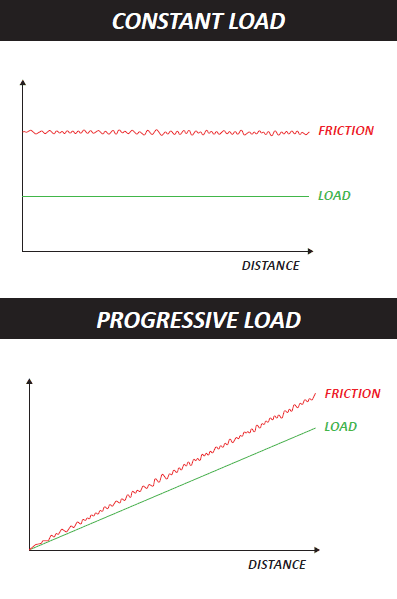
  2. A constant normal load is applied and held by closed-loop control.
  3. The sample moves under the counterbody at a set speed and distance, while the friction force is recorded continuously.
  4. The coefficient of friction is calculated along the path; repeats and different conditions (dry, liquid, humid, hot or cold) are compared.

Low load, real conditions

At low load, accurate force control matters more than raw capacity. In NANOVEA’s pacing lead study, the nano module held 50 mN constant while a 6 mm steel ball slid 10 mm at 20 mm/min over silicone and polyether-polyurethane lead insulation, both dry and in Hanks’ solution. That is the kind of contact the leads see in the body, which a tribometer at higher load could not reproduce.

Friction as a diagnostic in scratch testing

Friction is also recorded in every scratch test. As load increases, friction typically rises steadily, then changes abruptly when the stylus breaks through a coating. In NANOVEA’s TiN study, friction climbed to about 0.3 before the first chipping at about 3.3 N. Combined with depth and acoustic emission, the friction record helps locate failure precisely.

When to use a tribometer instead

For higher loads, long sliding distances, wear rate measurement and standard friction-and-wear methods such as ASTM G99 and G133, NANOVEA tribometers are the right platform. The mechanical tester covers the low-load end of the same range.

Test environments

Instruments that run this test

Every instrument is built to order. Send us your samples and we run your test in our laboratory first, then configure the instrument around the result.

Published results

Measured in our own laboratory, on the instruments we design and build, and published with full test parameters.

All mechanical testing application notes →

Independent published research

NANOVEA instruments appear in 438 published studies on indentation, hardness and scratch, by researchers at universities and industrial laboratories worldwide.

All 438 studies →

NANOVEA materials testing laboratory

Need low-load friction data? Send us your samples.

Our laboratory measures friction at nano and micro loads, alongside indentation and scratch, on the same mechanical testers we build.

Your samples are tested by the people who design the instruments, so you get advice on the method as well as the numbers.

Indentation & scratch lab services

Frequently asked questions

Why measure friction on a mechanical tester instead of a tribometer?

For contacts that carry very little load: thin films, soft polymers, medical devices, MEMS and optical coatings. The mechanical tester's nano and micro modules hold loads in the mN range accurately, where a tribometer's loading would be too coarse or too high to represent the real contact.

What is the coefficient of friction?

The ratio of the friction force resisting sliding to the normal load pressing the surfaces together. Static friction is the ratio needed to start sliding; kinetic friction is the ratio during sliding. Both depend on the materials, surfaces, environment and conditions, not just the material pair.

How is a constant low load maintained?

With true closed-loop control from independent load and depth sensors: as the counterbody slides over surface features, the system adjusts to keep the normal load at its set value. In NANOVEA's pacing-lead study, the nano module held 50 mN constant throughout the measurement.

Can friction be measured in liquid?

Yes. The liquid module allows sliding with the contact immersed, for example in Hanks' solution to simulate body fluid for implant materials, so friction is measured in conditions close to service.

Does friction help detect coating failure?

Yes. During scratch tests, friction is recorded alongside depth and acoustic emission. A step change in friction often marks the stylus breaking through a coating, as in NANOVEA's TiN coating study.