

Application Note | Lubricant Testing
Lubricating Eye Drop Comparison Using the NANOVEA T50 Tribometer
Comparing the Lubricating Efficiency of Three Eye Drop Solutions by Coefficient of Friction

Research & Experimental Testing
NANOVEA Laboratory
Visual Design & Editorial
Andrew Shore
Introduction
Eye drop solutions are used to alleviate symptoms caused by a range of eye problems. For example, they can be used to treat minor eye irritation (e.g. dryness and redness), delay the onset of glaucoma or treat infections. Eye drop solutions sold over-the-counter are mainly used to treat dryness. Their effectiveness in lubricating the eye can be compared and measured with a coefficient of friction test.
Why Testing Eye Drop Solutions Matters
Dry eyes can be caused by a wide range of factors, for example, computer eye strain or being outdoors in extreme weather conditions. Good lubricating eye drops help maintain and supplement the moisture on the outer surface of the eyes. This works to alleviate the discomfort, burning or irritation and redness associated with dry eyes. By measuring the coefficient of friction (COF) of an eye drop solution, its lubricating efficiency and how it compares to other solutions can be determined.
ℹ️ Learn more about friction testing lab services for lubricants and liquids.
Measurement Objective
In this study, the coefficient of friction (COF) of three different lubricating eye drop solutions was measured using the pin-on-disk setup on the NANOVEA T50 Tribometer.
NANOVEA T50 Compact
Free Weight Tribometer

Test Procedure

A 6 mm diameter spherical pin made of alumina was applied to a glass slide with each eye drop solution acting as the lubricant between the two surfaces. The test parameters used for all experiments are summarized in Table 1 below.
| Parameter | Value |
|---|---|
| Load | 1 N |
| Duration of test | 3 min |
| Rotational rate | 200 rpm |
| Radius of track | 2 mm |
| Revolutions | 600 |
| Ball diameter | 6 mm |
| Ball material | Alumina |
| Lubricant | Samples A, B, C, D |
| Temperature | 23°C (room) |

Table 1: Test parameters for COF measurements.
Results and Discussion
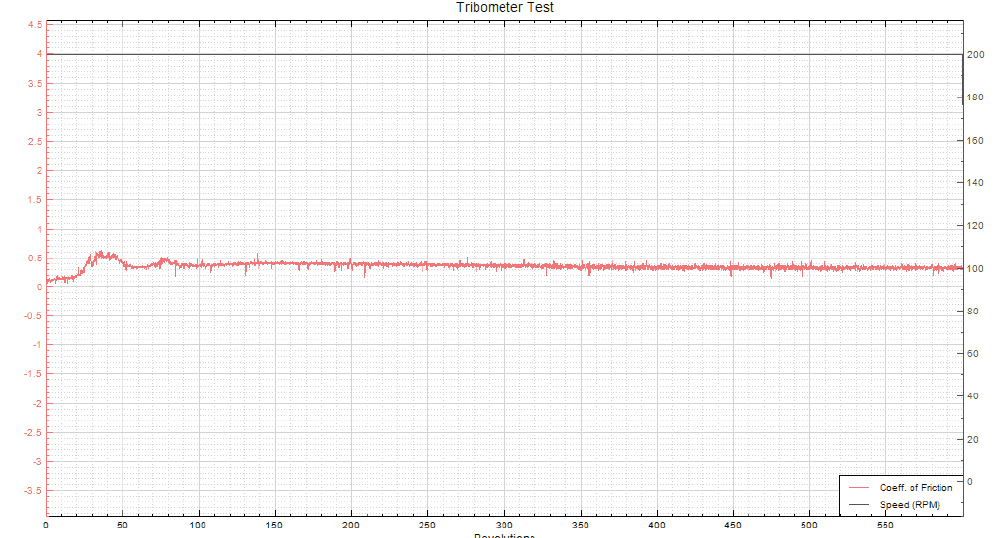
The maximum, minimum, and average coefficient of friction values for the three different eye drop solutions tested are tabulated in Table 2 below. The COF v. Revolutions graphs for each eye drop solution are depicted in Figures 2-4. The COF during each test remained relatively constant for most of the total test duration. Sample A had the lowest average COF indicating it had the best lubrication properties.
| Sample | Max COF | Min COF | Avg COF |
|---|---|---|---|
| A | 0.578 ± 0.205 | 0.18 ± 0.277 | 0.317 ± 0.121 |
| B | 1.05 ± 0.02 | 0.121 ± 0.071 | 0.78 ± 0.024 |
| C | 1.09 ± 0.06 | 0.085 ± 0.069 | 0.84 ± 0.103 |
Table 2: The measured coefficient of friction values for Samples A, B and C.


Conclusion
In this study we showcase the capability of the NANOVEA T50 Tribometer in measuring the coefficient of friction of three eye drop solutions. Based on these values, we show that Sample A had a lower coefficient of friction and therefore exhibits better lubrication in comparison to the other two samples.
NANOVEA Tribometers offer precise and repeatable wear and friction testing using ISO and ASTM compliant rotative and linear modules. They also provide optional high temperature wear, lubrication, and tribo-corrosion modules available in one pre-integrated system. Such versatility allows users to better simulate the real application environment and improve fundamental understanding of the wear mechanism and tribological characteristics of various materials.
Frequently Asked Questions About Eye Drop Lubricity Testing
Why measure the friction of eye drop solutions?
Over-the-counter eye drops are mainly used to treat dryness, and good lubricating drops help maintain and supplement moisture on the eye surface to relieve discomfort, burning, irritation and redness. Measuring their coefficient of friction shows their lubricating efficiency and how they compare.
How is eye drop lubricity tested on a tribometer?
A 6 mm alumina ball slides on a glass slide with the eye drop solution as the lubricant between the surfaces, here at 1 N and 200 rpm on a 2 mm radius for 3 minutes (600 revolutions) at 23°C, with friction recorded throughout.
Which eye drop lubricated best?
Sample A had the lowest average coefficient of friction (0.317 ± 0.121), indicating the best lubrication, compared with 0.78 ± 0.024 for Sample B and 0.84 ± 0.103 for Sample C.
Was friction stable during the tests?
Yes. The COF remained relatively constant for most of the test duration for each solution, as the COF versus revolutions graphs show.
What causes dry eyes?
A wide range of factors, for example computer eye strain or being outdoors in extreme weather conditions.
Which NANOVEA instrument was used?
The NANOVEA T50 tribometer in pin-on-disk mode. NANOVEA tribometers offer ISO and ASTM compliant rotative and linear modes with optional high temperature, lubrication and tribocorrosion modules.
