EUA/GLOBAL: +1-949-461-9292
EUROPA: +39-011-3052-794
FALE CONOSCO

Categoria: Perfilarometria | Geometria e Forma


3D optical profilometry image showing climbing hold surface roughness, pore morphology, and grip-related texture features.

Climbing Hold Surface Roughness Analysis

Application Note | 3D Optical Profilometry

Climbing Hold Surface Roughness Analysis Using 3D Optical Profilometry

Measuring Texture, Porosity, and Topography on Bouldering Holds

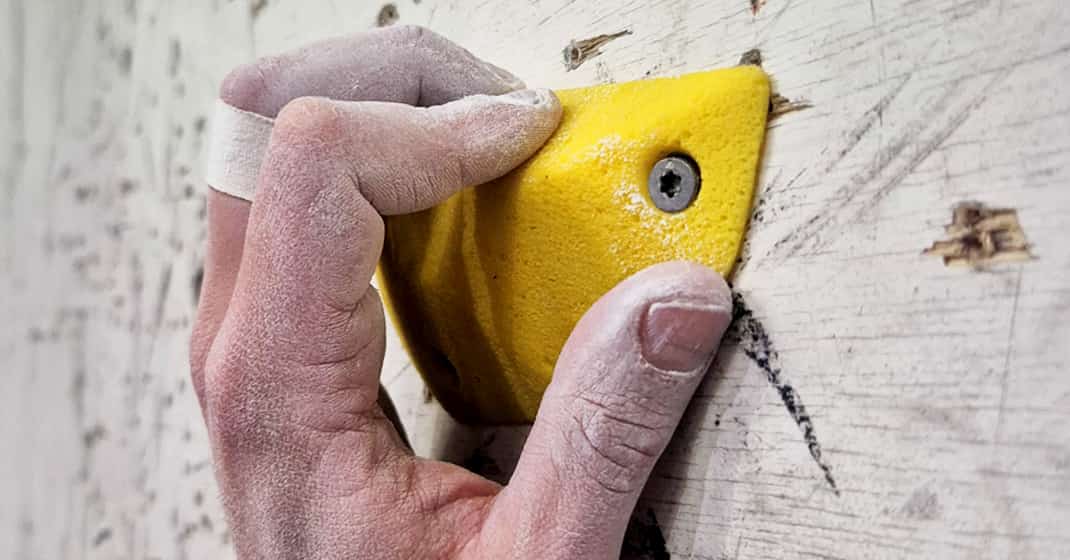
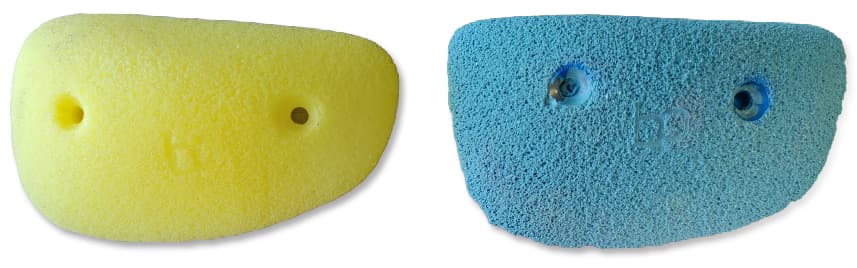
Bouldering holds analyzed for climbing hold surface roughness using 3D optical profilometry.

Research & Experimental Testing

Walter Alabiso, PhD

Visual Design & Editorial

Andrew Shore

Introdução

Bouldering is a demanding discipline that combines physical strength, precise body positioning, and an understanding of how the human body interacts with climbing surfaces. On slab routes, where the wall is angled below vertical and positive holds are limited or absent, a climber’s stability depends almost entirely on the tribological interaction between the body and the climbing hold surface.

Climbing hold surface roughness plays a central role in this contact. Roughness provides the microtexture needed for smearing, a technique where high-friction rubber soles are pressed firmly against the surface to expand the effective contact area and generate adherence. A similar mechanism occurs at the fingers, where the ridges of fingerprints and the pliability of skin deform slightly against the hold’s surface features, creating grip through microscopic interlocking.

Porosity contributes to grip performance by absorbing moisture, sweat, or chalk at the contact interface, preventing the formation of a thin lubricating film that would reduce friction. Micro-cracks and surface flaws act as additional friction points, helping the climber maintain lateral tension against the hold surface. Because these features (roughness, porosity, and surface morphology) operate at different scales and interact differently depending on the hold, quantitative 3D surface measurement is essential for comparing how different climbing hold textures perform under real contact conditions.

Bouldering grips used to compare surface roughness, pore morphology, and grip-related topography.

Why Use Non-Contact Profilometry for Climbing Hold Surface Analysis

Climbing holds and rock-like surfaces can include deep pores, steep asperities, sharp valleys, and irregular texture. These features are difficult to measure accurately with contact-based profilometry because a physical stylus can lose contact, deform local surface features, or fail to reach narrow cavities.

NANOVEA’s non-contact optical profilometry uses chromatic light technology to capture surface height data without touching the sample. This makes it suitable for reconstructing complex climbing hold topography, including deep nooks, pores, and surface flaws, while avoiding measurement artifacts caused by local plastic deformation.
In this study, the NANOVEA JR25 Optical Profiler was used to measure two bouldering grips: a yellow block with a smoother, flatter surface and a green block with a rougher tactile texture. Both samples were scanned using a PS4-MG35 single-point optical sensor with a 3000 µm Z-range and a 4 µm acquisition step in X and Y.

Dual-frequency acquisition was used to reduce light sensor saturation from localized bright spots on the grip surfaces, allowing the profiler to capture roughness and pore morphology across the scanned areas.

Objetivo da medição

The objective of this study was to demonstrate how non-contact 3D optical profilometry can be used to reconstruct and compare the surface roughness, topography, and pore morphology of climbing holds.

Two bouldering grip samples were analyzed: a yellow block with a smoother, flatter surface and a blue block with a rougher tactile texture and sharper grip features. The analysis focused on surface height variation, areal roughness parameters, pore coverage, pore size, pore depth, and functional surface behavior.

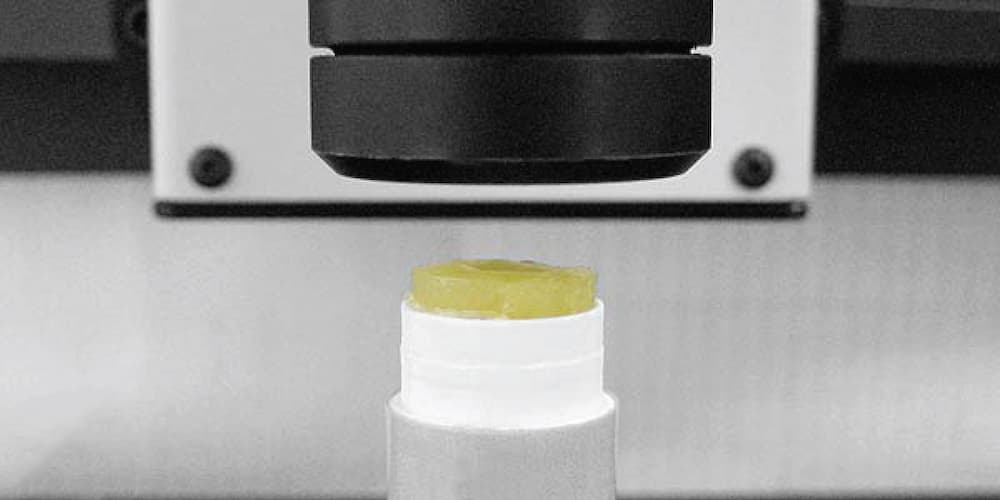
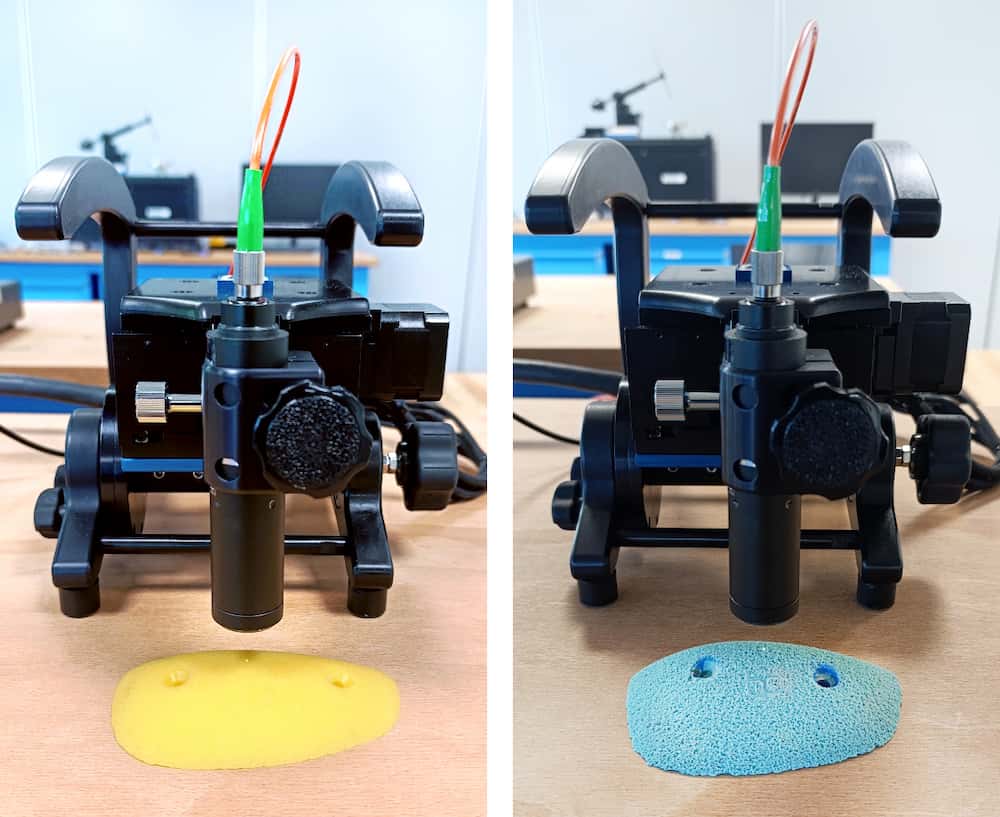
The NANOVEA JR25 Optical Profilometer measuring the climbing hold samples using an optical sensor.

Measurement Method

The NANOVEA JR25 Optical Profiler was used to measure the yellow and blue bouldering grip samples. Each surface was scanned with a PS4-MG35 single-point optical sensor with an enhanced 3000 µm Z-range, allowing the system to capture deep pores, sharp valleys, and irregular surface texture while maintaining a 4 µm acquisition step in X and Y.

Dual-frequency acquisition was used to reduce light sensor saturation from localized bright spots on the grip surfaces, improving data capture across rough, porous, and uneven areas.

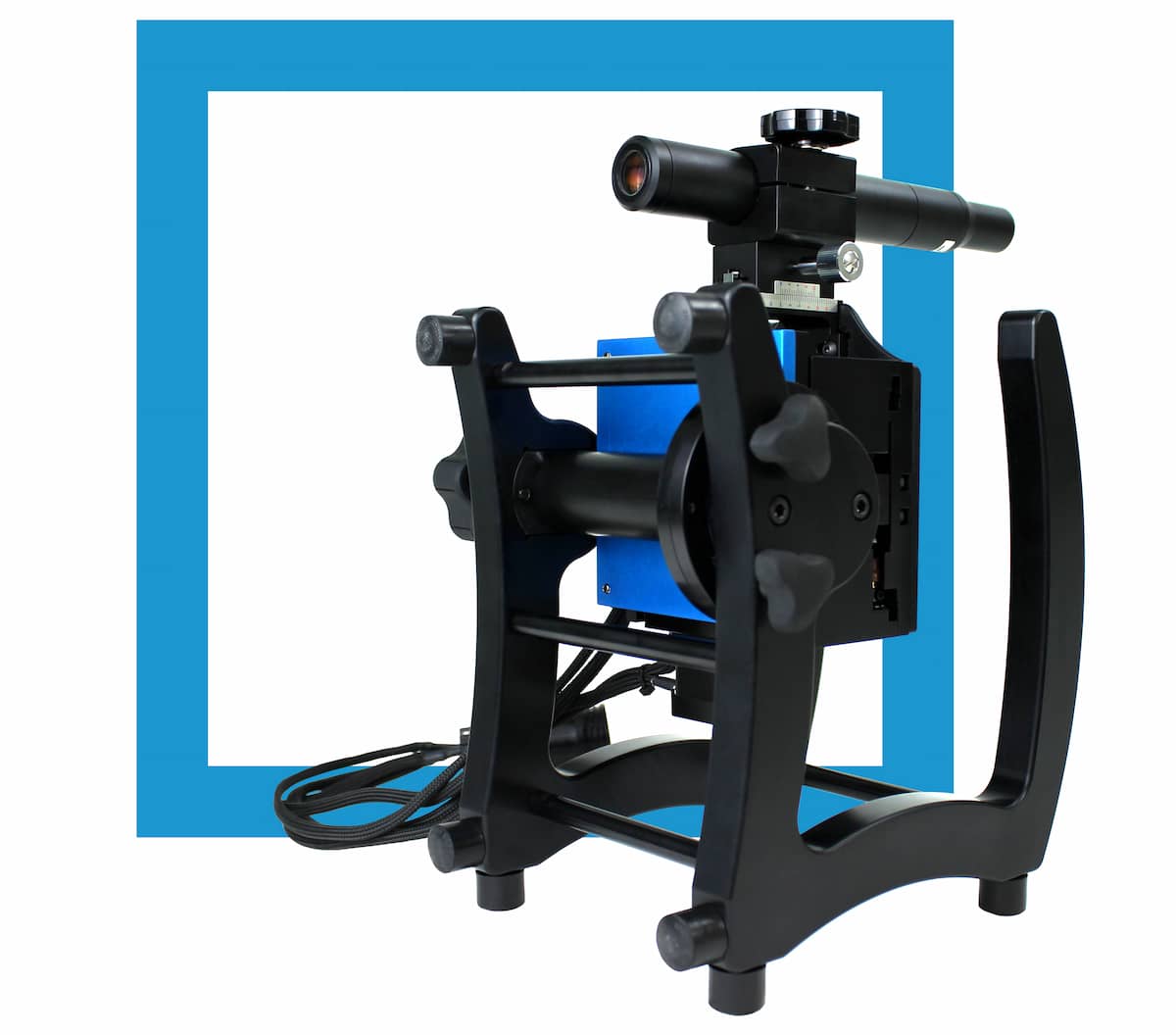
NANOVEA JR25 Portable

Perfilômetro Óptico

Parâmetros de teste

Two bouldering grip samples were analyzed: a yellow grip with a smoother, flatter surface and a blue grip with a rougher tactile texture and sharper grip features. The analysis focused on surface height variation, areal roughness parameters, pore coverage, pore size, pore depth, and functional surface behavior.

Measurement Setting Optical Profilometry Setup
Samples measured Yellow and blue bouldering grip samples
Optical pen PS4-MG35
Z-range 3000 µm
Scan area 5.00 mm × 5.00 mm
X-step size 4.00 µm
Y-step size 4.00 µm
Averaging 1
Measurement type Direct
Acquisition mode Dual frequency
Acquisition rate 100–400 Hz
Light intensity 100%

Tabela 1: Optical profilometry test conditions used to measure the bouldering grip samples.

Optical Profilometry Results

Yellow Grip Sample

Surface Roughness Analysis

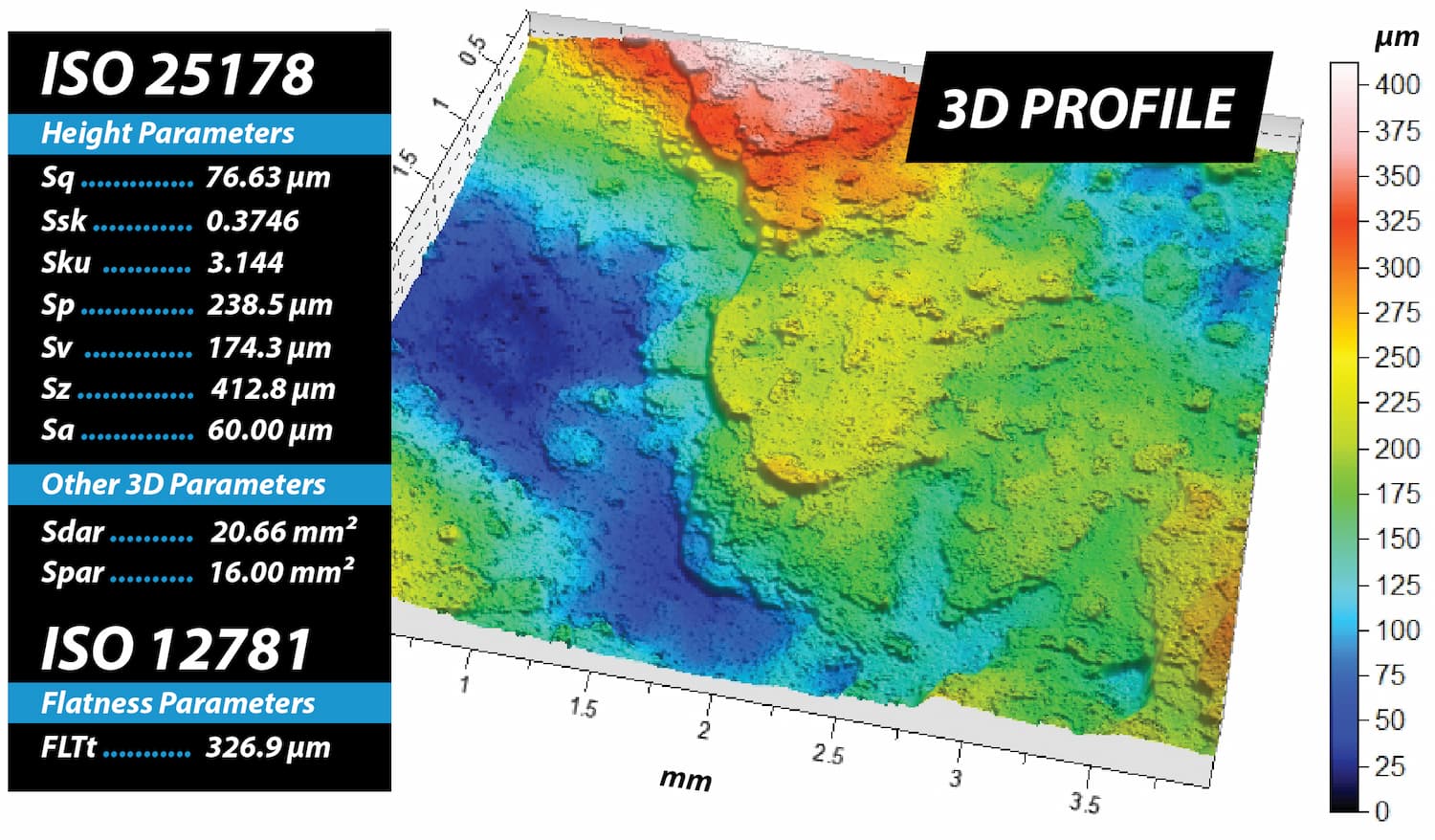
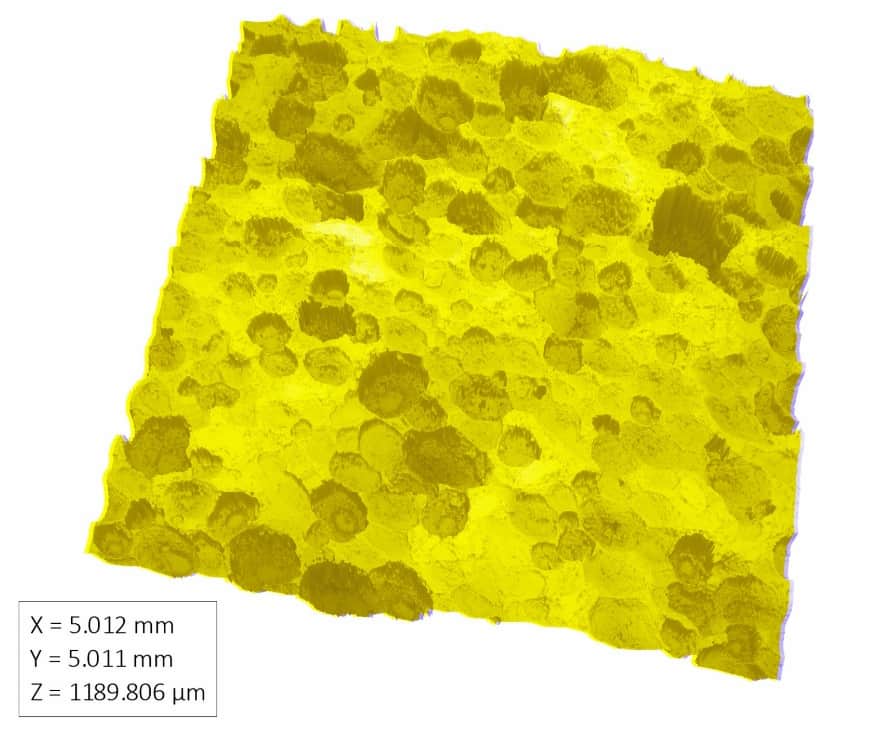
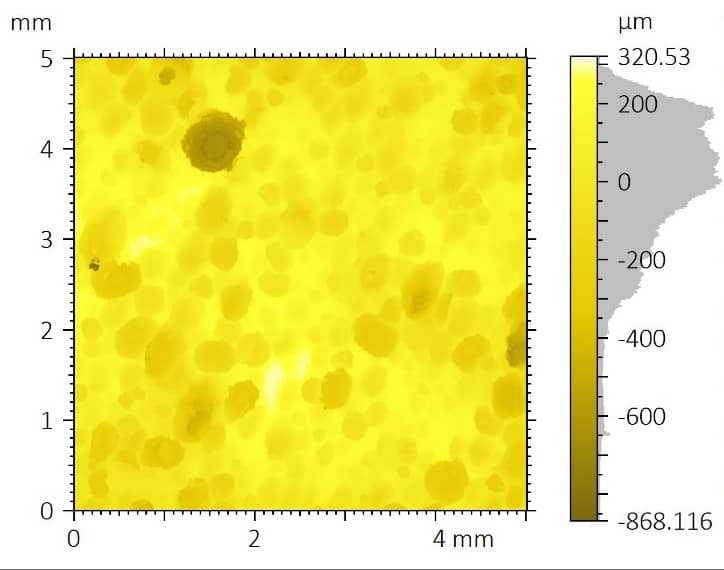
The 3D rendering below shows the reconstructed surface topography of the yellow climbing grip sample.

3D optical profilometry reconstruction of the yellow climbing grip surface showing pores, roughness, and surface height variation.
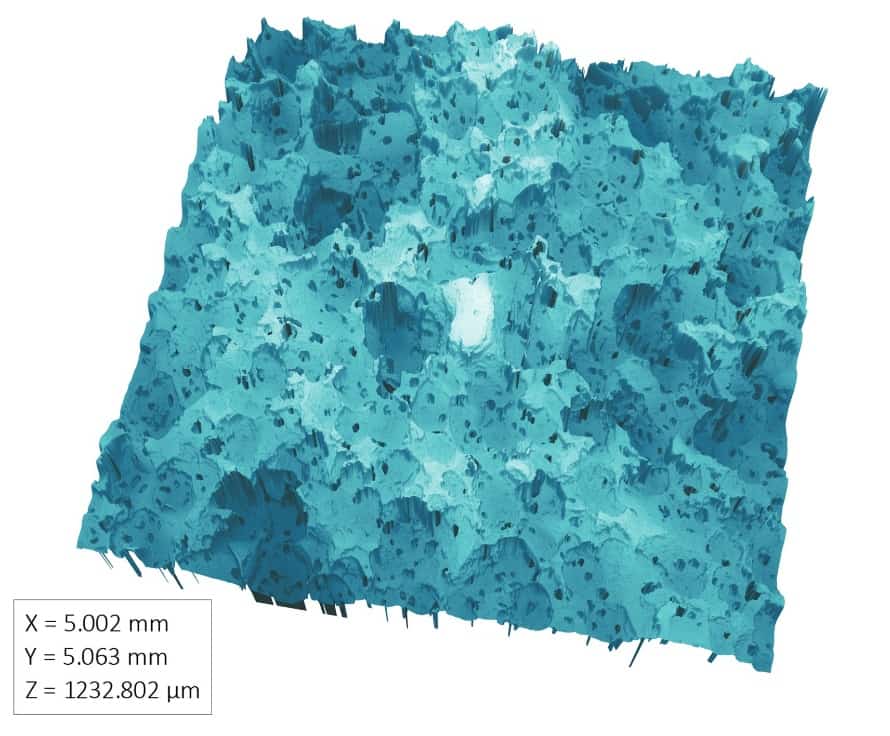
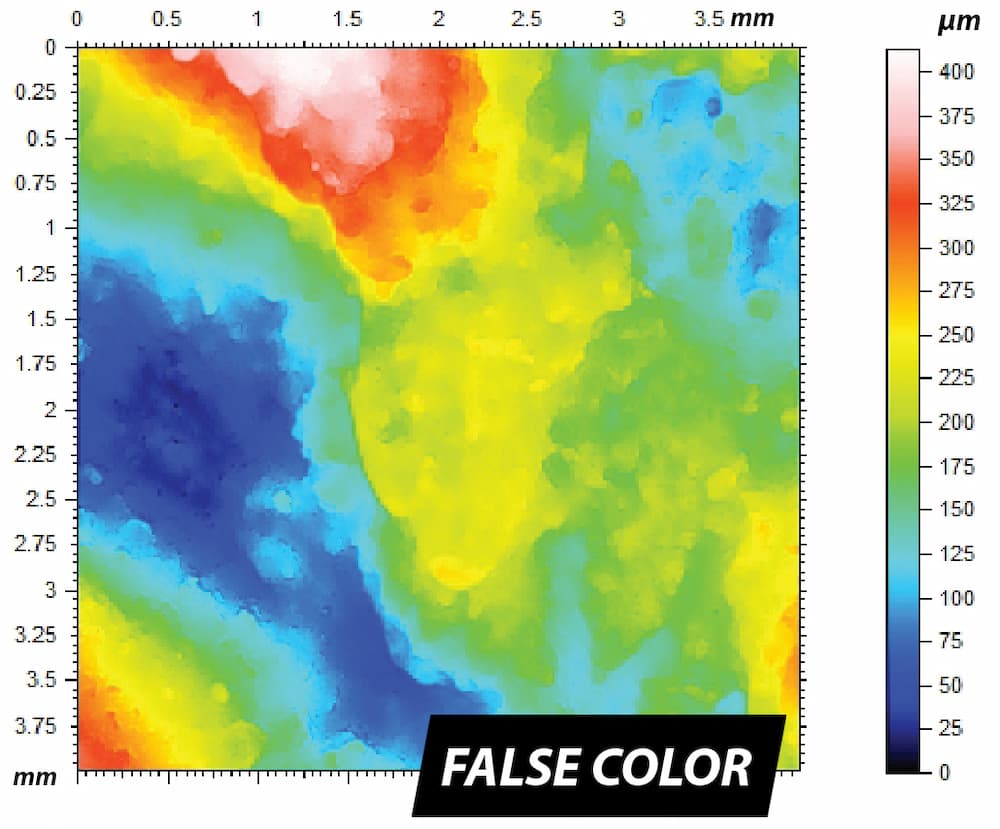
A total least-squares plane was removed to study surface properties. The roughness filters S-Gaussian 2.5 µm was applied following ISO 25178 (1/2 cut-off removed at each side). However, the sharp density of pores and asperities and the elevated average roughness make the use of a Gaussian L-filter (8 mm cut off) inapplicable. Therefore, the primary surface was considered, and the roughness parameters are listed in the table below, alongside the 2D false-color map of the filtered surface.

False-color optical profilometry surface roughness map of the yellow climbing grip sample with ISO 25178 height parameters.
ISO 25178-2 – Primary Surface
S-filter (λs): Gaussian, 2.5 µm, 1/2 cut-off
F-operation: [Workflow] Leveled (TLSPL)
Height Parameters
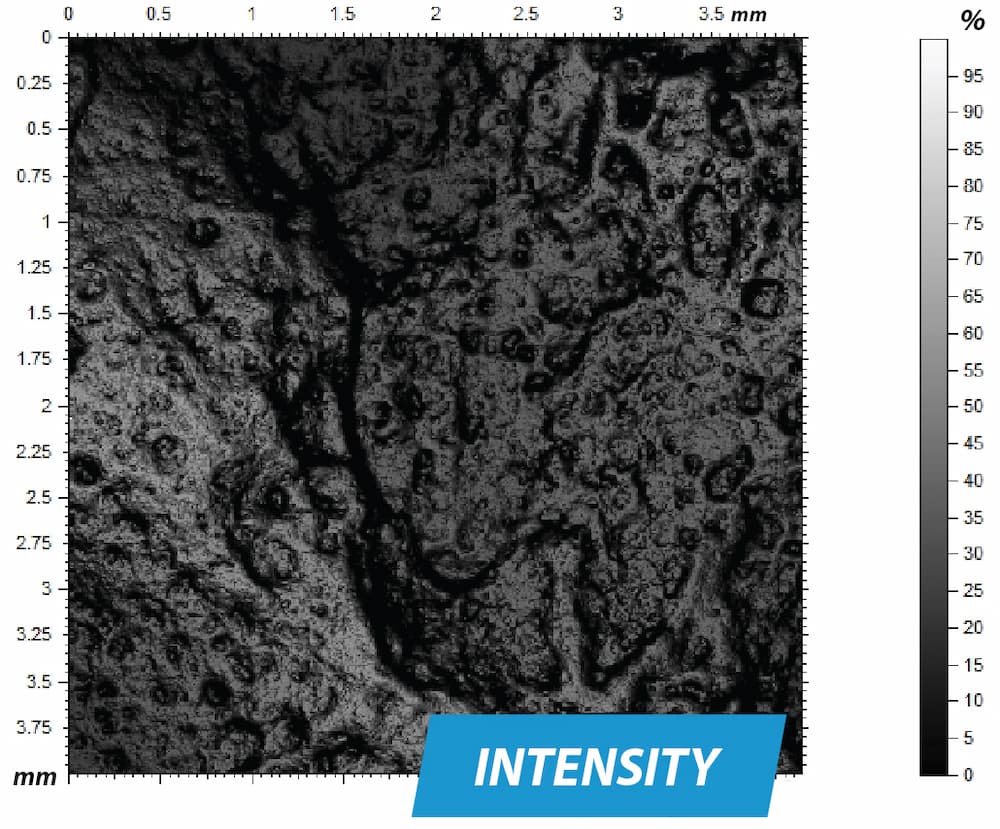
Sq 168.970 µm Altura da raiz quadrada média
Ssk -0.927 Skewness
SKU 4.117 Curtose
Sp 320.530 µm Altura máxima do pico
Sv 868.116 µm Maximum pit depth
Sz 1188.645 µm Altura máxima
Sa 132.953 µm Altura média aritmética

The average surface roughness Sa is 132.953 µm, whereas the peak-to-valley roughness, Sz amounts to 1188.645 µm. The surface morphology is skewed towards deep valleys (Ssk < 0, Sv > Sp), with a leptokurtotic (SKU > 3) distribution of peaks and valleys relative to the average plane.

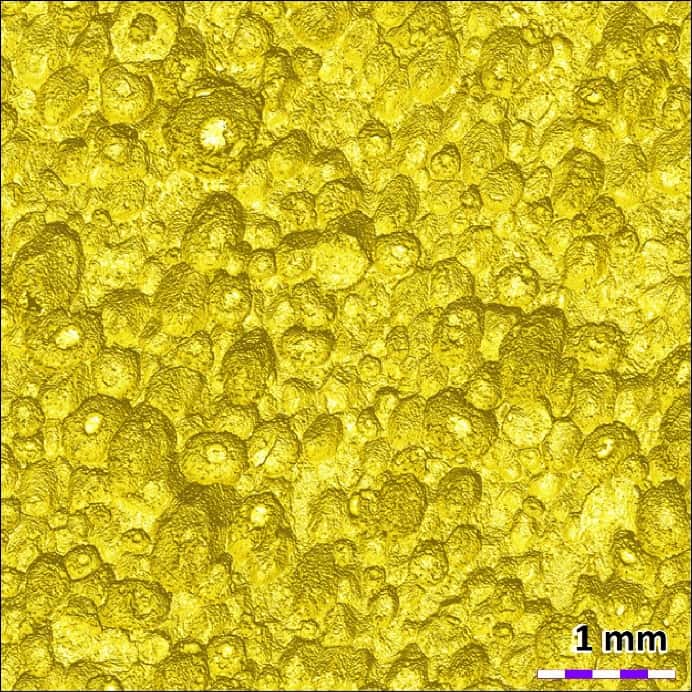
The following picture shows a 2D photo-simulation of the area under artificial lighting, highlighting the region’s morphology.

2D photo simulation of the yellow climbing grip surface showing pores, roughness, and morphology under artificial lighting.

Pore Morphology Analysis

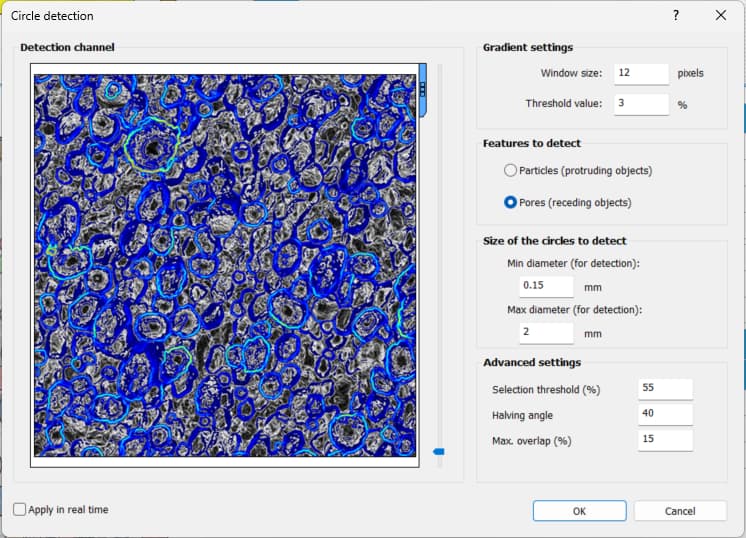
A pore analysis was performed across the full scanned area using a semi-automated edge-detection algorithm. The analysis identified recessed surface features to quantify pore coverage, pore density, radius, void volume, and maximum depth.

Pore detection analysis of the yellow climbing grip surface using semi-automated edge detection to identify recessed surface features.

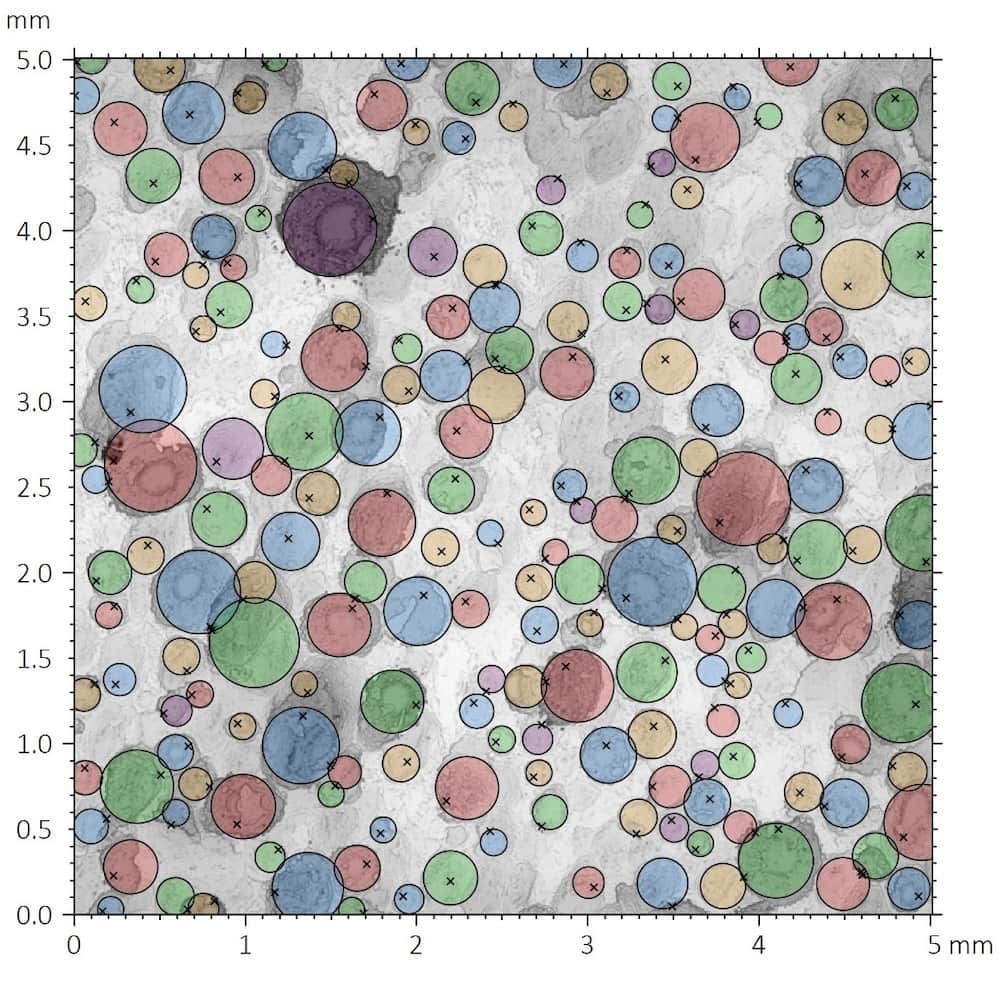
The detected pore locations were then mapped across the scanned 5 mm × 5 mm area to evaluate pore coverage, density, and size distribution.
Pore distribution map of the yellow climbing grip sample showing detected recessed surface features across a 5 mm by 5 mm scanned area.
Information
MethodCircle detection
Features detectedPores, recessed objects
Minimum detection diameter0.150 mm
Maximum detection diameter2.000 mm
Number of detected pores206
Surface coverage47.395%
Pore density8.203 particles/mm²
Global Statistics
ParameterUnitMeanStd. Dev.MinMax
Radiusmm0.1270.0490.0760.275
Void volumeµm³4,724,770.7056,748,143.92523,594.1724.422 × 10⁷
Maximum depthµm173.72994.94228.153716.480

Pores covered nearly half of the yellow grip’s scanned surface, with a measured coverage of 47.395% and a pore density of 8.203 particles/mm². The detected pores and cracks were highly heterogeneous in size, volume, and depth, ranging from large crater-like features with a maximum radius of 0.275 mm and void volume above 4.4 × 10⁷ µm³ to smaller pores with a minimum radius of 0.076 mm and void volume of 23,594.172 µm³. This uneven pore distribution is reflected in the large standard deviation measured for void volume and maximum depth.

Functional Surface Parameters (Abbott-Firestone curve)

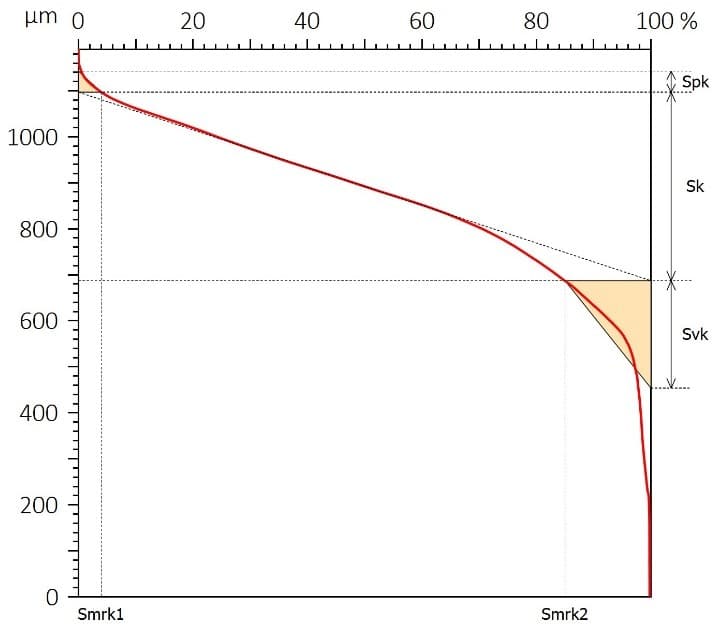
The Abbott-Firestone curve shows the cumulative areal material distribution of the yellow climbing grip sample. This analysis defines functional surface parameters including Sk, Spk, and Svk according to ISO 25178-2.

Abbott-Firestone curve for the yellow climbing grip sample showing cumulative areal material distribution and functional surface parameters.
Information
Padrão ISO 25178-2
Parameter Value Unit
Sk 409.738 µm
Spk 45.480 µm
Svk 233.446 µm
Smrk1 3.976 %
Smrk2 85.005 %

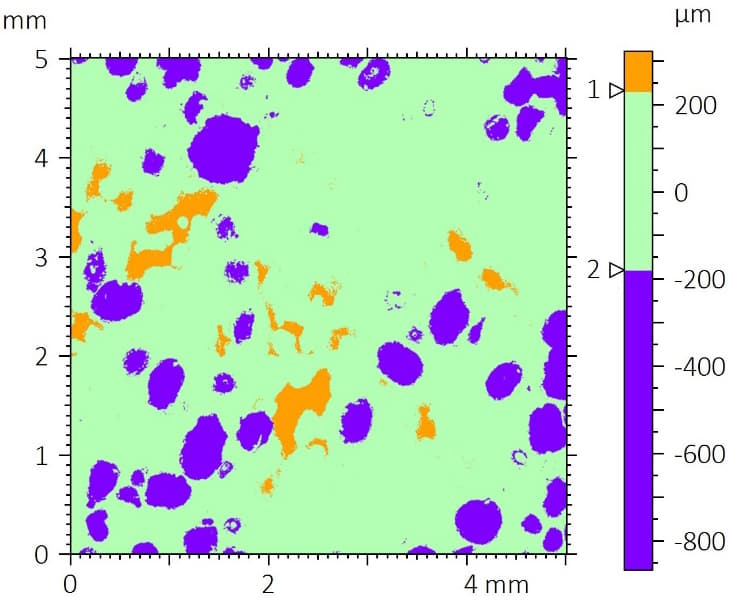
The chart below shows the peak-valley distribution from the mean plane based on the functional parameters derived from the Abbott-Firestone curve. Valleys are shown in purple, the mean plane in green, and peaks in orange.

Peak-valley distribution map of the yellow climbing grip sample showing valleys, mean plane regions, and peaks derived from Abbott-Firestone functional parameters.
Information
1st threshold Height – c1: 229.209 µm
2nd threshold Height – c2: -180.424 µm
Parameters Unit
Projected area (in %) % 14.995 81.029 3.976
Projected area mm² 3.772 20.381 1.000
Volume of material (in %) % 97.451 48.100 0.973
Volume of material µm³ 1.684 × 10¹⁰ 4.956 × 10⁹ 2.275 × 10⁷

The yellow grip sample shows a dominant mean-plane region with scattered recessed pores and a smaller population of raised peaks. This indicates a surface texture characterized mainly by average-sized pores distributed across the scanned area.

Blue Grip Sample

Surface Roughness Analysis

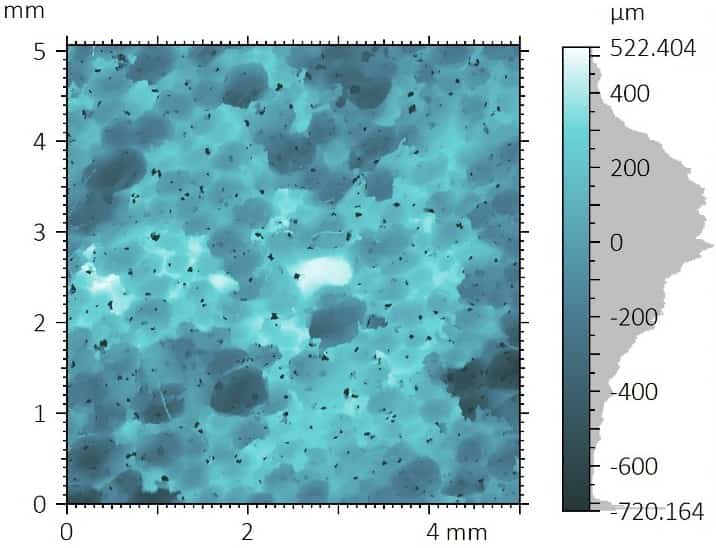
The 3D rendering below shows the reconstructed surface topography of the blue climbing grip sample.

3D optical profilometry reconstruction of the blue climbing grip surface showing roughness, pores, asperities, and surface height variation.
A total least-squares plane was removed to evaluate the blue grip’s surface properties. An S-Gaussian 2.5 µm roughness filter was applied following ISO 25178, with 1/2 cut-off removed at each side.

Because of the dense pores, asperities, and elevated average roughness, a Gaussian L-filter with an 8 mm cut-off was not applied. The primary surface was used for roughness analysis, with the roughness parameters listed alongside the 2D false-color map of the filtered surface.

False-color optical profilometry surface roughness map of the blue climbing grip sample with ISO 25178 height parameters.
ISO 25178-2 – Primary Surface
S-filter (λs): Gaussian, 2.5 µm, 1/2 cut-off
F-operation: [Workflow] Leveled (TLSPL)
Height Parameters
Sq 211.440 µm Altura da raiz quadrada média
Ssk -0.682 Skewness
SKU 3.672 Curtose
Sp 522.404 µm Altura máxima do pico
Sv 720.164 µm Maximum pit depth
Sz 1242.568 µm Altura máxima
Sa 166.719 µm Altura média aritmética

The blue grip sample had an average surface roughness, Sa, of 166.719 µm and a peak-to-valley roughness, Sz, of 1242.568 µm. The negative skewness value, Ssk &lt; 0, indicates that the surface morphology is skewed toward deep valleys, while Sv &gt; Sp shows that the maximum pit depth exceeded the maximum peak height.

The kurtosis value, Sku &gt; 3, indicates a leptokurtotic height distribution, meaning the blue grip surface contains sharper or more extreme peaks and valleys relative to the average plane.

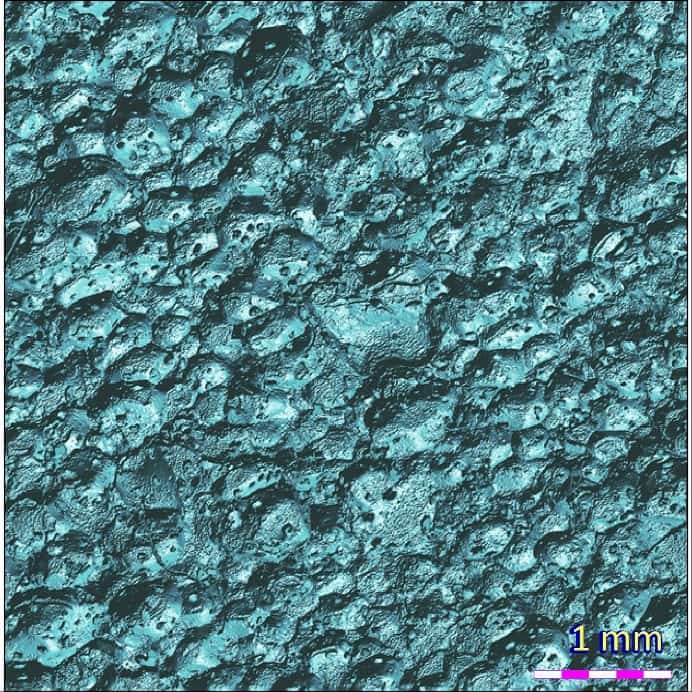
The 2D photo simulation below highlights the blue climbing grip’s surface morphology under artificial lighting.

2D photo simulation of the blue climbing grip surface showing pores, roughness, and morphology under artificial lighting.

Pore Morphology Analysis

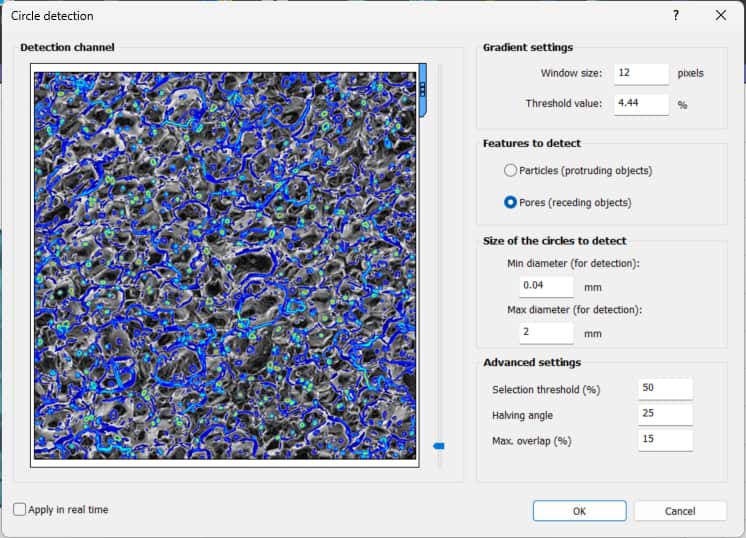
A pore analysis was performed across the full scanned area using a semi-automated edge-detection algorithm. The analysis identified recessed surface features to quantify pore coverage, pore density, radius, void volume, and maximum depth.

Pore detection analysis of the blue climbing grip surface using semi-automated edge detection to identify recessed surface features.

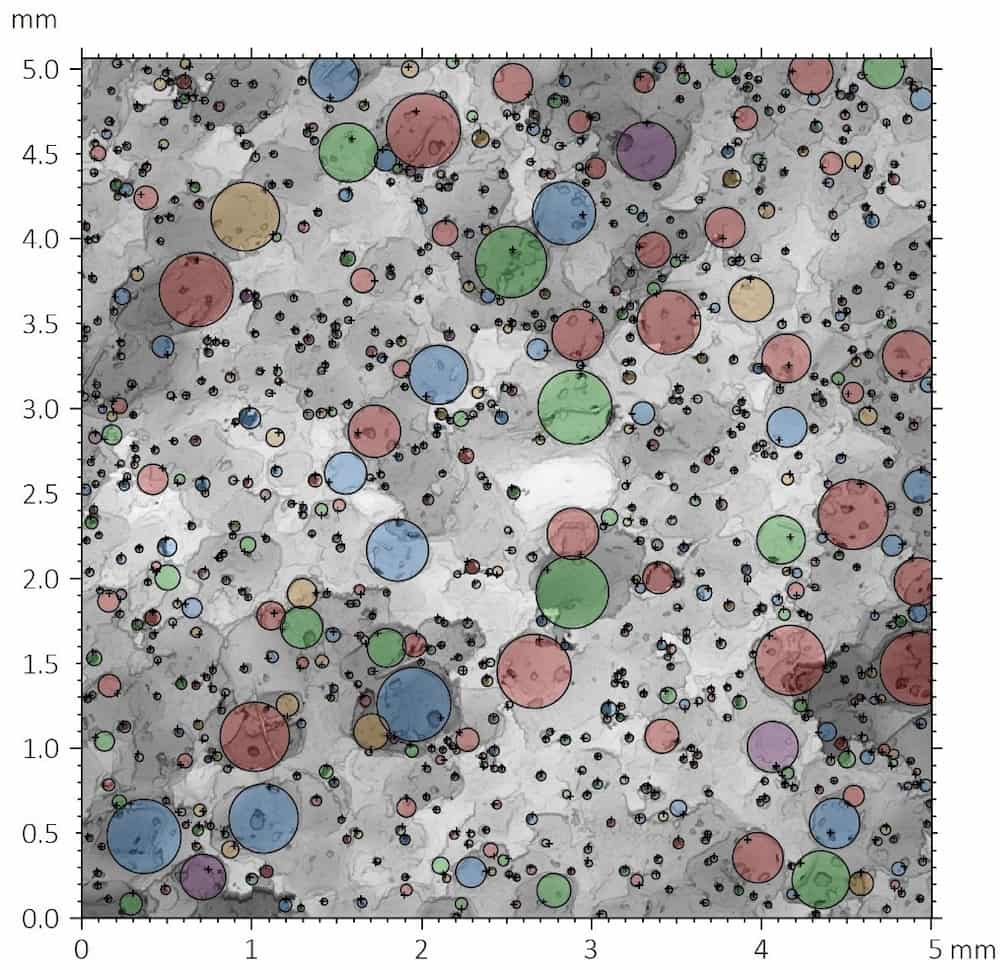
The detected pore locations were mapped across the scanned 5 mm × 5 mm area to evaluate pore coverage, density, and size distribution.
Pore distribution map of the blue climbing grip sample showing detected recessed surface features across a 5 mm by 5 mm scanned area.
Information
Method Circle detection
Features detected Pores, recessed objects
Minimum detection diameter 0.040 mm
Maximum detection diameter 2.000 mm
Number of detected pores 794
Surface coverage 24.208%
Pore density 31.355 particles/mm²
Global Statistics
Parameter Unit Mean Std. Dev. Min Max
Radius mm 0.035 0.035 0.020 0.218
Void volume µm³ 821,872.849 2,495,310.021 11,009.819 2.929 × 10⁷
Maximum depth µm 476.053 305.830 16.132 1044.045

Pores covered 24.208% of the blue grip’s scanned surface, with a pore density of 31.355 particles/mm². The detected pores and cracks were highly heterogeneous in size, volume, and depth, ranging from large crater-like features with a maximum radius of 0.218 mm and void volume greater than 2.9 × 10⁷ µm³ to small pores with a minimum radius of 0.020 mm and void volume of approximately 1.1 × 10⁴ µm³.

This uneven distribution is reflected in the large standard deviation measured for void volume and maximum depth. The pore distribution is bimodal, with one population of fine, deep pores and another population of larger crater-like valleys.

Functional Surface Parameters (Abbott-Firestone curve)

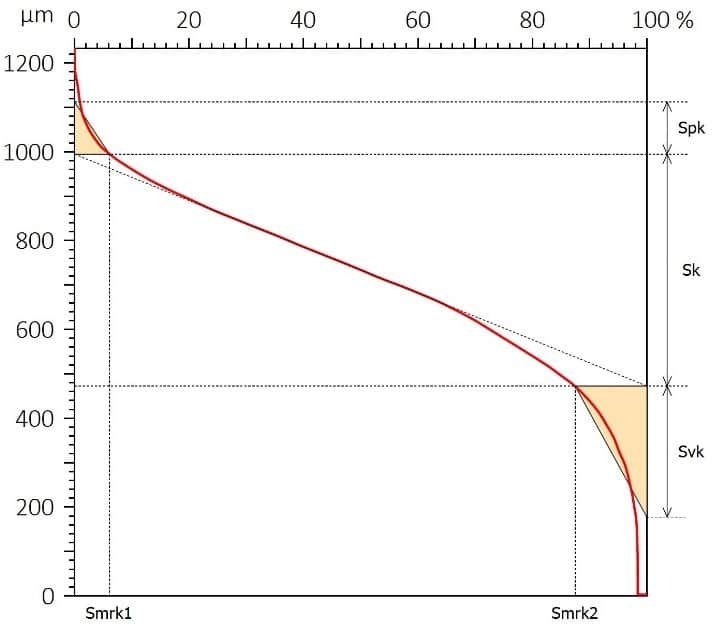
The Abbott-Firestone curve shows the cumulative areal material distribution of the blue climbing grip sample. This analysis defines functional surface parameters including Sk, Spk, and Svk according to ISO 25178-2.

Abbott-Firestone curve for the blue climbing grip sample showing cumulative areal material distribution and functional surface parameters.
Information
Padrão ISO 25178-2
Parameter Value Unit
Sk 522.359 µm
Spk 117.670 µm
Svk 295.209 µm
Smrk1 6.122 %
Smrk2 87.456 %

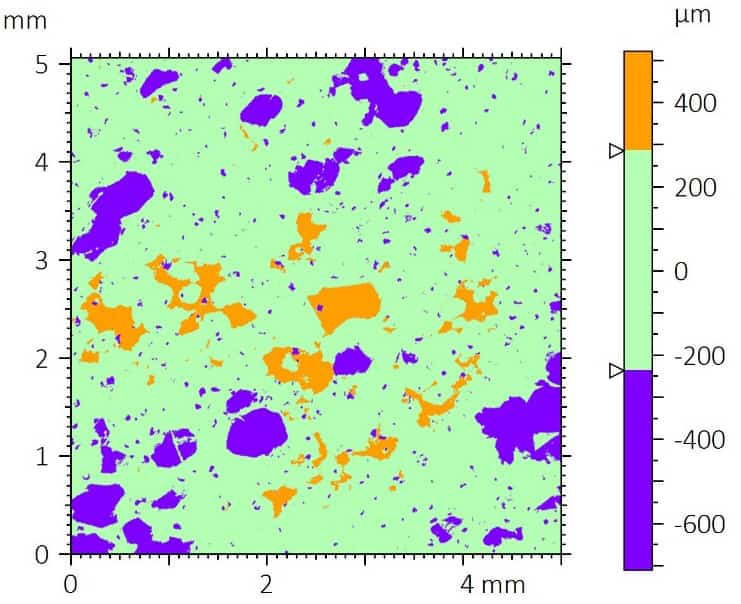
The chart below shows the peak-valley distribution from the mean plane based on the functional parameters derived from the Abbott-Firestone curve. Valleys are shown in purple, the mean plane in green, and peaks in orange.

Peak-valley distribution map of the blue climbing grip sample showing valleys, mean-plane regions, and peaks derived from Abbott-Firestone functional parameters.
Information
1st threshold Height – c1: 283.646 µm
2nd threshold Height – c2: -238.619 µm
Parameters Unit
Projected area (in %) % 12.544 81.334 6.122
Projected area mm² 3.182 20.629 1.553
Volume of material (in %) % 96.079 48.546 1.514
Volume of material µm³ 1.151 × 10¹⁰ 6.431 × 10⁹ 9.142 × 10⁷

The blue grip sample shows a dominant mean-plane region with fine, deep pores distributed across the surface and localized peak features. Compared with the yellow grip, the blue grip contains a higher projected peak area and a bimodal pore structure, combining fine recessed pores with larger crater-like valleys.

Conclusão

In this application, the NANOVEA JR25 Non-Contact Optical Profiler was used to measure the surface roughness, topography, and pore morphology of yellow and blue bouldering grip samples.

Topographic analysis showed that both grip samples had high surface roughness, with Sa values above 100 µm and Sz values above 1000 µm. Both surfaces also showed an asymmetric height distribution skewed toward valleys, indicating that recessed features played a major role in the measured surface morphology.

The yellow grip sample showed higher pore coverage, with pores covering 47.395% of the scanned surface. Its surface was mainly characterized by average-sized pores distributed across the measured area.

The blue grip sample showed lower pore coverage at 24.208%, but a much higher pore density of 31.355 particles/mm². Its pore distribution was bimodal, with a population of fine, deep pores and a separate population of larger crater-like valleys.

These results show how non-contact 3D optical profilometry can quantify climbing hold surface features that are difficult to evaluate from visual inspection alone, including roughness, pore coverage, pore depth, surface height distribution, and functional topography. The blue grip’s higher porosity and bimodal pore structure make it more likely to absorb moisture and chalk at the contact interface, while its elevated roughness and surface morphology support stable friction for shoe rubber and finger contact. The yellow grip’s lower roughness and flatter profile suggest it is better suited for use as a foothold in slab climbing, where broad surface contact matters more than deep textural engagement.

Frequently Asked Questions About Climbing Hold Surface Roughness

What is climbing hold surface roughness?

Climbing hold surface roughness describes the height variation, texture, pores, asperities, and valleys present on the surface of a climbing grip. These features can influence contact behavior between the hold, shoe rubber, skin, chalk, and moisture.

How can climbing hold surface roughness be measured?

Climbing hold surface roughness can be measured using non-contact 3D optical profilometry. This method reconstructs the surface topography and calculates areal roughness parameters such as Sa, Sz, Sp, Sv, Ssk, and Sku without touching or deforming the sample.

Why use non-contact optical profilometry for climbing hold analysis?

Non-contact optical profilometry is useful for climbing hold analysis because climbing grips can contain deep pores, sharp valleys, rough asperities, and irregular surface texture. A contact stylus may lose contact, fail to reach recessed features, or introduce artifacts on complex surfaces.

What does Sa mean in surface roughness analysis?

Sa is the arithmetic mean height of a surface and is commonly used to describe average areal surface roughness. In this app note, both climbing grip samples showed high Sa values above 100 µm, indicating strongly textured surfaces.

What does Sz mean in optical profilometry results?

Sz is the maximum height of the measured surface, calculated from the highest peak to the deepest valley. In climbing hold surface roughness analysis, Sz helps describe the full vertical range of the grip’s surface texture.

Why is pore morphology important for climbing grips?

Pore morphology can affect how a climbing grip interacts with chalk, sweat, humidity, skin, and shoe rubber. Measuring pore coverage, density, depth, and volume helps quantify surface features that are difficult to evaluate by visual inspection alone.

stent coating adhesion testing failure analysis drug eluting stent coating

Stent Coating Adhesion and Delamination Analysis Using Nano Scratch Testing

Application Note | Stent Coating Adhesion Testing

Stent Coating Adhesion and Delamination Analysis Using Nano Scratch Testing

Quantifying Coating Failure and Adhesion Performance on Drug-Eluting Stents

stent coating adhesion testing nano scratch delamination critical load

Research & Experimental Testing

Duanjie Li, PhD

Visual Design & Editorial

Andrew Shore

Introdução

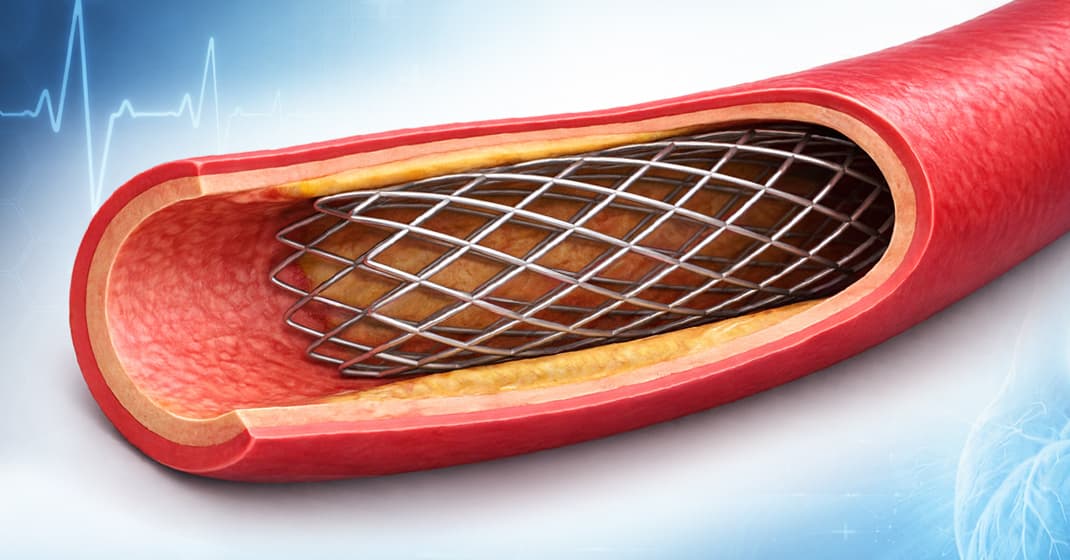
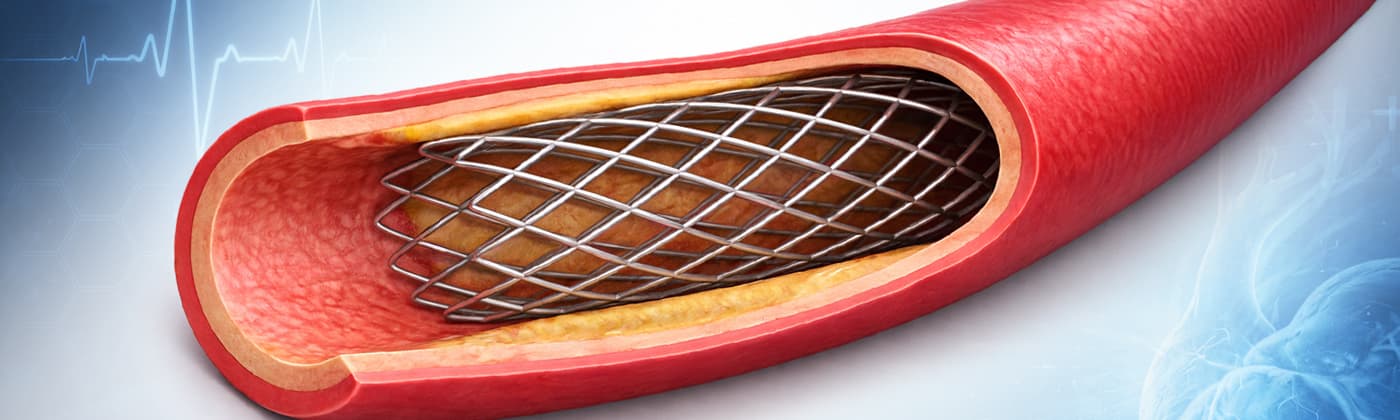
Blood is carried through arteries from the heart to the rest of the body. Any weakening or blockage of these vessels can pose significant health risks and may become life-threatening. A stent is a small mesh tube inserted into the lumen of a blood vessel to treat narrowed or weakened arteries. Stent implantation is now a widely used procedure to support the arterial wall and restore blood flowᶦ.

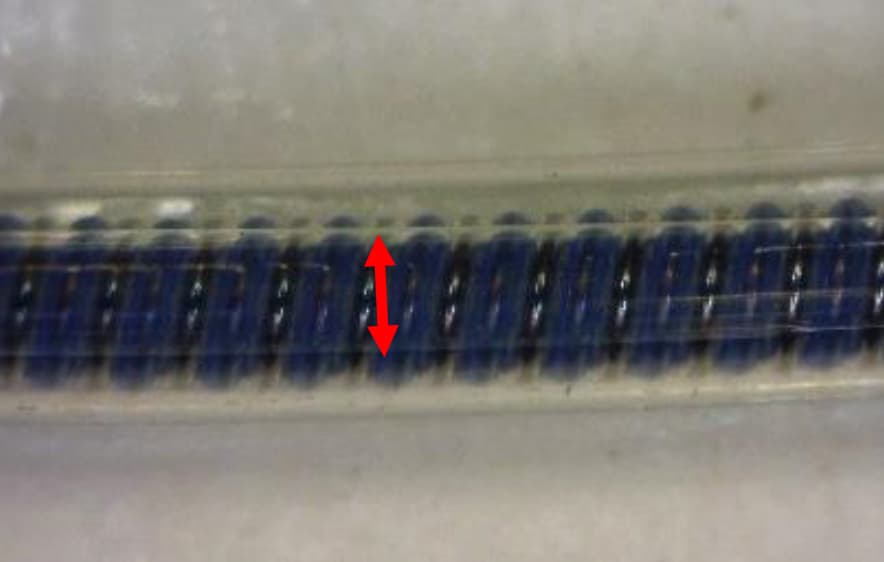
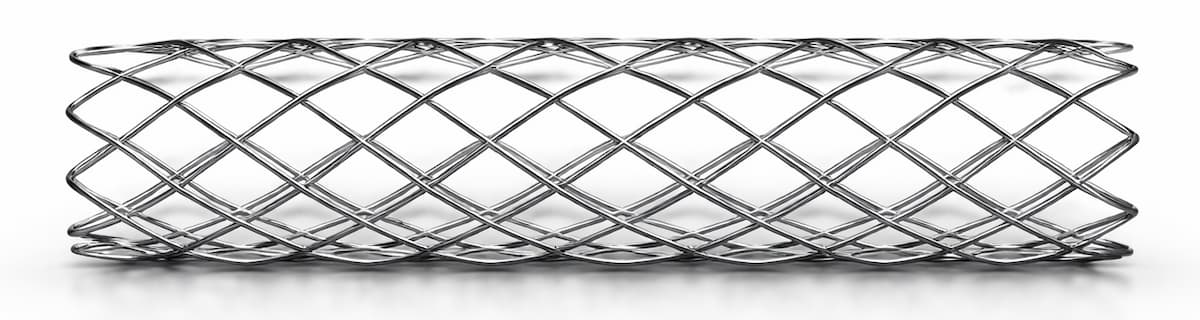
Metal stent mesh geometry illustrating the structural complexity of vascular implant design.

Why coating adhesion matters in drug-eluting stents

Drug-eluting stents represent a major advancement in stent technology. They incorporate a biodegradable, biocompatible polymer coating that enables controlled drug release at the arterial site, helping to inhibit intimal thickening and reduce the risk of restenosisᶦᶦ.

A critical concern in these systems is the delamination of the polymer coating from the metallic stent substrate. This coating carries the drug-eluting layer, and its adhesion directly impacts device performance and reliability.

To improve coating adhesion, stents are often designed with complex geometries. In this study, the polymer coating is located at the bottom of grooves within the stent mesh. This configuration presents a significant challenge for adhesion measurement.

A reliable method is required to quantitatively evaluate the interfacial strength between the polymer coating and the metal substrate. The small diameter of the stent mesh, comparable to a human hair, combined with its three-dimensional geometry, requires:

  • ultrafine X-Y positioning accuracy
  • precise control of applied load
  • accurate depth measurement during testing

Measurement Method

Nano scratch testing is performed using the Testador Mecânico NANOVEA PB1000, in Nano Scratch Mode, to evaluate the cohesive and adhesive strength of the polymer coating on the metal mesh of stent samples.

Controlled scratch measurements are carried out on stent geometries with dimensions comparable to a human hair, enabling precise evaluation of coating adhesion on complex stent structures.

NANOVEA PB1000 Advanced

Testador Mecânico

Condições de teste

1. Regular Stent Samples

The stent is fixed on the sample stage, with a support wire inserted inside the stent tube to ensure stability during nano scratch testing. The NANOVEA Mechanical Tester is used to perform nano scratch measurements using the parameters summarized in Table 1, to evaluate the cohesive and adhesive strength of the polymer coating on the metal substrate.

ParameterValue
Load typeProgressivo
Initial load0.05 mN
Final load300 and 100 mN
Sliding speed0.5 mm/min
Sliding distance0.5 mm
Indenter geometryCônico
Indenter material (tip)Diamante
Raio da ponta do indentador20 µm
Temperatura24°C (room)

Tabela 1: Test parameters for nano scratch measurements on regular stent samples

2. Grooved Stent Samples

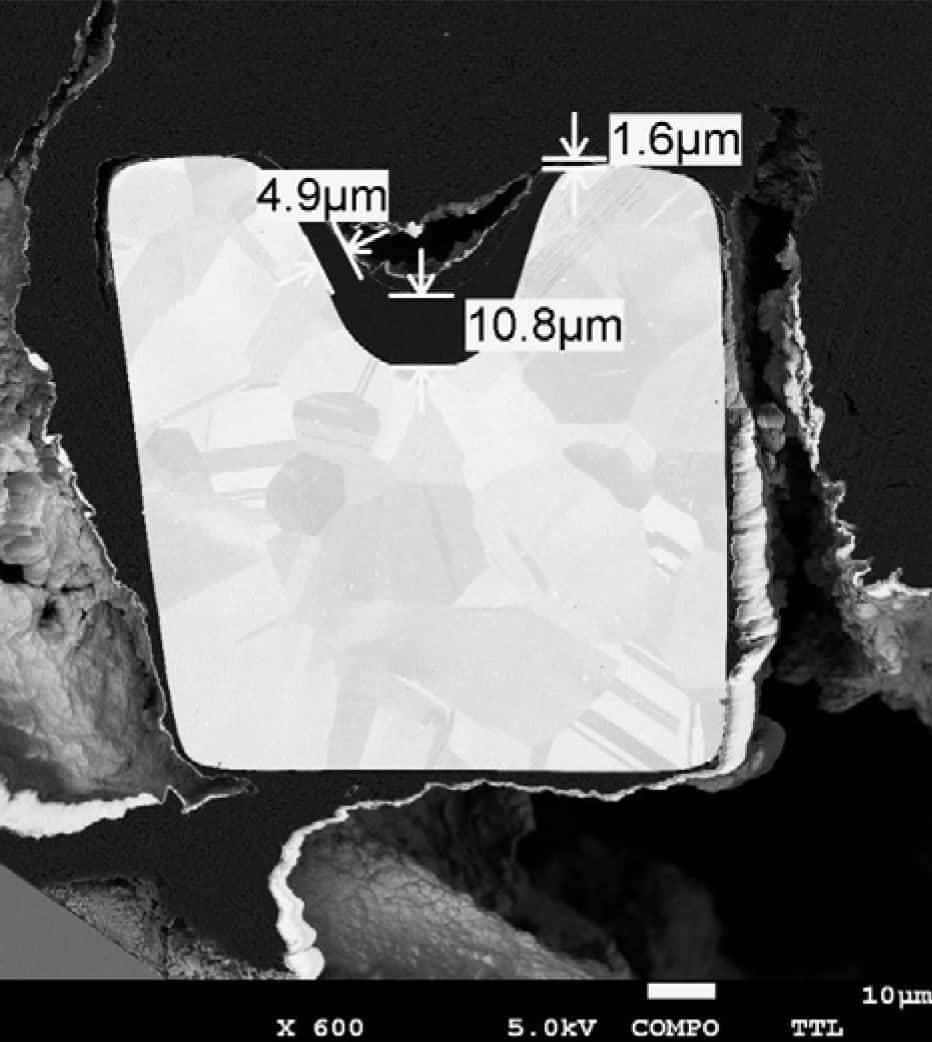
The SEM image in Fig. 1 shows the cross-section of the stent sample. The stent features a groove with a depth of approximately 30 µm. The polymer coating, with a thickness of 10.8 µm, is located at the bottom of the groove.

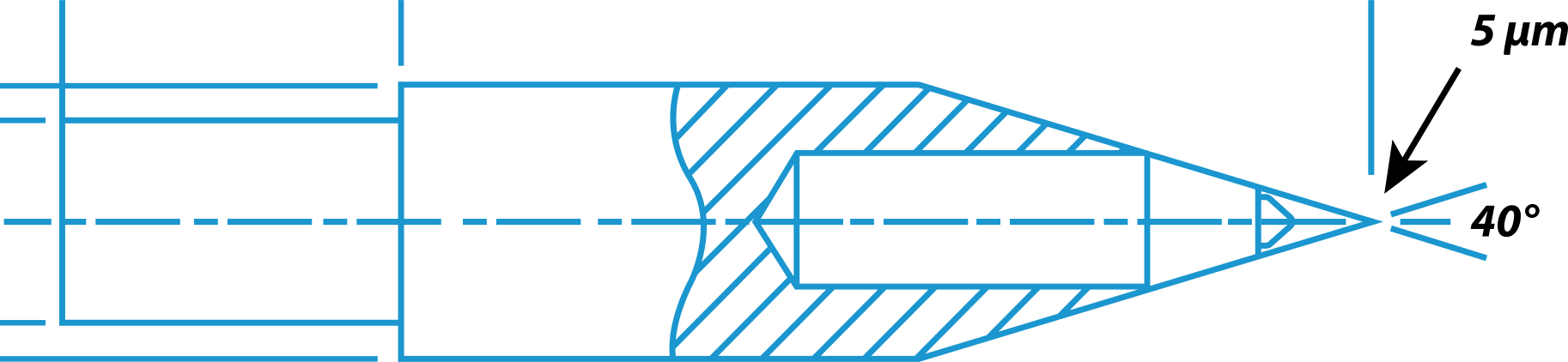
Standard 60° conical diamond tips are not sharp enough to reach the bottom of the groove without contacting the sidewalls. Therefore, a sharper 40° conical diamond tip is used in this study (Fig. 2).

Nano scratch measurements are performed using the parameters summarized in Table 2.

Parameter Value
Load type Progressivo
Initial load 0.1 mN
Final load 300 mN
Taxa de carregamento 300 mN/min
Scratch length 0.25 mm
Scratch speed 0.25 mm/min
Indenter geometry 40° cone
Indenter material (tip) Diamante
Raio da ponta do indentador 5 µm

Table 2: Test parameters for nano scratch measurements on grooved stent samples

stent groove cross section polymer coating thickness adhesion analysis nano scratch testing

Fig. 1: SEM cross-section of a grooved stent showing polymer coating located at the bottom of the groove, highlighting the challenge of coating adhesion measurement in recessed geometries.

nano scratch diamond tip 40 degree stent groove coating adhesion testing schematic

Fig. 2: Schematic of a 40° conical diamond tip designed for nano scratch testing inside stent grooves, enabling accurate adhesion measurement without sidewall interference.

Resultados e Discussão

The stent mesh has a diameter of approximately 100 μm, comparable to a human hair. Precise positioning is therefore critical to ensure the scratch test is performed at the center of the stent mesh. The NANOVEA Mechanical Tester provides X–Y positioning accuracy down to 0.25 μm, enabling accurate test placement under the integrated optical microscope.

1. Regular Stent Samples

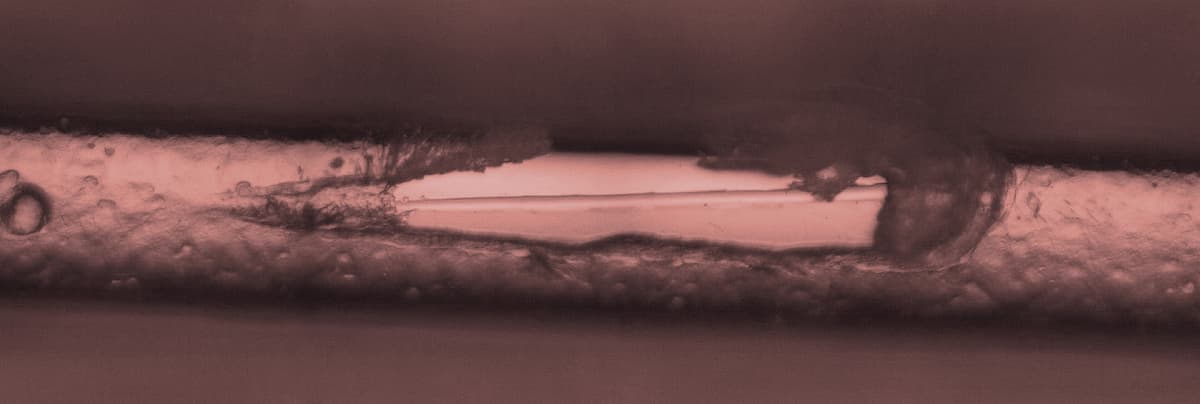
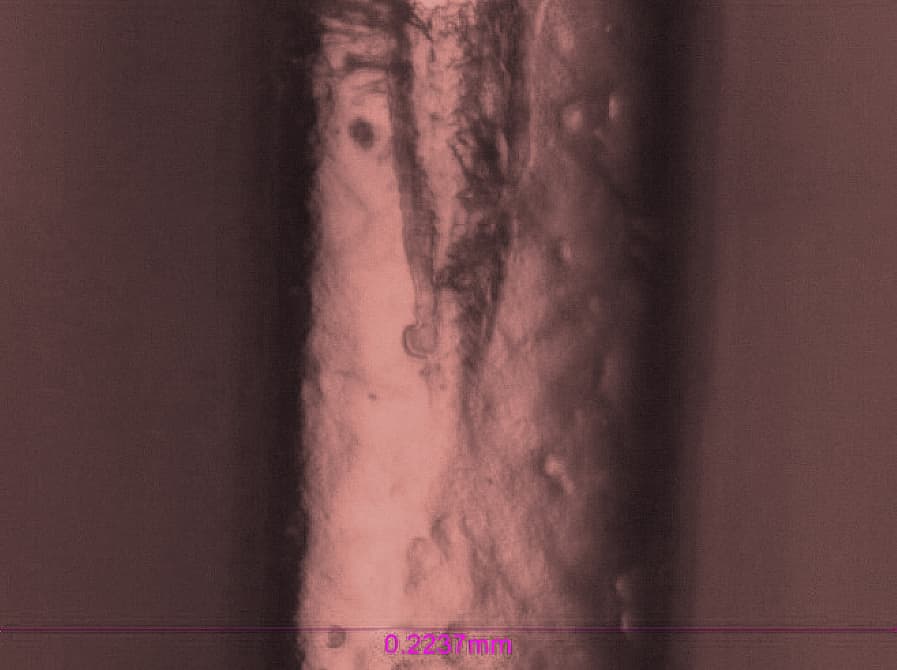
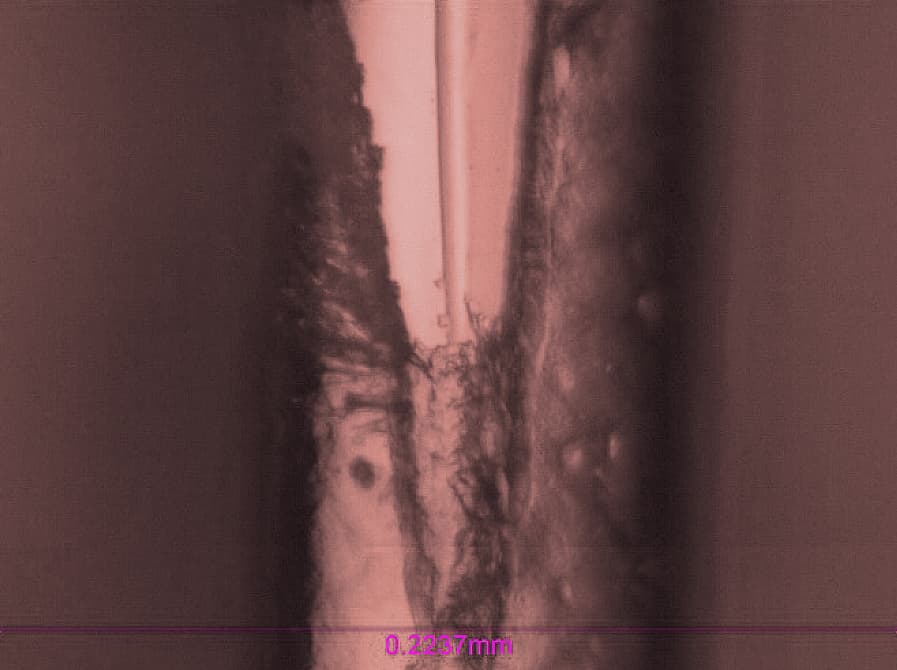
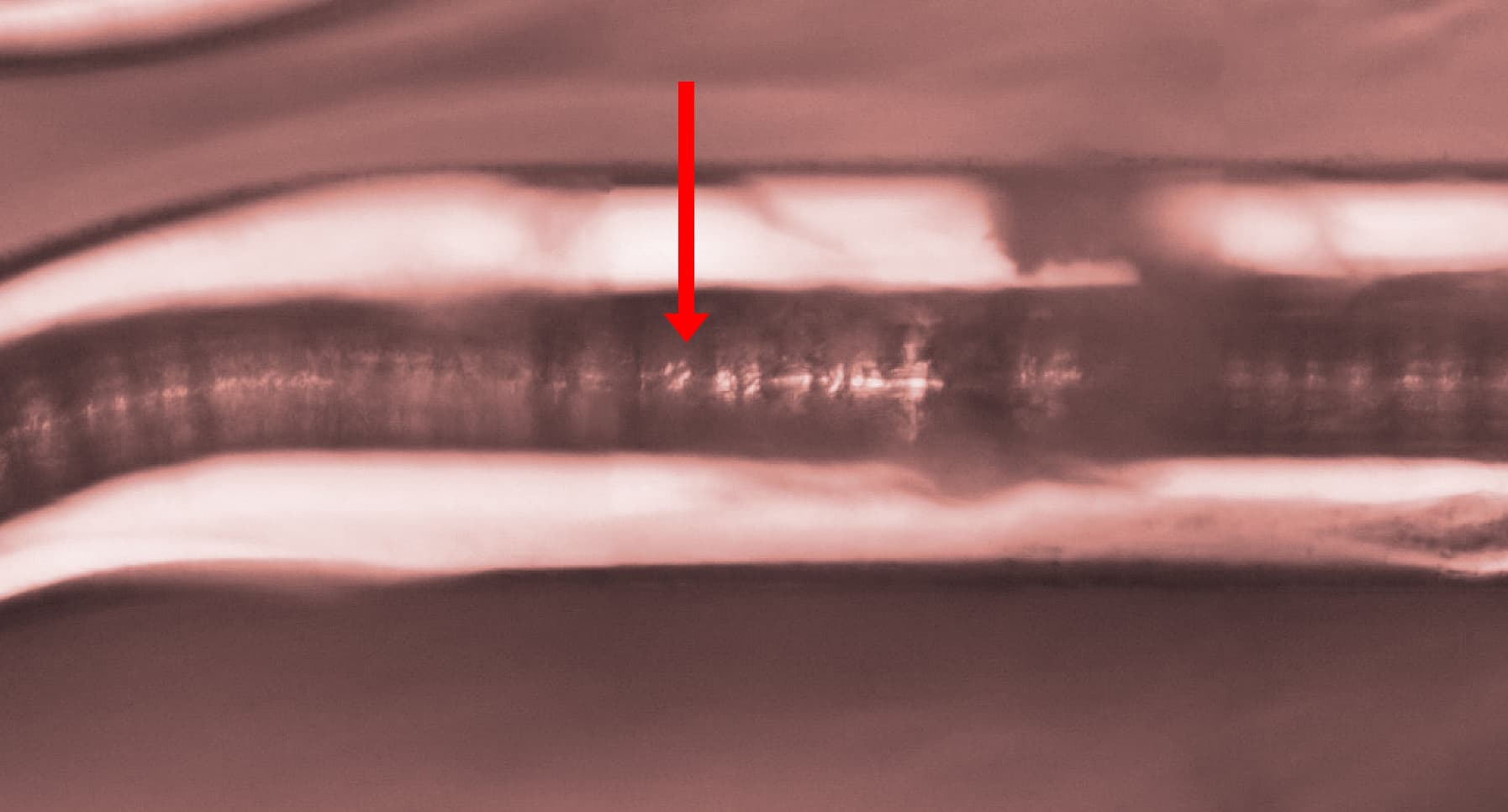
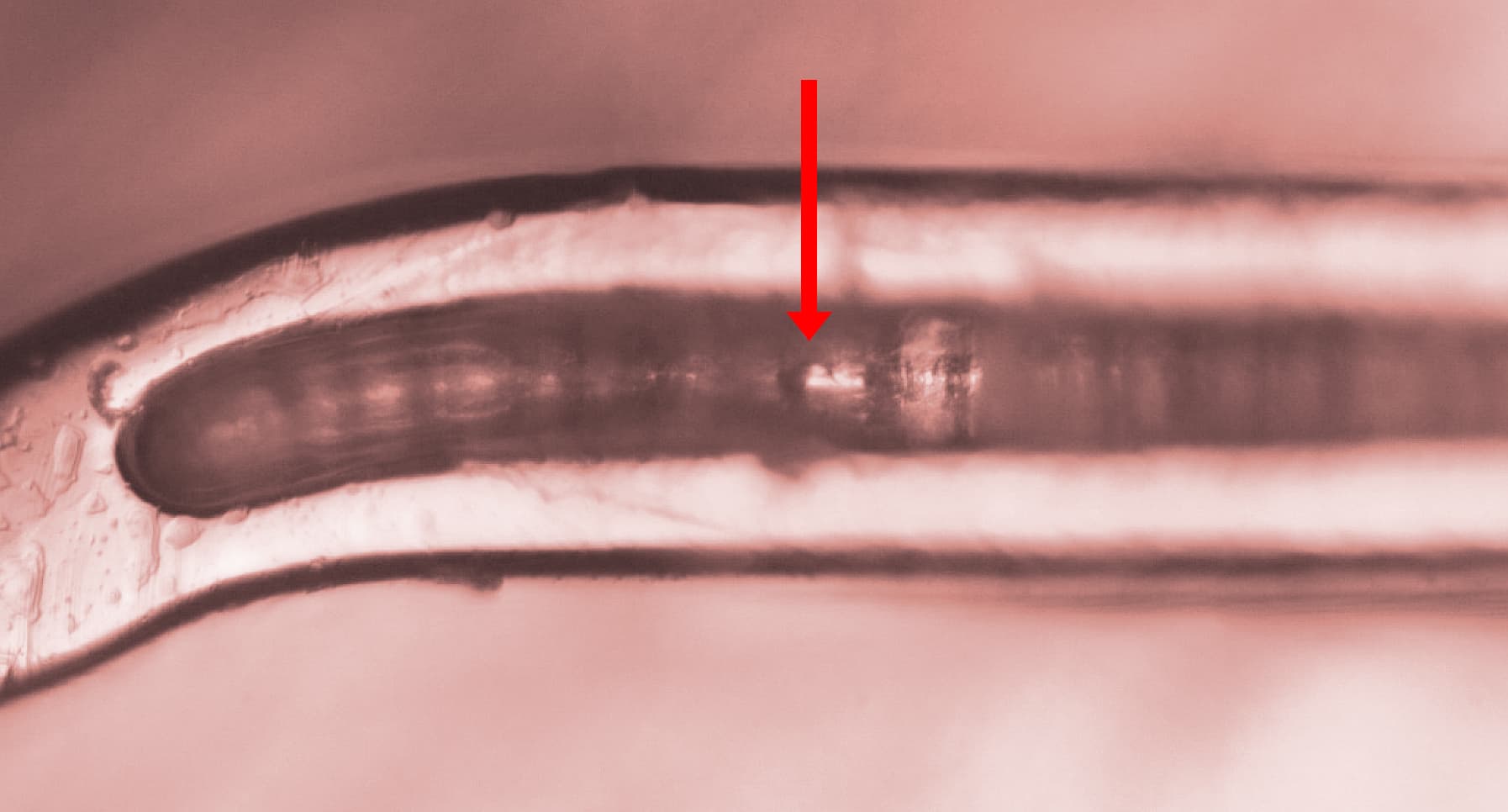
Nano scratch testing is performed with a progressively increasing load up to 300 mN. The full scratch track on the stent is shown in Fig. 3a, while failure behavior at different stages is presented in Fig. 3b and 3c.

Two critical loads are identified:

  • Lc1: the load at which the first visible damage appears on the coating
  • Lc2: the load at which the coating is fully removed and the substrate is exposed

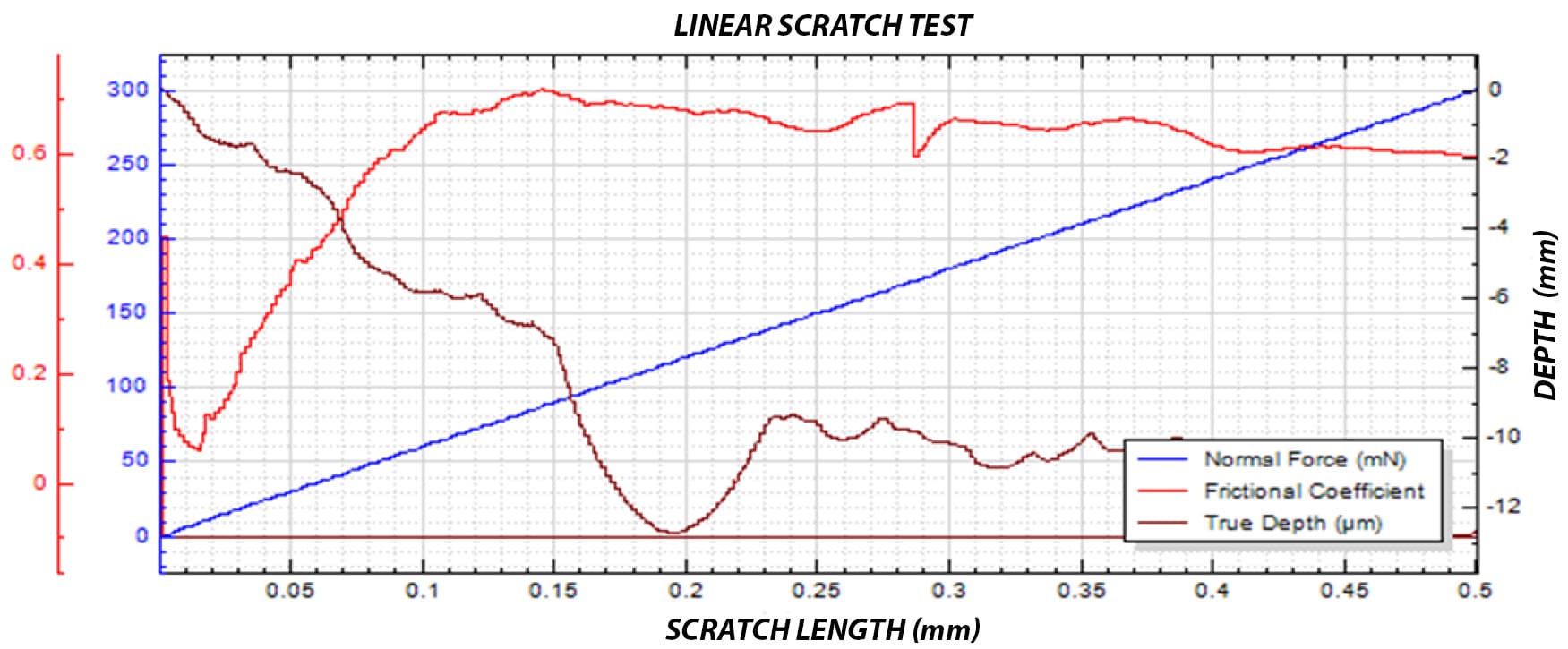
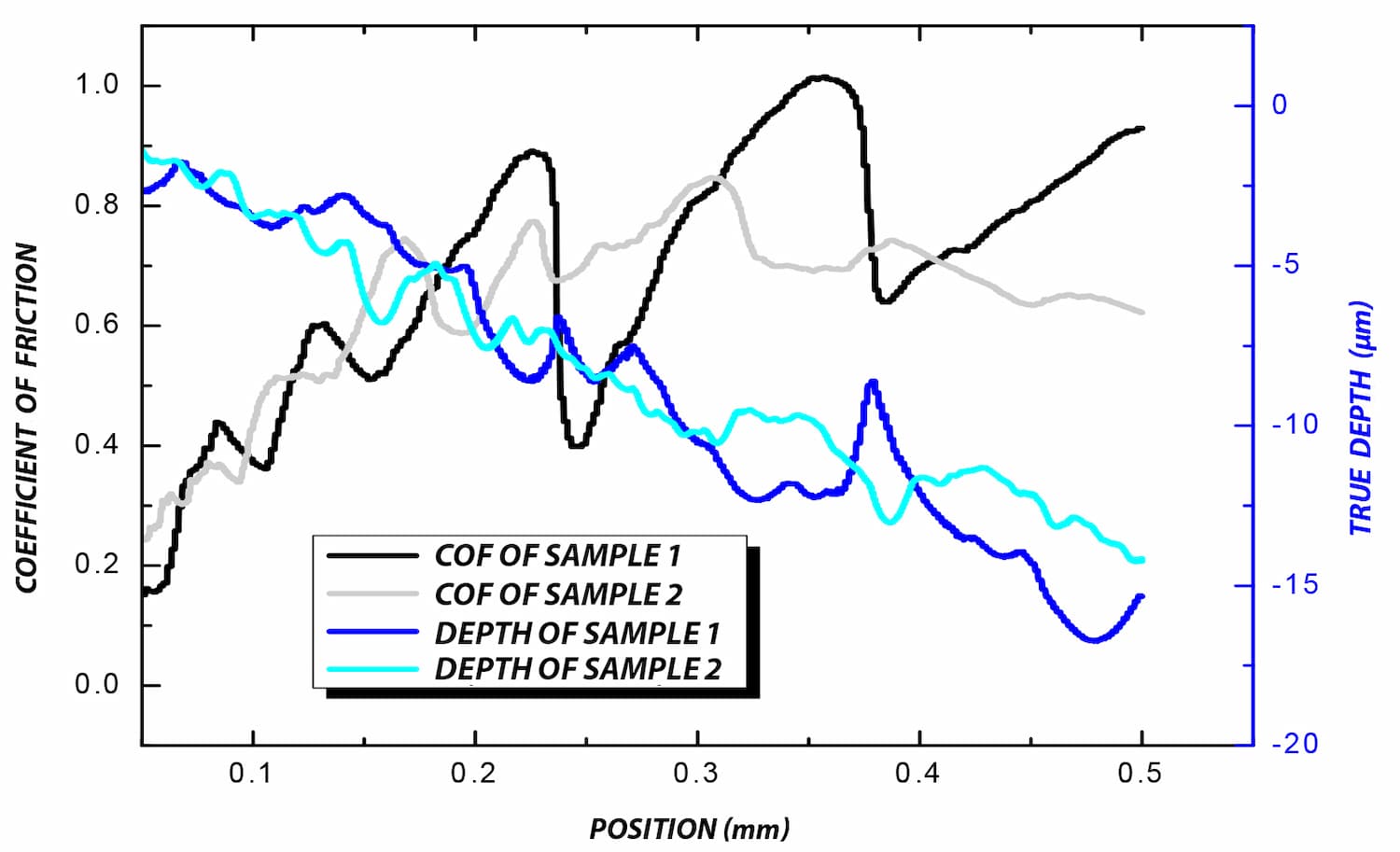
The evolution of coefficient of friction (COF) and penetration depth is shown in Fig. 4, providing insight into the progression of coating failure during the test.

The first signs of coating damage appear at Lc1 ≈ 14.5 mN. As the applied load increases, the diamond tip progressively penetrates the polymer coating, resulting in a wider and deeper scratch track. During this phase, the COF increases from approximately 0.05 to 0.7.

At Lc2 ≈ 78.1 mN, the coating is fully delaminated from the metal substrate. Beyond this point, as the load continues to increase, both COF and penetration depth remain relatively stable due to the mechanical support of the underlying metal substrate.

nano scratch track stent coating progressive load adhesion testing

(a) Full Scratch Track

(b) Lc1 ≈ 14.5 mN

stent coating delamination lc2 nano scratch 78.1 mN adhesion testing

(c) Lc2 ≈ 78.1 mN

Fig. 3: Nano scratch track on a stent coating under progressively increasing load, showing (a) full scratch path, (b) initial coating failure at Lc1 ≈ 14.5 mN, and (c) complete coating delamination at Lc2 ≈ 78.1 mN.

nano scratch testing stent coating coefficient of friction depth progression adhesion failure

Fig. 4: Evolution of coefficient of friction (COF) and penetration depth during nano scratch testing of a stent coating under progressively increasing load, showing the progression of coating failure and transition to substrate support.

Failures during nano scratch testing up to a maximum load of 300 mN occur at critical loads below 100 mN. To enable a more quantitative comparison of coating performance, additional tests are performed with a maximum load of 100 mN on two stent samples, referred to as Sample 1 and Sample 2.

Fig. 5 compares the scratch tracks of Sample 1 and Sample 2 after nano scratch testing. Sample 1 exhibits the first sign of coating damage at a critical load of Lc1 ≈ 13.2 mN, while Sample 2 shows initial failure at a higher load of Lc1 ≈ 21.1 mN.

Coating delamination occurs at 62.5 mN for Sample 1. In contrast, the coating on Sample 2 remains intact throughout the test, continuing to protect the metal substrate under the same loading conditions.

This behavior is further reflected in the evolution of coefficient of friction (COF) and penetration depth, as shown in Fig. 6. When the diamond tip penetrates through the coating and contacts the metal substrate in Sample 1, the COF reaches a peak while the penetration depth decreases due to the increased stiffness of the underlying substrate.

stent coating sample 1 early failure nano scratch track delamination adhesion testing

(a) Sample 1 – Early Coating Failure

stent coating sample 2 high adhesion nano scratch track minimal damage testing

(b) Sample 2 – Improved Coating Integrity

Fig. 5: Comparison of nano scratch tracks for two stent coatings, showing (a) early coating failure and delamination in Sample 1, and (b) improved coating integrity in Sample 2 under the same loading conditions.

nano scratch testing stent coating COF depth comparison sample 1 sample 2 adhesion performance

Fig. 6: Comparison of coefficient of friction (COF) and penetration depth for Sample 1 and Sample 2 during nano scratch testing, showing earlier substrate contact and higher friction response in Sample 1, indicating weaker coating adhesion.

2. Grooved Stent Samples

As shown in Fig. 1 and Fig. 7, the grooved stent mesh has a diameter of approximately 90 μm, comparable to a human hair. The groove has a width of ~50 μm and a depth of 30 μm. This geometry presents a significant challenge for nano scratch testing, particularly for evaluating coating adhesion at the bottom of the groove.

Precise positioning is critical to locate the scratch test within the groove. The nano scratch test is performed with a progressively increasing load up to 300 mN. The full scratch tracks of grooved stent Samples 3 and 4 are compared in Fig. 7.

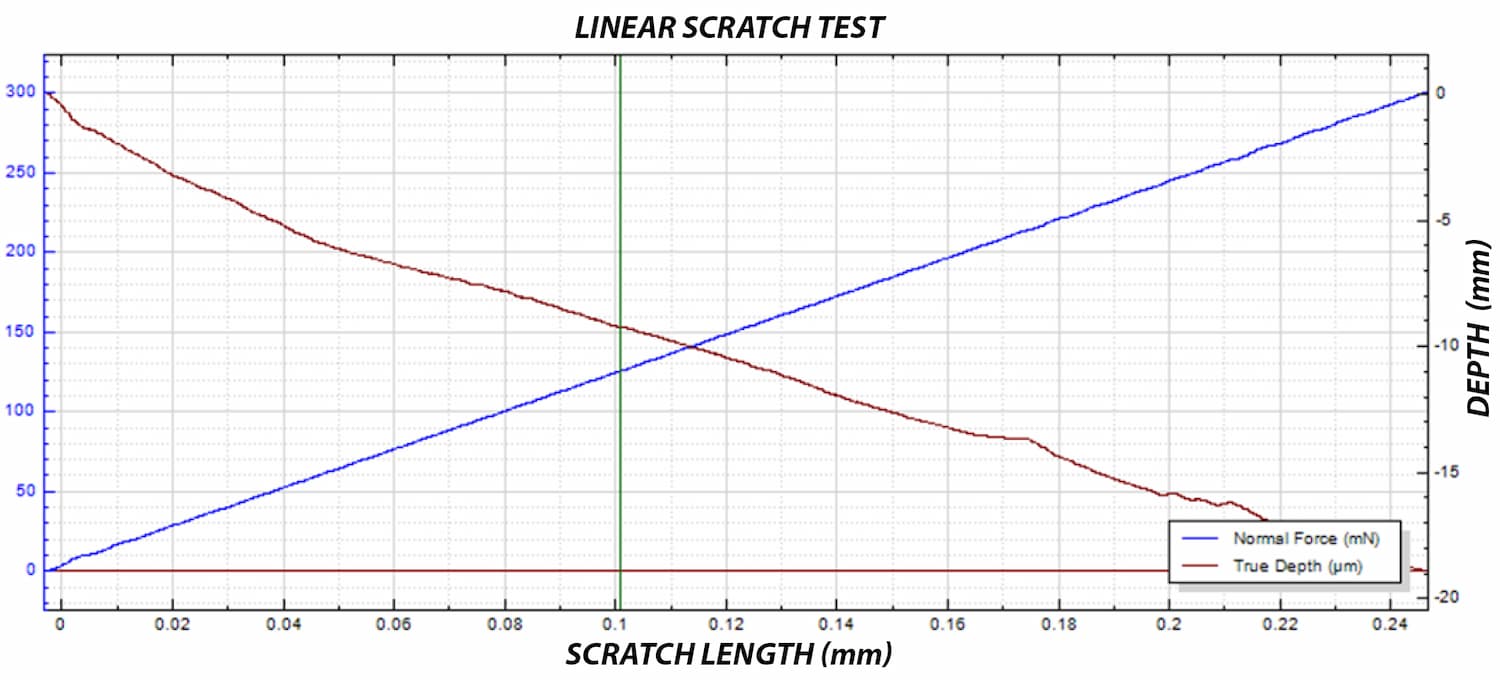
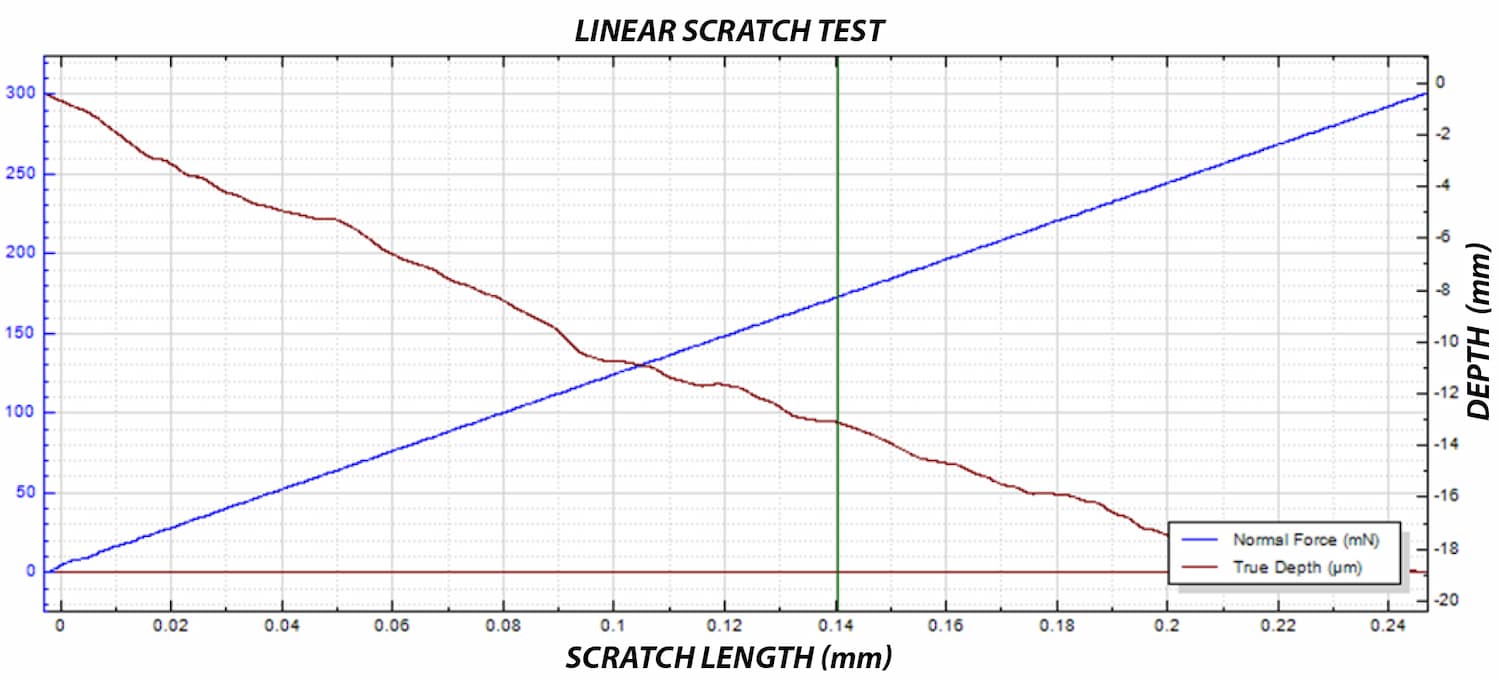
The critical load Lc is defined as the load at which the coating fails and the substrate becomes exposed. The evolution of normal load and penetration depth, shown in Fig. 8, provides further insight into the progression of coating failure during testing.

As the applied load increases, the diamond tip progressively penetrates the polymer coating, resulting in a deeper scratch track. When the critical load Lc is reached, the coating delaminates from the metal substrate.

Sample 3 exhibits coating failure at Lc ≈ 126 mN, while Sample 4 fails at a higher load of Lc ≈ 173 mN. This difference indicates stronger adhesion of the coating in Sample 4.

The measured critical loads enable quantitative comparison of coating adhesion performance. Under the same testing conditions, the coating on Sample 4 demonstrates higher resistance to delamination, making it the better-performing candidate in this study.

stent groove coating failure sample 3 nano scratch 126 mN adhesion testing

(c) Sample 3 – Coating Failure in Groove (Lc ≈ 126 mN)

stent groove coating adhesion sample 4 nano scratch 173 mN minimal failure testing

(d) Sample 4 – Higher Adhesion in Groove (Lc ≈ 173 mN)

Fig. 7: Nano scratch tracks inside stent grooves for Samples 3 and 4, showing (c) coating failure at Lc ≈ 126 mN in Sample 3 and (d) higher adhesion with delayed failure at Lc ≈ 173 mN in Sample 4.

(a) Sample 3 – Earlier Coating Failure (Lc ≈ 126 mN)

(b) Sample 4 – Delayed Failure and Higher Adhesion (Lc ≈ 173 mN)

Fig. 8: Evolution of normal load and penetration depth during nano scratch testing inside stent grooves for Samples 3 and 4, showing earlier coating failure in Sample 3 and delayed failure at higher load in Sample 4. The vertical green line indicates the critical load (Lc) where coating delamination occurs.

Conclusão

This study demonstrates the ability of the NANOVEA Mechanical Tester to quantitatively evaluate the cohesive and adhesive strength of polymer coatings on both regular and grooved stent geometries using nano scratch testing.

The recessed geometry of the stent grooves, approximately 50 μm wide and 30 μm deep, presents a significant challenge for coating adhesion measurement. The high X–Y positioning accuracy of 0.25 μm enables precise placement of the scratch test within these confined regions, allowing direct evaluation of coating performance where failure is most critical.

By applying a controlled, progressively increasing load, critical loads associated with coating failure can be identified and compared across samples. This approach enables reliable differentiation of coating adhesion performance and interfacial integrity, even on small, complex stent structures.

Referências

[I] http://www.nhlbi.nih.gov/health/health-topics/topics/stents
[II] http://www.scielo.org.mx/scielo.php?script=sci_arttext&pid=S1405-99402006000300008

Frequently Asked Questions About Stent Coating Adhesion Testing

What is stent coating adhesion testing?

Stent coating adhesion testing evaluates how strongly a polymer coating is bonded to the metal substrate of a stent. Techniques such as nano scratch testing quantify the load at which coating damage and delamination occur, providing measurable indicators of adhesion strength.

What is critical load (Lc) in nano scratch testing?

Critical load (Lc) is the applied load at which a coating fails during a scratch test.

  • Lc1 corresponds to the first visible damage in the coating
  • Lc2 indicates complete coating removal and exposure of the substrate

These values are used to quantify and compare coating adhesion performance.

Why is coating adhesion important in drug-eluting stents?

Coating adhesion directly affects the reliability of drug-eluting stents. Poor adhesion can lead to coating delamination, which may compromise controlled drug release and increase the risk of device failure.

How do you measure coating adhesion inside stent grooves?

Measuring adhesion inside stent grooves requires high positioning accuracy and appropriate indenter geometry. Nano scratch testing with sharp diamond tips allows access to recessed coating regions, enabling direct evaluation of adhesion within complex stent geometries.

What does coefficient of friction (COF) indicate in scratch testing?

The coefficient of friction (COF) reflects changes in surface interaction during the scratch test. A sudden increase in COF often indicates coating failure and contact between the indenter and the underlying metal substrate.

How can nano scratch testing compare different coating formulations?

Nano scratch testing enables direct comparison of coatings by measuring critical loads under controlled conditions. Higher critical loads indicate stronger adhesion and improved resistance to delamination, allowing selection of better-performing coating systems.

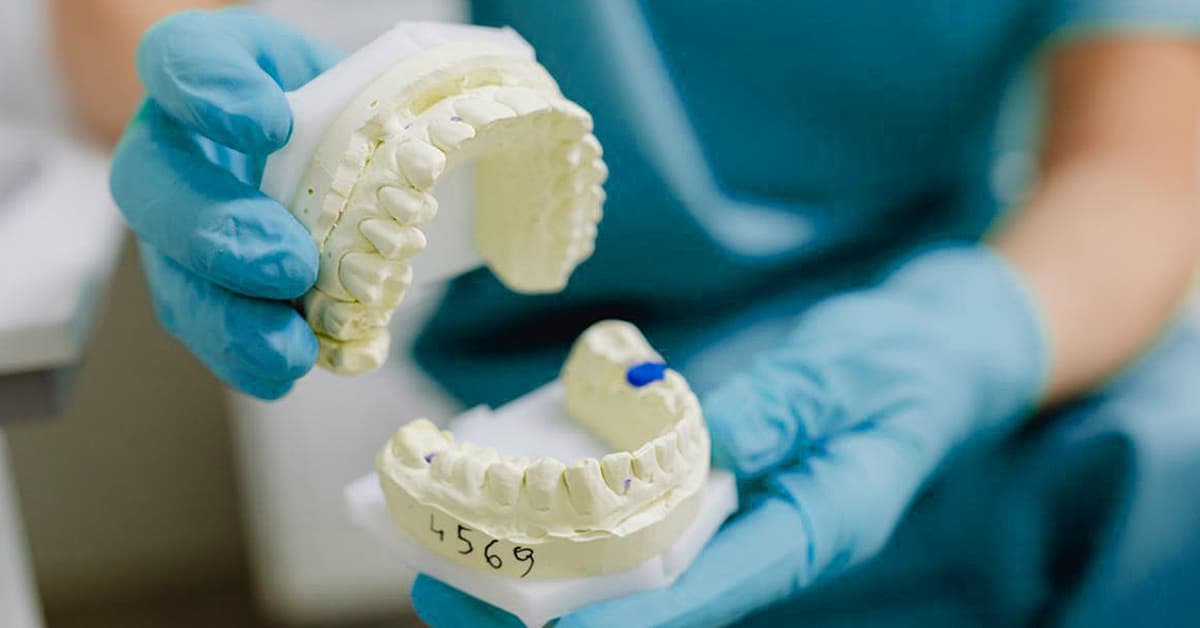
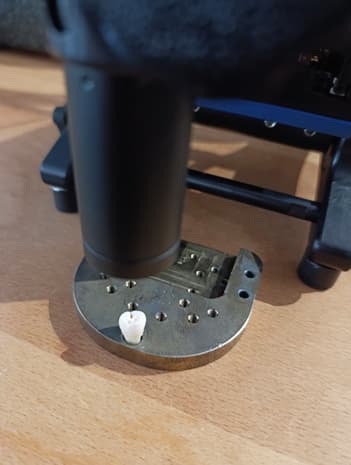
Dentist holding dental model for tooth surface roughness analysis and 3D reconstruction

Dental Surface Roughness Measurement & 3D Tooth Topography

Application Note | Dental Surface Characterization

Dental Surface Roughness Measurement and Full 3D Tooth Topography

Surface Roughness Analysis Using Non-Contact Optical Profilometry

Dental surface roughness measurement and 3D molar reconstruction using optical profilometry

Preparado por

Walter Alabiso, PhD; Davide Morrone, MPhys; Andrew Shore, MA

Introdução

The ability to accurately characterize tooth surfaces, including micro-roughness and 3D surface topography at the nanometer scale, enables advanced research and applications in orthodontics and dental materials science. Non-contact optical profilometry provides a precise method for measuring dental surface roughness and analyzing tooth surface morphology without damaging delicate structures. These measurements support the development of composite dental materials that replicate the natural surface roughness of enamel, as well as the design and fabrication of patient-specific dental casts and restorative components.

Low surface roughness plays a primary role in limiting bacterial adhesion and plaque formation, thereby reducing the risk of cavities. An increase in average roughness (Ra) above 2 µm leads to a steep increase in biofilm formation in vivo.¹ An Ra of 0.2 µm is considered the threshold value below which no further reduction in bacterial adhesion can be expected.²

Reconstruction of the tooth’s 3D surface topography enables the fabrication of dental casts, which are essential for accurate diagnosis, treatment planning, and the fabrication of dental appliances.

Non-Contact Optical Profilometry for Dental Surface Analysis

The present study illustrates the potential of NANOVEA’s high-precision non-contact optical profilometers for dental surface roughness measurement and 3D tooth topography analysis. Chromatic Light technology offers significant advantages over classical touch probe techniques. It acquires data points from deep crevices and complex geometries without introducing measurement errors or artifacts caused by local plastic deformation and without requiring extensive data manipulation.
Compared to focus variation systems, single-point optical sensing provides superior lateral and height accuracy, with X/Y resolution below 0.5 µm, maximum vertical resolution of 1.9 nm, and the ability to measure surface angles up to 87°. The technique is effective on transparent, opaque, specular, diffusive, polished, and rough dental surfaces, making it well suited for comprehensive dental surface characterization.
Measurement Method

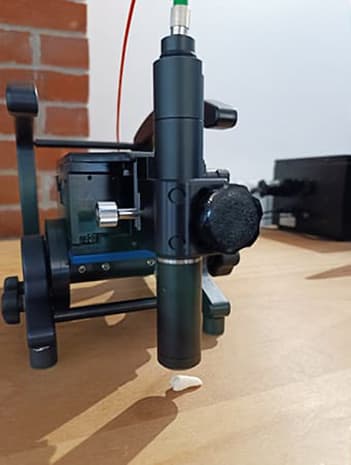
Nesta aplicação, o NANOVEA JR25 Non-Contact Optical Profiler was used to analyze the surface roughness and 3D surface topography of an adult human molar previously affected by tooth decay. The side of the tooth was scanned using a PS2–MG140 single-point optical sensor to measure surface roughness parameters over a defined region of interest and along multiple line profiles.

The crown of the tooth was then scanned and reconstructed using a PS5–MG35 single-point optical sensor, which is suited for larger-area acquisition and full 3D tooth topography measurement.


NANOVEA JR25 Portable
Perfilômetro Óptico

Surface Measurement Using NANOVEA Optical Profilometer

Surface roughness measurements were performed on the lateral side of the molar crown, followed by full 3D reconstruction of the crown surface. Separate single-point optical sensors were used to optimize measurement accuracy for both localized roughness analysis and large-area surface topography acquisition.
PS2 – MG140

Surface roughness analysis by area and parallel line profiles on the side of the tooth’s crown.

PS5 – MG35

Full 3D surface reconstruction of the tooth’s crown.

Parâmetros de medição

The following measurement parameters were used for localized surface roughness analysis and full 3D surface reconstruction of the molar crown using NANOVEA single-point optical sensors.

Parameter Roughness Analysis (Area) Roughness Analysis (Profiles) Full 3D Reconstruction
Optical Pen PS2-MG140 PS2-MG140 PS5-MG35
Z-Range [µm] 300 300 10000
X-Distance [mm] 2.00 3.00 7.50
X-Step Size [µm] 1.70 1.70 10.00
Y-Distance [mm] 2.00 1.00 7.00
Y-Step Size [µm] 1.70 100.00 10.00
Averaging (Avg) 1 1 1
Measurement Type Direct Direct Direct
Acquisition Mode Single Frequency Single Frequency Dual Frequency
Acquisition Rate [Hz] 200 200 100–400
Light Intensity [%] 100 100 100

Optical Profilometry Results

Surface Roughness Analysis (Area)

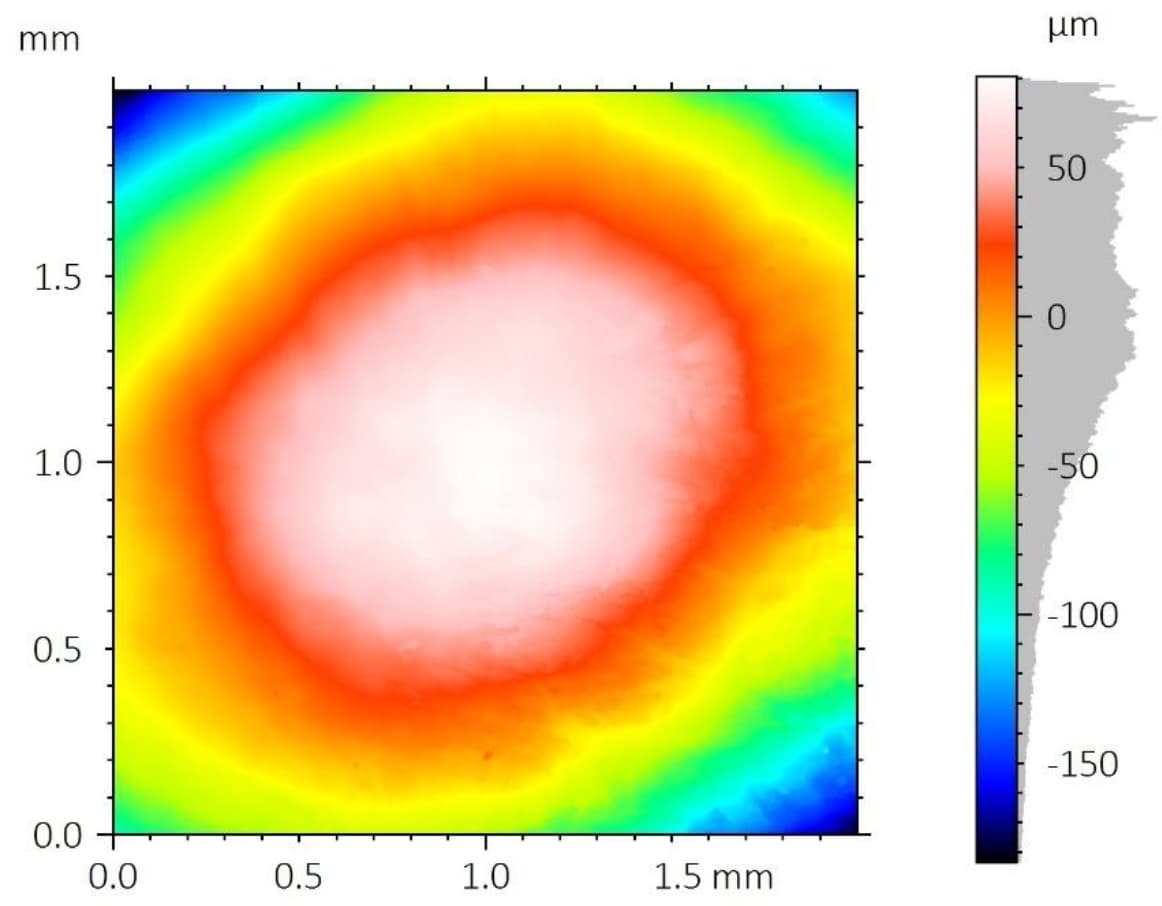
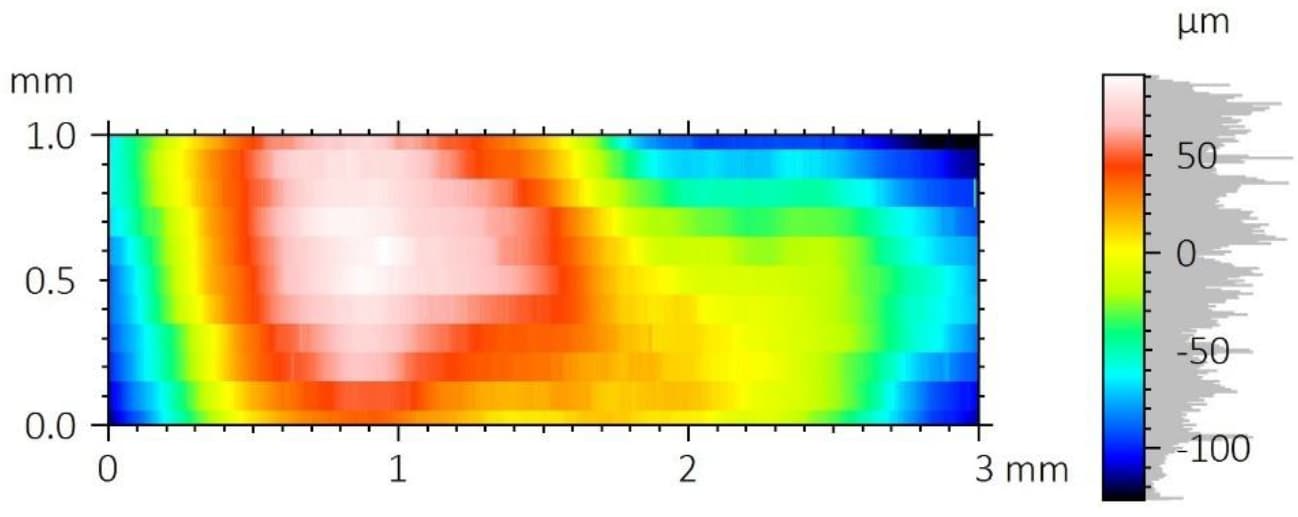
The PS2 single-point optical sensor was used to investigate fine surface features on the side of the tooth. The image below shows a false-color 2D surface map of the scanned region obtained by non-contact optical profilometry.

False-color 2D height map of scanned tooth surface region

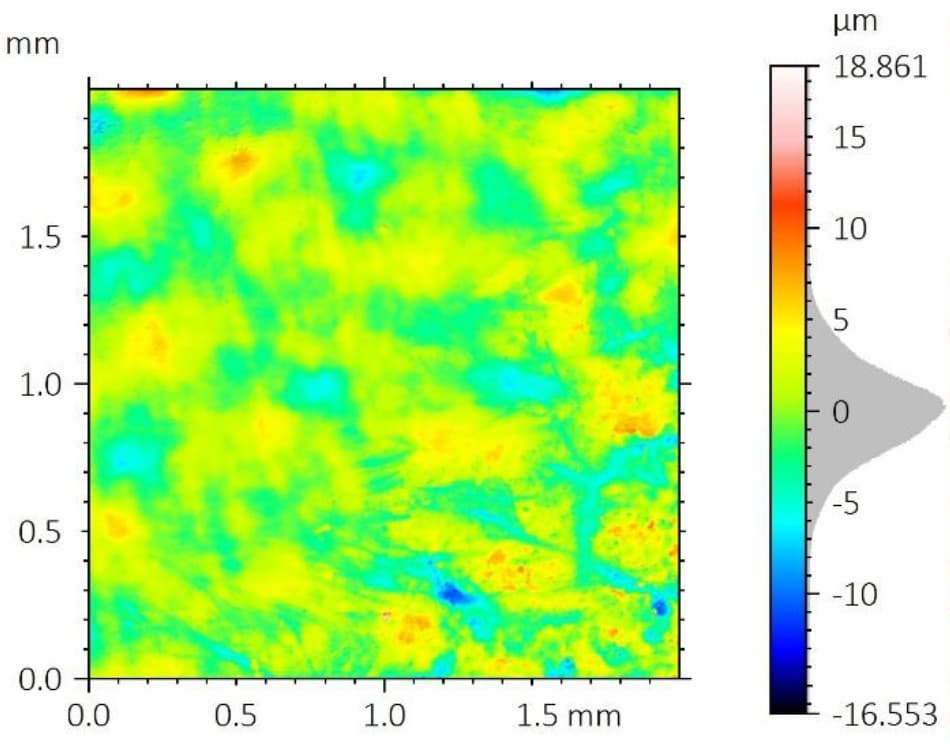
A least-squares degree-8 polynomial form removal was applied to isolate the surface roughness component. The roughness filters S-Gaussian 2.5 µm and L-Gaussian 0.8 mm were then applied according to ISO 25178. The resulting filtered surface and corresponding roughness parameters are presented below.

ISO 25178 – Roughness (S-L)
S-filter (λs): Gaussian, 2.5 µm
F: [Workflow] Form removed (LS-poly 8)
L-filter (λc): Gaussian, 0.8 mm
Height Parameters
Sq2.433µmAltura da raiz quadrada média
Ssk-0.102 Skewness
SKU3.715 Curtose
Sp18.861µmAltura máxima do pico
Sv16.553µmMaximum pit depth
Sz35.414µmAltura máxima
Sa1.888µmAltura média aritmética

The average surface roughness Sa is 1.888 µm, while the peak-to-valley height Sz reaches 35.414 µm.

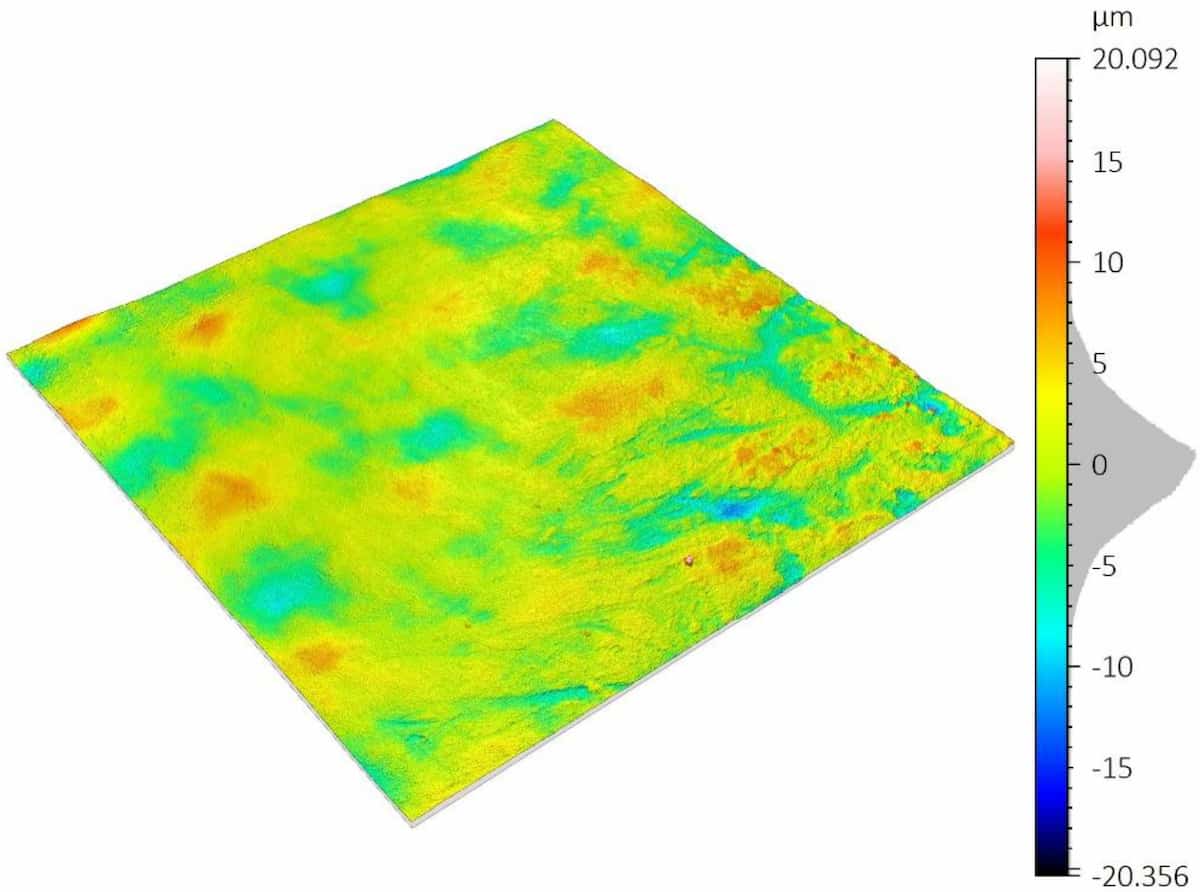
A 3D surface rendering of the filtered area is shown below for visualization.
3D rendering of ISO 25178 filtered tooth surface roughness

Roughness Analysis (Profiles)

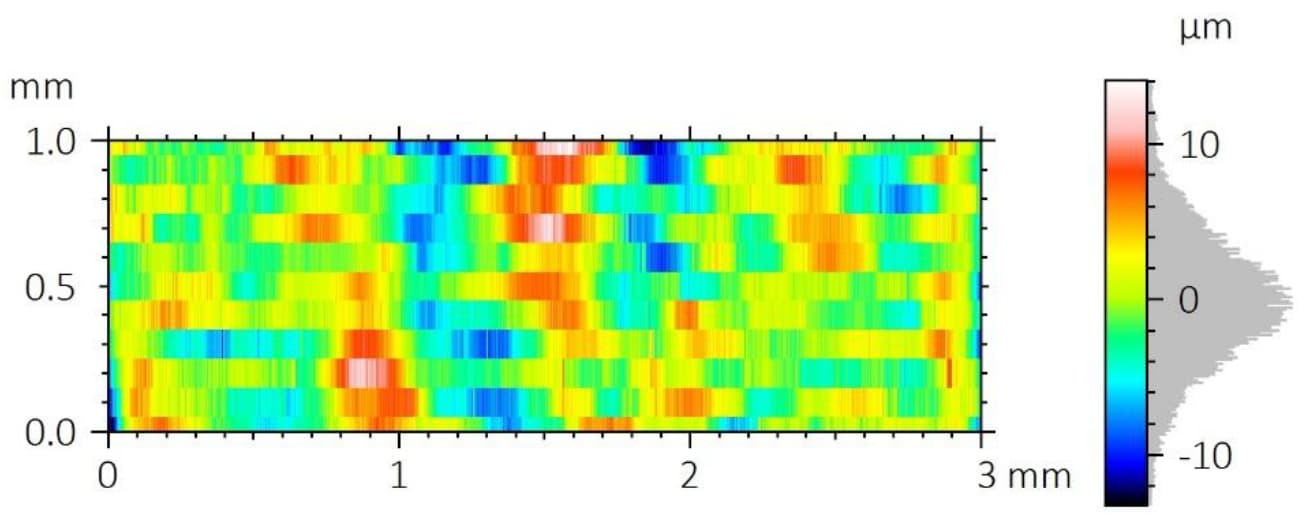
Surface roughness profiles were measured using a series of 11 parallel line scans along the X direction on the side of the tooth. The false-color 2D surface map of the raw scan is shown below.

False-color 2D raw scan of tooth surface for line roughness profiles

The surface form was removed using a least-squares 8-degree polynomial prior to applying the metrological filters, leaving the residual surface shown below.

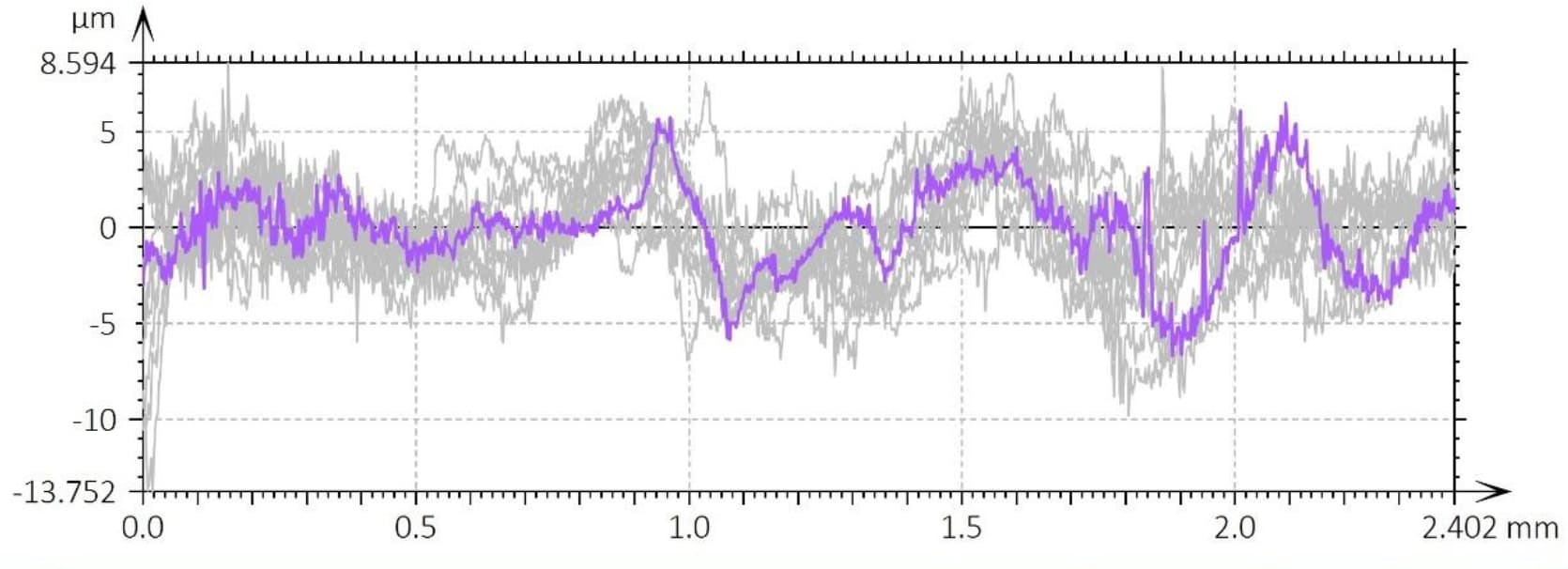
A statistical analysis of the measured surface roughness profiles reveals the following line roughness parameters.

Overlay of multiple tooth surface roughness profiles for statistical analysis

ISO 4287 – Roughness (S-L)
F: Nenhum
S-filter (λs): Gaussian, 2.5 µm
L-filter (λc): Gaussian, 0.8 mm
Evaluation length: All λc (3)
Amplitude Parameters – Roughness Profile
  DescriptionMeanStd devMinMax
RpµmMaximum peak height of the roughness profile5.6830.7614.3156.610
RvµmMaximum valley depth of the roughness profile6.2421.0094.7018.438
RzµmMaximum height of roughness profile11.9251.6769.12315.048
RaµmArithmetic mean deviation of the roughness profile2.0630.2971.7102.629
RqµmRoot-mean-square (RMS) deviation of the roughness profile2.5230.3612.0573.175

ISO 4287 – Roughness (S-L)
F: Nenhum
S-filter (λs): Gaussian, 2.5 µm
L-filter (λc): Gaussian, 0.8 mm
Evaluation length: All λc (3)
Amplitude Parameters – Roughness Profile
Rpµm
Maximum peak height of the roughness profile
Mean5.683
Std dev0.761
Min4.315
Max6.610
Rvµm
Maximum valley depth of the roughness profile
Mean6.242
Std dev1.009
Min4.701
Max8.438
Rzµm
Maximum height of roughness profile
Mean11.925
Std dev1.676
Min9.123
Max15.048
Raµm
Arithmetic mean deviation of the roughness profile
Mean2.063
Std dev0.297
Min1.710
Max2.629
Rqµm
Root-mean-square (RMS) deviation of the roughness profile
Mean2.523
Std dev0.361
Min2.057
Max3.175

The value of Ra is consistent with the Sa value extracted from the surface area measurement.

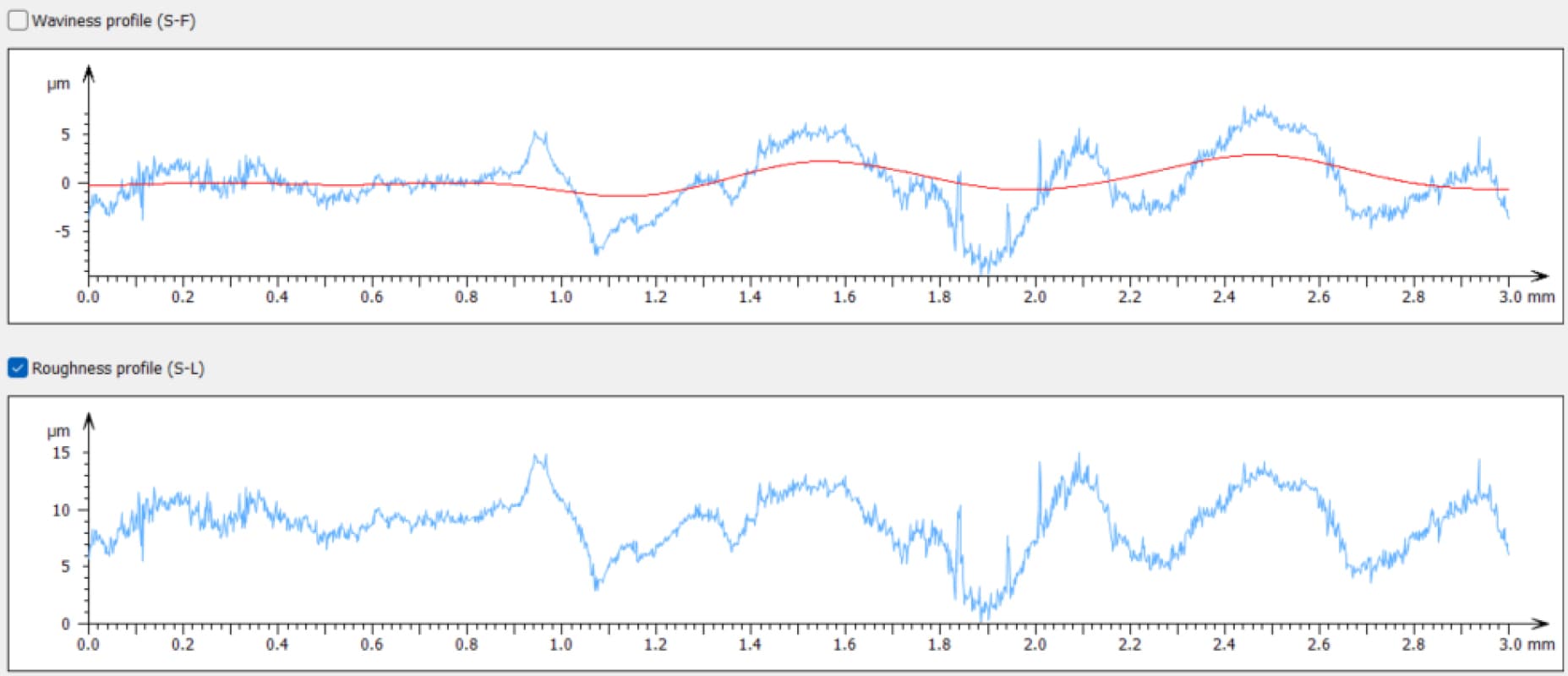
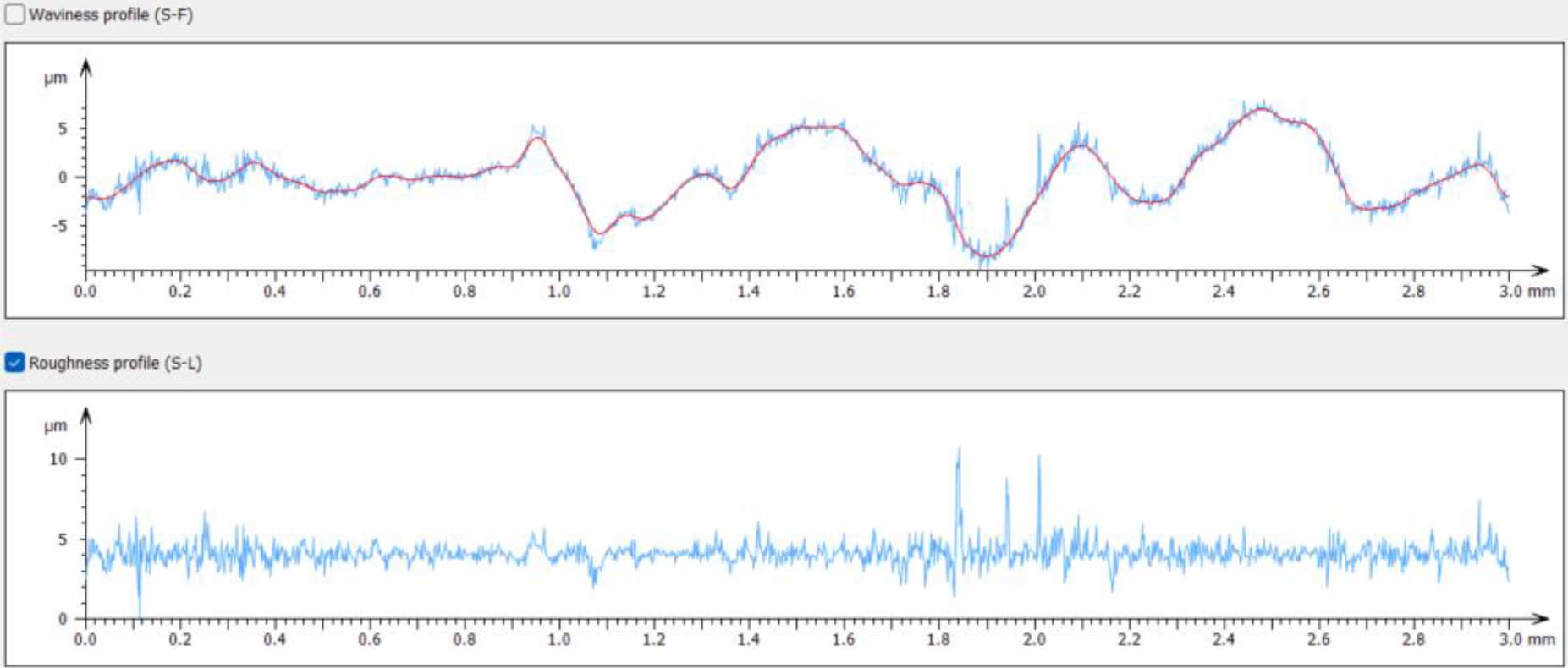
Different metrological filters can be applied to distinguish between macroscopic waviness and microscopic surface roughness. For example, a coarser filter cut-off, such as the 8 mm cut-off used with the Robust Gaussian order-2 filter, produces a smoother waviness profile (red) that is less sensitive to sharp local variations and follows the original surface profile more loosely.

Comparison of waviness and roughness profiles on tooth surface using coarse filter

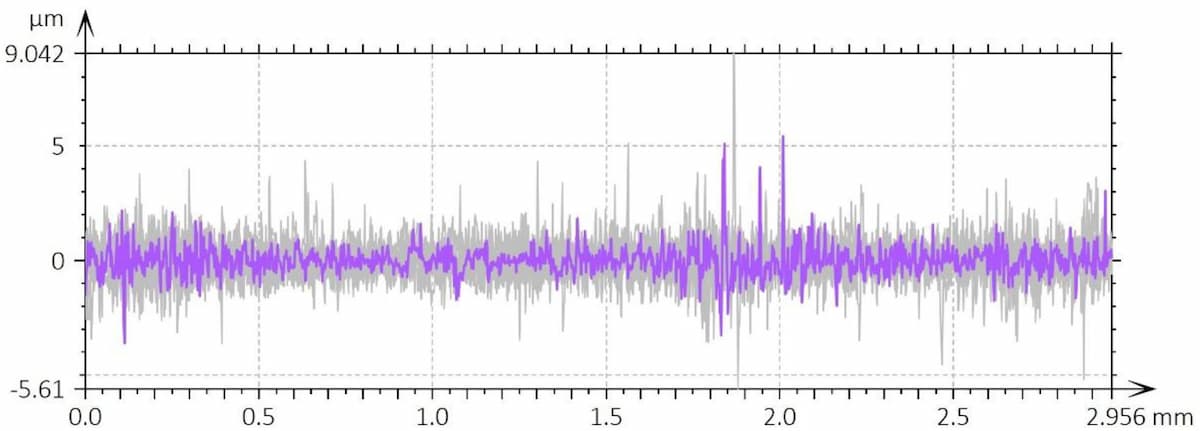
Alternatively, a finer cut-off (e.g., 0.08 mm) enables the analysis of micro-roughness by removing the waviness component that follows the original profile at a larger scale, leaving the finer surface roughness features of the tooth visible.

The microroughness analysis obtained using a 0.08 mm L-Gaussian filter is presented below.

Final microroughness profile of tooth surface after filtering

ISO 4287 – Roughness (S-L)
F: Nenhum
S-filter (λs): Gaussian, 2.5 µm
L-filter (λc): Gaussian, 0.08 mm
Evaluation length: All λc (37)
Amplitude Parameters – Roughness Profile
  DescriptionMeanStd devMinMax
RpµmMaximum peak height of the roughness profile1.5820.1221.3421.748
RvµmMaximum valley depth of the roughness profile1.4660.1191.2541.661
RzµmMaximum height of roughness profile3.0490.1962.8203.409
RaµmArithmetic mean deviation of the roughness profile0.4950.0470.4230.597
RqµmRoot-mean-square (RMS) deviation of the roughness profile0.6430.0560.5620.762

ISO 4287 – Roughness (S-L)
F: Nenhum
S-filter (λs): Gaussian, 2.5 µm
L-filter (λc): Gaussian, 0.8 mm
Evaluation length: All λc (3)
Amplitude Parameters – Roughness Profile
Rpµm
Maximum peak height of the roughness profile
Mean5.683
Std dev0.761
Min4.315
Max6.610
Rvµm
Maximum valley depth of the roughness profile
Mean6.242
Std dev1.009
Min4.701
Max8.438
Rzµm
Maximum height of roughness profile
Mean11.925
Std dev1.676
Min9.123
Max15.048
Raµm
Arithmetic mean deviation of the roughness profile
Mean2.063
Std dev0.297
Min1.710
Max2.629
Rqµm
Root-mean-square (RMS) deviation of the roughness profile
Mean2.523
Std dev0.361
Min2.057
Max3.175

Full 3D Tooth Surface Topography Reconstruction

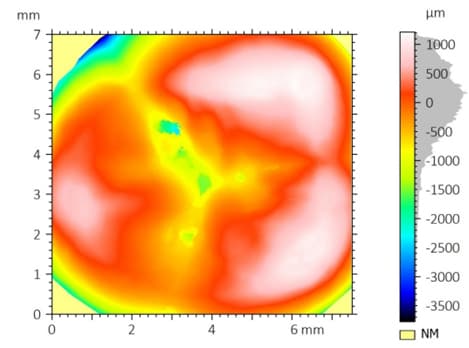
The extended Z-scan range of the PS5 optical sensor enables high-fidelity scanning of the entire tooth crown surface. The resulting 3D surface topography is shown below.

False-color surface topography map of full tooth crown measured with optical profilometer

2D VIEW: 2D surface map of the tooth crown measured with optical profilometry

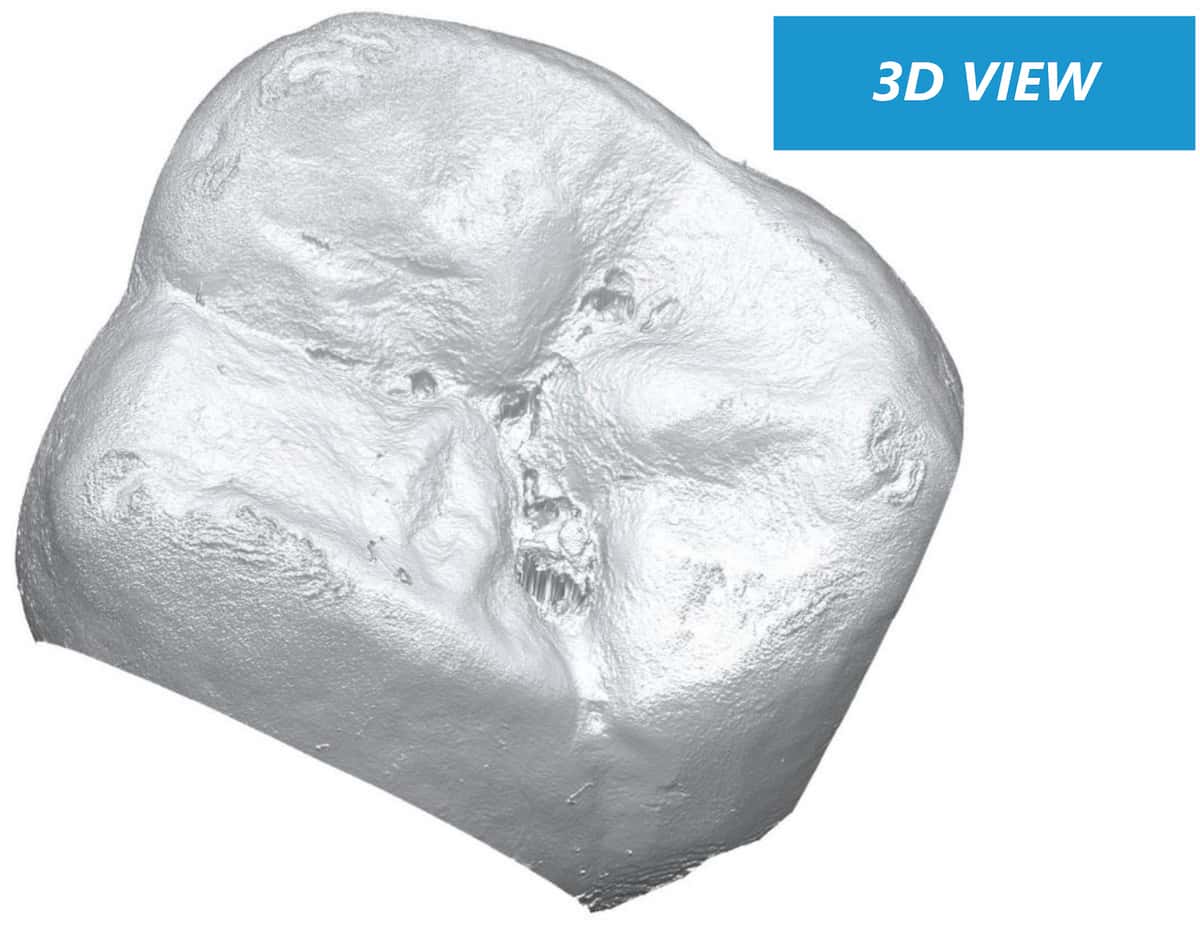
3D surface reconstruction of molar crown from optical profilometer scan

3D VIEW: High-fidelity 3D rendering of the molar crown surface obtained with optical profilometry

Conclusão

In this application, the NANOVEA JR25 Non-Contact Optical Profiler was used to measure the surface roughness and 3D surface topography of an adult human molar.

Both the area scan and the line profile analysis revealed a roughness Rq of approximately 2.5 µm and an Ra of about 1.9–2.0 µm. These values are consistent with results reported in the literature.³ The use of a narrower L-Gaussian filter with an 80 µm cut-off enabled further investigation of micro-roughness, revealing an Rq of 0.643 µm and an Ra of 0.495 µm.

The full 3D surface topography of the molar crown was reconstructed with high fidelity. The high measurement resolution allows detection of fine surface features and crevices. The resulting surface data can be easily processed and exported as STL files, enabling the design and fabrication of customized dental devices and restorative components.

Referências

[1] Shin, B.W., et al. Surface Roughness of Prefabricated Pediatric Zirconia Crowns Following Simulated Toothbrushing. Pediatric Dentistry 44.5 (2022): 363–367.
[2] Bollen, C.M.L., Paul Lambrechts, and Marc Quirynen. Comparison of surface roughness of oral hard materials to the threshold surface roughness for bacterial plaque retention: A review of the literature. Dental Materials 13.4 (1997): 258–269.
[3] Suputtamongkol, K., et al. Surface roughness resulting from wear of lithia-disilicate-based posterior crowns. Wear 269.3–4 (2010): 317–322.

Frequently Asked Questions About Dental Surface Roughness Measurement

What is dental surface roughness measurement?

Dental surface roughness measurement quantifies the microscopic texture of tooth surfaces using parameters such as Ra, Rq, and Sa. Optical profilometers measure these features without contacting the surface, allowing accurate analysis of enamel, restorative materials, and dental crowns.

Why use optical profilometry to measure tooth roughness?

Optical profilometry provides non-contact surface measurement with nanometer-scale vertical resolution. It captures 2D surface maps and full 3D surface topography of dental structures without damaging soft or polished surfaces.

What roughness parameters are used for dental surface analysis?

Common roughness parameters include Ra (arithmetic mean roughness), Rq (root mean square roughness), Sa (areal roughness), and Sz (maximum surface height). These parameters help evaluate enamel wear, plaque adhesion risk, and the performance of restorative materials.

Why is surface roughness important in dentistry?

Surface roughness affects plaque retention, wear resistance, and the long-term performance of dental restorations. Controlling micro-roughness can reduce bacterial adhesion and improve the durability of dental materials.

Need Reliable Surface Roughness Measurement for Dental Materials?

Inspeção de superfície de solda usando um Perfilômetro portátil 3D

Inspeção de superfície WELd

usando um profilômetro portátil 3d

Preparado por

CRAIG LEISING

INTRODUÇÃO

Pode tornar-se crítico que uma determinada solda, normalmente feita por inspeção visual, seja investigada com um nível extremo de precisão. Áreas específicas de interesse para análises precisas incluem fissuras superficiais, porosidade e crateras não preenchidas, independentemente dos procedimentos de inspeção subseqüentes. As características da solda, tais como dimensão/formato, volume, rugosidade, tamanho, etc., podem ser todas medidas para avaliação crítica.

IMPORTÂNCIA DO PROFILÔMETRO 3D SEM CONTATO PARA A INSPEÇÃO DA SUPERFÍCIE DE SOLDA

Ao contrário de outras técnicas, como sondas de toque ou interferometria, o NANOVEA Perfilômetro 3D sem contato, usando cromatismo axial, pode medir praticamente qualquer superfície, os tamanhos das amostras podem variar amplamente devido ao preparo aberto e não há necessidade de preparação da amostra. A faixa nano a macro é obtida durante a medição do perfil da superfície com influência zero da refletividade ou absorção da amostra, possui capacidade avançada para medir ângulos de superfície elevados e não há manipulação de resultados por software. Meça facilmente qualquer material: transparente, opaco, especular, difusivo, polido, áspero, etc. Os recursos 2D e 2D dos perfilômetros portáteis NANOVEA os tornam instrumentos ideais para inspeção completa da superfície da solda, tanto no laboratório quanto no campo.

OBJETIVO DA MEDIÇÃO

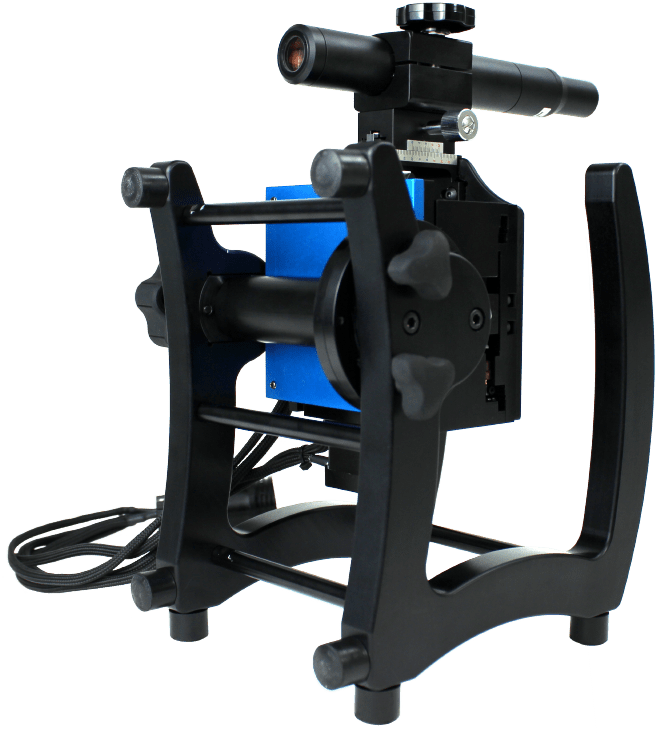
Nesta aplicação, o perfilador portátil NANOVEA JR25 é utilizado para medir a rugosidade da superfície, forma e volume de uma solda, bem como a área circundante. Estas informações podem fornecer informações críticas para investigar adequadamente a qualidade da solda e do processo de soldagem.

NANOVEA

JR25

RESULTADOS DO TESTE

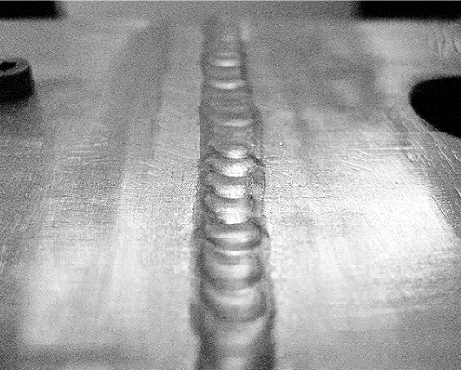
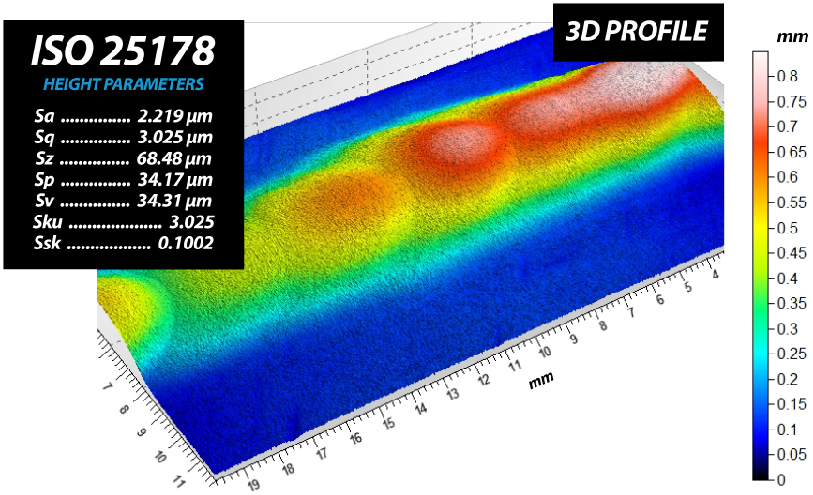
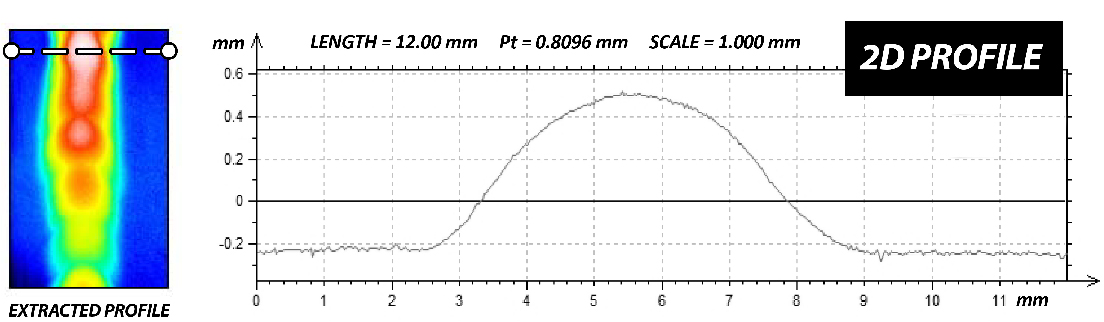
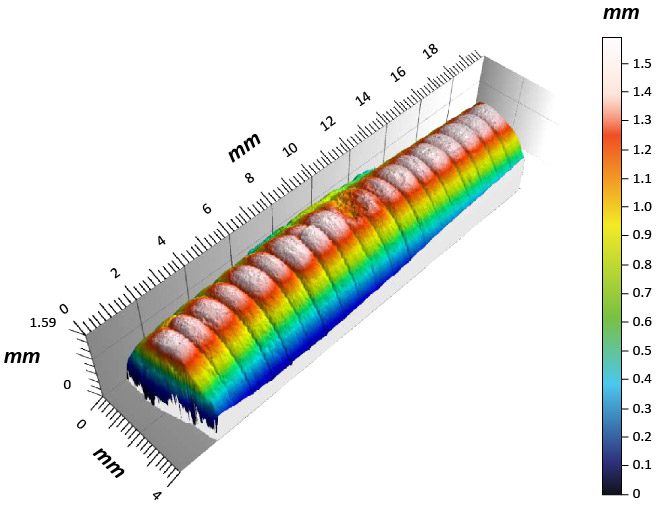
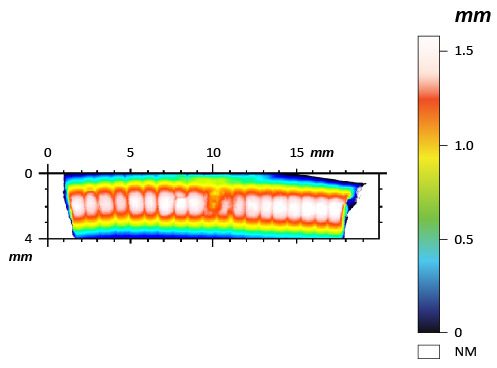
A imagem abaixo mostra a visão 3D completa da solda e da área circundante juntamente com os parâmetros de superfície da solda apenas. O perfil da seção transversal 2D é mostrado abaixo.

a amostra

Com o perfil de seção transversal 2D acima removido do 3D, as informações dimensionais da solda são calculadas abaixo. Área de superfície e volume de material calculado para a solda somente abaixo.

 HOLEPEAK
SUPERFÍCIE1,01 mm214,0 mm2
VOLUME8.799e-5 mm323,27 mm3
PROFUNDIDADE/ALTURA MÁXIMA0,0276 mm0,6195 mm
PROFUNDIDADE/ALTURA MÉDIA 0,004024 mm 0,2298 mm

CONCLUSÃO

Nesta aplicação, mostramos como o NANOVEA 3D Non-Contact Profiler pode caracterizar com precisão as características críticas de uma solda e a área de superfície circundante. A partir da rugosidade, dimensões e volume, um método quantitativo de qualidade e repetibilidade pode ser determinado e ou investigado mais detalhadamente. As amostras de solda, como o exemplo nesta nota de aplicação, podem ser facilmente analisadas, com uma mesa padrão ou com o Profiler NANOVEA portátil para testes internos ou de campo.

Análise de Fractografia usando a Perfilometria 3D

ANÁLISE DA FRACTOGRAFIA

USANDO A PROFILOMETRIA 3D

Preparado por

CRAIG LEISING

INTRODUÇÃO

A fractografia é o estudo de características em superfícies fraturadas e tem sido historicamente investigada via microscópio ou SEM. Dependendo do tamanho do recurso, um microscópio (recursos macro) ou SEM (recursos nano e micro) são selecionados para a análise de superfície. Em última análise, ambos permitem a identificação do tipo de mecanismo de fratura. Embora eficaz, o microscópio tem limitações claras e o SEM na maioria dos casos, além da análise em nível atômico, é impraticável para medição de superfície de fratura e carece de capacidade de uso mais ampla. Com os avanços na tecnologia de medição óptica, o NANOVEA Perfilômetro 3D sem contato é agora considerado o instrumento de escolha, com sua capacidade de fornecer nanometria por meio de medições de superfície 2D e 3D em macroescala

IMPORTÂNCIA DO PROFILÔMETRO 3D SEM CONTATO PARA A INSPEÇÃO DE FRATURAS

Ao contrário de um SEM, um Perfilômetro 3D sem contato pode medir quase qualquer superfície, tamanho de amostra, com o mínimo de preparação de amostra, tudo isso enquanto oferece dimensões verticais/horizontais superiores às de um SEM. Com um perfilador, as características de nano através de macro range são capturadas em uma única medição com influência zero da refletividade da amostra. Mede facilmente qualquer material: transparente, opaco, especular, difusivo, polido, rugoso, etc. O Profilômetro 3D sem contato oferece uma ampla e amigável capacidade para maximizar os estudos de fratura superficial a uma fração do custo de um SEM.

OBJETIVO DA MEDIÇÃO

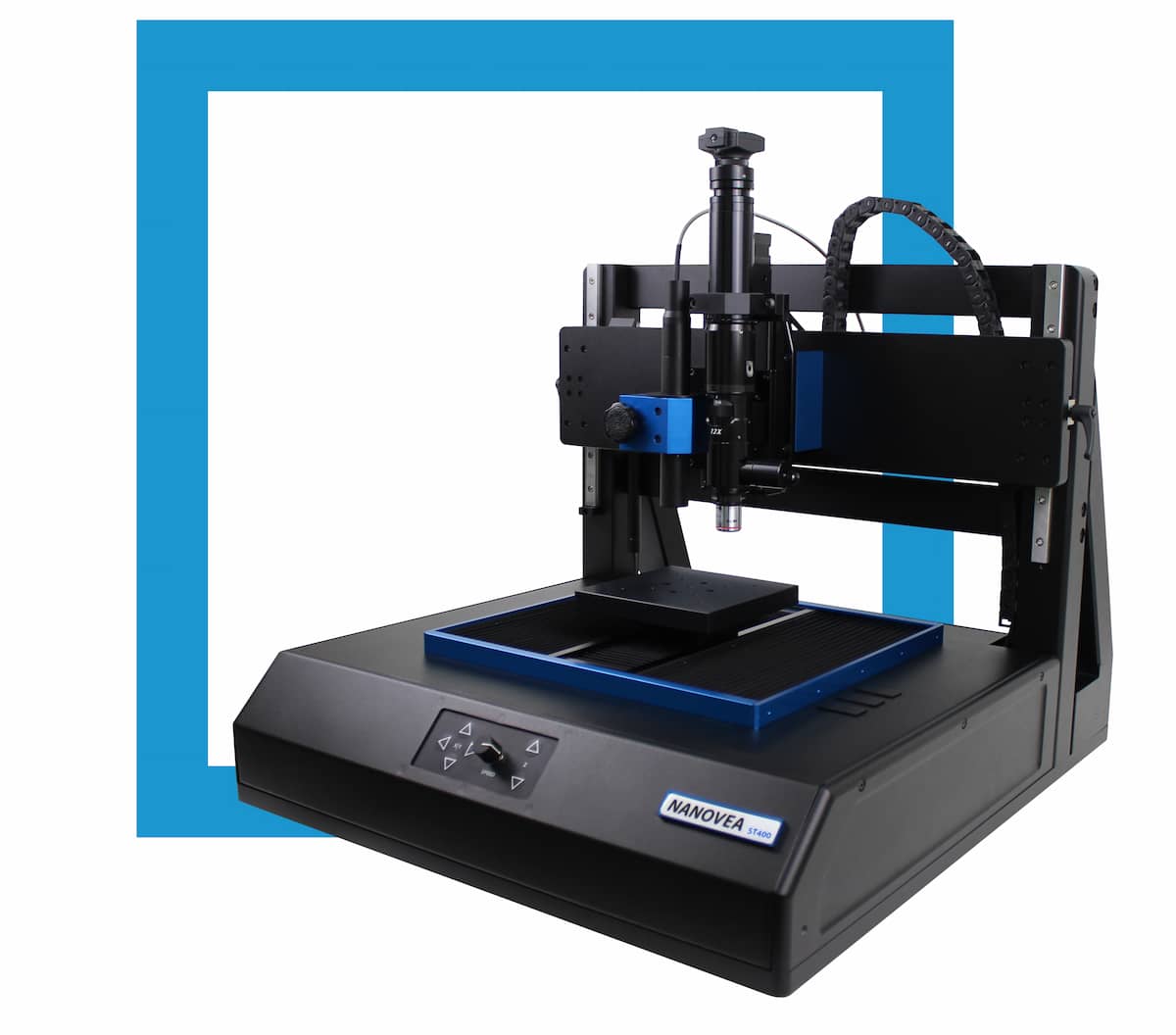
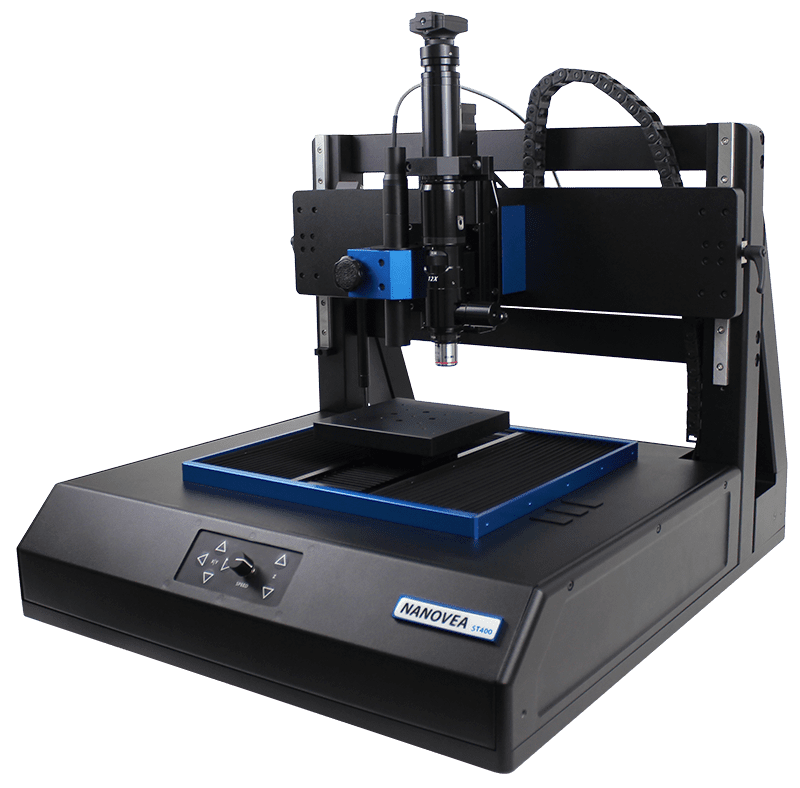
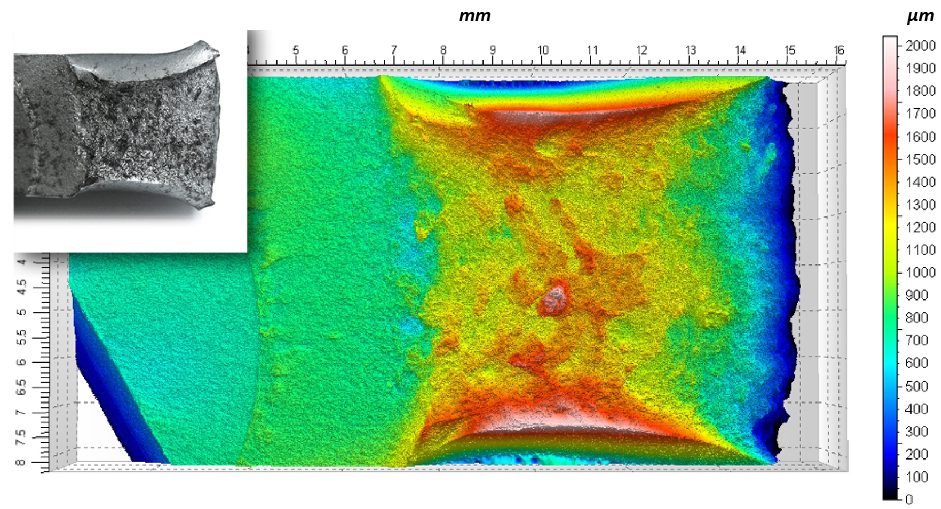
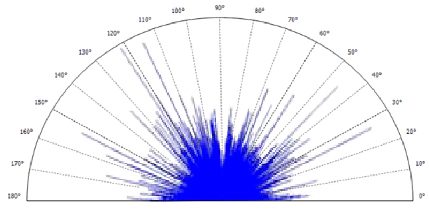
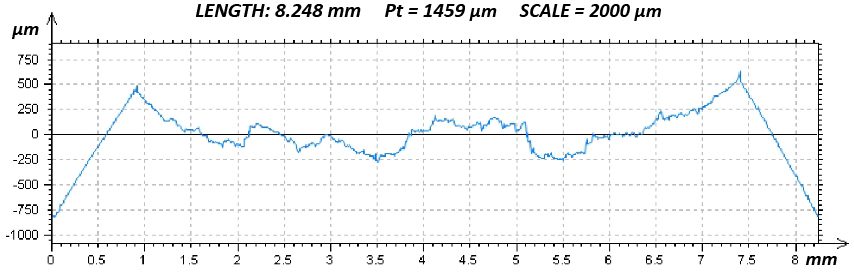
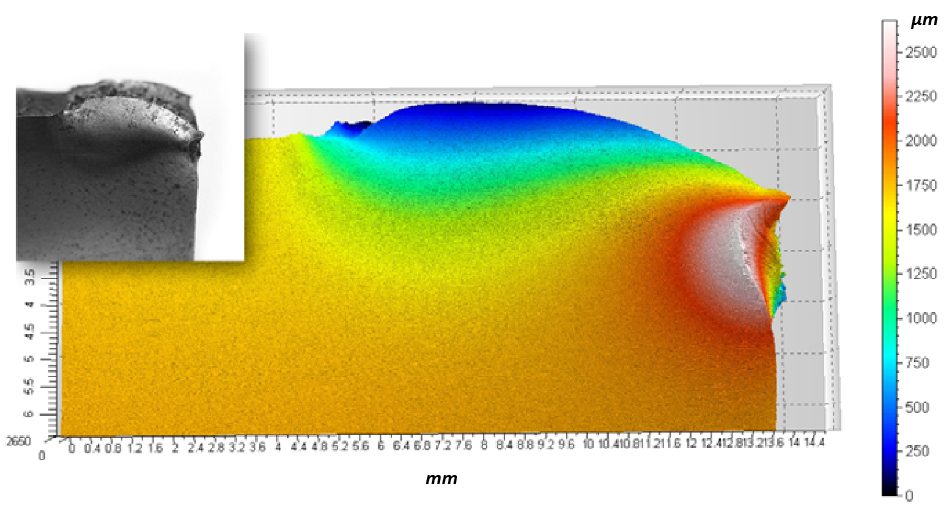
Nesta aplicação, o NANOVEA ST400 é utilizado para medir a superfície fraturada de uma amostra de aço. Neste estudo, mostraremos uma área 3D, extração do perfil 2D e mapa direcional da superfície.

NANOVEA

ST400

RESULTADOS

SUPERFÍCIE TOP SUPERFÍCIE

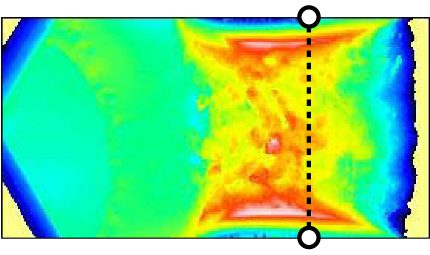
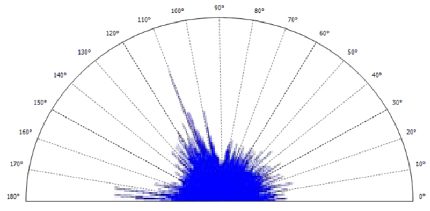
Direção da textura da superfície 3D

Isotropia51.26%
Primeira Direção123.2º
Segunda Direção116.3º
Terceira direção0.1725º

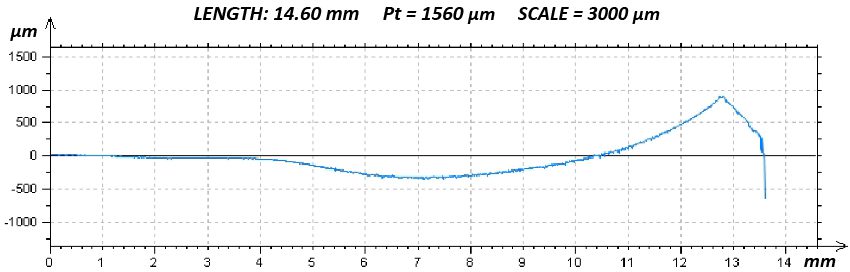
Área de superfície, volume, rugosidade e muitos outros podem ser calculados automaticamente a partir desta extração.

Extração de perfil 2D

RESULTADOS

SUPERFÍCIE LATERAL

Direção da textura da superfície 3D

Isotropia15.55%
Primeira Direção0.1617º
Segunda Direção110.5º
Terceira direção171.5º

Área de superfície, volume, rugosidade e muitos outros podem ser calculados automaticamente a partir desta extração.

Extração de perfil 2D

CONCLUSÃO

Nesta aplicação, mostramos como o NANOVEA ST400 3D Non-Contact Profilometer pode caracterizar com precisão a topografia completa (nano, micro e macro características) de uma superfície fraturada. Da área 3D, a superfície pode ser claramente identificada e sub-áreas ou perfis/seções transversais podem ser rapidamente extraídas e analisadas com uma lista interminável de cálculos de superfície. As características da superfície sub nanométrica podem ser analisadas com um módulo AFM integrado.

Além disso, a NANOVEA incluiu uma versão portátil em sua linha de Perfisômetros, especialmente crítica para estudos de campo onde uma superfície de fratura é imóvel. Com esta ampla lista de capacidades de medição de superfície, a análise da superfície de fratura nunca foi tão fácil e mais conveniente com um único instrumento.

Desgaste e Atrito de Correia Polimérica usando um Tribômetro

CELULOS DE POLÍMERO

GUERRA E FRICAÇÃO UTILIZANDO um TRIBOMETRO

Preparado por

DUANJIE LI, PhD

INTRODUÇÃO

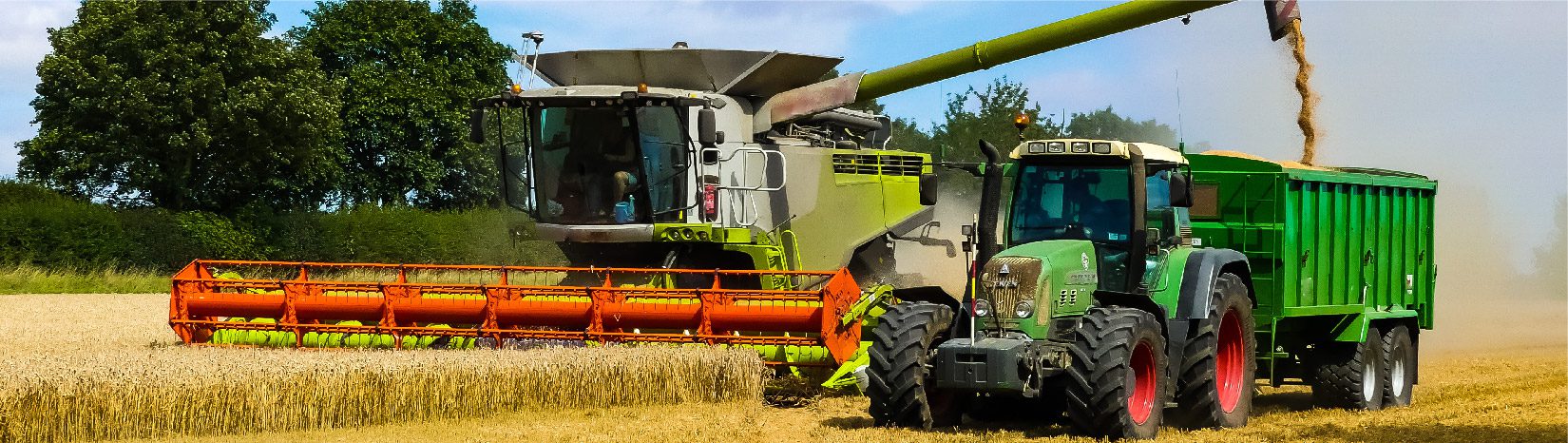
O acionamento por correia transmite potência e rastreia o movimento relativo entre dois ou mais eixos rotativos. Como uma solução simples e barata com manutenção mínima, os acionamentos por correia são amplamente utilizados em uma variedade de aplicações, tais como serras, serrarias, debulhadoras, sopradores de silo e transportadores. Os acionamentos por correia podem proteger as máquinas de sobrecarga, bem como de vibrações úmidas e isoladas.

IMPORTÂNCIA DA AVALIAÇÃO DO DESGASTE PARA ACIONAMENTO POR CORREIA

A fricção e o desgaste são inevitáveis para as correias em uma máquina acionada por correia. O atrito suficiente garante uma transmissão de potência eficaz sem escorregar, mas o atrito excessivo pode desgastar rapidamente a correia. Diferentes tipos de desgaste, como fadiga, abrasão e atrito, ocorrem durante a operação de acionamento da correia. A fim de prolongar a vida útil da correia e reduzir o custo e o tempo de reparo e substituição da correia, é desejável uma avaliação confiável do desempenho de desgaste das correias para melhorar a vida útil da correia, a eficiência da produção e o desempenho da aplicação. A medição precisa do coeficiente de atrito e da taxa de desgaste da correia facilita a P&D e o controle de qualidade da produção da correia.

OBJETIVO DA MEDIÇÃO

Neste estudo, simulamos e comparamos os comportamentos de desgaste das correias com diferentes texturas de superfície para mostrar a capacidade do NANOVEA T2000 Tribômetro na simulação do processo de desgaste da esteira de forma controlada e monitorada.

NANOVEA

T2000

PROCEDIMENTOS DE TESTE

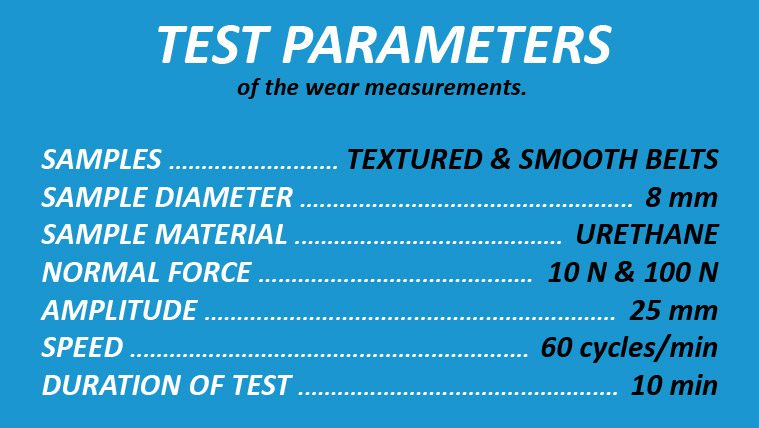
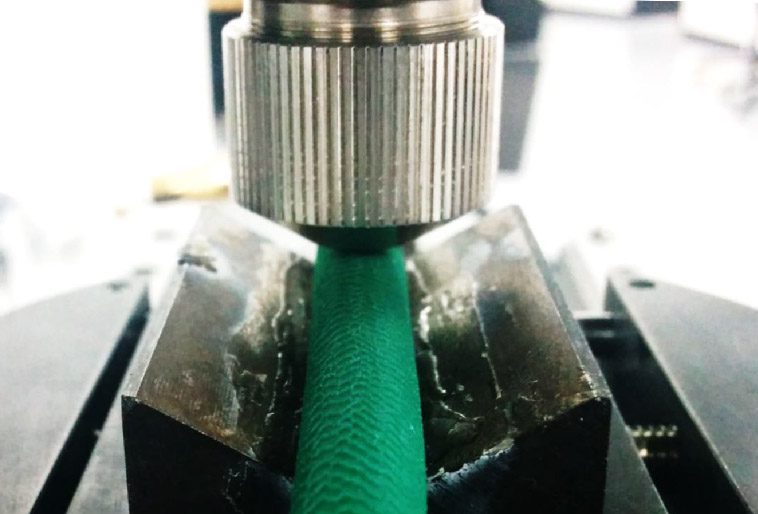
O coeficiente de atrito, COF, e a resistência ao desgaste de duas correias com rugosidade e textura de superfície diferentes foram avaliados pelo NANOVEA Carga elevada Tribômetro usando Módulo de Desgaste Alternativo Linear. Uma esfera de aço 440 (10 mm de diâmetro) foi utilizada como contra-material. A rugosidade da superfície e o rastro de desgaste foram examinados usando um Perfilômetro 3D sem contato. A taxa de desgaste, Kfoi avaliada usando a fórmula K=Vl(Fxs)onde V é o volume gasto, F é a carga normal e s é a distância de deslizamento.


Por favor, note que uma contraparte de esfera lisa de aço 440 foi usada como exemplo neste estudo, qualquer material sólido com diferentes formas e acabamento superficial pode ser aplicado usando dispositivos personalizados para simular a situação real de aplicação.

RESULTADOS & DISCUSSÃO

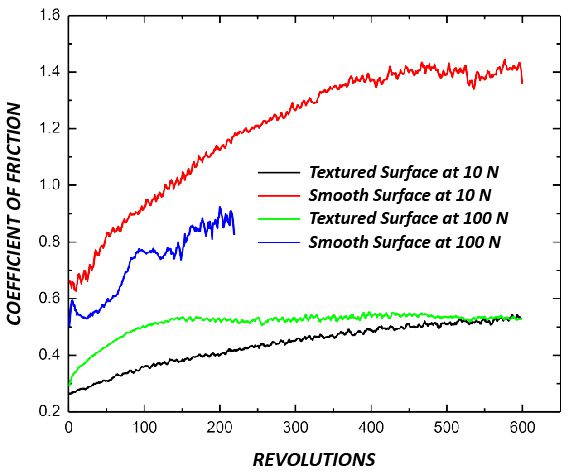
A esteira texturizada e a esteira lisa têm uma rugosidade de superfície Ra de 33,5 e 8,7 um, respectivamente, de acordo com os perfis de superfície analisados tomados com um NANOVEA Perfilador ótico 3D sem contato. O COF e a taxa de desgaste das duas correias testadas foram medidos em 10 N e 100 N, respectivamente, para comparar o comportamento de desgaste das correias com cargas diferentes.

FIGURA 1 mostra a evolução do COF das correias durante os testes de desgaste. As correias com texturas diferentes exibem comportamentos de desgaste substancialmente diferentes. É interessante que após o período de rodagem durante o qual o COF aumenta progressivamente, a Correia Texturizada atinge um COF mais baixo de ~0,5 em ambos os testes realizados usando cargas de 10 N e 100 N. Em comparação, a Correia Lisa testada sob a carga de 10 N exibe um COF significativamente mais alto de ~ 1,4 quando o COF fica estável e se mantém acima deste valor durante o resto do teste. A Smooth Belt testada sob a carga de 100 N rapidamente foi desgastada pela esfera de aço 440 e formou uma grande pista de desgaste. O teste foi, portanto, interrompido a 220 rotações.

FIGURA 1: Evolução do COF das correias com diferentes cargas.

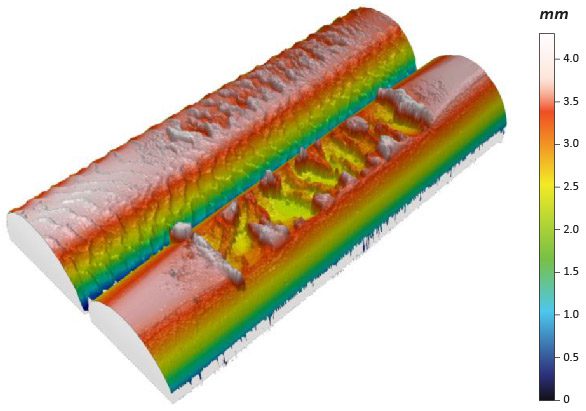
FIGURA 2 compara as imagens das pistas de desgaste 3D após os testes a 100 N. O NANOVEA 3D sem contato oferece uma ferramenta para analisar a morfologia detalhada das pistas de desgaste, fornecendo mais informações sobre a compreensão fundamental do mecanismo de desgaste.

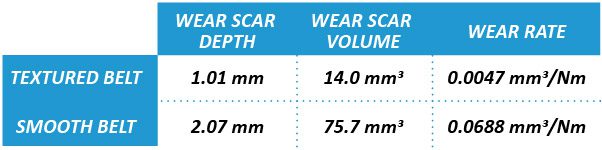
TABELA 1: Resultado da análise da pista de desgaste.

FIGURA 2:  Vista 3D das duas correias
após os testes a 100 N.

O perfil da pista de desgaste 3D permite a determinação direta e precisa do volume da pista de desgaste calculado pelo software de análise avançada, como mostrado na TABELA 1. Em um teste de desgaste para 220 rotações, a Smooth Belt tem uma pista de desgaste muito maior e mais profunda com um volume de 75,7 mm3, em comparação com um volume de desgaste de 14,0 mm3 para a Textured Belt após um teste de desgaste de 600 rotações. O atrito significativamente maior da esteira lisa contra a esfera de aço leva a uma taxa de desgaste 15 vezes maior em comparação com a esteira texturizada.


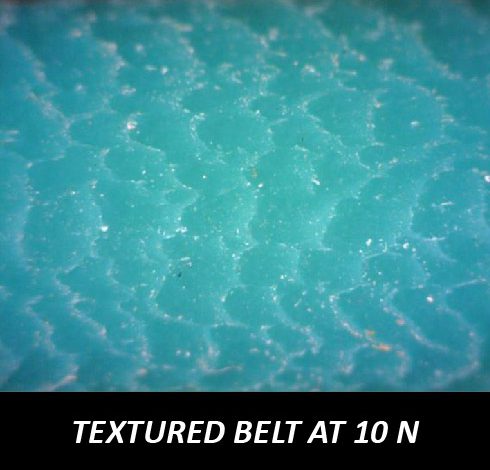
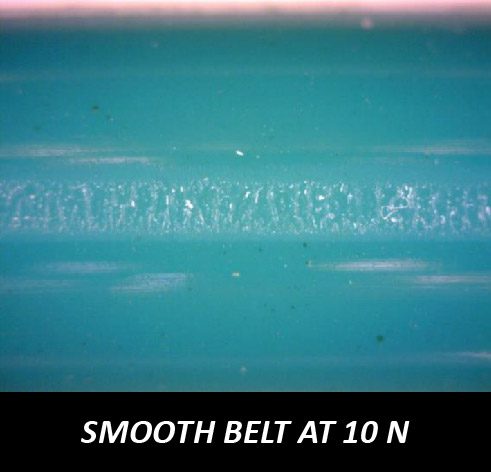
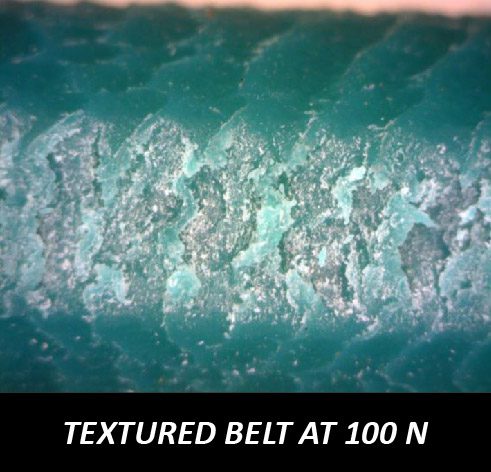
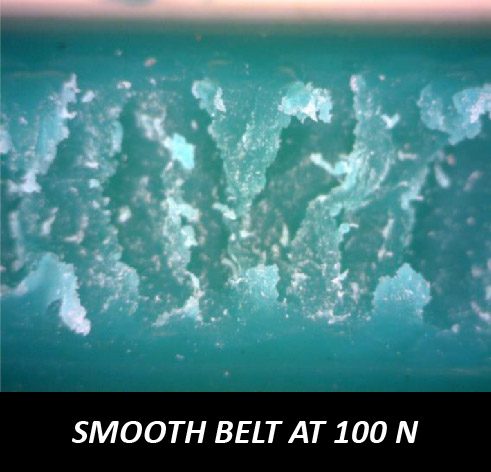
Uma diferença tão drástica de COF entre a esteira texturizada e a esteira lisa está possivelmente relacionada ao tamanho da área de contato entre a esteira e a esfera de aço, o que também leva a seu desempenho de desgaste diferente. A FIGURA 3 mostra as faixas de desgaste das duas correias sob o microscópio ótico. O exame das faixas de desgaste está de acordo com a observação sobre a evolução do COF: A Correia Texturizada, que mantém um COF baixo de ~0,5, não apresenta sinais de desgaste após o teste de desgaste sob uma carga de 10 N. A Correia Lisa mostra uma pequena faixa de desgaste a 10 N. Os testes de desgaste realizados a 100 N criam faixas de desgaste substancialmente maiores tanto na Correia Texturizada quanto na Correia Lisa, e a taxa de desgaste será calculada usando perfis 3D, como será discutido no parágrafo seguinte.

FIGURA 3:  Desgaste de trilhos sob microscópio ótico.

CONCLUSÃO

Neste estudo, mostramos a capacidade do Tribômetro NANOVEA T2000 em avaliar o coeficiente de atrito e a taxa de desgaste das correias de uma maneira bem controlada e quantitativa. A textura da superfície desempenha um papel crítico na resistência ao atrito e ao desgaste das correias durante seu desempenho de serviço. A correia texturizada apresenta um coeficiente de atrito estável de ~0,5 e possui uma longa vida útil, o que resulta em tempo e custo reduzidos no reparo ou substituição de ferramentas. Em comparação, o atrito excessivo da esteira lisa contra a esfera de aço rapidamente usa a esteira. Além disso, a carga sobre a correia é um fator vital de sua vida útil. A sobrecarga cria um atrito muito alto, levando a um desgaste acelerado da correia.

O Tribômetro NANOVEA T2000 oferece testes de desgaste e atrito precisos e repetíveis usando os modos rotativo e linear compatíveis com ISO e ASTM, com módulos opcionais de desgaste em alta temperatura, lubrificação e tribocorrosão disponíveis em um sistema pré-integrado. NANOVEA's A gama inigualável é uma solução ideal para determinar a gama completa de propriedades tribológicas de revestimentos, filmes e substratos finos ou grossos, macios ou duros.

Microestrutura fóssil usando a Perfilometria 3D

MICROESTRUTURA FÓSSIL

USANDO A PROFILOMETRIA 3D

Preparado por

DUANJIE LI, PhD

INTRODUÇÃO

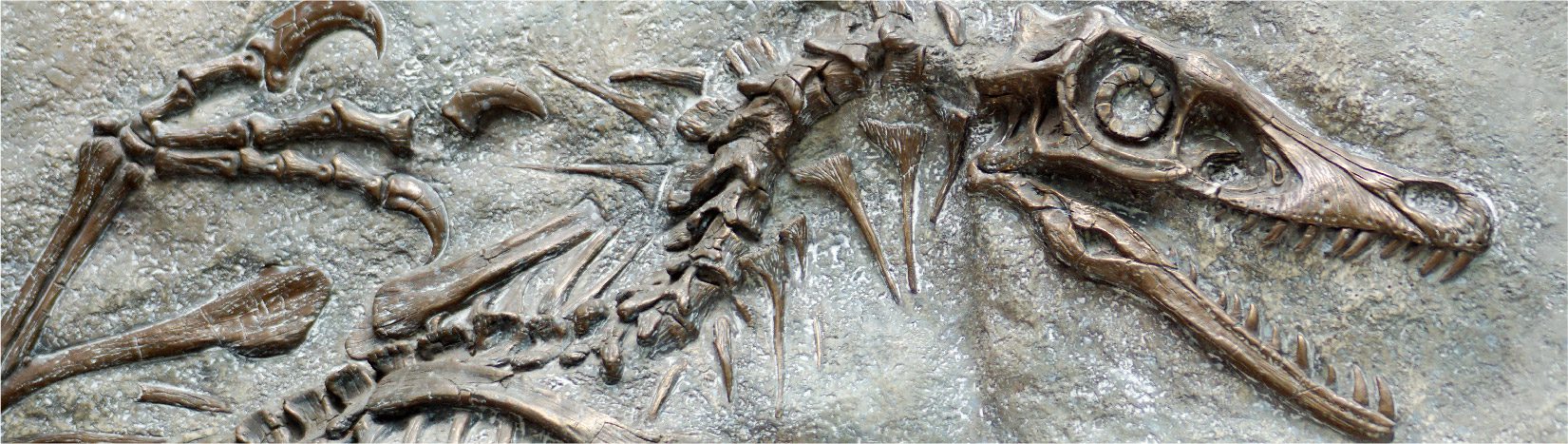
Os fósseis são os restos preservados de vestígios de plantas, animais e outros organismos enterrados em sedimentos sob antigos mares, lagos e rios. O tecido mole do corpo geralmente se decompõe após a morte, mas as conchas duras, os ossos e os dentes se fossilizam. As características da superfície da microestrutura são frequentemente preservadas quando ocorre a substituição mineral das conchas e ossos originais, o que proporciona uma visão da evolução do tempo e do mecanismo de formação dos fósseis.

IMPORTÂNCIA DE UM PROFILÔMETRO 3D SEM CONTATO PARA O EXAME FÓSSIL

Perfis 3D do fóssil nos permitem observar as características detalhadas da superfície da amostra fóssil de um ângulo mais próximo. A alta resolução e precisão do perfilômetro NANOVEA podem não ser discerníveis a olho nu. O software de análise do perfilômetro oferece uma ampla gama de estudos aplicáveis a essas superfícies únicas. Ao contrário de outras técnicas, como sondas de toque, o NANOVEA Perfilômetro 3D sem contato mede as características da superfície sem tocar na amostra. Isto permite a preservação das verdadeiras características da superfície de certas amostras fósseis delicadas. Além disso, o perfilômetro portátil modelo Jr25 permite a medição 3D em sítios fósseis, o que facilita substancialmente a análise e proteção de fósseis após a escavação.

OBJETIVO DA MEDIÇÃO

Neste estudo, o Profilômetro NANOVEA Jr25 é usado para medir a superfície de duas amostras representativas de fósseis. Toda a superfície de cada fóssil foi escaneada e analisada a fim de caracterizar suas características de superfície que incluem rugosidade, contorno e direção da textura.

NANOVEA

Jr25

BRACHIOPOD FÓSSIL

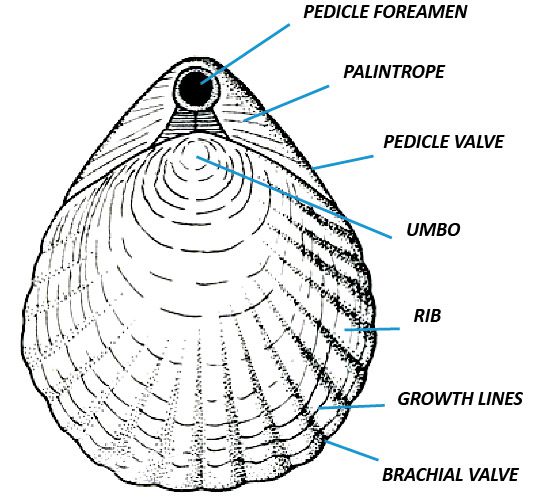
A primeira amostra fóssil apresentada neste relatório é um fóssil Brachiopod, que veio de um animal marinho que possui "válvulas" (conchas) duras em suas superfícies superior e inferior. Eles apareceram pela primeira vez no período Cambriano, que é mais de 550 milhões de anos atrás.

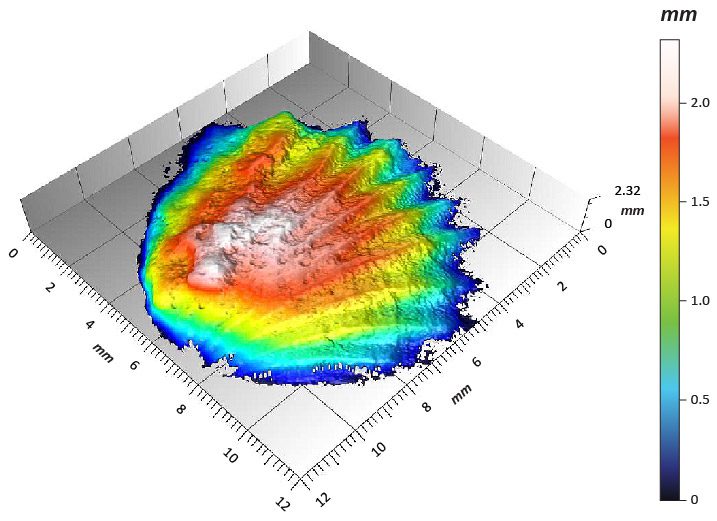
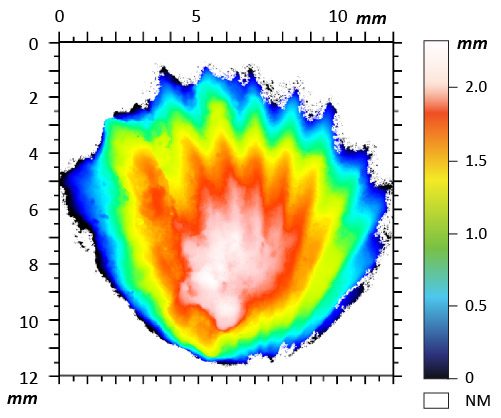
A Vista 3D da varredura é mostrada em FIGURA 1 e a Vista Falsa Cor é mostrada em FIGURA 2. 

FIGURA 1: Vista 3D da amostra fóssil do Brachiopod.

FIGURA 2: Falsa visão colorida da amostra de fóssil Brachiopod.

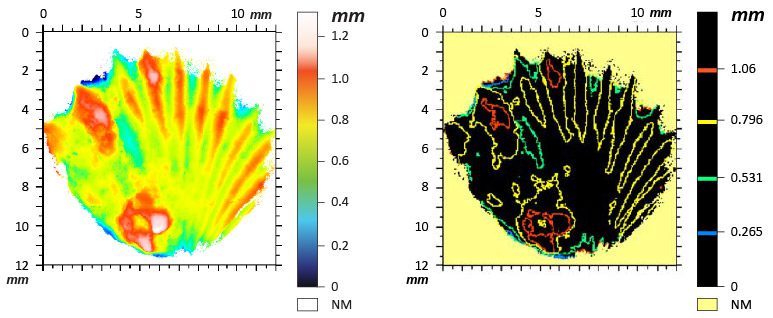
A forma geral foi então removida da superfície a fim de investigar a morfologia local da superfície e o contorno do fóssil Brachiopod, conforme mostrado na FIGURA 3. Uma peculiar textura de ranhura divergente pode agora ser observada na amostra do fóssil Brachiopod.

FIGURA 3: Vista falsa de cores e linhas de contorno após a remoção do formulário.

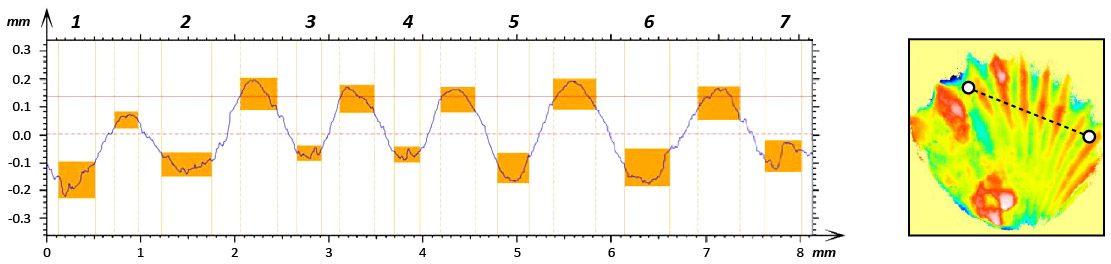
Um perfil de linha é extraído da área texturizada para mostrar uma visão transversal da superfície fóssil na FIGURA 4. O estudo Step Height mede as dimensões precisas das características da superfície. As ranhuras possuem uma largura média de ~0,38 mm e profundidade de ~0,25 mm.

FIGURA 4: Estudo do perfil da linha e da altura do degrau da superfície texturizada.

FÓSSIL DE TRONCO DE CRINOIDES

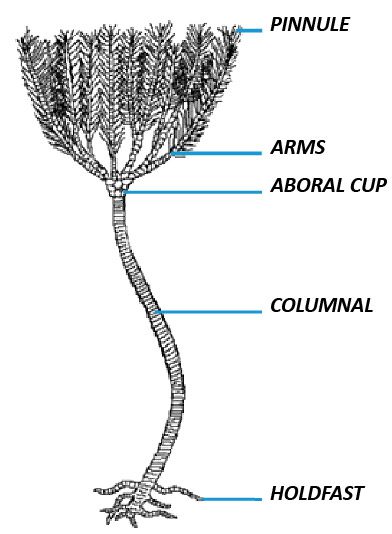
A segunda amostra fóssil é um fóssil Crinoide stem. Os Crinoides apareceram pela primeira vez nos mares do Período Médio Cambriano, cerca de 300 milhões de anos antes dos dinossauros. 


A vista 3D da varredura é mostrada no FIGURA 5 e a Vista Falsa Colorida é mostrada no FIGURA 6. 

FIGURA 5: Vista 3D da amostra do fóssil Crinoide.

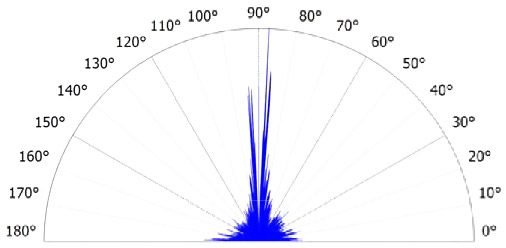
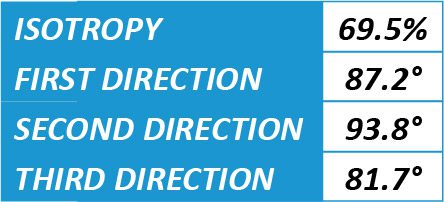
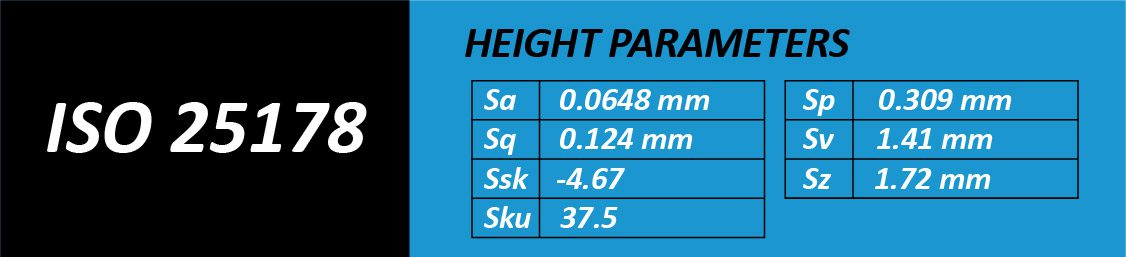
A textura superficial da isotropia e a rugosidade do fóssil Crinoide-tronco são analisadas na FIGURA 7. 

 Este fóssil tem uma direção de textura preferencial no ângulo próximo a 90°, levando a uma isotropia de textura de 69%.

FIGURA 6: Vista Falsa de Cor do Haste de crinoides amostra.


FIGURA 7: Textura da superfície isotropia e rugosidade do fóssil Crinoide-tronco.

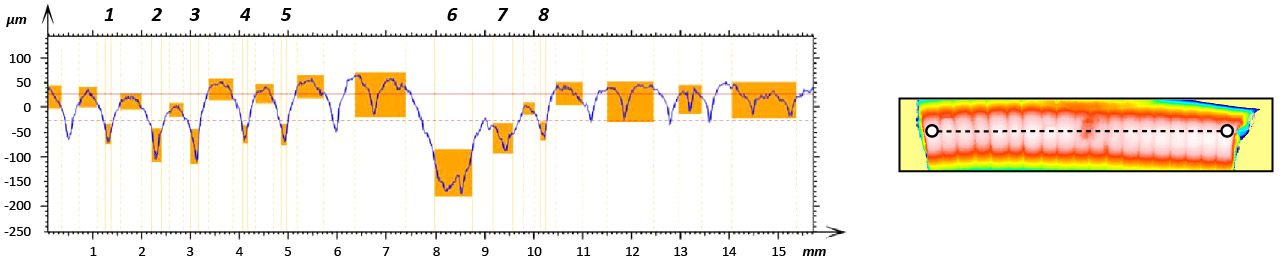
O perfil 2D ao longo da direção axial do fóssil Crinoide stem é mostrado na FIGURA 8. 

O tamanho dos picos da textura da superfície é bastante uniforme.

FIGURA 8: Análise do perfil 2D do fóssil Crinoid stem.

CONCLUSÃO

Nesta aplicação, estudamos de forma abrangente as características de superfície 3D de um fóssil de Brachiopod e haste Crinoide utilizando o NANOVEA Jr25 Portable Non-Contact Profilometer. Mostramos que o instrumento pode caracterizar com precisão a morfologia 3D das amostras fósseis. As interessantes características de superfície e textura das amostras são então analisadas mais detalhadamente. A amostra Brachiopod possui uma textura de ranhura divergente, enquanto que o fóssil Crinoid mostra uma isotropia de textura preferencial. As varreduras detalhadas e precisas da superfície 3D provam ser ferramentas ideais para paleontólogos e geólogos estudarem a evolução de vidas e a formação de fósseis.

Os dados mostrados aqui representam apenas uma parte dos cálculos disponíveis no software de análise. Os Profilômetros NANOVEA medem praticamente qualquer superfície em campos como Semicondutor, Microeletrônica, Solar, Fibra Óptica, Automotivo, Aeroespacial, Metalurgia, Usinagem, Revestimentos, Farmacêutico, Biomédico, Ambiental e muitos outros.

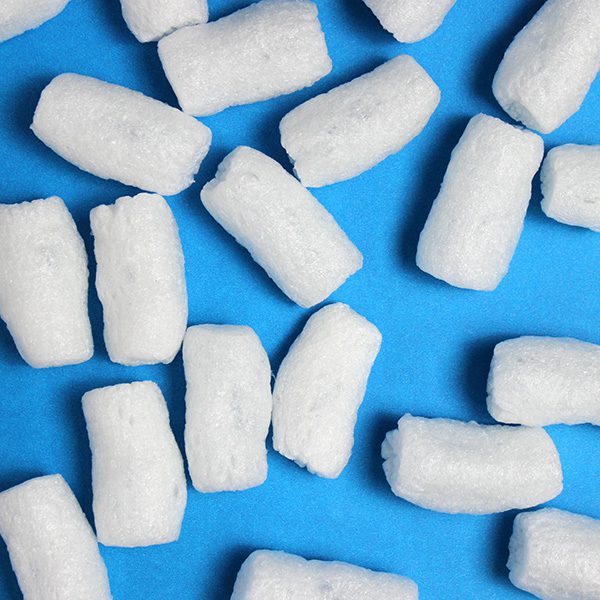
Profilometria de Medição de Limites de Superfície de isopor

Medição de Limite Superficial

Medição de Limites Superficiais Utilizando a Profilometria 3D

Saiba mais

MEDIÇÃO DOS LIMITES DE SUPERFÍCIE

USANDO A PROFILOMETRIA 3D

Preparado por

Craig Leising

INTRODUÇÃO

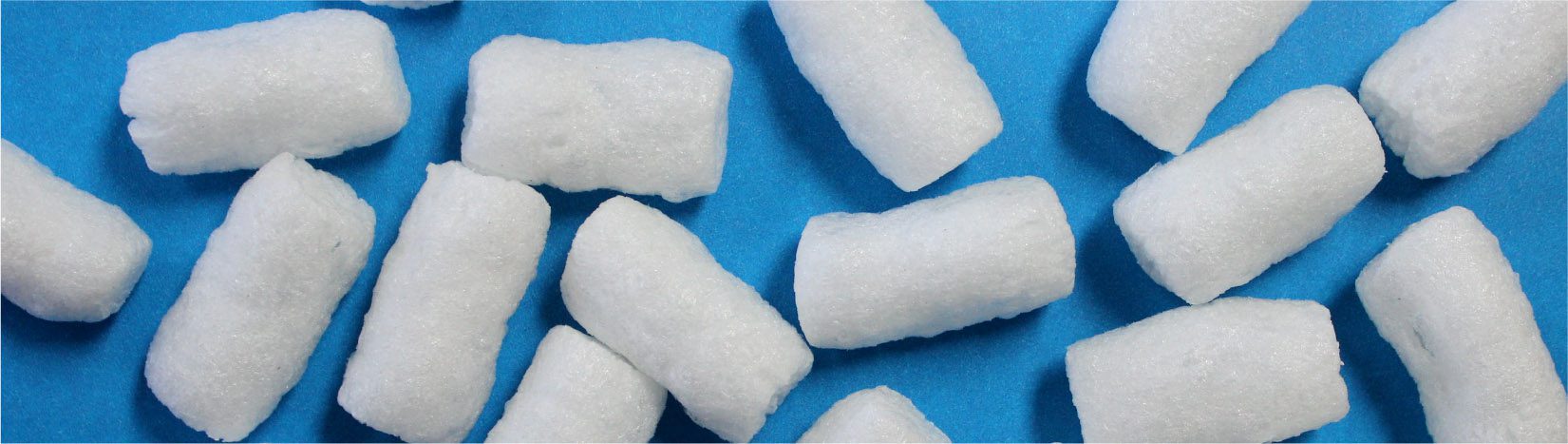
Em estudos onde a interface das características da superfície, padrões, formas, etc., estão sendo avaliados para orientação, será útil identificar rapidamente áreas de interesse em todo o perfil de medição. Ao segmentar uma superfície em áreas significativas, o usuário pode avaliar rapidamente limites, picos, poços, áreas, volumes e muitos outros para entender seu papel funcional em todo o perfil de superfície em estudo. Por exemplo, como a imagem de um limite de grãos de metais, a importância da análise é a interface de muitas estruturas e sua orientação geral. Através da compreensão de cada área de interesse podem ser identificados defeitos e ou anormalidades dentro da área geral. Embora as imagens de limite de grão sejam tipicamente estudadas em uma faixa que ultrapassa a capacidade do Profilômetro e seja apenas uma análise de imagem 2D, é uma referência útil para ilustrar o conceito do que será mostrado aqui em uma escala maior, juntamente com as vantagens da medição de superfície 3D.

IMPORTÂNCIA DO PROFILÔMETRO 3D SEM CONTATO PARA O ESTUDO DA SEPARAÇÃO DA SUPERFÍCIE

Ao contrário de outras técnicas, como sondas de toque ou interferometria, o Perfilômetro sem contato 3D, usando cromatismo axial, pode medir praticamente qualquer superfície, os tamanhos das amostras podem variar amplamente devido ao preparo aberto e não há necessidade de preparação da amostra. A faixa nano a macro é obtida durante a medição do perfil da superfície com influência zero da refletividade ou absorção da amostra, possui capacidade avançada para medir ângulos de superfície elevados e não há manipulação de resultados por software. Meça facilmente qualquer material: transparente, opaco, especular, difusivo, polido, áspero, etc. A técnica do perfilômetro sem contato fornece uma capacidade ideal, ampla e fácil de usar para maximizar estudos de superfície quando a análise de limites de superfície for necessária; juntamente com os benefícios da capacidade combinada de 2D e 3D.

OBJETIVO DA MEDIÇÃO

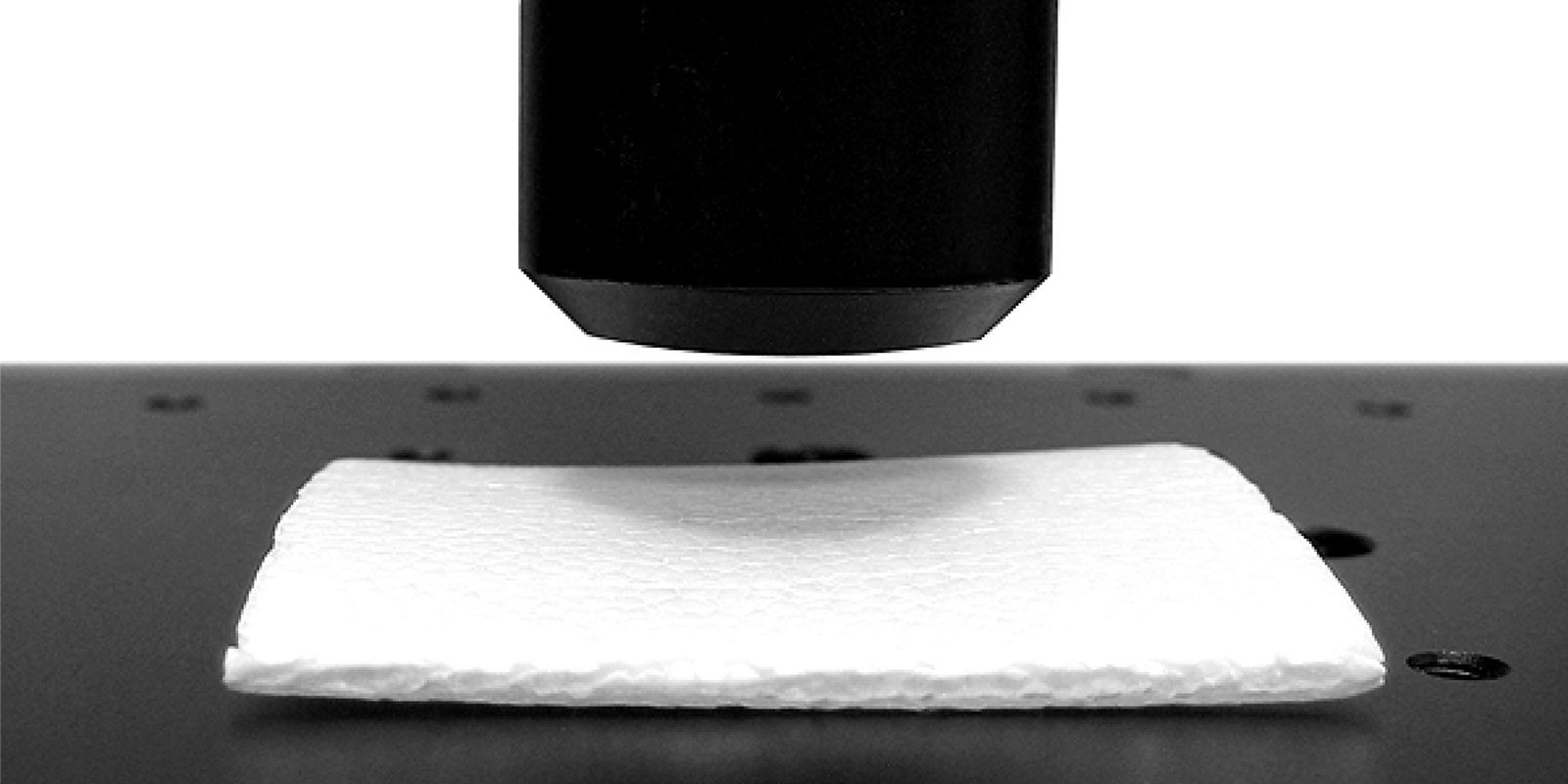
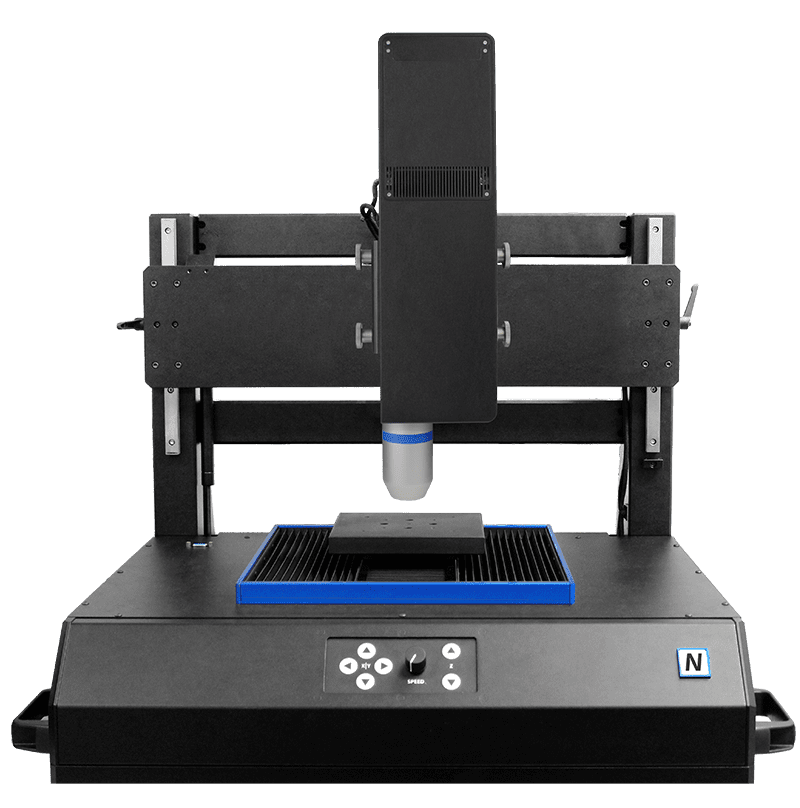
Nesta aplicação, o Nanovea ST400 Profilometer é usado para medir a área de superfície do isopor. Os limites foram estabelecidos pela combinação de um arquivo de intensidade refletida junto com a topografia, que são adquiridos simultaneamente usando o NANOVEA ST400. Estes dados foram então usados para calcular diferentes informações de forma e tamanho de cada "grão" de isopor.

NANOVEA

ST400

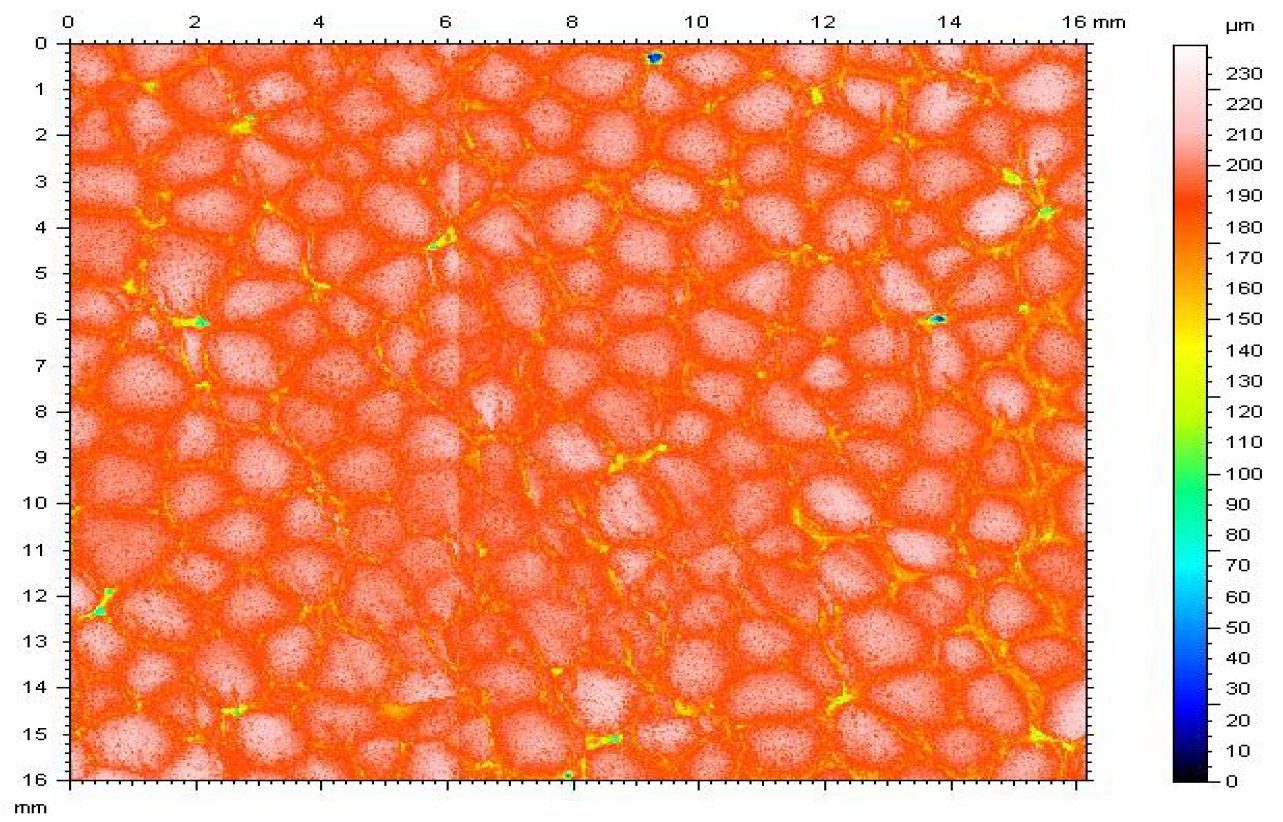
RESULTADOS & DISCUSSÃO: Medição de Limite de Superfície 2D

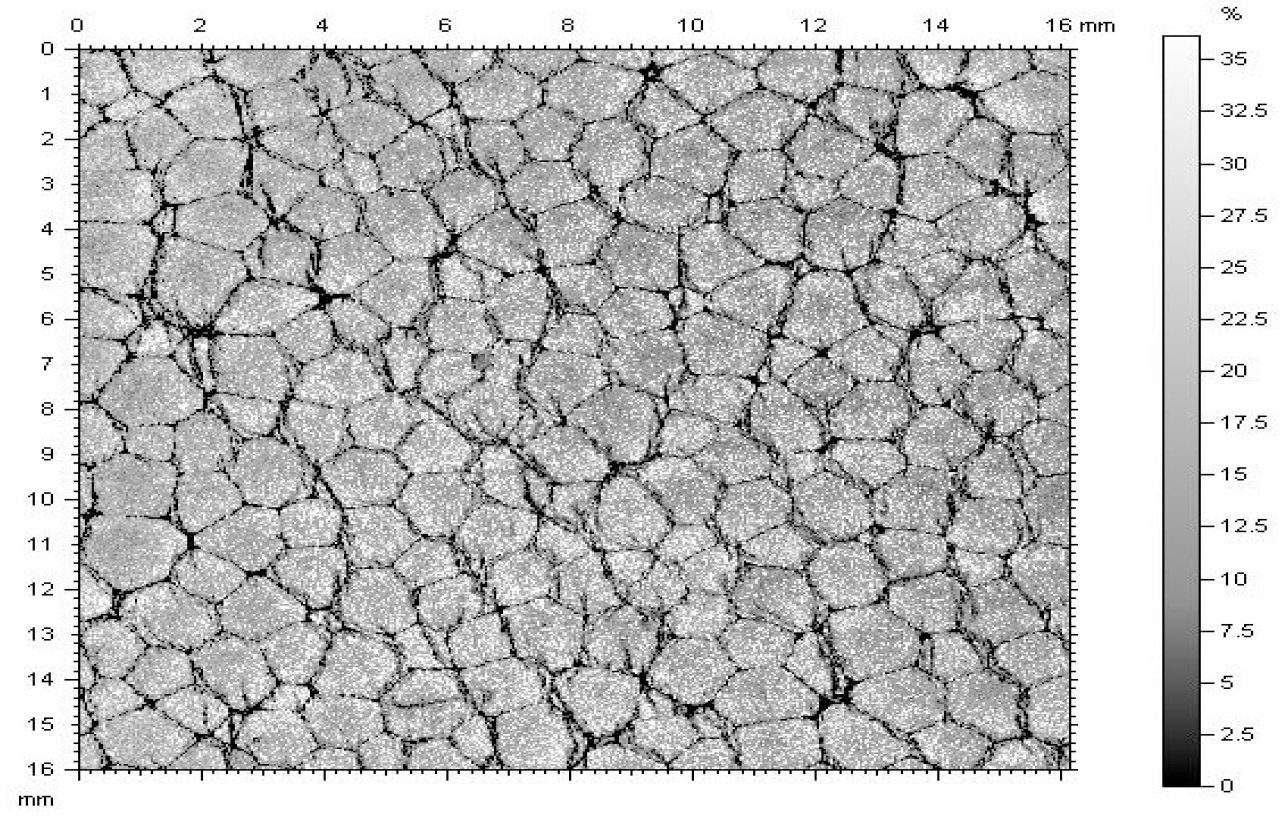
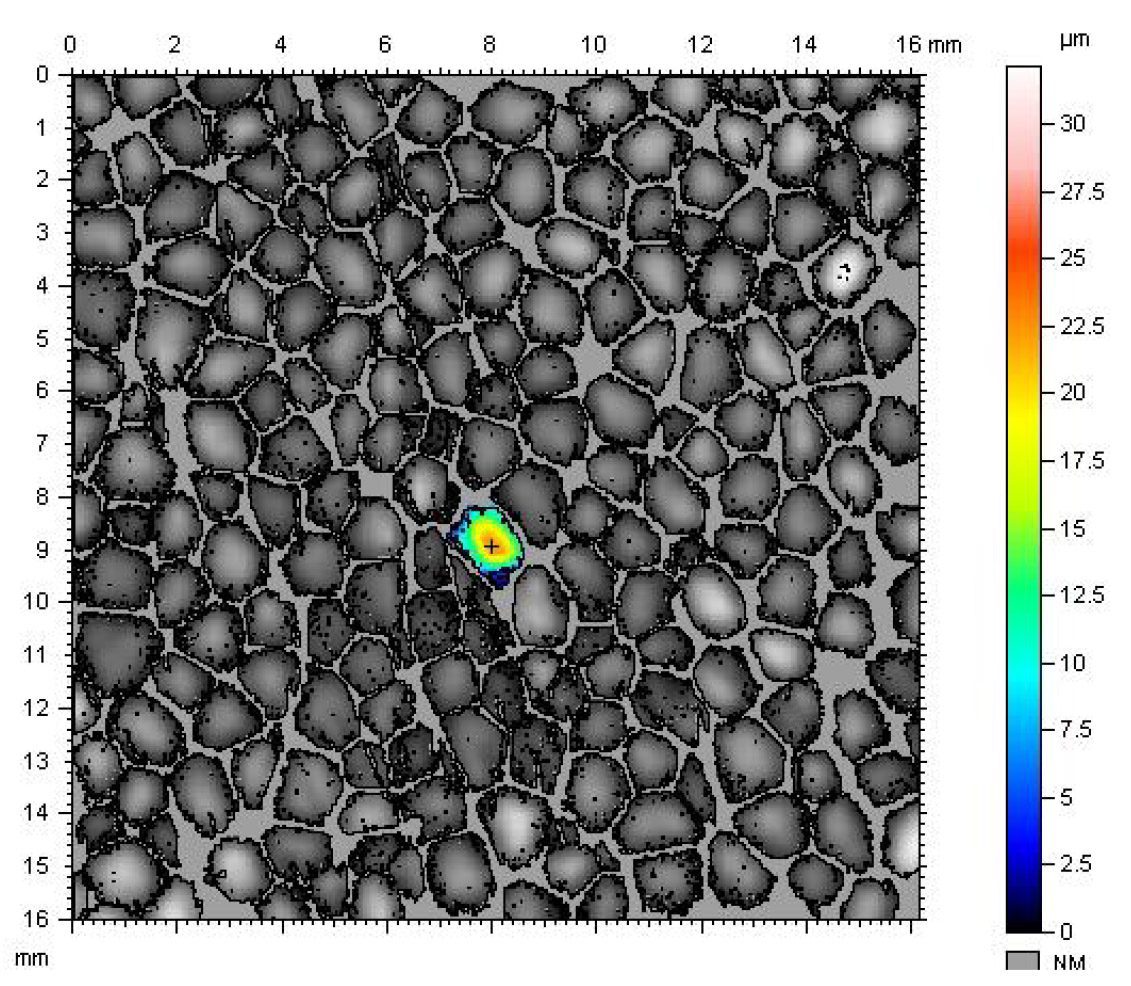
Imagem topográfica (abaixo à esquerda) mascarada pela imagem de intensidade refletida (abaixo à direita) para definir claramente os limites dos grãos. Todos os grãos com diâmetro inferior a 565µm foram ignorados pela aplicação de filtro.

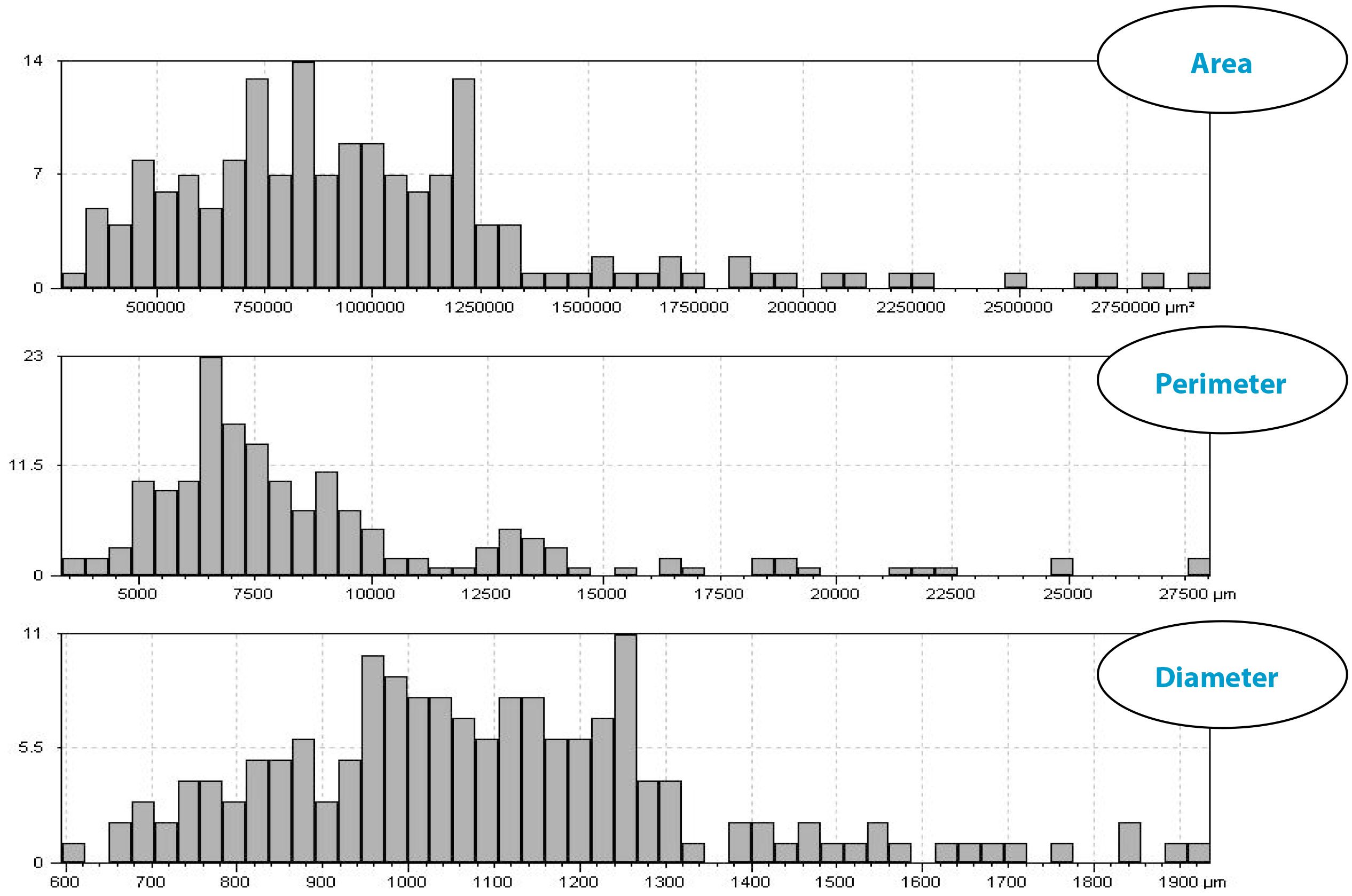
Número total de grãos: 167
Área total projetada ocupada pelos grãos: 166.917 mm² (64.5962 %)
Área total projetada ocupada por limites: (35.4038 %)
Densidade de grãos: 0,646285 grãos / mm2

Área = 0,999500 mm² +/- 0,491846 mm²
Perímetro = 9114,15 µm +/- 4570,38 µm
Diâmetro equivalente = 1098,61 µm +/- 256,235 µm
Diâmetro médio = 945,373 µm +/- 248,344 µm
Diâmetro mínimo = 675,898 µm +/- 246,850 µm
Diâmetro máximo = 1312,43 µm +/- 295,258 µm

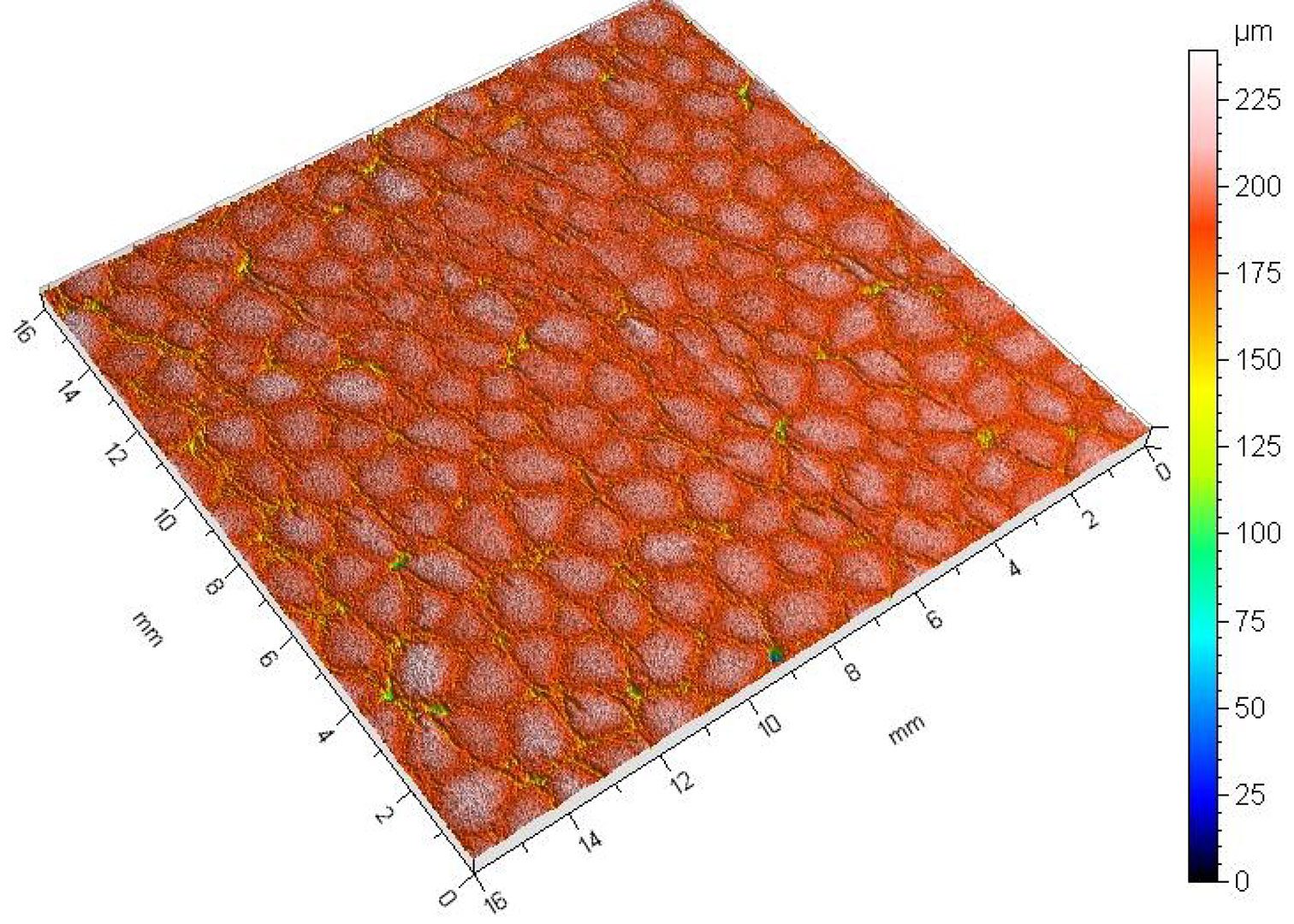
RESULTADOS & DISCUSSÃO: Medição 3D de Limites Superficiais

Utilizando os dados de topografia 3D obtidos, as informações de volume, altura, pico, relação de aspecto e forma geral podem ser analisadas em cada grão. Área 3D total ocupada: 2,525mm3

CONCLUSÃO

Nesta aplicação, mostramos como o NANOVEA 3D Non Contact Profilometer pode caracterizar com precisão a superfície do isopor. Informações estatísticas podem ser obtidas sobre toda a superfície de interesse ou sobre grãos individuais, sejam eles picos ou poços. Neste exemplo, todos os grãos maiores que um tamanho definido pelo usuário foram usados para mostrar a área, perímetro, diâmetro e altura. As características mostradas aqui podem ser críticas para a pesquisa e controle de qualidade de superfícies naturais e pré-fabricadas que vão desde aplicações bio-médicas a micromáquinas, juntamente com muitas outras. 

Medição de contorno usando o Profilômetro da NANOVEA

Medição da profundidade do piso do pneu e da rugosidade da superfície da borracha | Perfilador óptico 3D

MEDIÇÃO DA PROFUNDIDADE DO PERFIL DO PNEU E DA RUGOSIDADE DA SUPERFÍCIE DA BORRACHA usando o perfilador óptico 3D

Referência para medição da profundidade do piso dos pneus, mostrando vários padrões de piso de pneus de automóveis

Preparado por

ANDREA HERRMANN

Embora a profundidade do piso dos pneus seja normalmente medida com medidores manuais para a segurança do consumidor, a pesquisa e desenvolvimento industrial e os fabricantes de pneus exigem métodos mais avançados. Esta nota de aplicação demonstra como um perfilômetro óptico 3D fornece medições precisas da profundidade do piso dos pneus, mapeamento de contornos e análise da rugosidade da superfície da borracha para estudos de alta precisão.

INTRODUÇÃO

Como todos os materiais, o coeficiente de atrito da borracha está relacionado, em parte, à rugosidade da sua superfície. Nos pneus dos veículos, tanto a profundidade do piso como a rugosidade da superfície afetam diretamente a tração, a frenagem e o desempenho em termos de desgaste. Neste estudo, a superfície da borracha e a rugosidade e dimensões do piso são analisadas utilizando perfilometria 3D sem contato.
Amostra de pneu utilizada para medição da profundidade do piso e da rugosidade da superfície da borracha

A AMOSTRA

IMPORTÂNCIA DA PERFILOMETRIA 3D SEM CONTATO PARA A MEDIÇÃO DA PROFUNDIDADE DO SOLO DO PNEU

Ao contrário de outras técnicas, como sondas de contato ou interferometria, Perfiladores ópticos 3D sem contato da NANOVEA use o cromatismo axial para medir praticamente qualquer superfície.

O sistema Profiler permite uma ampla variedade de tamanhos de amostra e não requer nenhuma preparação da amostra. Com uma única varredura, os usuários podem capturar tanto a profundidade geral do piso do pneu quanto a rugosidade da superfície em nível micro, sem nenhuma influência da refletividade ou absorção da amostra. Além disso, esses perfiladores têm a capacidade avançada de medir ângulos de superfície elevados sem a necessidade de manipulação dos resultados por software.

Essa versatilidade torna os perfiladores NANOVEA ideais tanto para testes de desgaste de pneus quanto para pesquisas avançadas sobre materiais de borracha.

OBJETIVO DA MEDIÇÃO

Nesta aplicação, apresentamos o NANOVEA ST400, um perfilador óptico 3D sem contato que mede a profundidade do piso do pneu, a geometria do contorno e a rugosidade da superfície da borracha. Uma área de superfície de amostra grande o suficiente para representar toda a superfície do pneu foi selecionada aleatoriamente para este estudo. Para quantificar as características da borracha, usamos o software de análise NANOVEA Ultra 3D para medir as dimensões das ranhuras, a profundidade do piso, a rugosidade da superfície e a área desenvolvida em comparação com a área projetada.

NANOVEA Padrão ST400
Profilômetro óptico 3D

ANÁLISE: VIAGEM PNEUMÁTICA
A visualização 3D e a visualização em cores falsas dos sulcos mostram o valor do mapeamento de projetos de superfícies 3D. Isso fornece aos engenheiros uma ferramenta simples para avaliar a uniformidade da profundidade dos sulcos, o projeto das ranhuras e o desgaste sob vários ângulos. A análise avançada de contornos e a análise da altura dos degraus são ferramentas extremamente poderosas para medir com precisão as dimensões das formas e do projeto das amostras.
Perfilometria óptica 3D em falsa cor da profundidade do piso do pneu e da geometria dos sulcos
Visão da superfície do perfilômetro 3D da medição da profundidade do piso do pneu

ANÁLISE AVANÇADA DE CONTORNO

Análise avançada do contorno das ranhuras do piso dos pneus utilizando perfilometria 3D

ANÁLISE DA ALTURA DOS DEGRAUS

Análise da altura dos degraus para medição da profundidade do piso dos pneus com perfilador óptico 3D
Perfil de altura de degrau da perfilometria 3D mostrando a medição da profundidade do piso do pneu
ANÁLISE: SUPERFÍCIE DE RUBRICAS
A superfície da borracha pode ser quantificada de várias maneiras usando ferramentas de software integradas, conforme mostrado nas figuras a seguir. Pode-se observar que a rugosidade da superfície é de 2,688 μm, e a área desenvolvida versus a área projetada é de 9,410 mm² versus 8,997 mm². Esses resultados demonstram como a rugosidade da superfície da borracha afeta a tração e o desempenho, permitindo comparações entre diferentes formulações de borracha ou níveis variados de desgaste da superfície.
Análise da rugosidade da superfície da borracha com perfilômetro óptico 3D
ISO 25178 Parâmetros de altura da superfície da borracha dos pneus
Visão da perfilometria óptica 3D da rugosidade da superfície da borracha e área desenvolvida
Parâmetros do perfilador de superfície de borracha de pneus

CONCLUSÃO

Nesta aplicação, mostramos como o perfilador óptico sem contato NANOVEA 3D pode caracterizar com precisão a profundidade do piso do pneu, as dimensões do contorno e a rugosidade da superfície da borracha. Os dados mostram uma rugosidade superficial de 2,69 µm e uma área desenvolvida de 9,41 mm² com uma área projetada de 9 mm². Várias dimensões e raios dos pisos de borracha também foram medidos. Essas informações podem ser usadas por fabricantes de pneus, pesquisadores automotivos e engenheiros de materiais para comparar designs de banda de rodagem, formulações de borracha ou pneus com diferentes graus de desgaste. Os dados mostrados aqui representam apenas uma parte dos cálculos disponíveis no software de análise Ultra 3D.
Peças usinadas QC

Inspeção de peças usinadas

PEÇAS FABRICADAS

inspeção a partir do modelo CAD utilizando a profilometria 3D

Autor:

Duanjie Li, PhD

Revisado por

Jocelyn Esparza

Inspeção de peças usinadas com um Perfílômetro

INTRODUÇÃO

A demanda por usinagem de precisão capaz de criar geometrias complexas tem aumentado em todo um espectro de indústrias. Do aeroespacial, médico e automotivo, a engrenagens tecnológicas, máquinas e instrumentos musicais, a contínua inovação e evolução elevam as expectativas e os padrões de precisão a novos patamares. Conseqüentemente, vemos o aumento da demanda por técnicas e instrumentos de inspeção rigorosos para garantir a mais alta qualidade dos produtos.

Importância da Profilometria 3D sem contato para inspeção de peças

A comparação das propriedades das peças usinadas com seus modelos CAD é essencial para verificar as tolerâncias e a aderência aos padrões de produção. A inspeção durante o tempo de serviço também é crucial, pois o desgaste das peças pode exigir a substituição das mesmas. A identificação de quaisquer desvios das especificações exigidas em tempo hábil ajudará a evitar reparos dispendiosos, paradas de produção e reputação manchada.

Ao contrário de uma técnica de sonda de toque, o NANOVEA Perfis ópticos execute varreduras de superfícies 3D com contato zero, permitindo medições rápidas, precisas e não destrutivas de formas complexas com a mais alta precisão.

OBJETIVO DA MEDIÇÃO

Nesta aplicação, mostramos o NANOVEA HS2000, um Profiler 3D sem contato com um sensor de alta velocidade, realizando uma inspeção de superfície abrangente de dimensão, raio e rugosidade. 

Tudo isso em menos de 40 segundos.

NANOVEA

HS2000

MODELO CAD

Uma medição precisa da dimensão e rugosidade da superfície da peça usinada é fundamental para garantir que ela atenda às especificações, tolerâncias e acabamentos superficiais desejados. O modelo 3D e o desenho de engenharia da peça a ser inspecionada são apresentados abaixo. 

FALSA VISÃO COLORIDA

A falsa visão de cor do modelo CAD e a superfície da peça usinada digitalizada são comparadas na FIGURA 3. A variação de altura na superfície da amostra pode ser observada pela mudança de cor.

Três perfis 2D são extraídos do scan de superfície 3D, como indicado no FIGURA 2, para verificar melhor a tolerância dimensional da peça usinada.

COMPARAÇÃO DE PERFIS E RESULTADOS

Os perfis de 1 a 3 são mostrados no FIGURA 3 a 5. A inspeção de tolerância quantitativa é realizada comparando o perfil medido com o modelo CAD para manter padrões rigorosos de fabricação. O perfil 1 e o perfil 2 medem o raio de diferentes áreas na peça usinada curvada. A variação de altura do Perfil 2 é de 30 µm sobre um comprimento de 156 mm que atende à exigência de tolerância desejada de ±125 µm. 

Ao estabelecer um valor limite de tolerância, o software de análise pode determinar automaticamente a passagem ou falha da peça usinada.

Inspeção de peças de máquinas com um perfilômetro

A rugosidade e uniformidade da superfície da peça usinada desempenham um papel importante para garantir sua qualidade e funcionalidade. O FIGURA 6 é uma área de superfície extraída da varredura da peça usinada que foi utilizada para quantificar o acabamento superficial. A rugosidade média da superfície (Sa) foi calculada como sendo de 2,31 µm.

CONCLUSÃO

Neste estudo, mostramos como o perfilador sem contato HS2000 da NANOVEA, equipado com um sensor de alta velocidade, realiza uma inspeção de superfície abrangente das dimensões e rugosidade. 

As varreduras de alta resolução permitem aos usuários medir a morfologia detalhada e as características de superfície das peças usinadas e compará-las quantitativamente com seus modelos CAD. O instrumento também é capaz de detectar quaisquer defeitos, incluindo arranhões e rachaduras. 

A análise avançada de contorno serve como uma ferramenta inigualável não apenas para determinar se as peças usinadas satisfazem as especificações estabelecidas, mas também para avaliar os mecanismos de falha dos componentes desgastados.

Os dados mostrados aqui representam apenas uma parte dos cálculos possíveis com o software de análise avançada que vem equipado com cada NANOVEA Optical Profiler.