美国/全球:+1-949-461-9292
欧洲。+39-011-3052-794
联系我们

类别。轮廓测量法 | 几何和形状


stent coating adhesion testing failure analysis drug eluting stent coating

Stent Coating Adhesion and Delamination Analysis Using Nano Scratch Testing

Application Note | Stent Coating Adhesion Testing

Stent Coating Adhesion and Delamination Analysis Using Nano Scratch Testing

Quantifying Coating Failure and Adhesion Performance on Drug-Eluting Stents

stent coating adhesion testing nano scratch delamination critical load

Research & Experimental Testing

李端杰,博士

Visual Design & Editorial

安德鲁-肖尔

简介

Blood is carried through arteries from the heart to the rest of the body. Any weakening or blockage of these vessels can pose significant health risks and may become life-threatening. A stent is a small mesh tube inserted into the lumen of a blood vessel to treat narrowed or weakened arteries. Stent implantation is now a widely used procedure to support the arterial wall and restore blood flowᶦ.
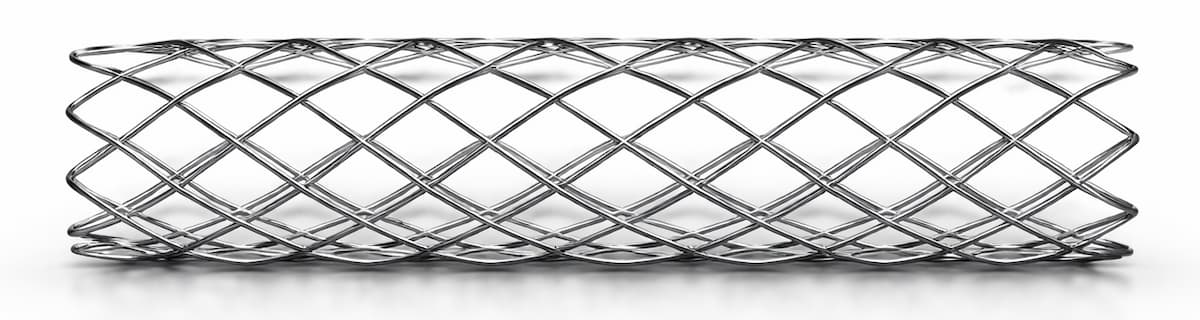
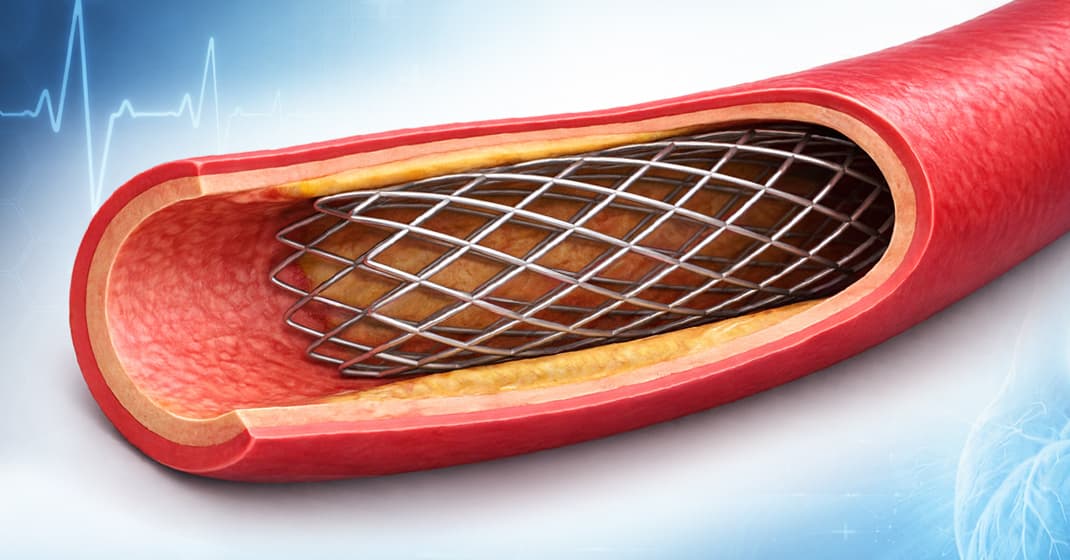
Metal stent mesh geometry illustrating the structural complexity of vascular implant design.

Why coating adhesion matters in drug-eluting stents

Drug-eluting stents represent a major advancement in stent technology. They incorporate a biodegradable, biocompatible polymer coating that enables controlled drug release at the arterial site, helping to inhibit intimal thickening and reduce the risk of restenosisᶦᶦ.

A critical concern in these systems is the delamination of the polymer coating from the metallic stent substrate. This coating carries the drug-eluting layer, and its adhesion directly impacts device performance and reliability.

To improve coating adhesion, stents are often designed with complex geometries. In this study, the polymer coating is located at the bottom of grooves within the stent mesh. This configuration presents a significant challenge for adhesion measurement.

A reliable method is required to quantitatively evaluate the interfacial strength between the polymer coating and the metal substrate. The small diameter of the stent mesh, comparable to a human hair, combined with its three-dimensional geometry, requires:

  • ultrafine X-Y positioning accuracy
  • precise control of applied load
  • accurate depth measurement during testing
Measurement Method

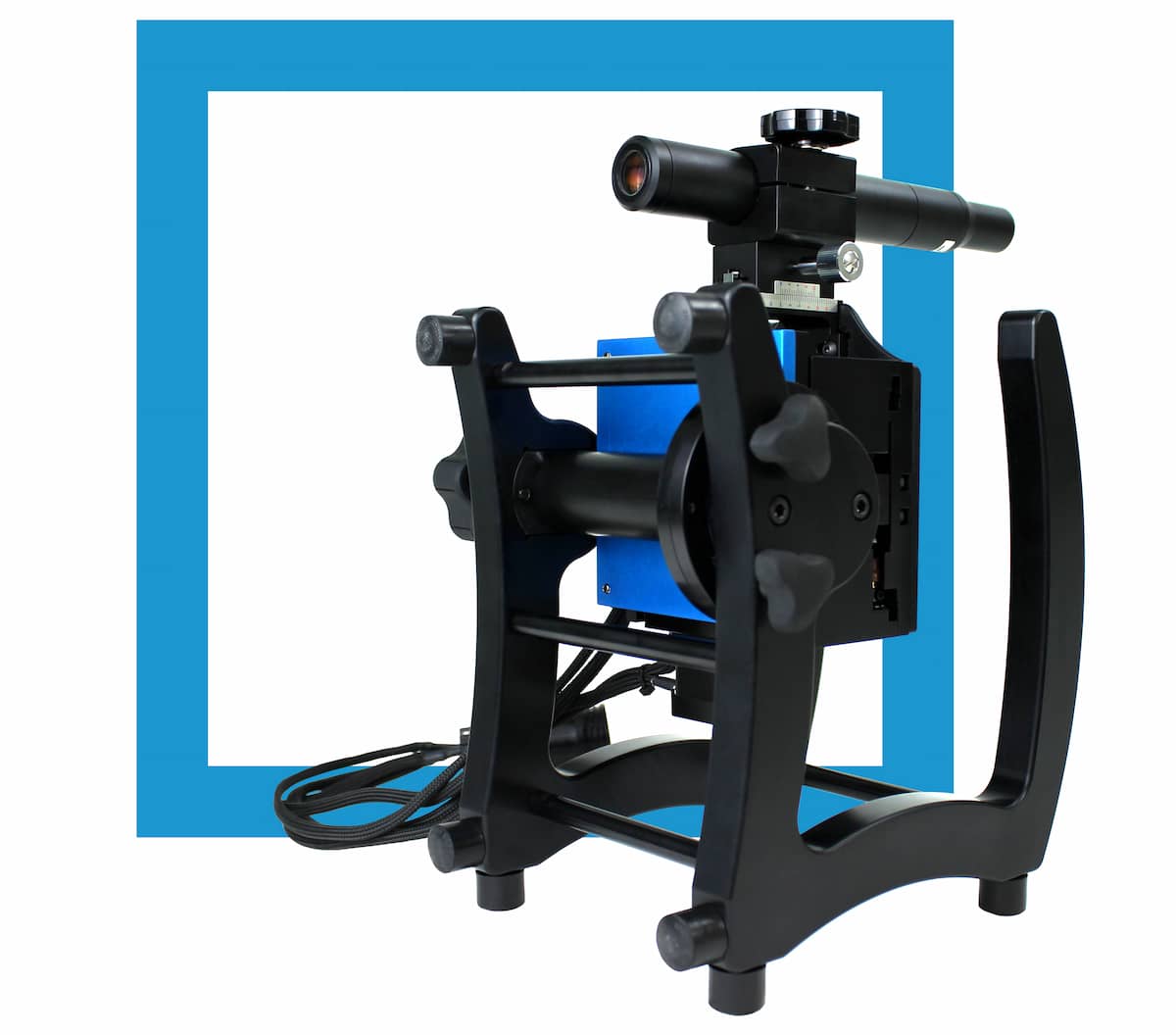
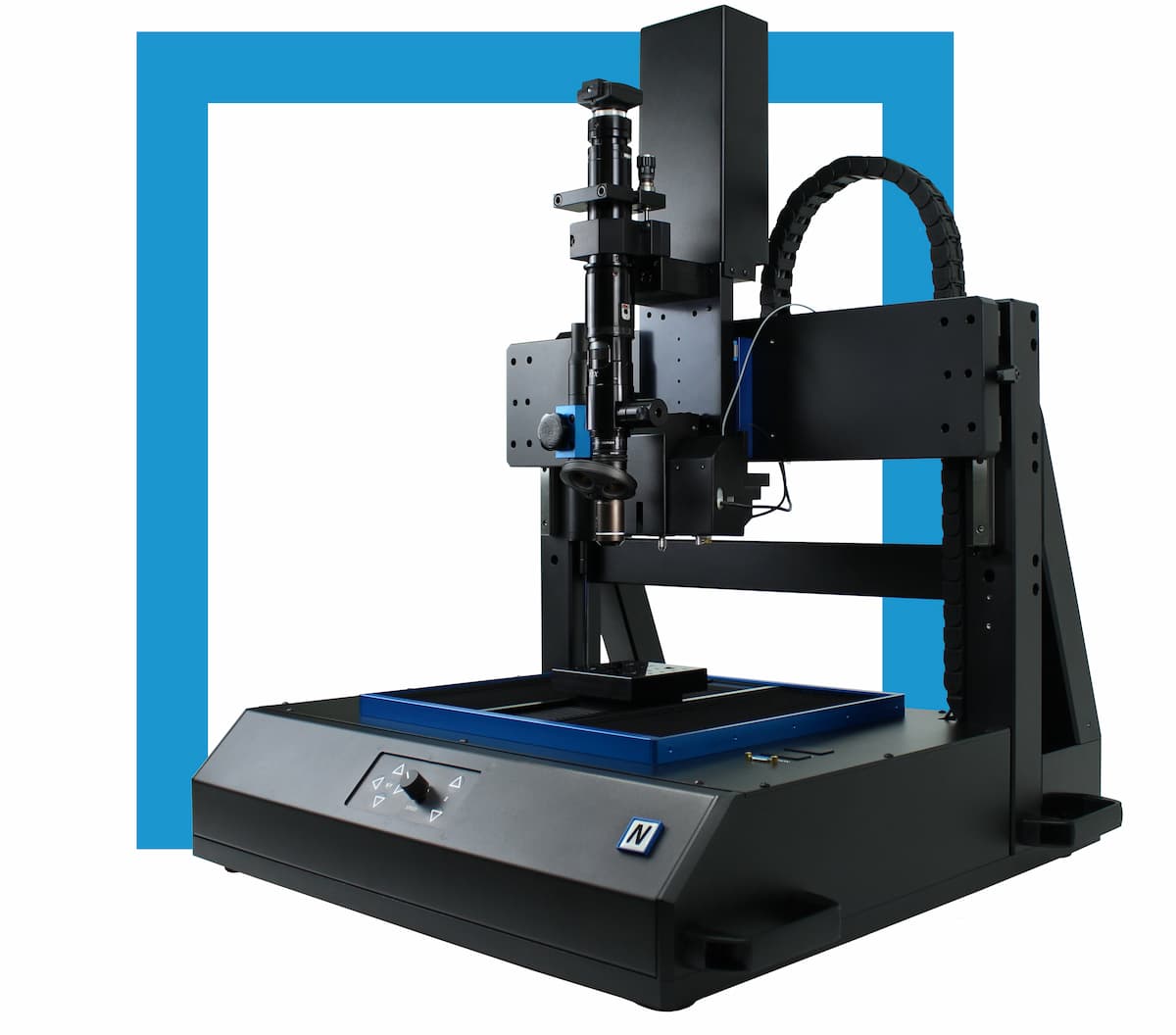
Nano scratch testing is performed using the 纳诺维亚 PB1000 机械测试仪, in Nano Scratch Mode, to evaluate the cohesive and adhesive strength of the polymer coating on the metal mesh of stent samples.
Controlled scratch measurements are carried out on stent geometries with dimensions comparable to a human hair, enabling precise evaluation of coating adhesion on complex stent structures.

NANOVEA PB1000 Advanced

机械测试仪

测试条件

1. Regular Stent Samples

The stent is fixed on the sample stage, with a support wire inserted inside the stent tube to ensure stability during nano scratch testing. The NANOVEA Mechanical Tester is used to perform nano scratch measurements using the parameters summarized in Table 1, to evaluate the cohesive and adhesive strength of the polymer coating on the metal substrate.

ParameterValue
Load type渐进的
Initial load0.05 mN
Final load300 and 100 mN
Sliding speed0.5 mm/min
Sliding distance0.5 mm
Indenter geometry锥形
Indenter material (tip)钻石
压头尖端半径20 µm
温度24°C (room)

表1: Test parameters for nano scratch measurements on regular stent samples

2. Grooved Stent Samples

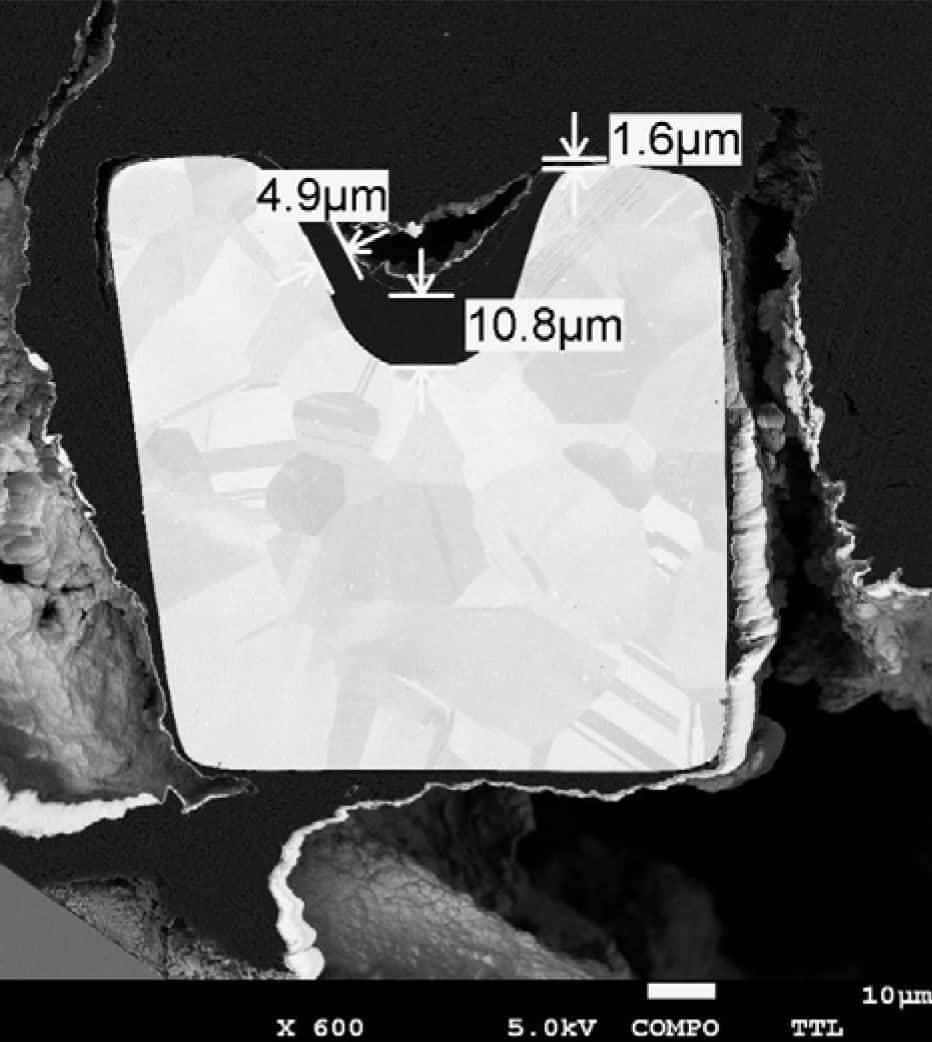
The SEM image in Fig. 1 shows the cross-section of the stent sample. The stent features a groove with a depth of approximately 30 µm. The polymer coating, with a thickness of 10.8 µm, is located at the bottom of the groove.

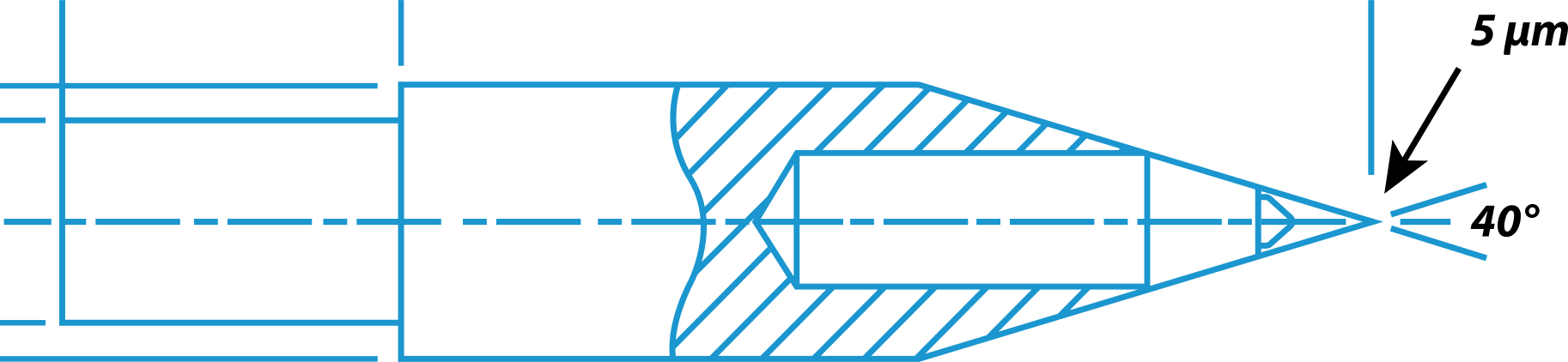
Standard 60° conical diamond tips are not sharp enough to reach the bottom of the groove without contacting the sidewalls. Therefore, a sharper 40° conical diamond tip is used in this study (Fig. 2).

Nano scratch measurements are performed using the parameters summarized in Table 2.

Parameter Value
Load type 渐进的
Initial load 0.1 mN
Final load 300 mN
装载率 300 mN/min
Scratch length 0.25 mm
Scratch speed 0.25 mm/min
Indenter geometry 40° cone
Indenter material (tip) 钻石
压头尖端半径 5 µm

Table 2: Test parameters for nano scratch measurements on grooved stent samples

stent groove cross section polymer coating thickness adhesion analysis nano scratch testing
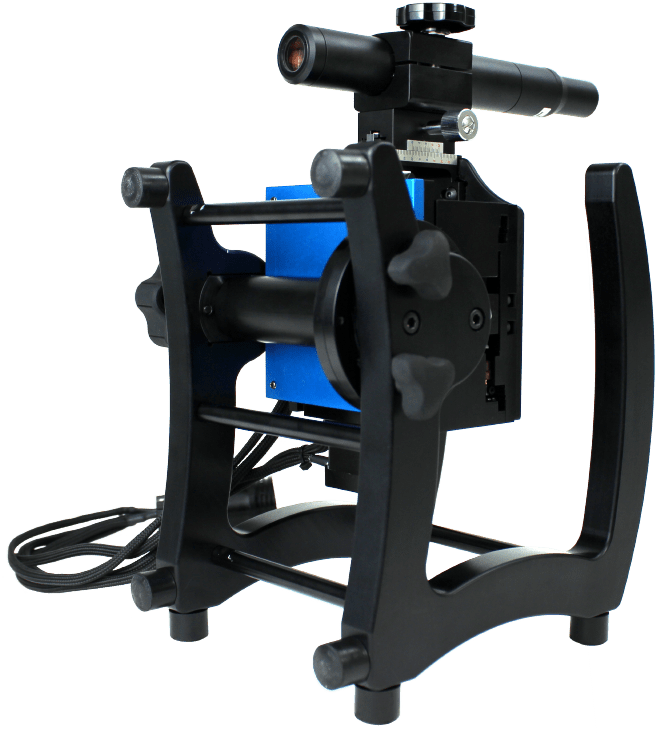
Fig. 1: SEM cross-section of a grooved stent showing polymer coating located at the bottom of the groove, highlighting the challenge of coating adhesion measurement in recessed geometries.

nano scratch diamond tip 40 degree stent groove coating adhesion testing schematic
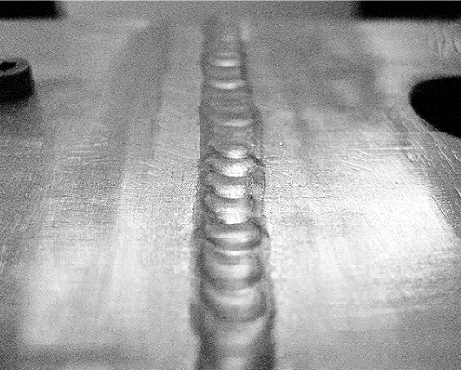
Fig. 2: Schematic of a 40° conical diamond tip designed for nano scratch testing inside stent grooves, enabling accurate adhesion measurement without sidewall interference.
结果和讨论

The stent mesh has a diameter of approximately 100 μm, comparable to a human hair. Precise positioning is therefore critical to ensure the scratch test is performed at the center of the stent mesh. The NANOVEA Mechanical Tester provides X–Y positioning accuracy down to 0.25 μm, enabling accurate test placement under the integrated optical microscope.

1. Regular Stent Samples

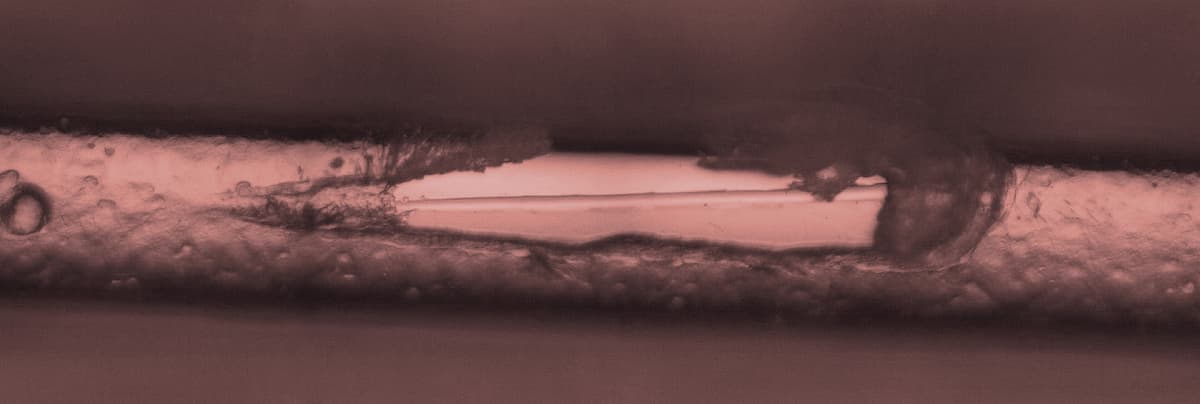
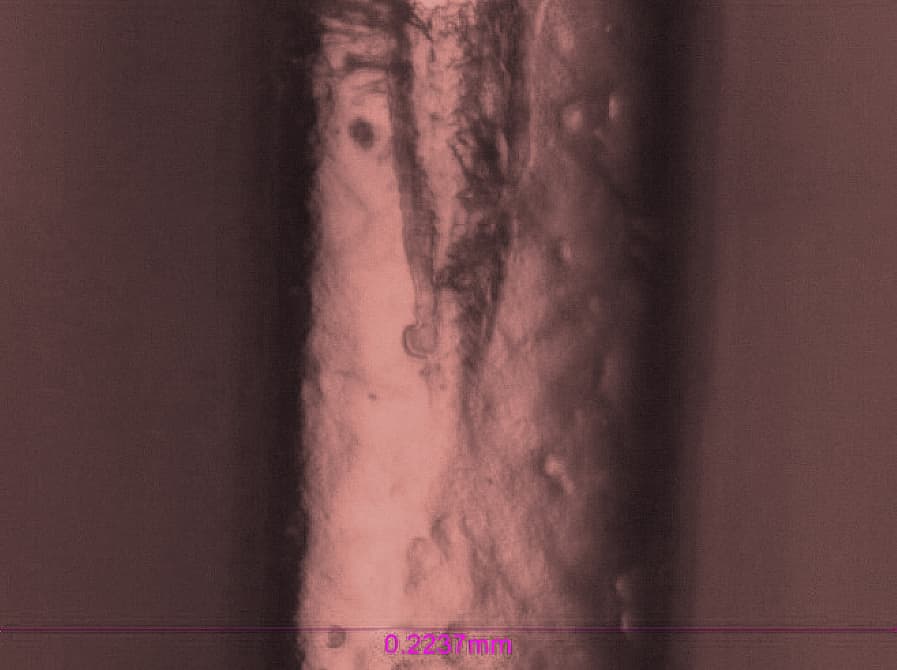
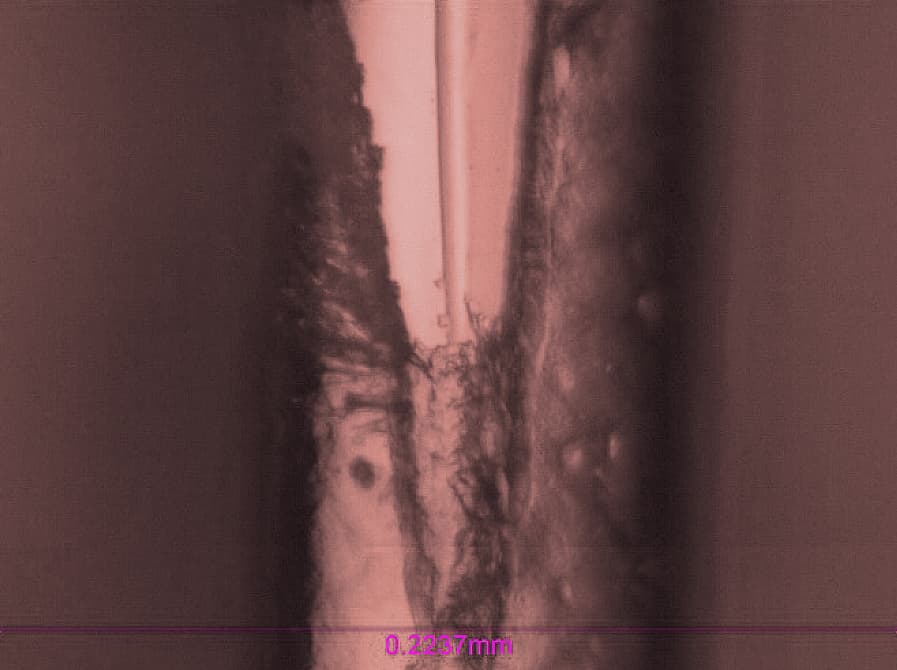
Nano scratch testing is performed with a progressively increasing load up to 300 mN. The full scratch track on the stent is shown in Fig. 3a, while failure behavior at different stages is presented in Fig. 3b and 3c.
Two critical loads are identified:

  • Lc1: the load at which the first visible damage appears on the coating
  • Lc2: the load at which the coating is fully removed and the substrate is exposed
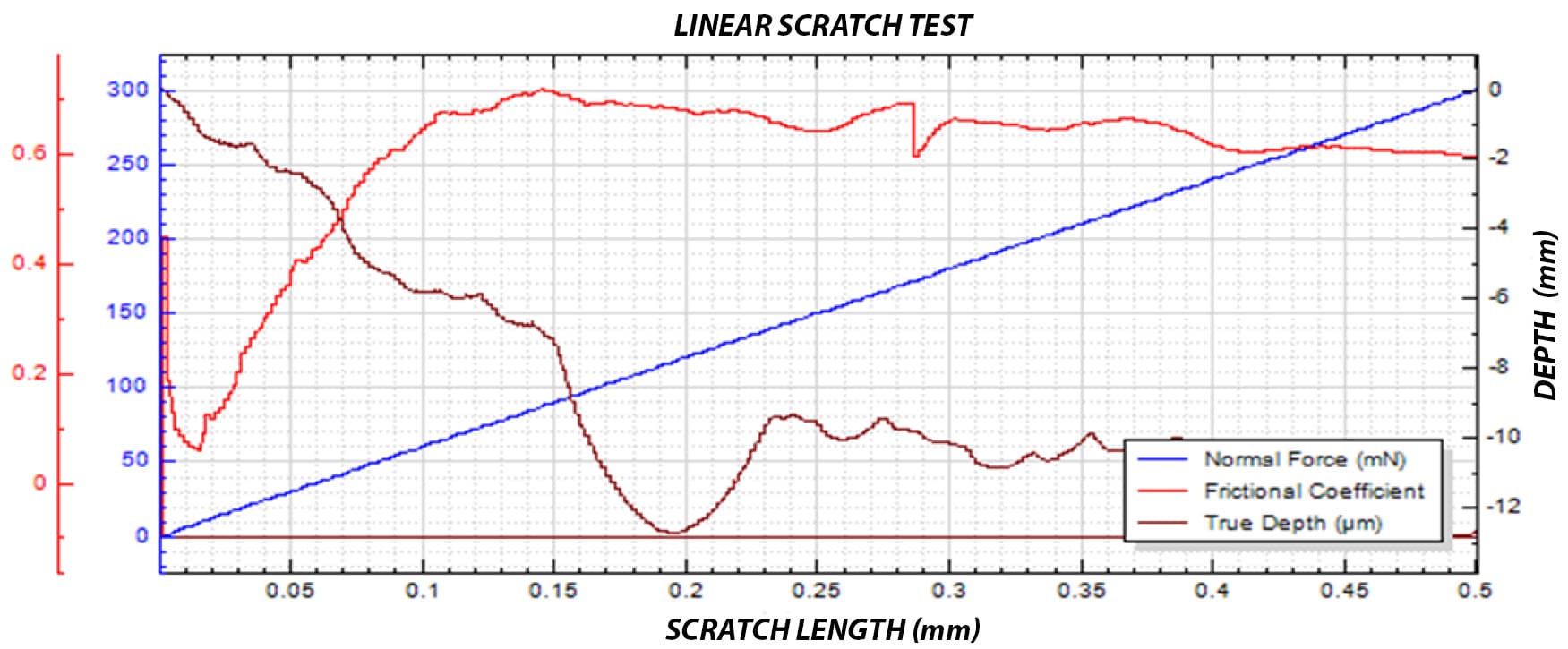
The evolution of coefficient of friction (COF) and penetration depth is shown in Fig. 4, providing insight into the progression of coating failure during the test.

The first signs of coating damage appear at Lc1 ≈ 14.5 mN. As the applied load increases, the diamond tip progressively penetrates the polymer coating, resulting in a wider and deeper scratch track. During this phase, the COF increases from approximately 0.05 to 0.7.

At Lc2 ≈ 78.1 mN, the coating is fully delaminated from the metal substrate. Beyond this point, as the load continues to increase, both COF and penetration depth remain relatively stable due to the mechanical support of the underlying metal substrate.

nano scratch track stent coating progressive load adhesion testing
(a) Full Scratch Track

(b) Lc1 ≈ 14.5 mN

stent coating delamination lc2 nano scratch 78.1 mN adhesion testing

(c) Lc2 ≈ 78.1 mN

Fig. 3: Nano scratch track on a stent coating under progressively increasing load, showing (a) full scratch path, (b) initial coating failure at Lc1 ≈ 14.5 mN, and (c) complete coating delamination at Lc2 ≈ 78.1 mN.

nano scratch testing stent coating coefficient of friction depth progression adhesion failure
Fig. 4: Evolution of coefficient of friction (COF) and penetration depth during nano scratch testing of a stent coating under progressively increasing load, showing the progression of coating failure and transition to substrate support.
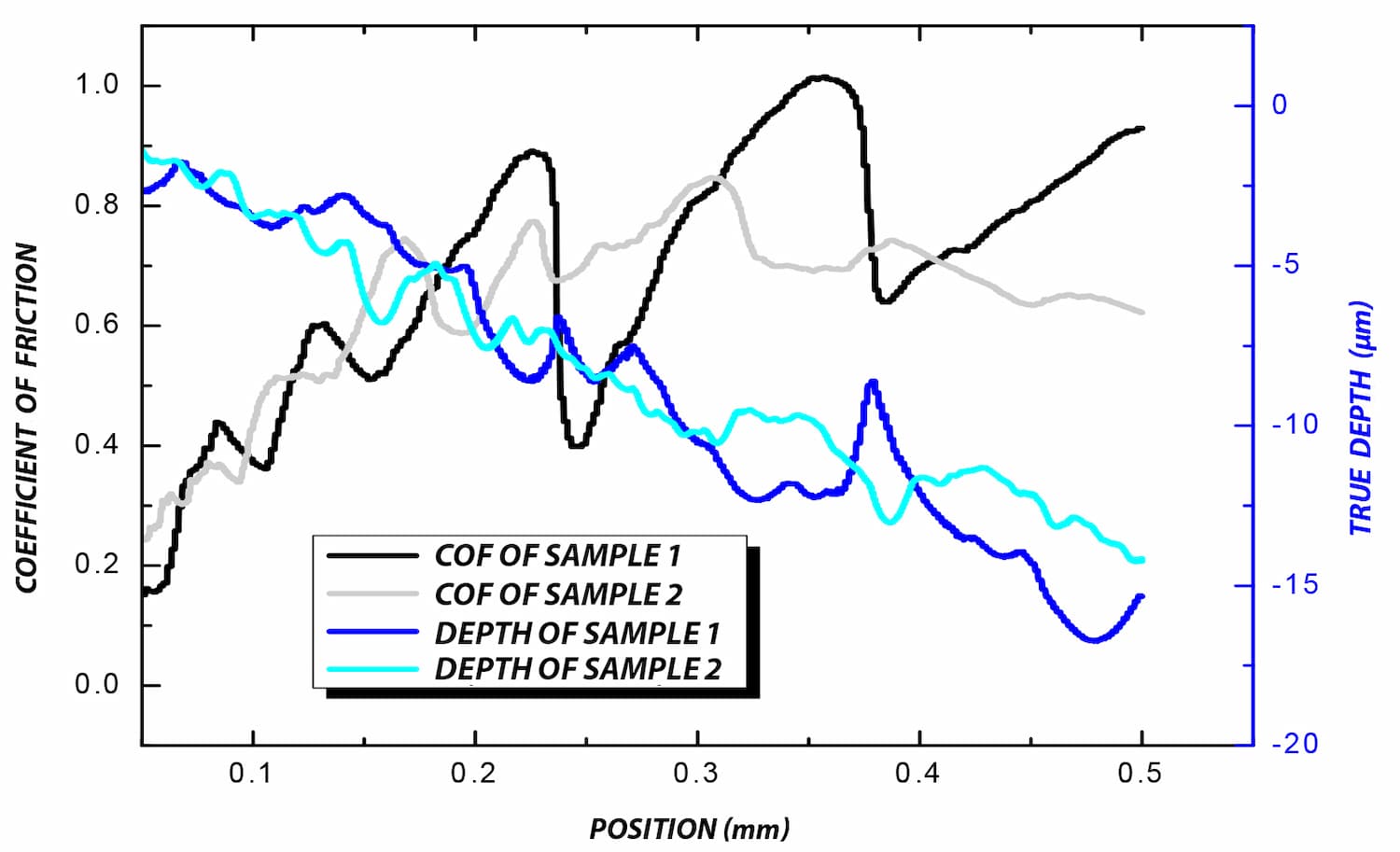
Failures during nano scratch testing up to a maximum load of 300 mN occur at critical loads below 100 mN. To enable a more quantitative comparison of coating performance, additional tests are performed with a maximum load of 100 mN on two stent samples, referred to as Sample 1 and Sample 2.

Fig. 5 compares the scratch tracks of Sample 1 and Sample 2 after nano scratch testing. Sample 1 exhibits the first sign of coating damage at a critical load of Lc1 ≈ 13.2 mN, while Sample 2 shows initial failure at a higher load of Lc1 ≈ 21.1 mN.

Coating delamination occurs at 62.5 mN for Sample 1. In contrast, the coating on Sample 2 remains intact throughout the test, continuing to protect the metal substrate under the same loading conditions.

This behavior is further reflected in the evolution of coefficient of friction (COF) and penetration depth, as shown in Fig. 6. When the diamond tip penetrates through the coating and contacts the metal substrate in Sample 1, the COF reaches a peak while the penetration depth decreases due to the increased stiffness of the underlying substrate.

stent coating sample 1 early failure nano scratch track delamination adhesion testing

(a) Sample 1 – Early Coating Failure

stent coating sample 2 high adhesion nano scratch track minimal damage testing

(b) Sample 2 – Improved Coating Integrity

Fig. 5: Comparison of nano scratch tracks for two stent coatings, showing (a) early coating failure and delamination in Sample 1, and (b) improved coating integrity in Sample 2 under the same loading conditions.

nano scratch testing stent coating COF depth comparison sample 1 sample 2 adhesion performance

Fig. 6: Comparison of coefficient of friction (COF) and penetration depth for Sample 1 and Sample 2 during nano scratch testing, showing earlier substrate contact and higher friction response in Sample 1, indicating weaker coating adhesion.

2. Grooved Stent Samples

As shown in Fig. 1 and Fig. 7, the grooved stent mesh has a diameter of approximately 90 μm, comparable to a human hair. The groove has a width of ~50 μm and a depth of 30 μm. This geometry presents a significant challenge for nano scratch testing, particularly for evaluating coating adhesion at the bottom of the groove.

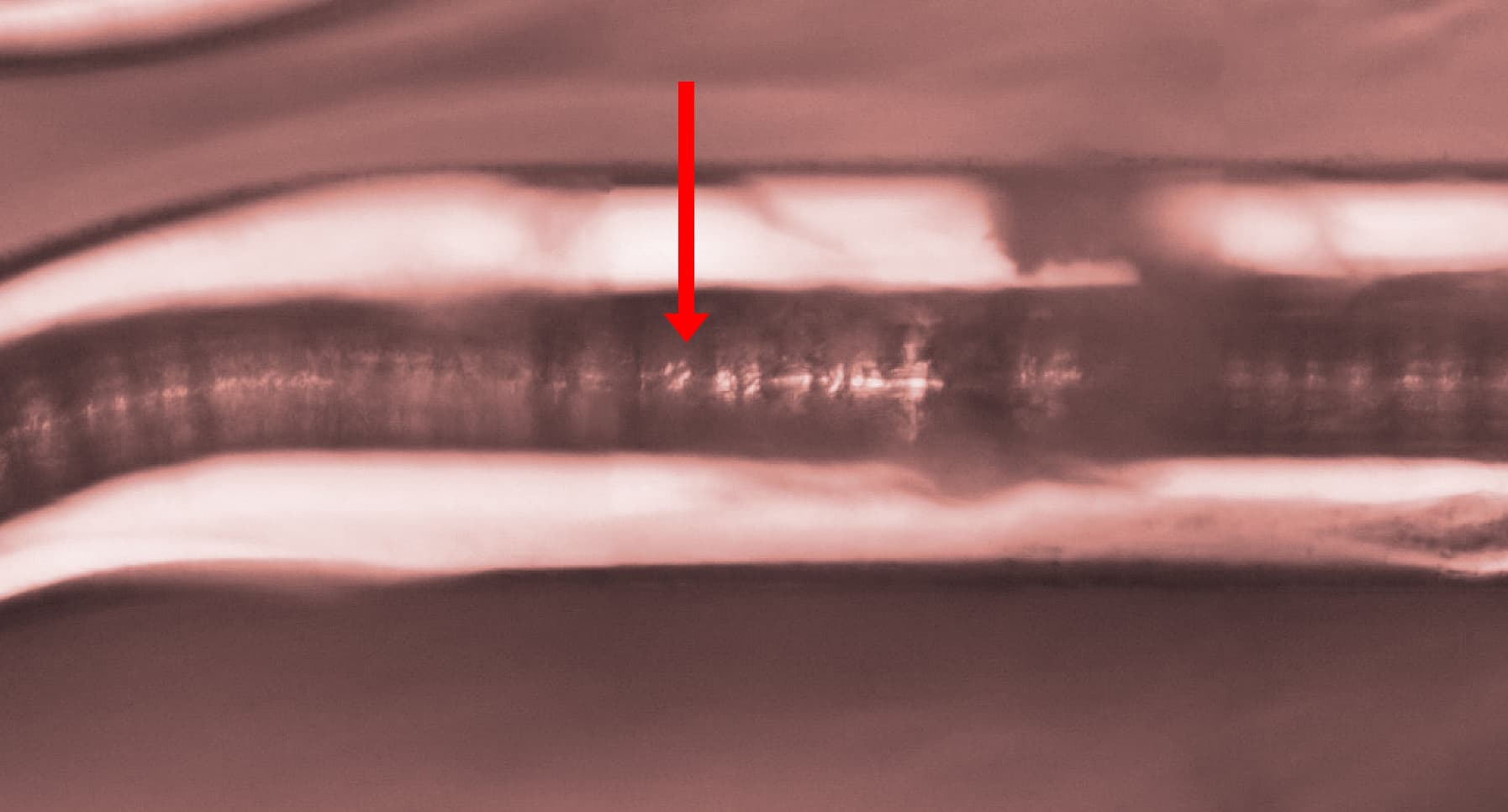
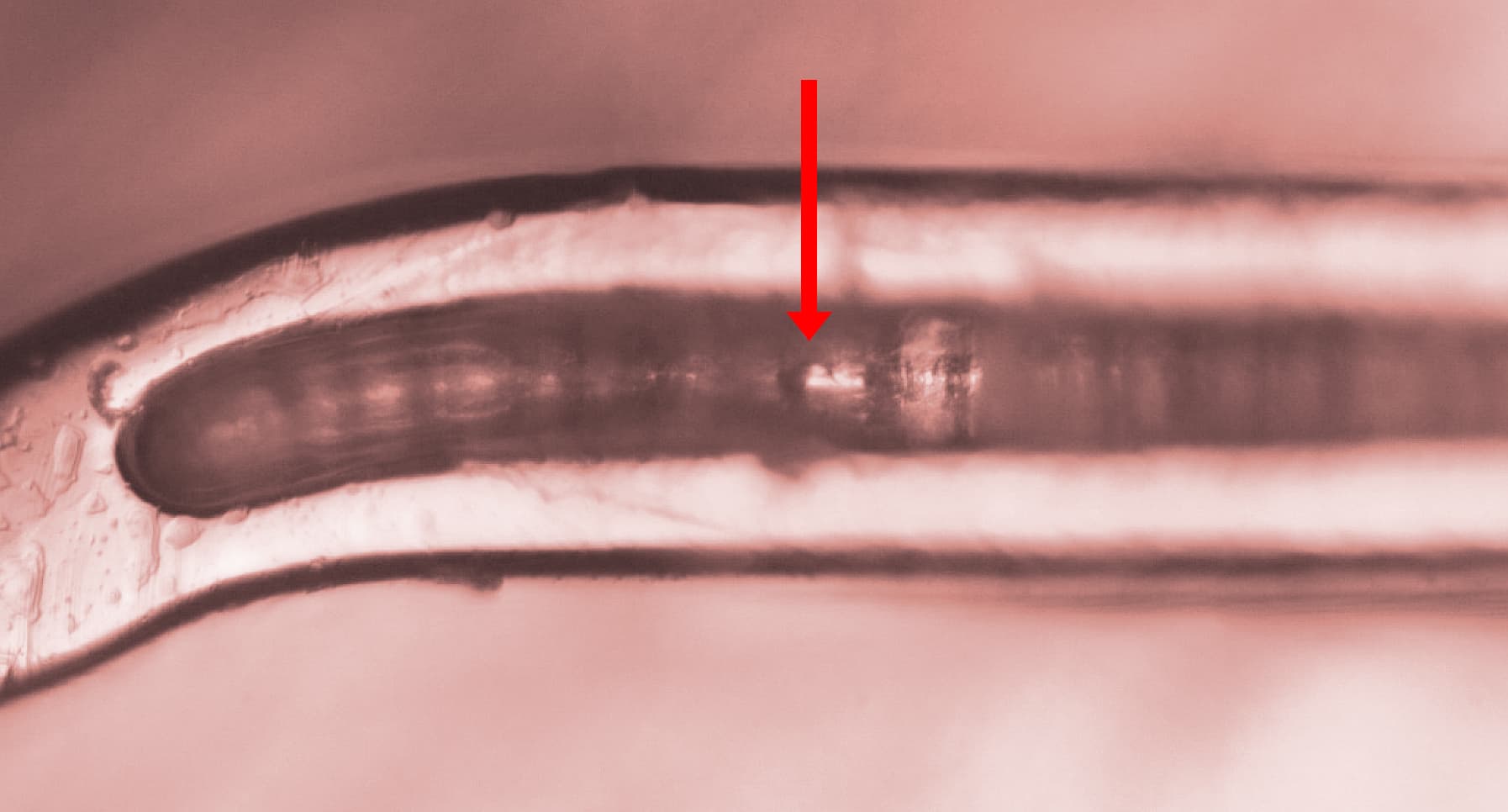
Precise positioning is critical to locate the scratch test within the groove. The nano scratch test is performed with a progressively increasing load up to 300 mN. The full scratch tracks of grooved stent Samples 3 and 4 are compared in Fig. 7.

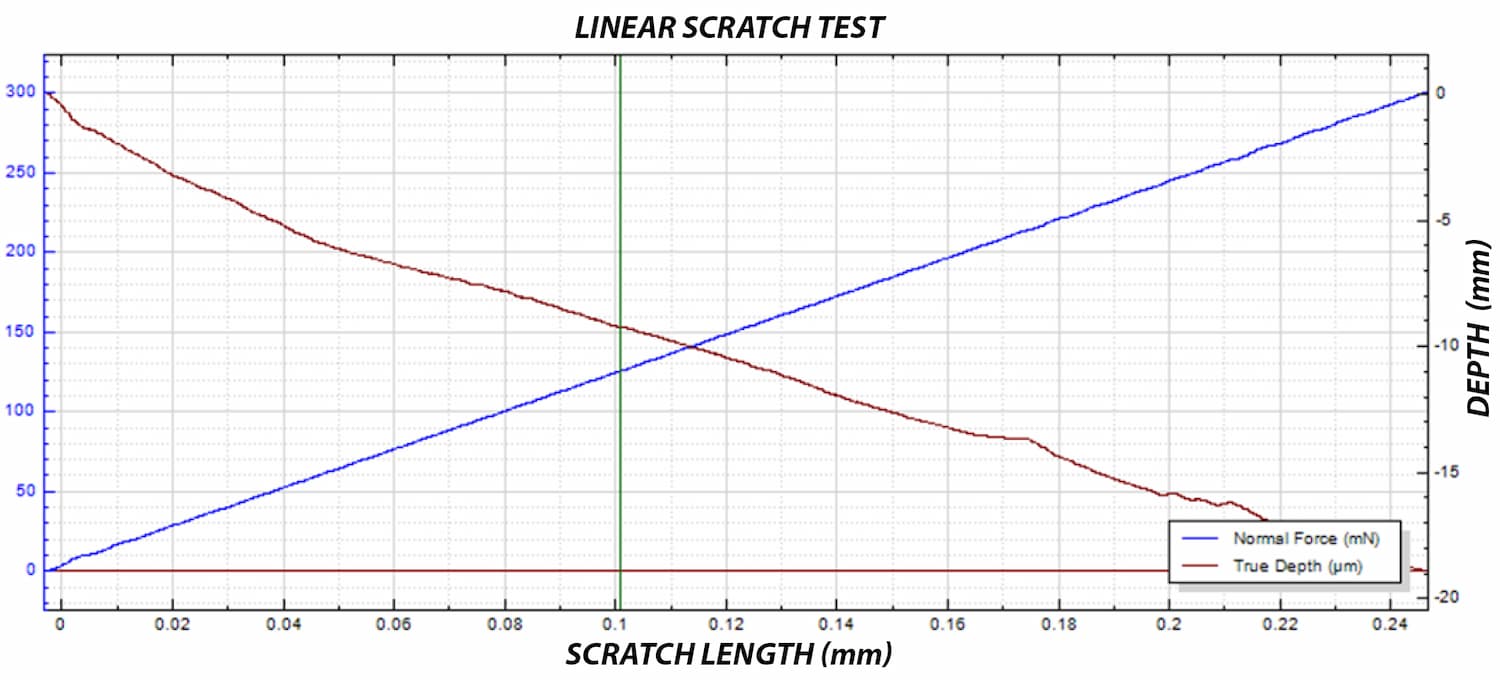
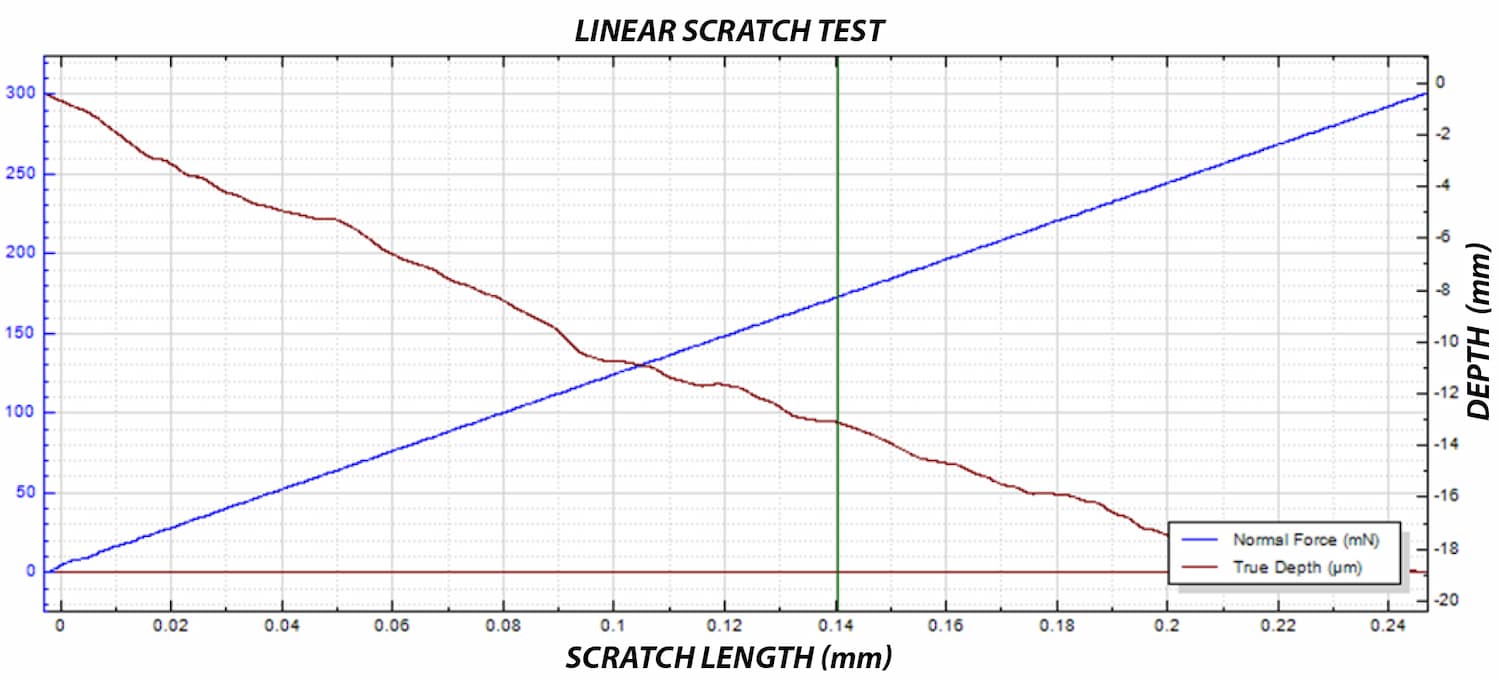
The critical load Lc is defined as the load at which the coating fails and the substrate becomes exposed. The evolution of normal load and penetration depth, shown in Fig. 8, provides further insight into the progression of coating failure during testing.

As the applied load increases, the diamond tip progressively penetrates the polymer coating, resulting in a deeper scratch track. When the critical load Lc is reached, the coating delaminates from the metal substrate.

Sample 3 exhibits coating failure at Lc ≈ 126 mN, while Sample 4 fails at a higher load of Lc ≈ 173 mN. This difference indicates stronger adhesion of the coating in Sample 4.

The measured critical loads enable quantitative comparison of coating adhesion performance. Under the same testing conditions, the coating on Sample 4 demonstrates higher resistance to delamination, making it the better-performing candidate in this study.

stent groove coating failure sample 3 nano scratch 126 mN adhesion testing

(c) Sample 3 – Coating Failure in Groove (Lc ≈ 126 mN)

stent groove coating adhesion sample 4 nano scratch 173 mN minimal failure testing

(d) Sample 4 – Higher Adhesion in Groove (Lc ≈ 173 mN)

Fig. 7: Nano scratch tracks inside stent grooves for Samples 3 and 4, showing (c) coating failure at Lc ≈ 126 mN in Sample 3 and (d) higher adhesion with delayed failure at Lc ≈ 173 mN in Sample 4.

(a) Sample 3 – Earlier Coating Failure (Lc ≈ 126 mN)

(b) Sample 4 – Delayed Failure and Higher Adhesion (Lc ≈ 173 mN)

Fig. 8: Evolution of normal load and penetration depth during nano scratch testing inside stent grooves for Samples 3 and 4, showing earlier coating failure in Sample 3 and delayed failure at higher load in Sample 4. The vertical green line indicates the critical load (Lc) where coating delamination occurs.

总结

This study demonstrates the ability of the NANOVEA Mechanical Tester to quantitatively evaluate the cohesive and adhesive strength of polymer coatings on both regular and grooved stent geometries using nano scratch testing.

The recessed geometry of the stent grooves, approximately 50 μm wide and 30 μm deep, presents a significant challenge for coating adhesion measurement. The high X–Y positioning accuracy of 0.25 μm enables precise placement of the scratch test within these confined regions, allowing direct evaluation of coating performance where failure is most critical.

By applying a controlled, progressively increasing load, critical loads associated with coating failure can be identified and compared across samples. This approach enables reliable differentiation of coating adhesion performance and interfacial integrity, even on small, complex stent structures.

参考文献

[I] http://www.nhlbi.nih.gov/health/health-topics/topics/stents
[II] http://www.scielo.org.mx/scielo.php?script=sci_arttext&pid=S1405-99402006000300008

Frequently Asked Questions About Stent Coating Adhesion Testing

What is stent coating adhesion testing?

Stent coating adhesion testing evaluates how strongly a polymer coating is bonded to the metal substrate of a stent. Techniques such as nano scratch testing quantify the load at which coating damage and delamination occur, providing measurable indicators of adhesion strength.

What is critical load (Lc) in nano scratch testing?

Critical load (Lc) is the applied load at which a coating fails during a scratch test.

  • Lc1 corresponds to the first visible damage in the coating
  • Lc2 indicates complete coating removal and exposure of the substrate

These values are used to quantify and compare coating adhesion performance.

Why is coating adhesion important in drug-eluting stents?

Coating adhesion directly affects the reliability of drug-eluting stents. Poor adhesion can lead to coating delamination, which may compromise controlled drug release and increase the risk of device failure.

How do you measure coating adhesion inside stent grooves?

Measuring adhesion inside stent grooves requires high positioning accuracy and appropriate indenter geometry. Nano scratch testing with sharp diamond tips allows access to recessed coating regions, enabling direct evaluation of adhesion within complex stent geometries.

What does coefficient of friction (COF) indicate in scratch testing?

The coefficient of friction (COF) reflects changes in surface interaction during the scratch test. A sudden increase in COF often indicates coating failure and contact between the indenter and the underlying metal substrate.

How can nano scratch testing compare different coating formulations?

Nano scratch testing enables direct comparison of coatings by measuring critical loads under controlled conditions. Higher critical loads indicate stronger adhesion and improved resistance to delamination, allowing selection of better-performing coating systems.

Dentist holding dental model for tooth surface roughness analysis and 3D reconstruction

Dental Surface Roughness Measurement & 3D Tooth Topography

Application Note | Dental Surface Characterization

Dental Surface Roughness Measurement and Full 3D Tooth Topography

Surface Roughness Analysis Using Non-Contact Optical Profilometry

Dental surface roughness measurement and 3D molar reconstruction using optical profilometry

编写者

Walter Alabiso, PhD; Davide Morrone, MPhys; Andrew Shore, MA

简介

The ability to accurately characterize tooth surfaces, including micro-roughness and 3D surface topography at the nanometer scale, enables advanced research and applications in orthodontics and dental materials science. Non-contact optical profilometry provides a precise method for measuring dental surface roughness and analyzing tooth surface morphology without damaging delicate structures. These measurements support the development of composite dental materials that replicate the natural surface roughness of enamel, as well as the design and fabrication of patient-specific dental casts and restorative components.

Low surface roughness plays a primary role in limiting bacterial adhesion and plaque formation, thereby reducing the risk of cavities. An increase in average roughness (Ra) above 2 µm leads to a steep increase in biofilm formation in vivo.¹ An Ra of 0.2 µm is considered the threshold value below which no further reduction in bacterial adhesion can be expected.²

Reconstruction of the tooth’s 3D surface topography enables the fabrication of dental casts, which are essential for accurate diagnosis, treatment planning, and the fabrication of dental appliances.

Non-Contact Optical Profilometry for Dental Surface Analysis

The present study illustrates the potential of NANOVEA’s high-precision non-contact optical profilometers for dental surface roughness measurement and 3D tooth topography analysis. Chromatic Light technology offers significant advantages over classical touch probe techniques. It acquires data points from deep crevices and complex geometries without introducing measurement errors or artifacts caused by local plastic deformation and without requiring extensive data manipulation.

Compared to focus variation systems, single-point optical sensing provides superior lateral and height accuracy, with X/Y resolution below 0.5 µm, maximum vertical resolution of 1.9 nm, and the ability to measure surface angles up to 87°. The technique is effective on transparent, opaque, specular, diffusive, polished, and rough dental surfaces, making it well suited for comprehensive dental surface characterization.

Measurement Method

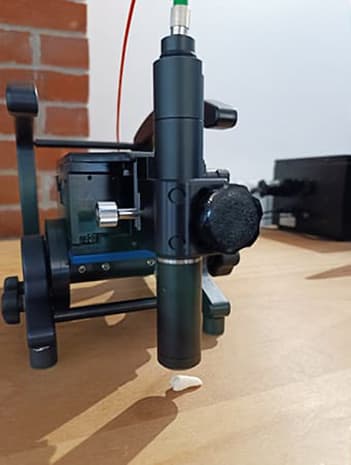
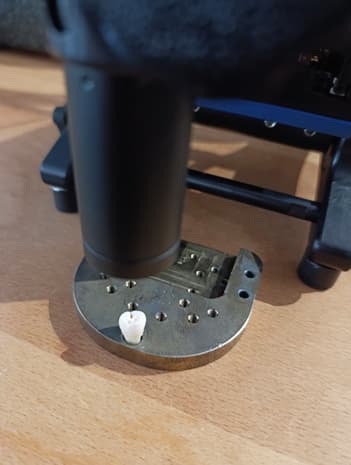
在这个应用中, NANOVEA JR25 Non-Contact Optical Profiler was used to analyze the surface roughness and 3D surface topography of an adult human molar previously affected by tooth decay. The side of the tooth was scanned using a PS2–MG140 single-point optical sensor to measure surface roughness parameters over a defined region of interest and along multiple line profiles.

The crown of the tooth was then scanned and reconstructed using a PS5–MG35 single-point optical sensor, which is suited for larger-area acquisition and full 3D tooth topography measurement.


NANOVEA JR25 Portable
光学轮廓仪

Surface Measurement Using NANOVEA Optical Profilometer

Surface roughness measurements were performed on the lateral side of the molar crown, followed by full 3D reconstruction of the crown surface. Separate single-point optical sensors were used to optimize measurement accuracy for both localized roughness analysis and large-area surface topography acquisition.

PS2 – MG140

Surface roughness analysis by area and parallel line profiles on the side of the tooth’s crown.

PS5 – MG35

Full 3D surface reconstruction of the tooth’s crown.

测量参数

The following measurement parameters were used for localized surface roughness analysis and full 3D surface reconstruction of the molar crown using NANOVEA single-point optical sensors.

ParameterRoughness Analysis (Area)Roughness Analysis (Profiles)Full 3D Reconstruction
Optical PenPS2-MG140PS2-MG140PS5-MG35
Z-Range [µm]30030010000
X-Distance [mm]2.003.007.50
X-Step Size [µm]1.701.7010.00
Y-Distance [mm]2.001.007.00
Y-Step Size [µm]1.70100.0010.00
Average (Avg)111
Measurement TypeDirectDirectDirect
Acquisition ModeSingle FrequencySingle FrequencyDouble Frequency
Acquisition Rate [Hz]200200100–400
Light Intensity [%]100100100

Optical Profilometry Results

Surface Roughness Analysis (Area)

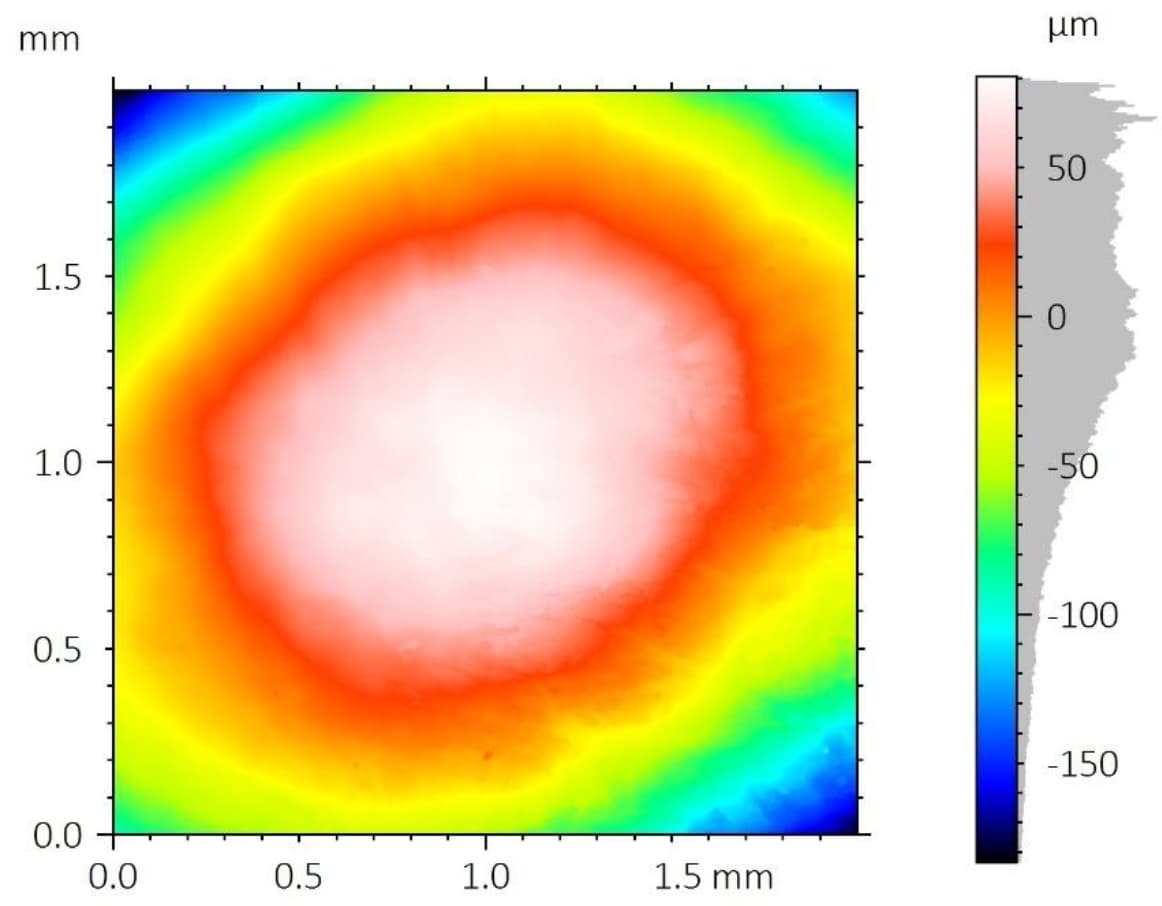
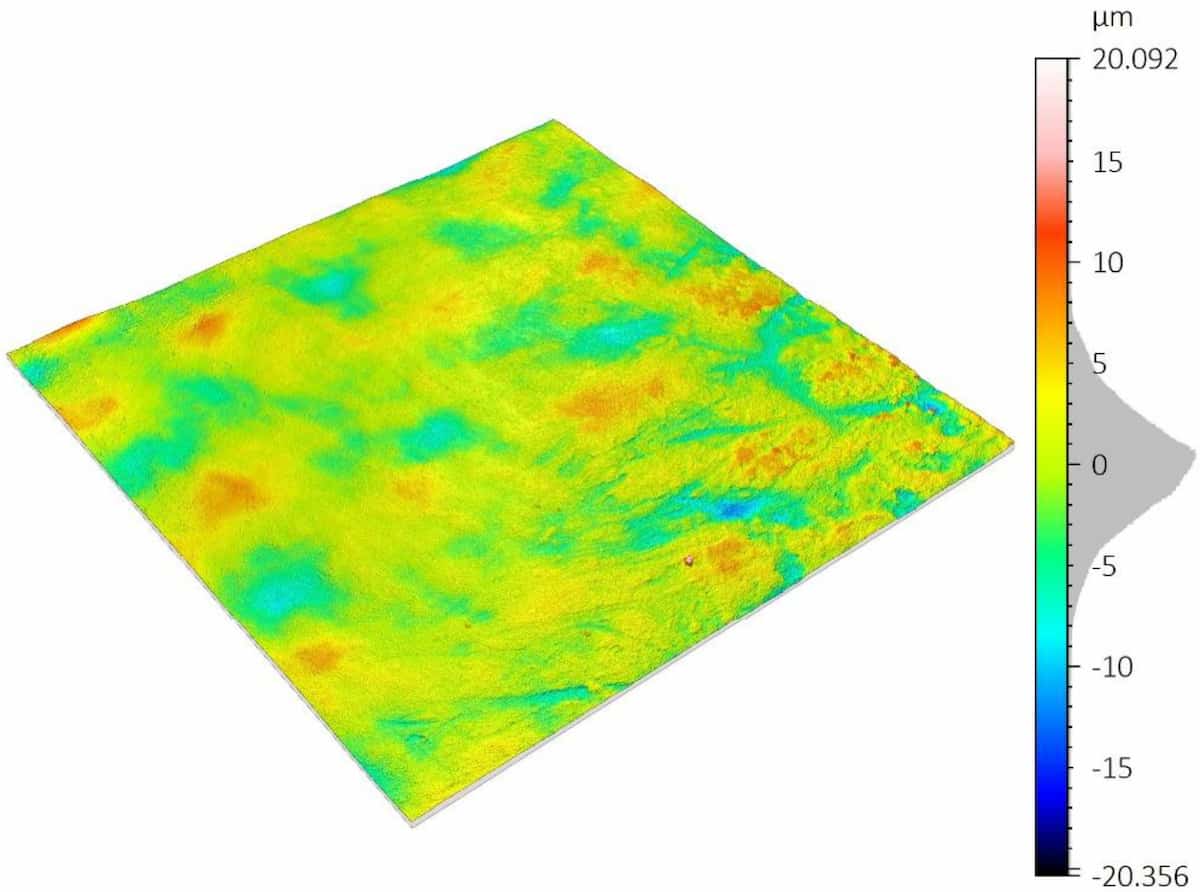
The PS2 single-point optical sensor was used to investigate fine surface features on the side of the tooth. The image below shows a false-color 2D surface map of the scanned region obtained by non-contact optical profilometry.

False-color 2D height map of scanned tooth surface region

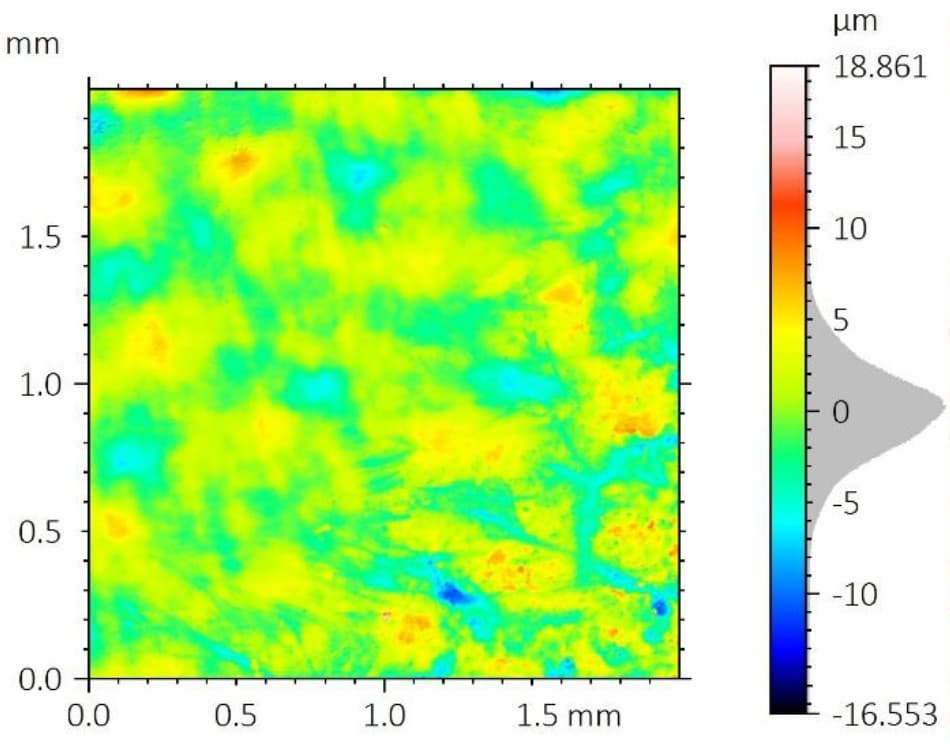
A least-squares degree-8 polynomial form removal was applied to isolate the surface roughness component. The roughness filters S-Gaussian 2.5 µm and L-Gaussian 0.8 mm were then applied according to ISO 25178. The resulting filtered surface and corresponding roughness parameters are presented below.

ISO 25178 – Roughness (S-L)
S-filter (λs): Gaussian, 2.5 µm
F: [Workflow] Form removed (LS-poly 8)
L-filter (λc): Gaussian, 0.8 mm
Height Parameters
规模2.433µm均方根高度
スクリート-0.102 倾斜度
价格3.715 峰度
ǞǞǞ18.861µm最大峰高
ǞǞǞ16.553µmMaximum pit depth
35.414µm最大高度
1.888µm算术平均身高

The average surface roughness Sa is 1.888 µm, while the peak-to-valley height Sz reaches 35.414 µm.

A 3D surface rendering of the filtered area is shown below for visualization.

3D rendering of ISO 25178 filtered tooth surface roughness

Roughness Analysis (Profiles)

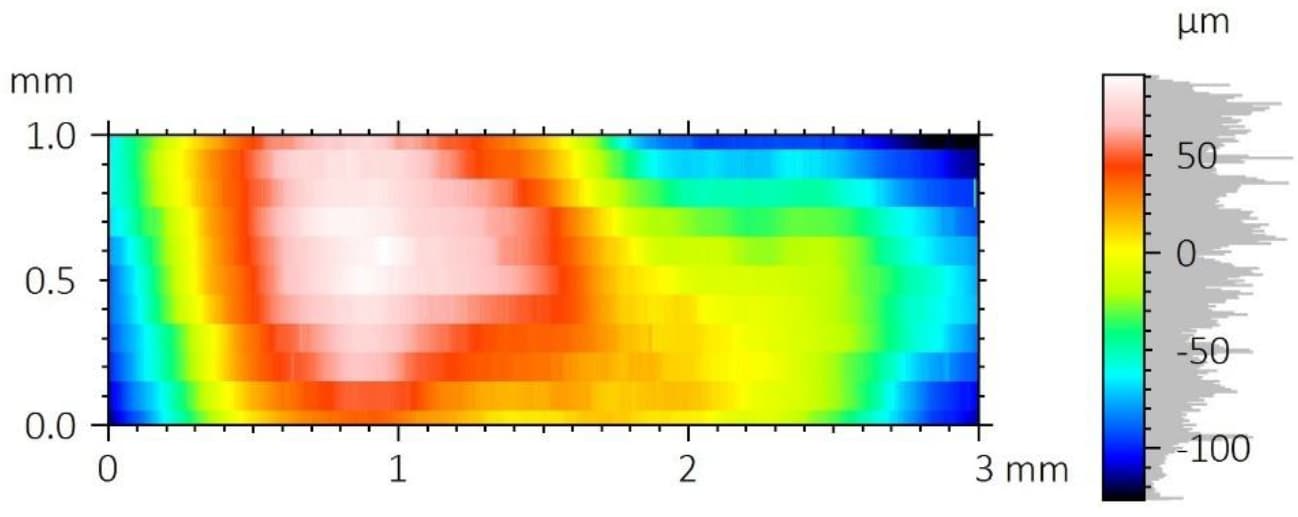
Surface roughness profiles were measured using a series of 11 parallel line scans along the X direction on the side of the tooth. The false-color 2D surface map of the raw scan is shown below.

False-color 2D raw scan of tooth surface for line roughness profiles

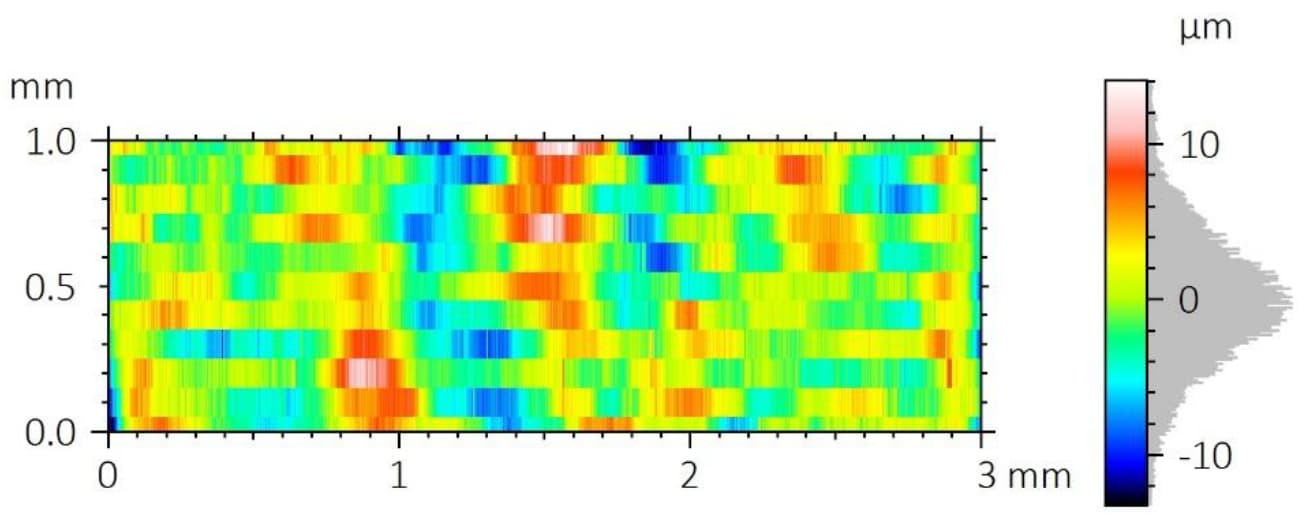
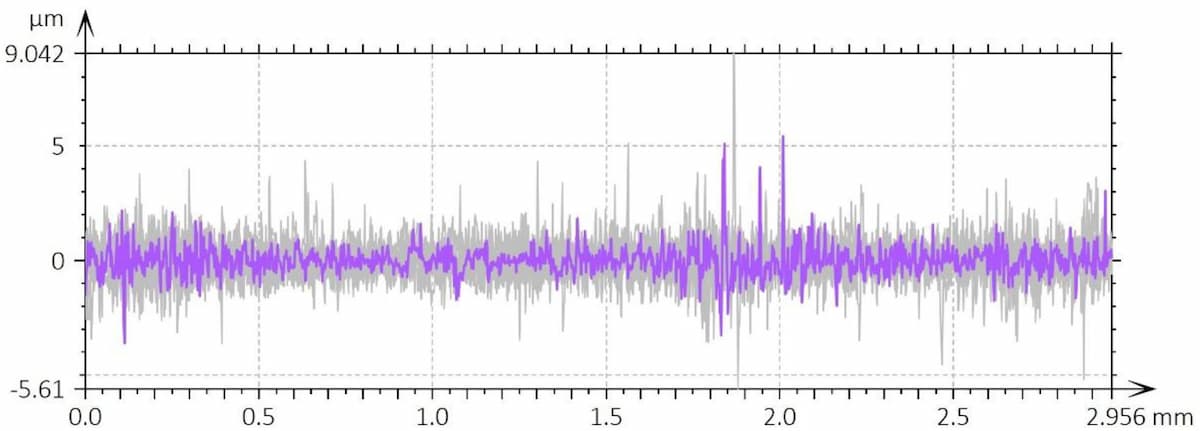
The surface form was removed using a least-squares 8-degree polynomial prior to applying the metrological filters, leaving the residual surface shown below.

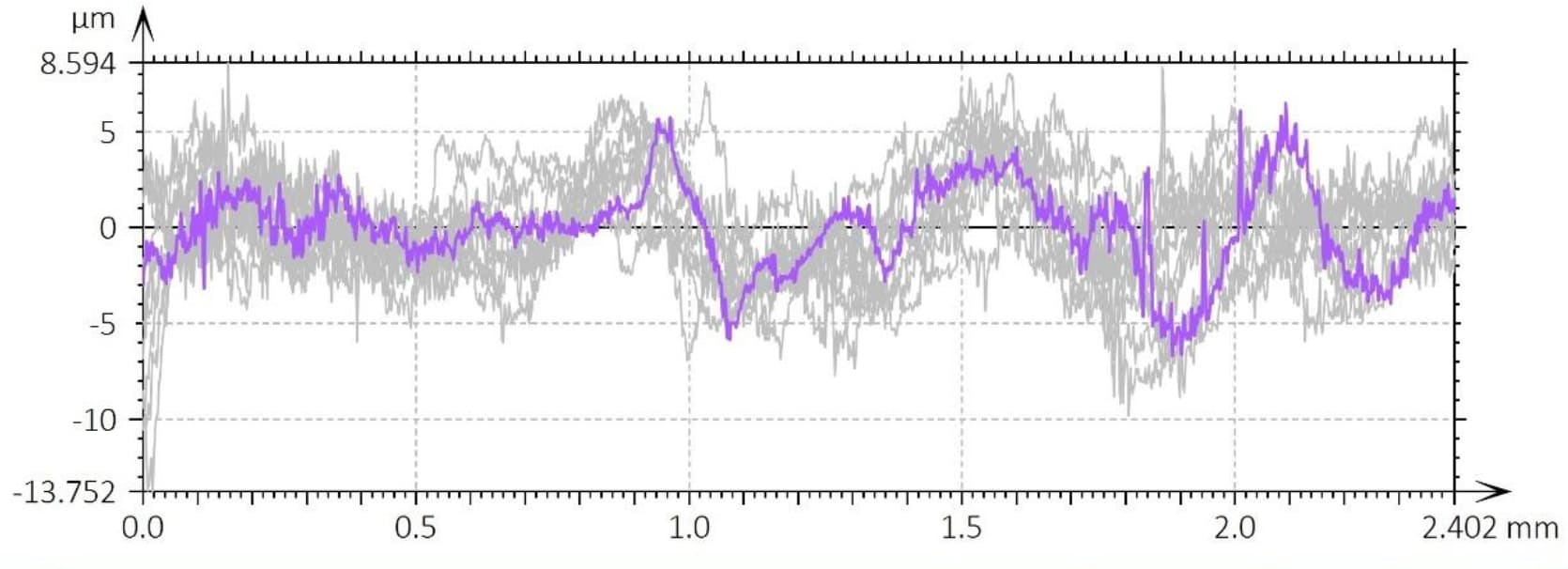
A statistical analysis of the measured surface roughness profiles reveals the following line roughness parameters.

Overlay of multiple tooth surface roughness profiles for statistical analysis

ISO 4287 – Roughness (S-L)
F:
S-filter (λs): Gaussian, 2.5 µm
L-filter (λc): Gaussian, 0.8 mm
Evaluation length: All λc (3)
Amplitude Parameters – Roughness Profile
  DescriptionMeanStd devMinMax
RpµmMaximum peak height of the roughness profile5.6830.7614.3156.610
RvµmMaximum valley depth of the roughness profile6.2421.0094.7018.438
RzµmMaximum height of roughness profile11.9251.6769.12315.048
RaµmArithmetic mean deviation of the roughness profile2.0630.2971.7102.629
RqµmRoot-mean-square (RMS) deviation of the roughness profile2.5230.3612.0573.175

ISO 4287 – Roughness (S-L)
F:
S-filter (λs): Gaussian, 2.5 µm
L-filter (λc): Gaussian, 0.8 mm
Evaluation length: All λc (3)
Amplitude Parameters – Roughness Profile
Rpµm
Maximum peak height of the roughness profile
Mean5.683
Std dev0.761
Min4.315
Max6.610
Rvµm
Maximum valley depth of the roughness profile
Mean6.242
Std dev1.009
Min4.701
Max8.438
Rzµm
Maximum height of roughness profile
Mean11.925
Std dev1.676
Min9.123
Max15.048
Raµm
Arithmetic mean deviation of the roughness profile
Mean2.063
Std dev0.297
Min1.710
Max2.629
Rqµm
Root-mean-square (RMS) deviation of the roughness profile
Mean2.523
Std dev0.361
Min2.057
Max3.175

The value of Ra is consistent with the Sa value extracted from the surface area measurement.

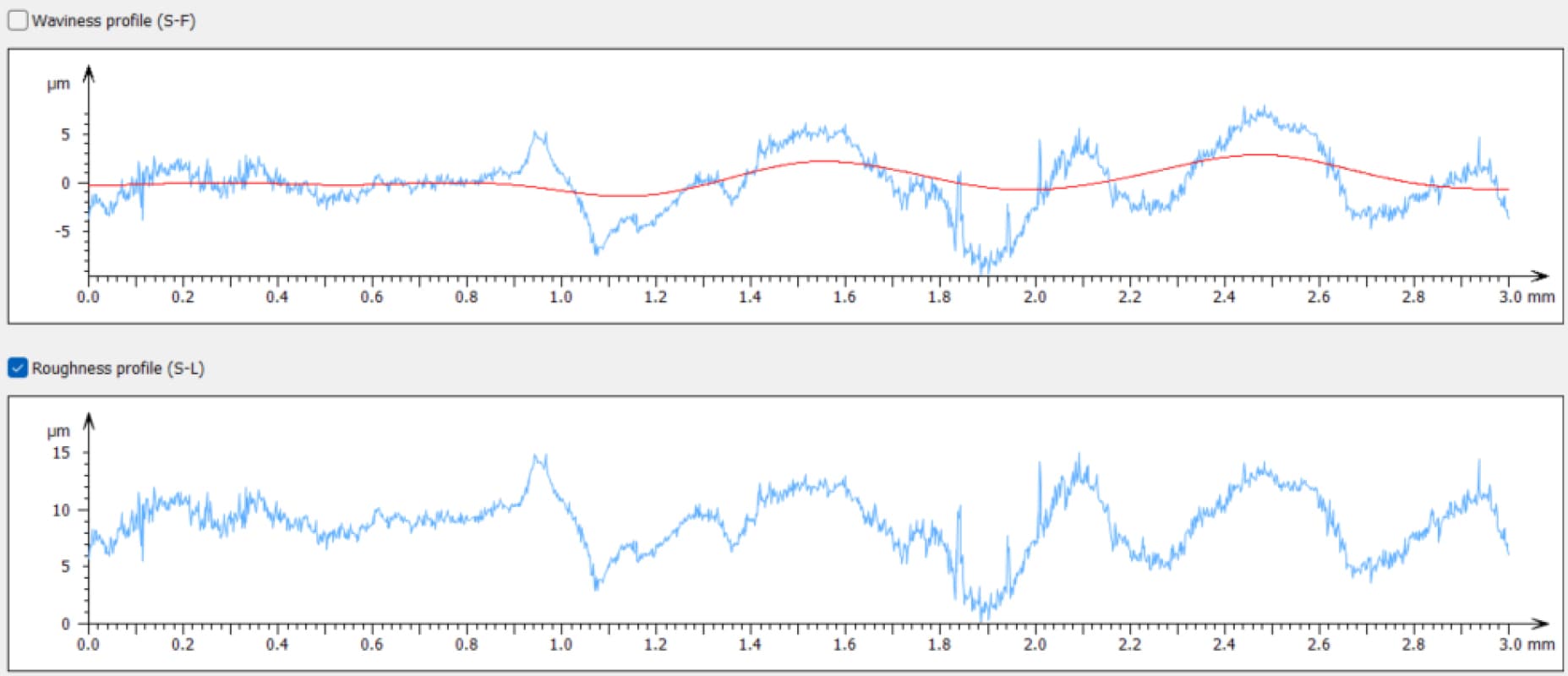
Different metrological filters can be applied to distinguish between macroscopic waviness and microscopic surface roughness. For example, a coarser filter cut-off, such as the 8 mm cut-off used with the Robust Gaussian order-2 filter, produces a smoother waviness profile (red) that is less sensitive to sharp local variations and follows the original surface profile more loosely.

Comparison of waviness and roughness profiles on tooth surface using coarse filter

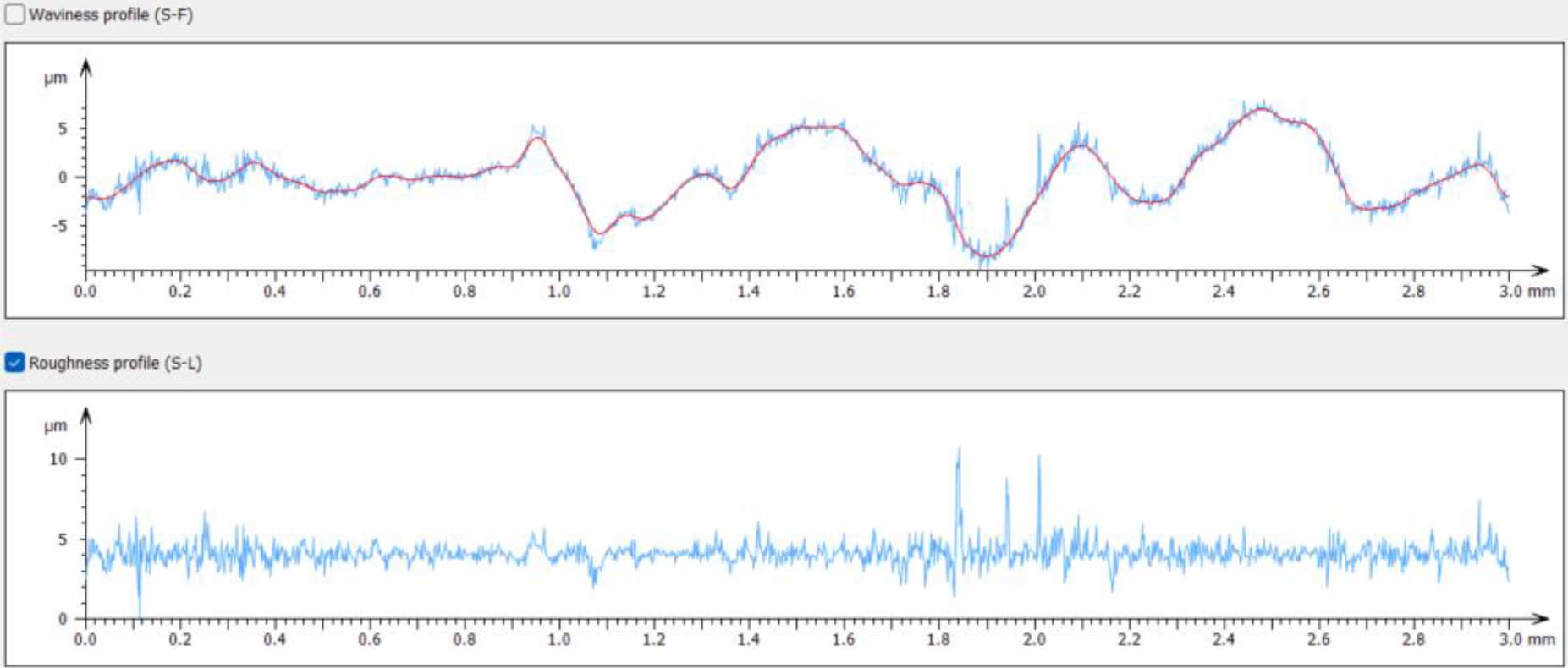
Alternatively, a finer cut-off (e.g., 0.08 mm) enables the analysis of micro-roughness by removing the waviness component that follows the original profile at a larger scale, leaving the finer surface roughness features of the tooth visible.

The microroughness analysis obtained using a 0.08 mm L-Gaussian filter is presented below.

Final microroughness profile of tooth surface after filtering

ISO 4287 – Roughness (S-L)
F:
S-filter (λs): Gaussian, 2.5 µm
L-filter (λc): Gaussian, 0.08 mm
Evaluation length: All λc (37)
Amplitude Parameters – Roughness Profile
  DescriptionMeanStd devMinMax
RpµmMaximum peak height of the roughness profile1.5820.1221.3421.748
RvµmMaximum valley depth of the roughness profile1.4660.1191.2541.661
RzµmMaximum height of roughness profile3.0490.1962.8203.409
RaµmArithmetic mean deviation of the roughness profile0.4950.0470.4230.597
RqµmRoot-mean-square (RMS) deviation of the roughness profile0.6430.0560.5620.762

ISO 4287 – Roughness (S-L)
F:
S-filter (λs): Gaussian, 2.5 µm
L-filter (λc): Gaussian, 0.8 mm
Evaluation length: All λc (3)
Amplitude Parameters – Roughness Profile
Rpµm
Maximum peak height of the roughness profile
Mean5.683
Std dev0.761
Min4.315
Max6.610
Rvµm
Maximum valley depth of the roughness profile
Mean6.242
Std dev1.009
Min4.701
Max8.438
Rzµm
Maximum height of roughness profile
Mean11.925
Std dev1.676
Min9.123
Max15.048
Raµm
Arithmetic mean deviation of the roughness profile
Mean2.063
Std dev0.297
Min1.710
Max2.629
Rqµm
Root-mean-square (RMS) deviation of the roughness profile
Mean2.523
Std dev0.361
Min2.057
Max3.175

Full 3D Tooth Surface Topography Reconstruction

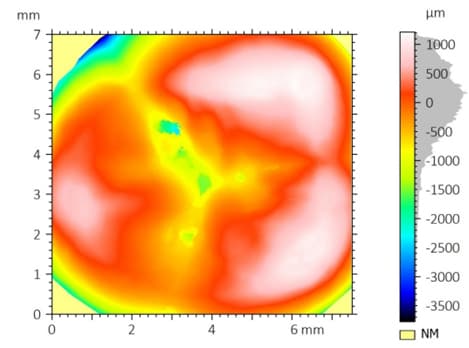
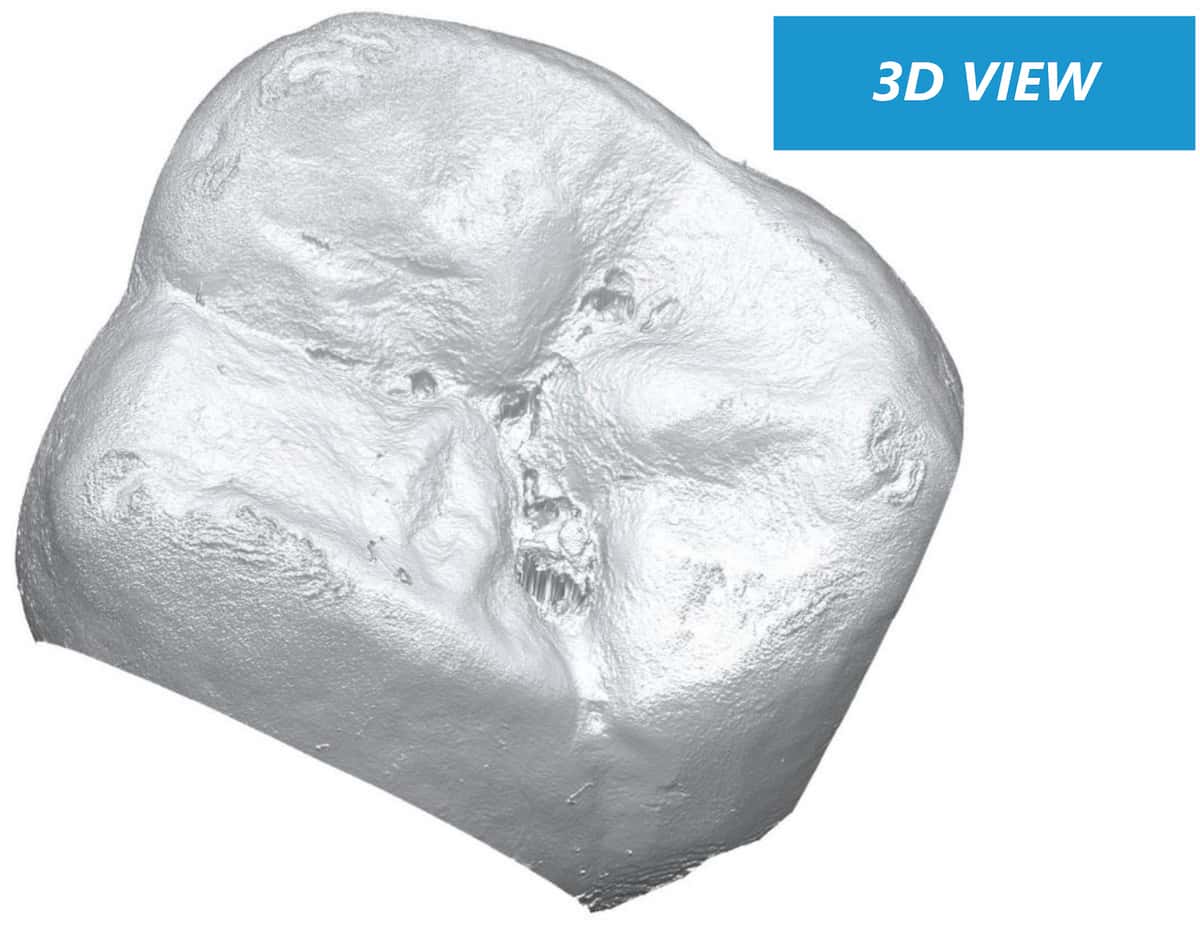
The extended Z-scan range of the PS5 optical sensor enables high-fidelity scanning of the entire tooth crown surface. The resulting 3D surface topography is shown below.

False-color surface topography map of full tooth crown measured with optical profilometer

2D VIEW: 2D surface map of the tooth crown measured with optical profilometry

3D surface reconstruction of molar crown from optical profilometer scan

3D VIEW: High-fidelity 3D rendering of the molar crown surface obtained with optical profilometry

总结

In this application, the NANOVEA JR25 Non-Contact Optical Profiler was used to measure the surface roughness and 3D surface topography of an adult human molar.

Both the area scan and the line profile analysis revealed a roughness Rq of approximately 2.5 µm and an Ra of about 1.9–2.0 µm. These values are consistent with results reported in the literature.³ The use of a narrower L-Gaussian filter with an 80 µm cut-off enabled further investigation of micro-roughness, revealing an Rq of 0.643 µm and an Ra of 0.495 µm.

The full 3D surface topography of the molar crown was reconstructed with high fidelity. The high measurement resolution allows detection of fine surface features and crevices. The resulting surface data can be easily processed and exported as STL files, enabling the design and fabrication of customized dental devices and restorative components.

参考文献

[1] Shin, B.W., et al. Surface Roughness of Prefabricated Pediatric Zirconia Crowns Following Simulated Toothbrushing. Pediatric Dentistry 44.5 (2022): 363–367.
[2] Bollen, C.M.L., Paul Lambrechts, and Marc Quirynen. Comparison of surface roughness of oral hard materials to the threshold surface roughness for bacterial plaque retention: A review of the literature. Dental Materials 13.4 (1997): 258–269.
[3] Suputtamongkol, K., et al. Surface roughness resulting from wear of lithia-disilicate-based posterior crowns. Wear 269.3–4 (2010): 317–322.

Frequently Asked Questions About Dental Surface Roughness Measurement

What is dental surface roughness measurement?

Dental surface roughness measurement quantifies the microscopic texture of tooth surfaces using parameters such as Ra, Rq, and Sa. Optical profilometers measure these features without contacting the surface, allowing accurate analysis of enamel, restorative materials, and dental crowns.

Why use optical profilometry to measure tooth roughness?

Optical profilometry provides non-contact surface measurement with nanometer-scale vertical resolution. It captures 2D surface maps and full 3D surface topography of dental structures without damaging soft or polished surfaces.

What roughness parameters are used for dental surface analysis?

Common roughness parameters include Ra (arithmetic mean roughness), Rq (root mean square roughness), Sa (areal roughness), and Sz (maximum surface height). These parameters help evaluate enamel wear, plaque adhesion risk, and the performance of restorative materials.

Why is surface roughness important in dentistry?

Surface roughness affects plaque retention, wear resistance, and the long-term performance of dental restorations. Controlling micro-roughness can reduce bacterial adhesion and improve the durability of dental materials.

Need Reliable Surface Roughness Measurement for Dental Materials?

便携式三维轮廓仪测量焊缝表面

焊接表面检查

使用便携式三维轮廓仪

编写者

CRAIG LEISING

简介

对于通常通过目视检查完成的特定焊缝,以极高的精度进行调查可能变得至关重要。焊缝精确分析包括表面裂纹、孔隙和未填充的凹坑。焊缝特征,如尺寸/形状、体积、粗糙度、尺寸等,都可以进行测量,都是焊缝评估的关键参数。

3D非接触式轮廓仪在焊接表面检测中的重要性

与接触式探针或干涉测量等其他技术不同,NANOVEA 3D 非接触式轮廓仪使用轴向色差,几乎可以测量任何表面,由于开放式分级,样品尺寸可能变化很大,并且不需要样品制备。在表面轮廓测量过程中获得从纳米到宏观的范围,样品反射率或吸收的影响为零,具有测量高表面角度的先进能力,并且无需软件对结果进行操作。轻松测量任何材料:透明、不透明、镜面、漫射、抛光、粗糙等。NANOVEA 便携式轮廓仪的 2D 和 2D 功能使其成为实验室和现场全面焊接表面检测的理想仪器。

测量目标

在这个应用中,NANOVEA JR25便携式轮廓仪被用来测量焊缝的表面粗糙度、形状和体积,以及周围区域。这些信息可以提供关键的信息,以正确评估焊接和焊接过程的质量。

NANOVEA

JR25

测试结果

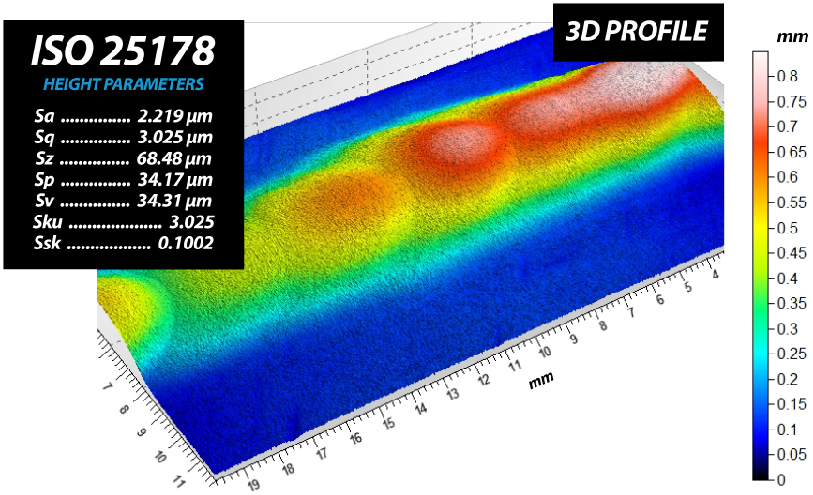
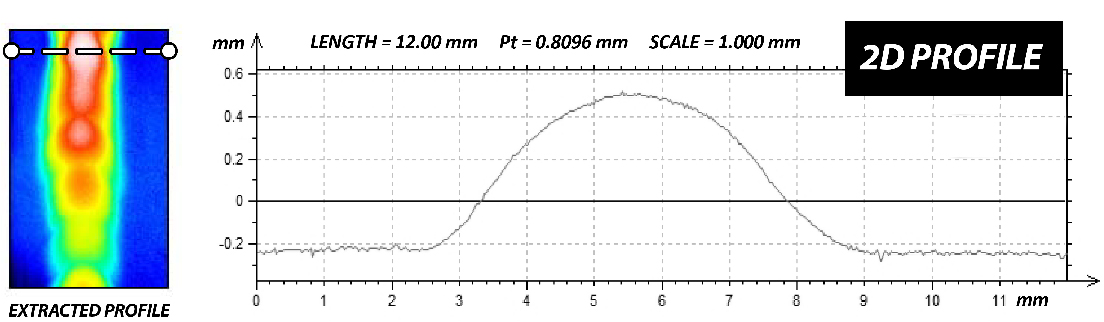
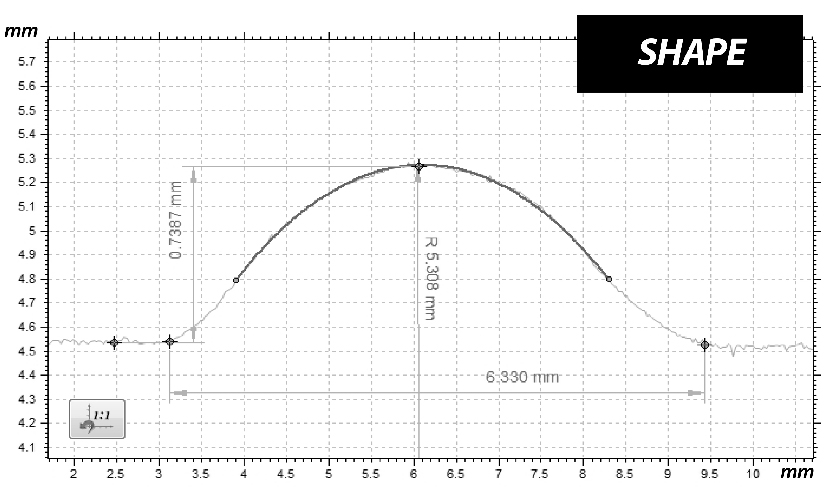
下面的图片显示了焊缝和周围区域的完整的三维视图,以及只显示焊缝的表面参数。下面显示的是二维截面剖面图。

样本

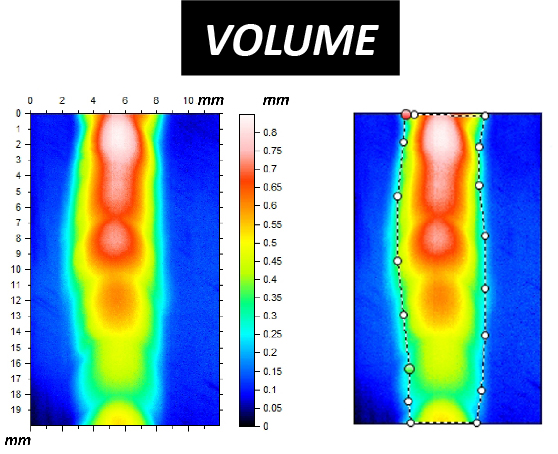
从三维图中提取二维剖面,焊缝的尺寸信息计算如下。下面只计算焊缝的表面积和材料的体积。

 洞口PEAK
表面1.01毫米214.0毫米2
体积8.799e-5 mm323.27毫米3
最大深度/高度0.0276毫米0.6195毫米
平均深度/高度 0.004024毫米 0.2298毫米

结论

在这个应用中,我们展示了NANOVEA 3D非接触式轮廓仪如何精确地表征焊缝和周围表面区域的关键特性。从粗糙度、尺寸和体积,可以确定质量和可重复性的定量方法,或进一步研究。样品焊缝,如本应用说明中的例子,可以很容易地进行分析,用标准的台式或便携式NANOVEA轮廓仪进行内部或现场测试。

使用三维轮廓仪分析断裂样品

裂缝分析

使用三维轮廓仪测量

编写者

CRAIG LEISING

简介

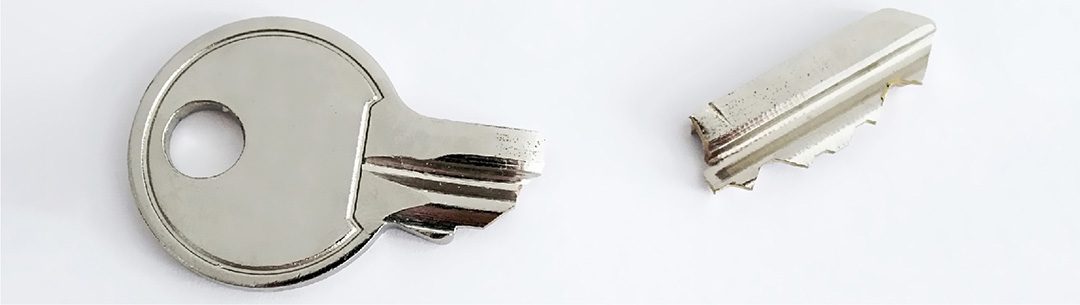
断口分析是对断裂表面特征的研究,历史上一直通过显微镜或 SEM 进行研究。根据特征的大小,选择显微镜(宏观特征)或SEM(纳米和微观特征)进行表面分析。两者最终都可以识别断裂机制类型。尽管有效,但显微镜具有明显的局限性,并且在大多数情况下,除了原子级分析之外,SEM 对于断裂表面测量来说是不切实际的,并且缺乏更广泛的使用能力。随着光学测量技术的进步,NANOVEA 3D 非接触式轮廓仪 现在被认为是首选仪器,能够通过宏观尺度 2D 和 3D 表面测量提供纳米级测量

3D非接触式轮廓仪在断裂检测中的重要性

与SEM不同,3D非接触式轮廓仪几乎可以测量任何表面和样品尺寸,只需最少的样品准备,同时提供优于SEM的垂直/水平尺寸。使用轮廓仪,从纳米到宏观范围的特征都可以在一次测量中捕捉到,而样品反射率的影响为零。可以轻松地测量任何材料:透明的、不透明的、镜面的、扩散的、抛光的、粗糙的等等。三维非接触式轮廓仪提供了广泛和用户友好的能力,以SEM的一小部分成本,最大限度地提高表面断裂研究。

测量目标

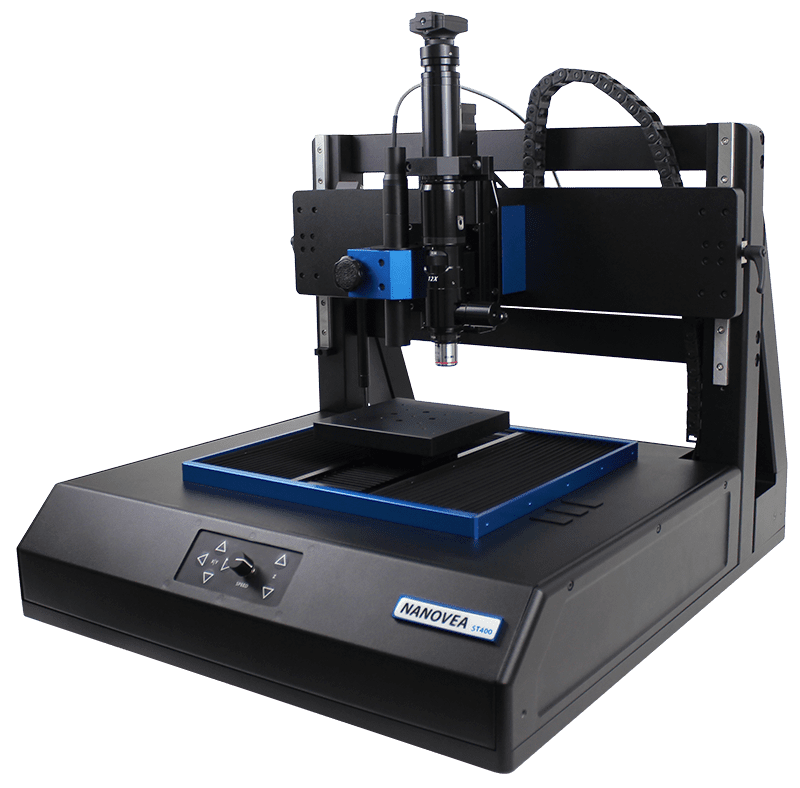
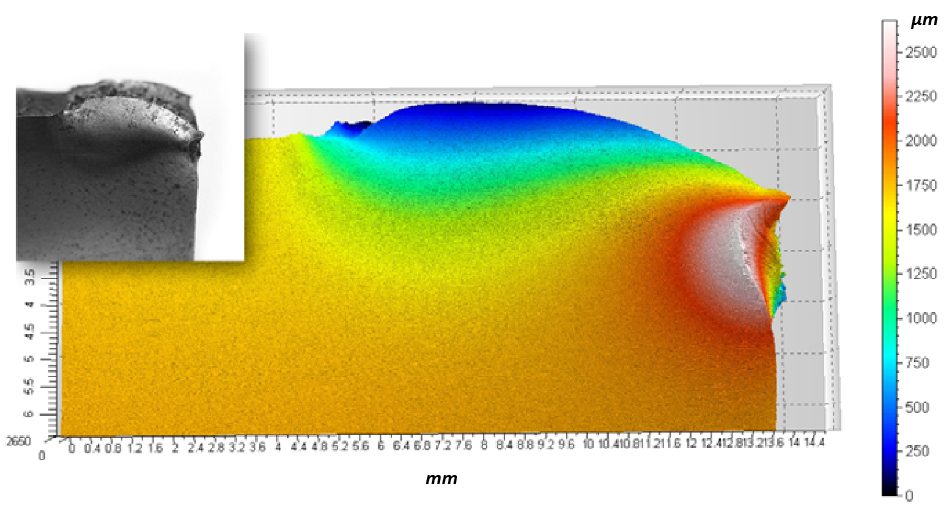
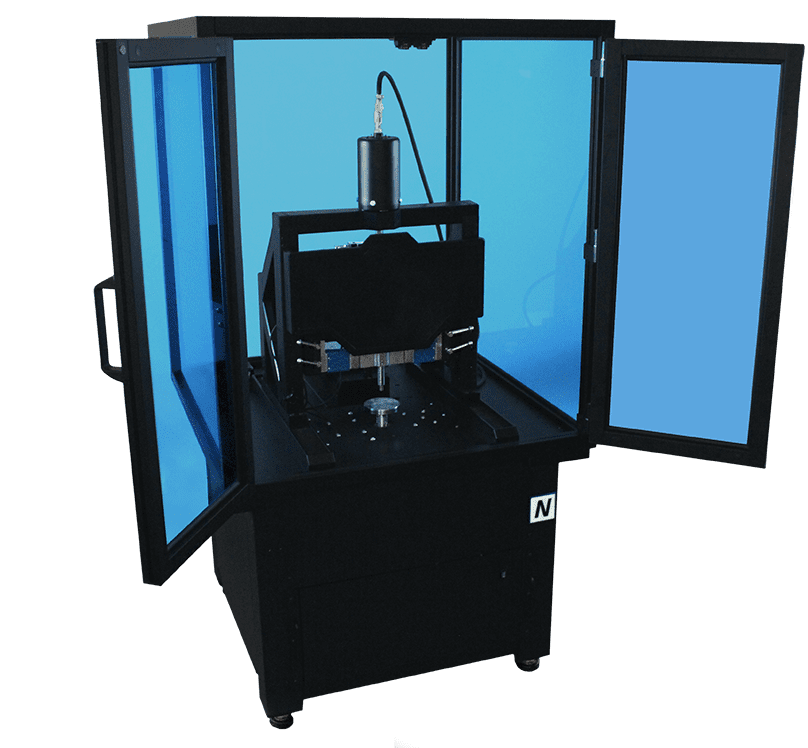
在这个应用中,NANOVEA ST400被用来测量一个钢铁样品的断裂表面。在这项研究中,我们将展示表面的三维区域、二维轮廓提取和表面方向图。

NANOVEA

ST400

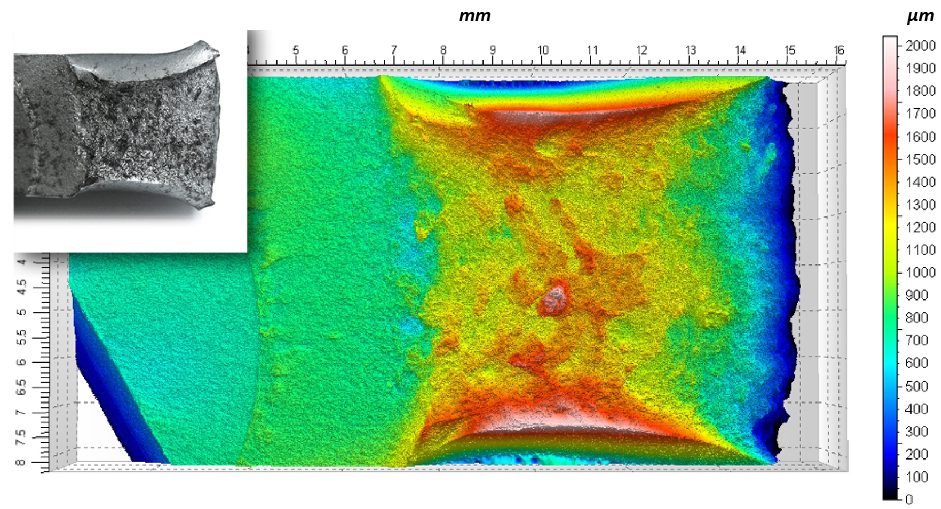
结果

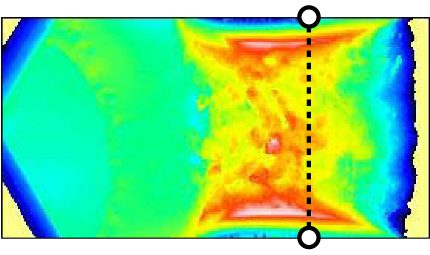
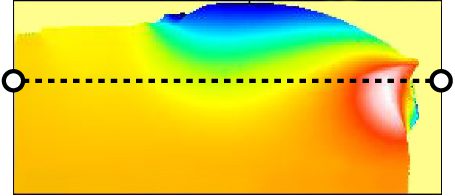
顶部表面

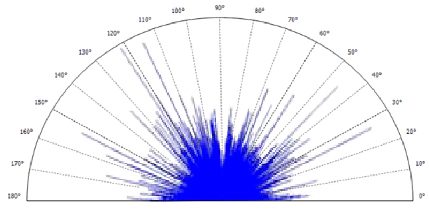
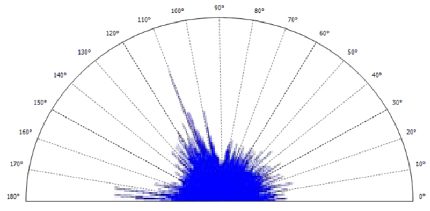
三维表面纹理方向

同向性51.26%
第一方向123.2º
第二方向116.3º
第三方向0.1725º

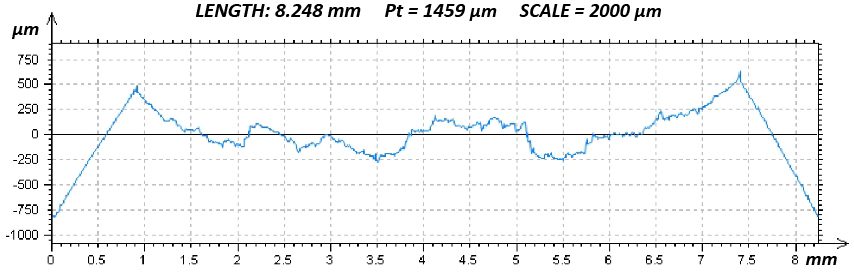
表面积、体积、粗糙度和许多其他方面都可以从这个提取中自动计算。

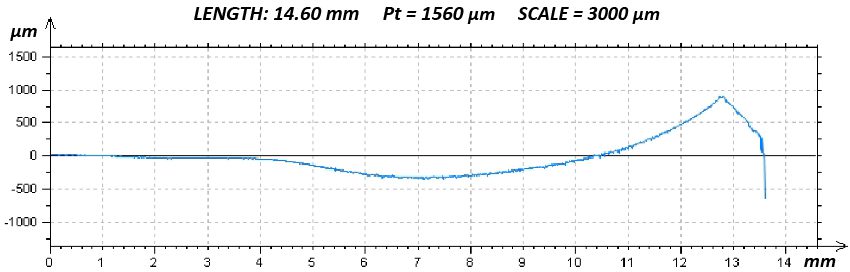
二维轮廓提取

结果

侧面

三维表面纹理方向

同向性15.55%
第一方向0.1617º
第二方向110.5º
第三方向171.5º

表面积、体积、粗糙度和许多其他方面都可以从这个提取中自动计算。

二维轮廓提取

结论

在这个应用中,我们展示了NANOVEA ST400 3D非接触式轮廓仪是如何精确表征断裂表面的全部地形(纳米、微观和宏观特征)的。从三维区域中,可以清楚地识别出表面,并且可以快速提取子区域或剖面/横截面,并通过无尽的表面计算列表进行分析。亚纳米级的表面特征可以通过集成的AFM模块进一步分析。

此外,NANOVEA还在其Profilometer阵容中加入了一个便携式版本,这对于不可移动的裂缝表面现场研究来说尤其重要。有了这些广泛的表面测量能力,使用一台仪器进行断裂表面分析从未如此简单和方便。

摩擦仪试验机测量聚合物皮带的磨损和摩擦

聚酯带

使用三坐标测量仪的磨损和破损情况

编写者

李端杰,博士

简介

皮带传动装置在两个或多个旋转轴之间传递动力和跟踪相对运动。作为一种简单和廉价的解决方案,维护工作最少,皮带传动被广泛用于各种应用,如电锯、锯木厂、脱粒机、筒仓鼓风机和输送机。皮带传动装置可以保护机械免于过载,也可以阻尼和隔离振动。

磨损评估的重要性 对皮带传动的重要性

摩擦和磨损对于皮带驱动的机器中的皮带来说是不可避免的。足够的摩擦确保有效的动力传输而不打滑,但过度的摩擦可能会迅速磨损皮带。不同类型的磨损,如疲劳、磨损和摩擦,都发生在皮带传动操作中。为了延长皮带的使用寿命,减少皮带维修和更换的成本和时间,可靠地评估皮带的磨损性能对于提高皮带寿命、生产效率和应用性能是可取的。准确测量皮带的摩擦系数和磨损率,有利于研发和皮带生产的质量控制。

测量目标

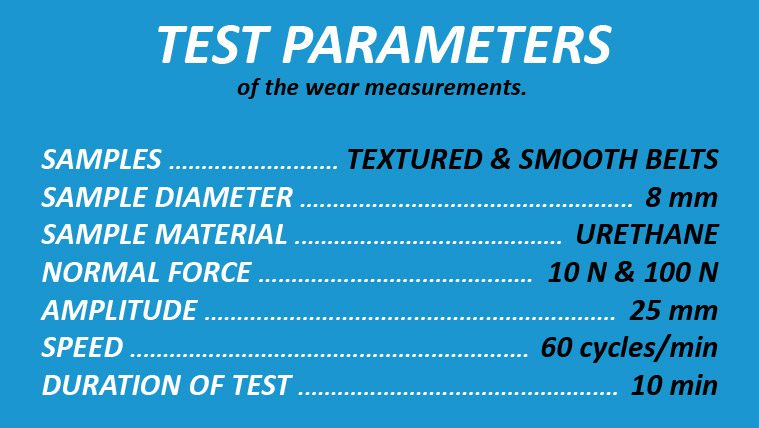
在这项研究中,我们模拟和比较了具有不同表面纹理的皮带的磨损行为,以展示其能力。 NANOVEA T2000摩擦磨损仪以受控和监测的方式模拟皮带的磨损过程。

NANOVEA

T2000

测试程序

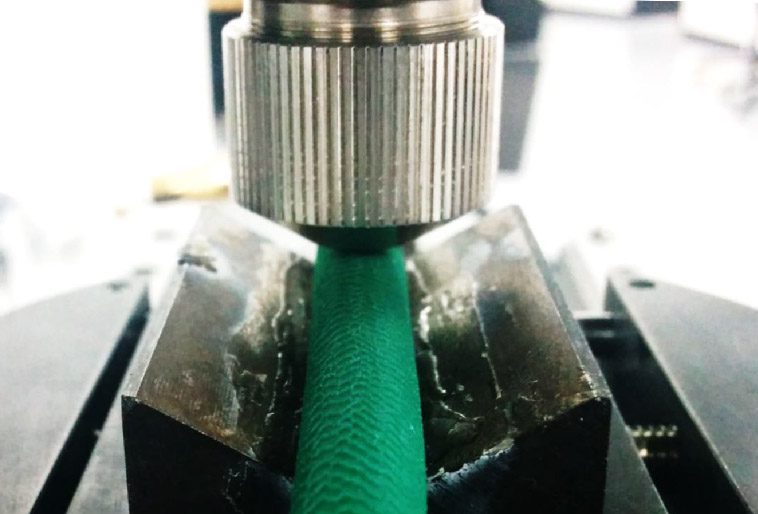
两条具有不同表面粗糙度和纹理的皮带的摩擦系数,COF和耐磨性是通过以下方法评估的 NANOVEA 高负载 摩擦仪 使用线性往复磨损模块。使用钢 440 球(直径 10 毫米)作为计数器材料。使用集成的方法检查表面粗糙度和磨损轨迹 3D 非接触式轮廓仪。磨损率, K使用公式评估 K=Vl(Fxs),其中 V 是磨损的体积。 F 是法向载荷和 s 是滑动距离。


请注意,本研究中使用了光滑的钢440球的对应物作为例子,任何具有不同形状和表面处理的固体材料都可以使用定制的夹具来模拟实际应用情况。

结果与讨论

纹理带和光滑带的表面粗糙度Ra分别为33.5和8.7um,根据用显微镜分析的表面轮廓。 NANOVEA 三维非接触式光学剖面仪。分别在10N和100N的条件下测量了两条被测皮带的COF和磨损率,以比较皮带在不同载荷下的磨损行为。

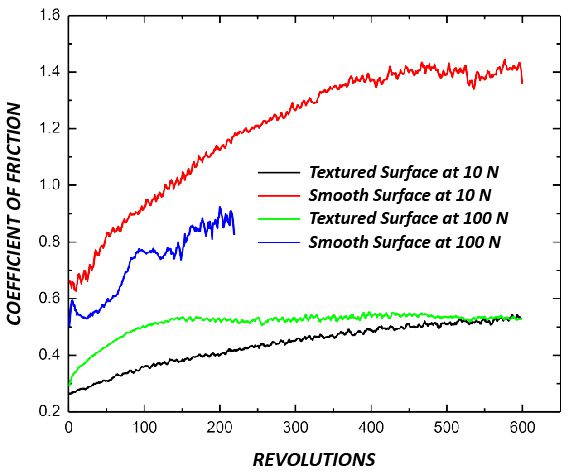
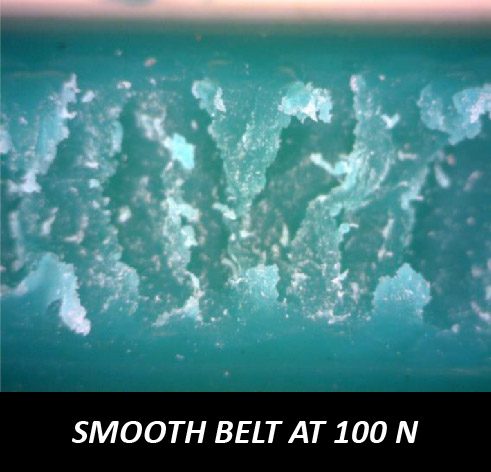
图1 显示了磨损测试期间皮带的COF的演变。具有不同纹理的带子表现出明显不同的磨损行为。有趣的是,在COF逐渐增加的磨合期之后,在使用10N和100N载荷进行的测试中,纹理带的COF达到较低的~0.5。相比之下,在10N载荷下测试的光滑带在COF稳定后表现出明显较高的~1.4的COF,并在测试的其余部分保持在该值以上。在100N载荷下测试的平滑带迅速被钢制440球磨损,并形成一个大的磨损轨迹。因此,测试在220转时被停止。

图1: 不同载荷下皮带的COF的演变。

NANOVEA三维非接触式轮廓仪提供了一个分析磨损痕迹的详细形态的工具,为从根本上理解磨损机制提供了更多的见解。

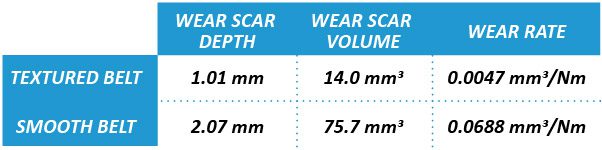
表1: 磨损轨迹分析的结果。

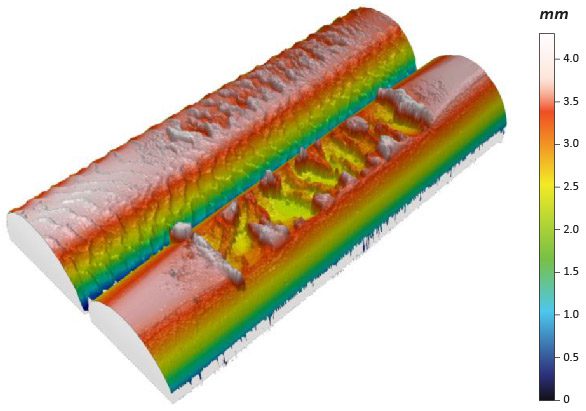
图2:  两条皮带的三维视图
在100N的测试之后。

如表1所示,三维磨损轨迹剖面可直接和准确地确定先进分析软件计算的磨损轨迹体积。在220转的磨损试验中,平滑带的磨损轨迹更大更深,体积为75.7 mm3,而纹理带在600转的磨损试验后,磨损体积为14.0 mm3。光滑带对钢球的摩擦力明显增大,导致磨损率比有纹路的皮带高15倍。


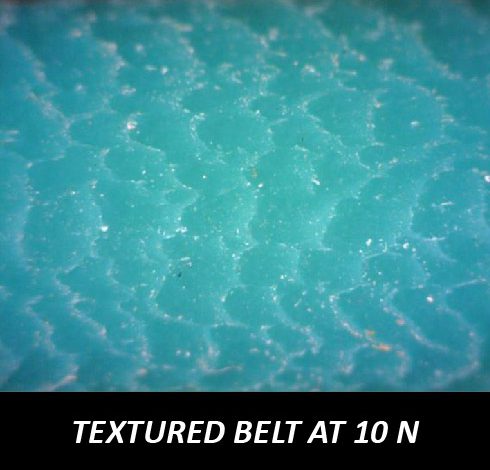
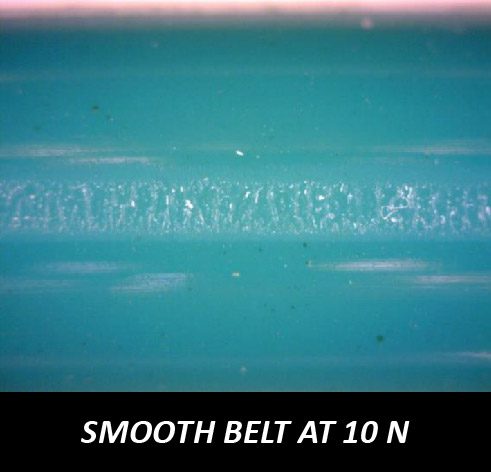
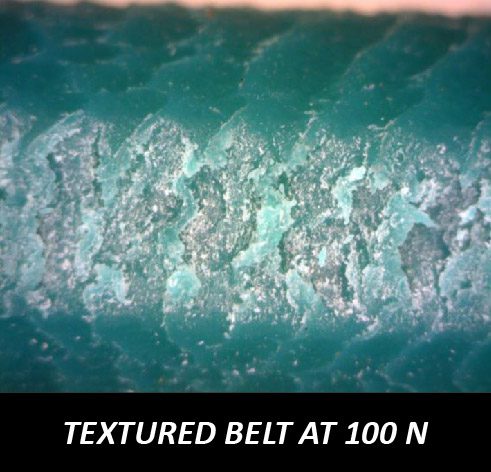
纹理带和光滑带之间如此巨大的COF差异,可能与带子和钢球之间的接触面积大小有关,这也导致了它们不同的磨损性能。图3显示了两种带子在光学显微镜下的磨损痕迹。磨损轨迹检查与COF演变的观察结果一致。纹理带保持着约0.5的低COF,在10N的负载下进行磨损试验后,没有表现出磨损的迹象。光滑带在10N时显示出一个小的磨损轨迹。

图3:  光学显微镜下的磨损痕迹。

结论

在这项研究中,我们展示了NANOVEA T2000摩擦仪在以良好的控制和定量方式评估皮带的摩擦系数和磨损率方面的能力。在皮带的使用性能中,表面纹理对皮带的摩擦和耐磨性起着关键作用。有纹理的皮带表现出稳定的摩擦系数约为0.5,并拥有较长的使用寿命,从而减少了工具维修或更换的时间和成本。相比之下,光滑皮带对钢球的过度摩擦会迅速磨损皮带。此外,皮带上的负载是影响其使用寿命的一个重要因素。过载会产生非常大的摩擦,导致皮带加速磨损。

NANOVEA T2000摩擦仪采用符合ISO和ASTM标准的旋转和线性模式,提供精确和可重复的磨损和摩擦测试,并在一个预集成的系统中提供可选的高温磨损、润滑和摩擦腐蚀模块。 NANOVEA的 无与伦比的产品系列是确定薄或厚、软或硬的涂层、薄膜和基材的全部摩擦学特性的理想解决方案。

三维轮廓仪测量化石微观结构

化石的微观结构

使用三维轮廓仪测量

编写者

李端杰,博士

简介

化石是埋在古代海洋、湖泊和河流下的沉积物中的植物、动物和其他生物的痕迹的保存遗迹。软体组织通常在死后腐烂,但硬壳、骨骼和牙齿会成为化石。原有的贝壳和骨骼发生矿物替换时,微观结构的表面特征往往被保留下来,这为了解天气的演变和化石的形成机制提供了启示。

3D非接触式轮廓仪在化石检查中的重要性

化石的 3D 剖面使我们能够从更近的角度观察化石样本的详细表面特征。 NANOVEA 轮廓仪的高分辨率和精确度可能是肉眼无法辨别的。轮廓仪的分析软件提供了适用于这些独特表面的广泛研究。与接触式探针等其他技术不同,NANOVEA 3D 非接触式轮廓仪 无需接触样品即可测量表面特征。这样可以保留某些精致化石样本的真实表面特征。此外,便携式Jr25轮廓仪可以对化石遗址进行3D测量,极大地方便了化石挖掘后的分析和保护。

测量目标

在这项研究中,NANOVEA Jr25轮廓仪被用来测量两个有代表性的化石样品的表面。对每个化石的整个表面进行了扫描和分析,以确定其表面特征,包括粗糙度、轮廓和纹理方向。

NANOVEA

小25

腕足类化石

本报告介绍的第一个化石样本是腕足类化石,它来自于一种海洋动物,其上下表面有坚硬的 "瓣"(壳)。它们首次出现在距今5.5亿年前的寒武纪时期。

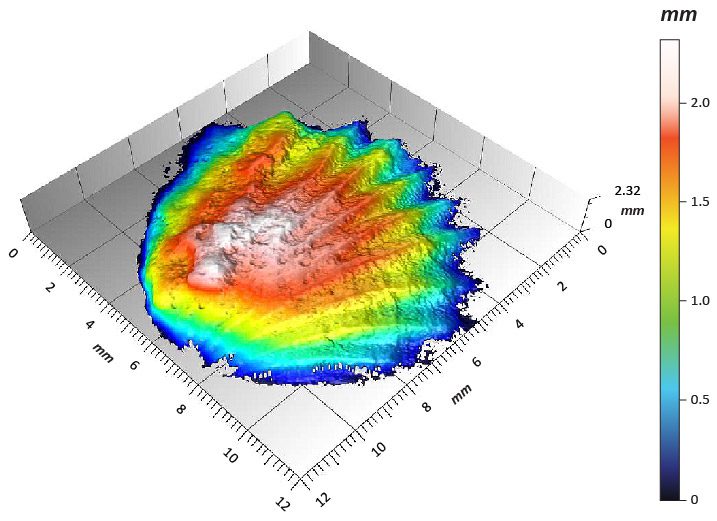
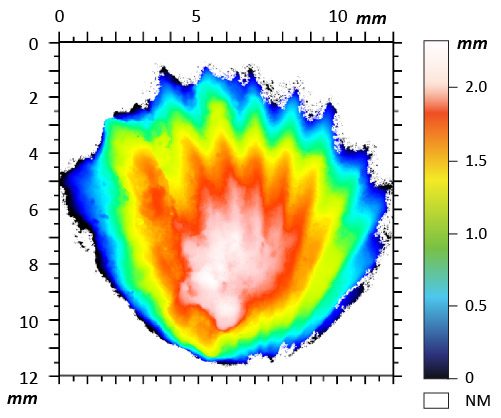
扫描的三维视图见图1,假彩色视图见图2。 

图1: 腕足类化石样本的三维视图。

图2: 腕足类化石样本的假彩图。

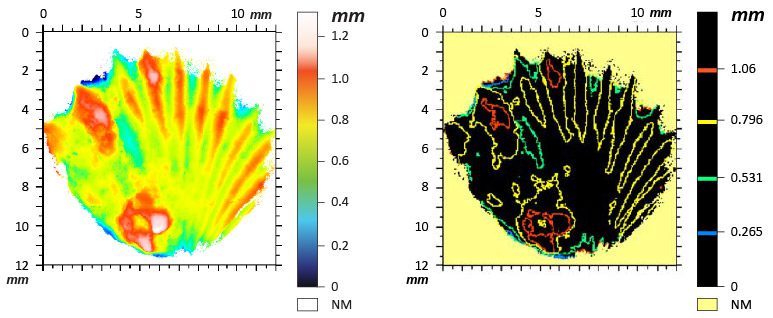
然后将整体形态从表面移除,以研究腕足动物化石的局部表面形态和轮廓,如图3所示。现在可以在腕足动物化石样品上观察到一个奇特的分歧槽纹理。

图3: 去除表格后的假彩色视图和轮廓线视图。

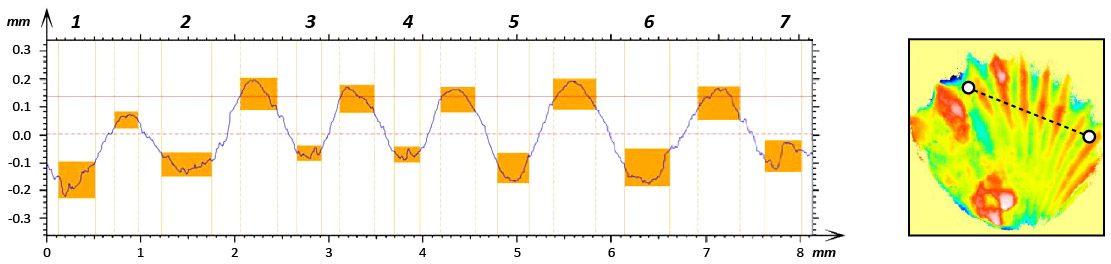
从纹理区域提取线状剖面图,以显示图4中化石表面的横断面图。步高研究测量了表面特征的精确尺寸。凹槽拥有平均宽度约0.38毫米和深度约0.25毫米。

图4: 纹理表面的线条轮廓和阶梯高度研究。

板蓝根茎化石

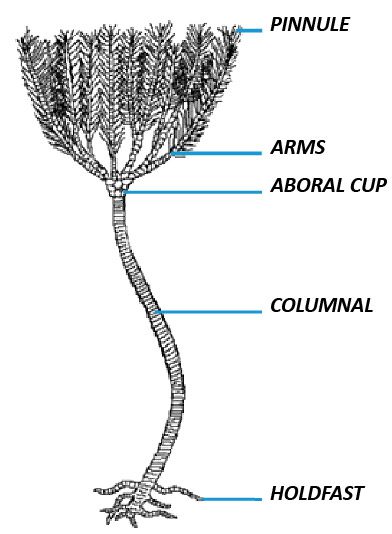
第二块化石样本是一块甲壳虫茎部化石。甲壳虫首次出现在中寒武纪的海洋中,大约比恐龙早3亿年。 


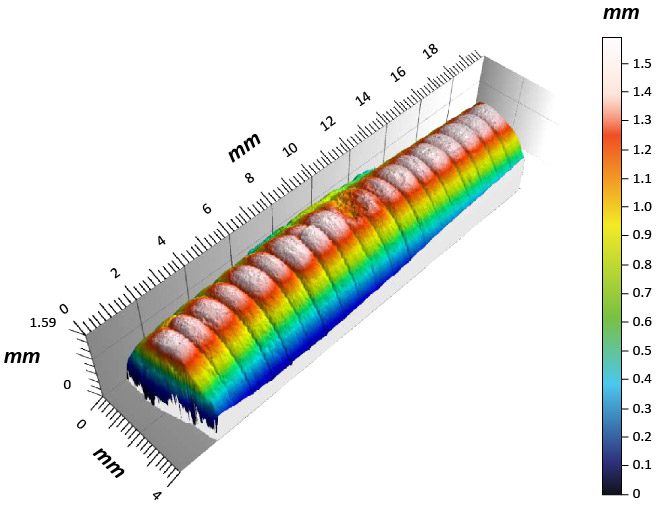
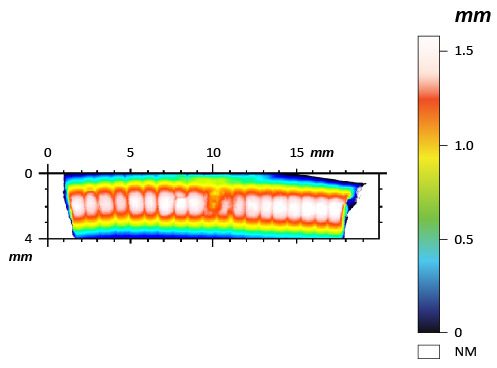
扫描的三维视图见图5,假彩色视图见图6。 

图5: 腕足类化石样本的三维视图。

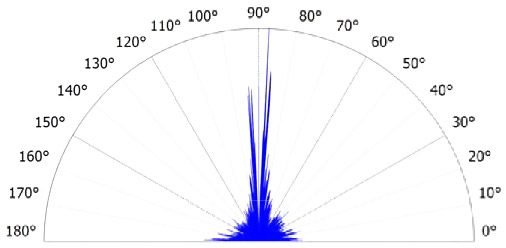
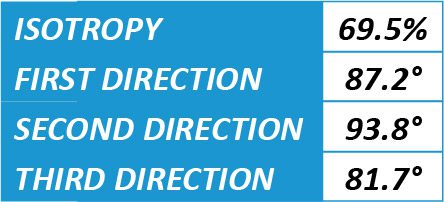
图7分析了Crinoid茎化石的表面纹理各向异性和粗糙度。 

 该化石在接近90°的角度有一个优先的纹理方向,导致69%的纹理各向同性。

图6: 虚假的彩色视图 缩骨动物茎 采样。


图7: 碎石类干化石的表面纹理各向异性和粗糙度。

图8显示了沿Crinoid茎化石的轴向的二维剖面。 

表面纹理的山峰大小相当均匀。

图8: 碎石类干化石的二维剖面分析。

结论

在这个应用中,我们使用NANOVEA Jr25便携式非接触式轮廓仪全面研究了腕足类和腕足类茎化石的三维表面特征。我们展示了该仪器可以精确描述化石样品的三维形态。然后进一步分析了样品有趣的表面特征和纹理。腕足类样品拥有分歧的沟槽纹理,而腕足类茎部化石则显示出优先的纹理各向同性。详细而精确的三维表面扫描被证明是古生物学家和地质学家研究生命进化和化石形成的理想工具。

这里显示的数据只代表了分析软件中的一部分计算结果。NANOVEA轮廓仪几乎可以测量任何领域的表面,包括半导体、微电子、太阳能、光纤、汽车、航空航天、冶金、加工、涂层、制药、生物医学、环境和许多其他领域。

保丽龙表面边界测量轮廓仪

表面边界测量

使用三维轮廓测量法的表面边界测量

了解更多

表面边界测量

使用三维轮廓仪测量

编写者

克雷格-莱辛

简介

在对表面特征、图案、形状等的界面进行方位评估的研究中,快速确定整个测量剖面上的关注区域将是非常有用的。通过将一个表面分割成重要的区域,用户可以快速评估边界、峰值、凹点、面积、体积和许多其他方面,以了解它们在整个研究的表面轮廓中的功能作用。例如,像金属的晶界成像,分析的重要性是许多结构的界面和它们的整体方向。通过了解每个感兴趣的区域的缺陷和或整体区域内的异常可以被识别。尽管晶界成像通常是在超过Profilometer能力的范围内进行研究,而且只是二维图像分析,但它是一个有用的参考,说明这里将在更大范围内显示的概念以及三维表面测量的优势。

3D非接触式轮廓仪对表面分离研究的重要性

与接触式探针或干涉测量等其他技术不同, 3D 非接触式轮廓仪使用轴向色差,可以测量几乎任何表面,由于开放式分级,样品尺寸可能变化很大,并且不需要样品制备。在表面轮廓测量过程中获得纳米到宏观范围,样品反射率或吸收的影响为零,具有测量高表面角度的先进能力,并且无需软件对结果进行操作。轻松测量任何材料:透明、不透明、镜面、漫射、抛光、粗糙等。非接触式轮廓仪技术提供了理想、广泛且用户友好的功能,可在需要表面边界分析时最大限度地进行表面研究;以及 2D 和 3D 组合功能的优势。

测量目标

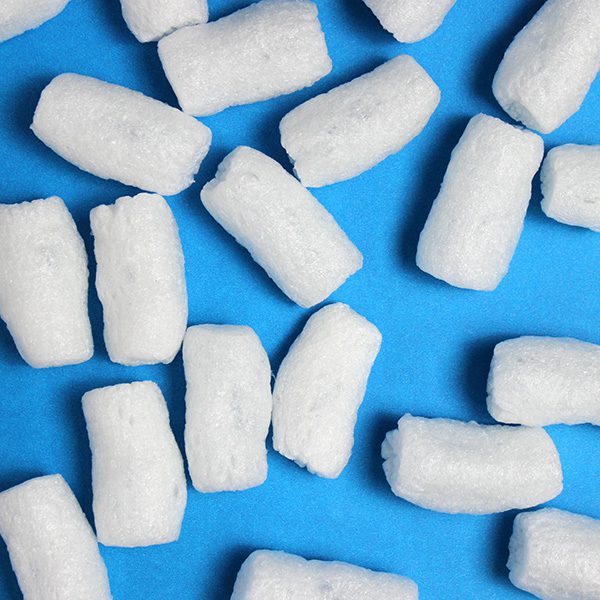
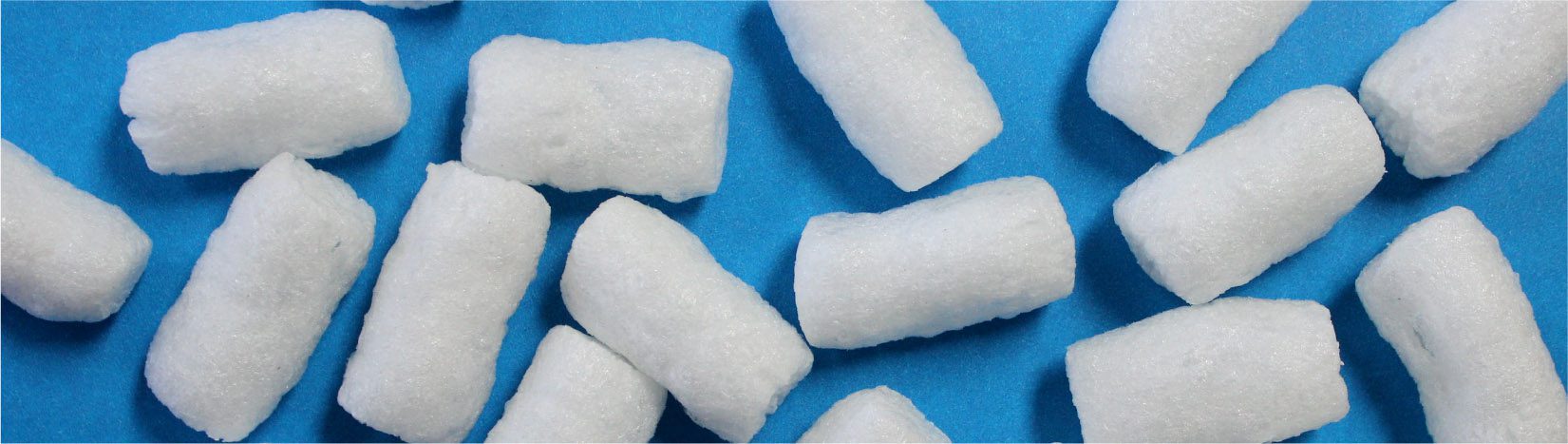
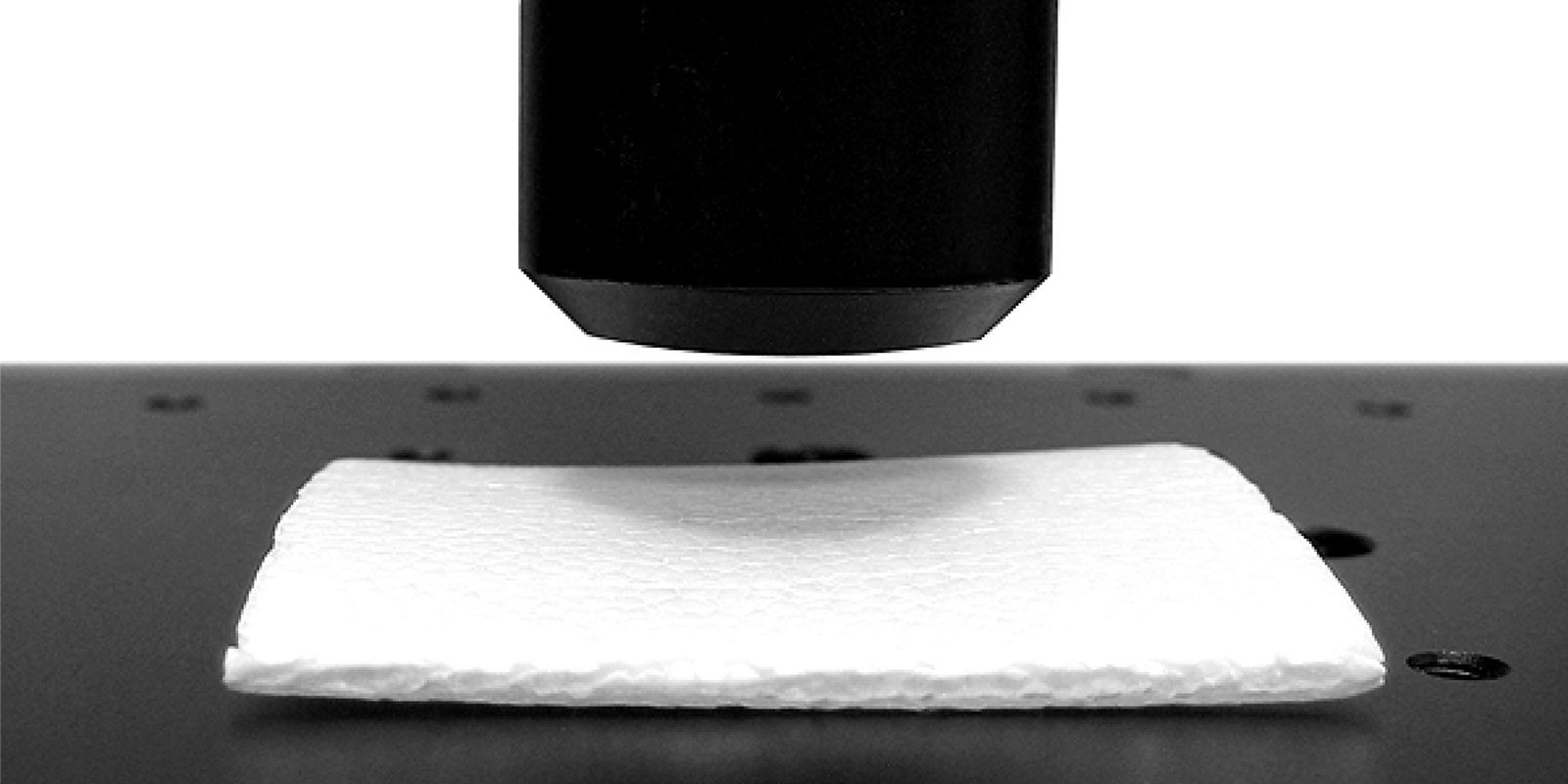
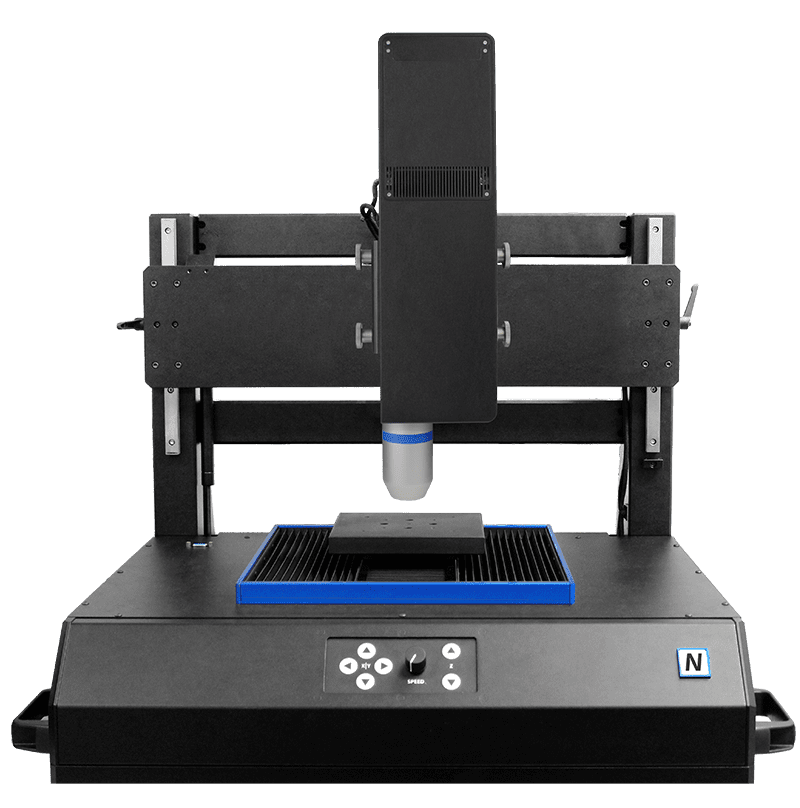
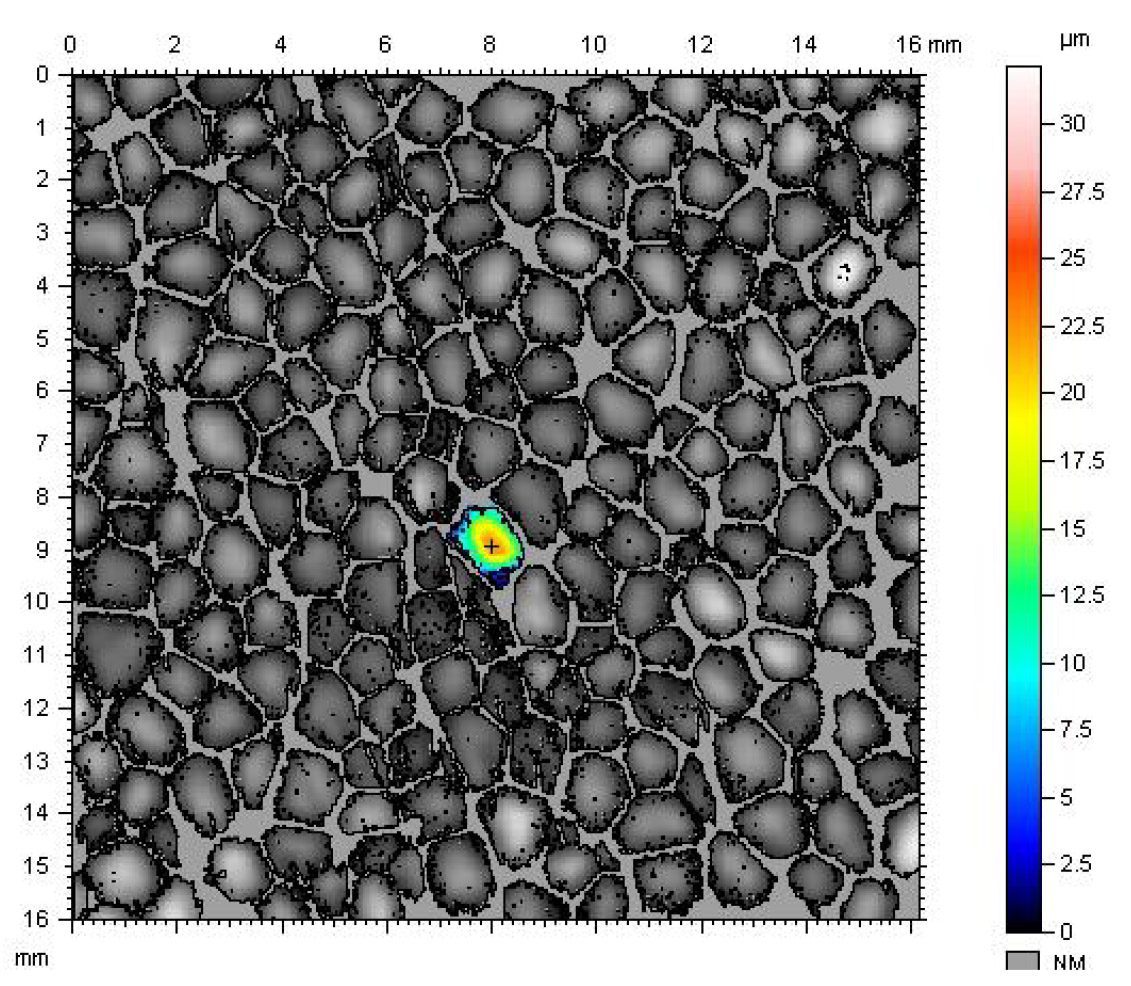
在这个应用中,Nanovea ST400轮廓仪被用来测量泡沫聚苯乙烯的表面积。通过结合反射强度文件和地形来建立边界,这些文件由NANOVEA ST400同时获取。这些数据被用来计算每个聚苯乙烯泡沫“颗粒”的不同形状和大小信息。

NANOVEA

ST400

结果与讨论:二维表面边界测量

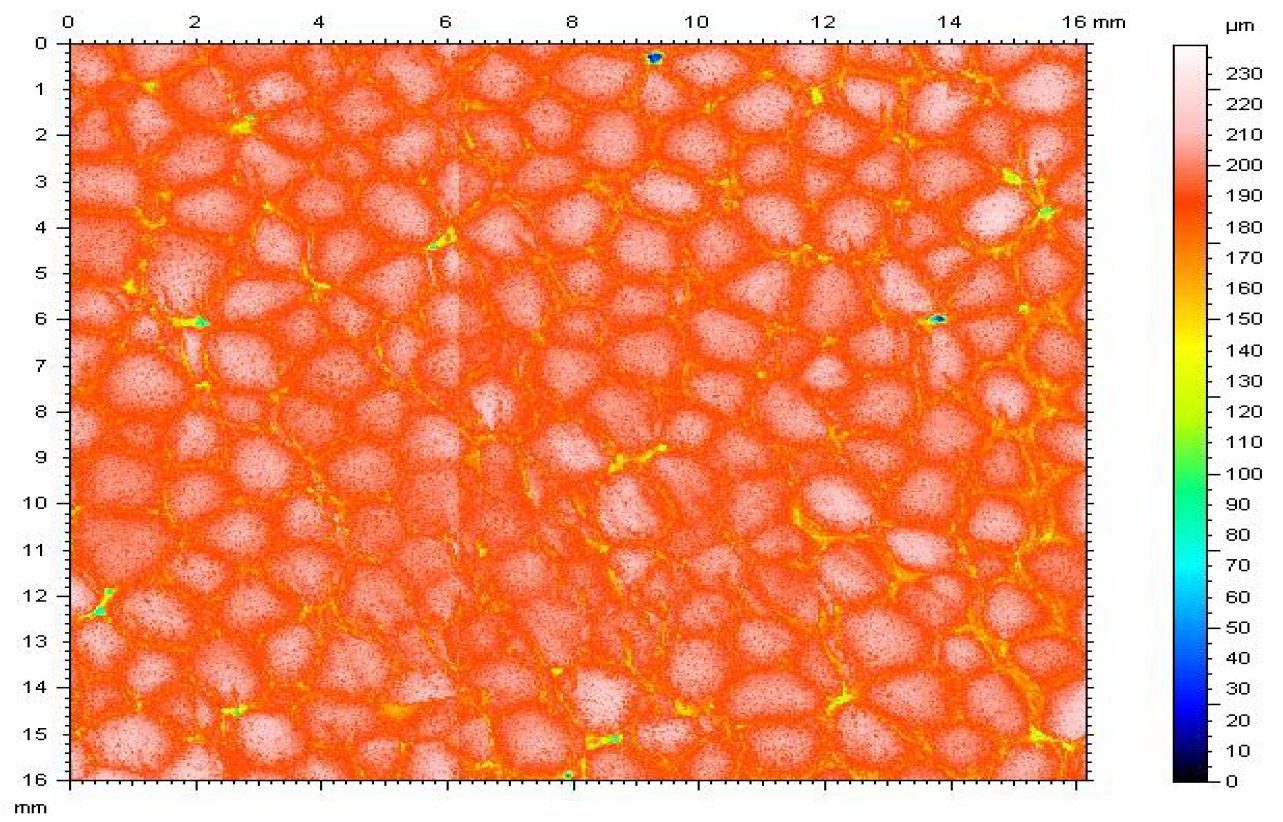
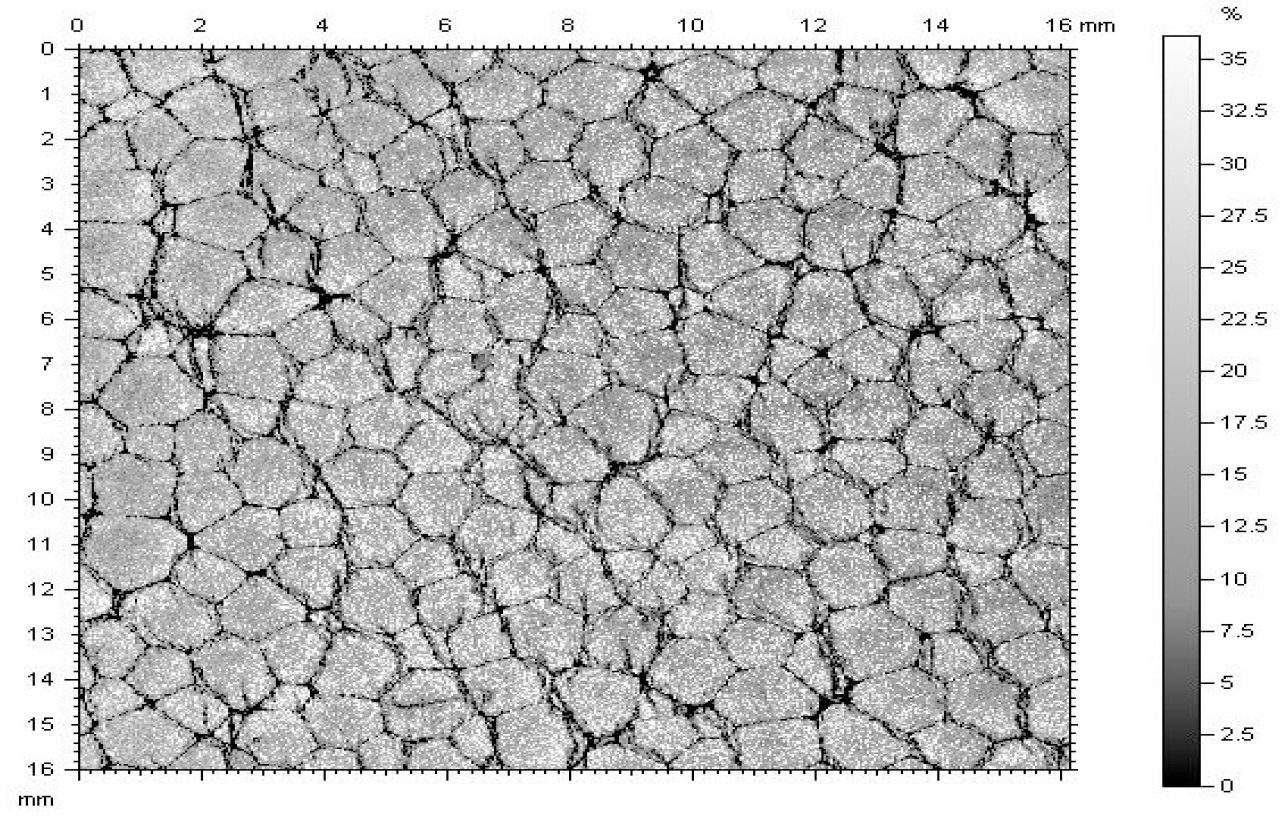
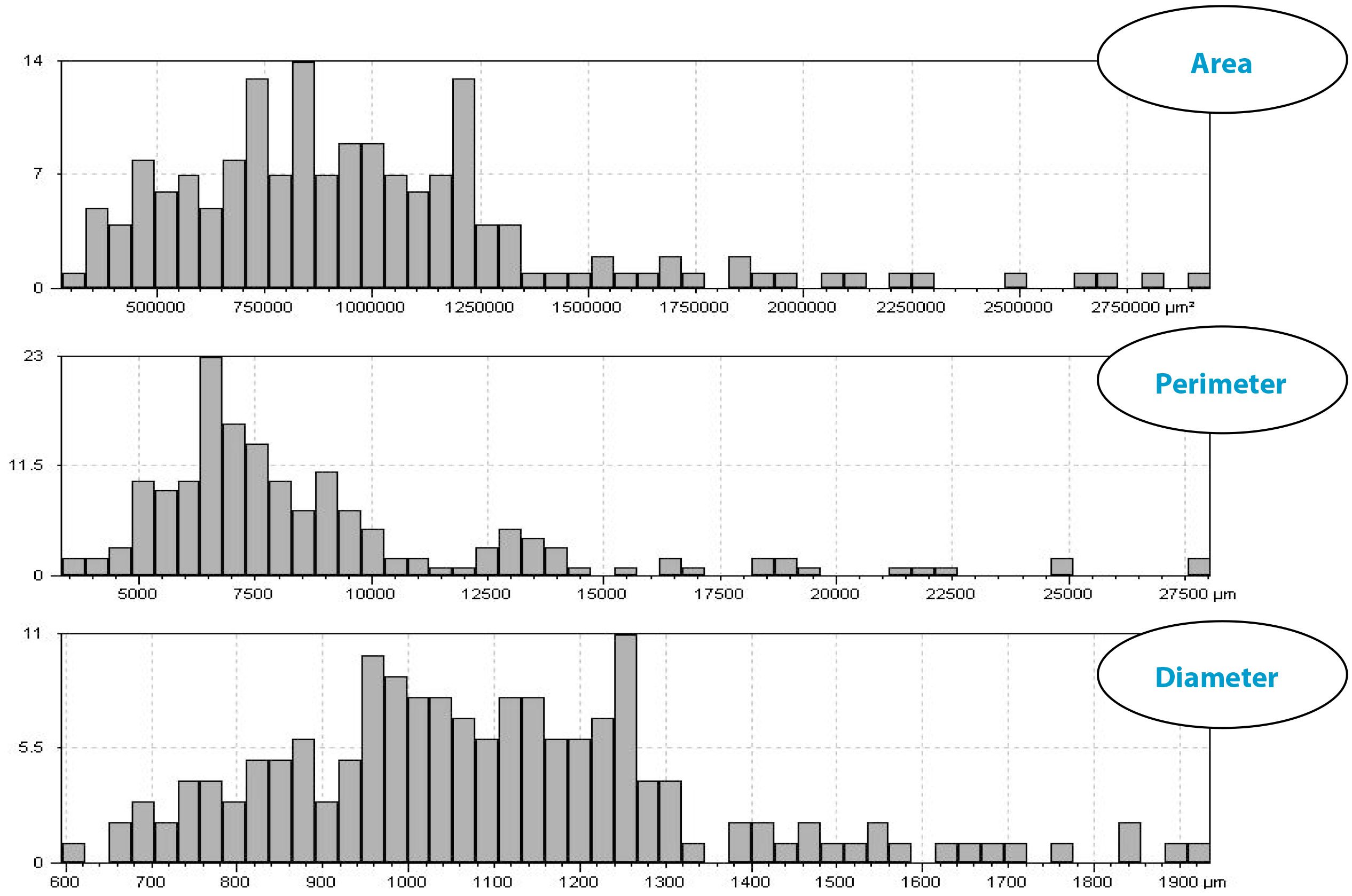
地形图(下图左)被反射强度图(下图右)所掩盖,以明确界定晶粒的边界。所有直径在565微米以下的晶粒都通过应用过滤器被忽略了。

谷物总数。167
谷物所占的总投影面积。166.917 mm² (64.5962 %)
边界所占的预计总面积:(35.4038 %)
谷物的密度。0.646285粒/平方毫米

面积 = 0.999500 mm² +/- 0.491846 mm²
周长 = 9114.15 µm +/- 4570.38 µm
等效直径=1098.61 µm +/- 256.235 µm
平均直径=945.373µm +/- 248.344 µm
最小直径 = 675.898 µm +/- 246.850 µm
最大直径 = 1312.43 µm +/- 295.258 µm

结果与讨论:三维表面边界测量

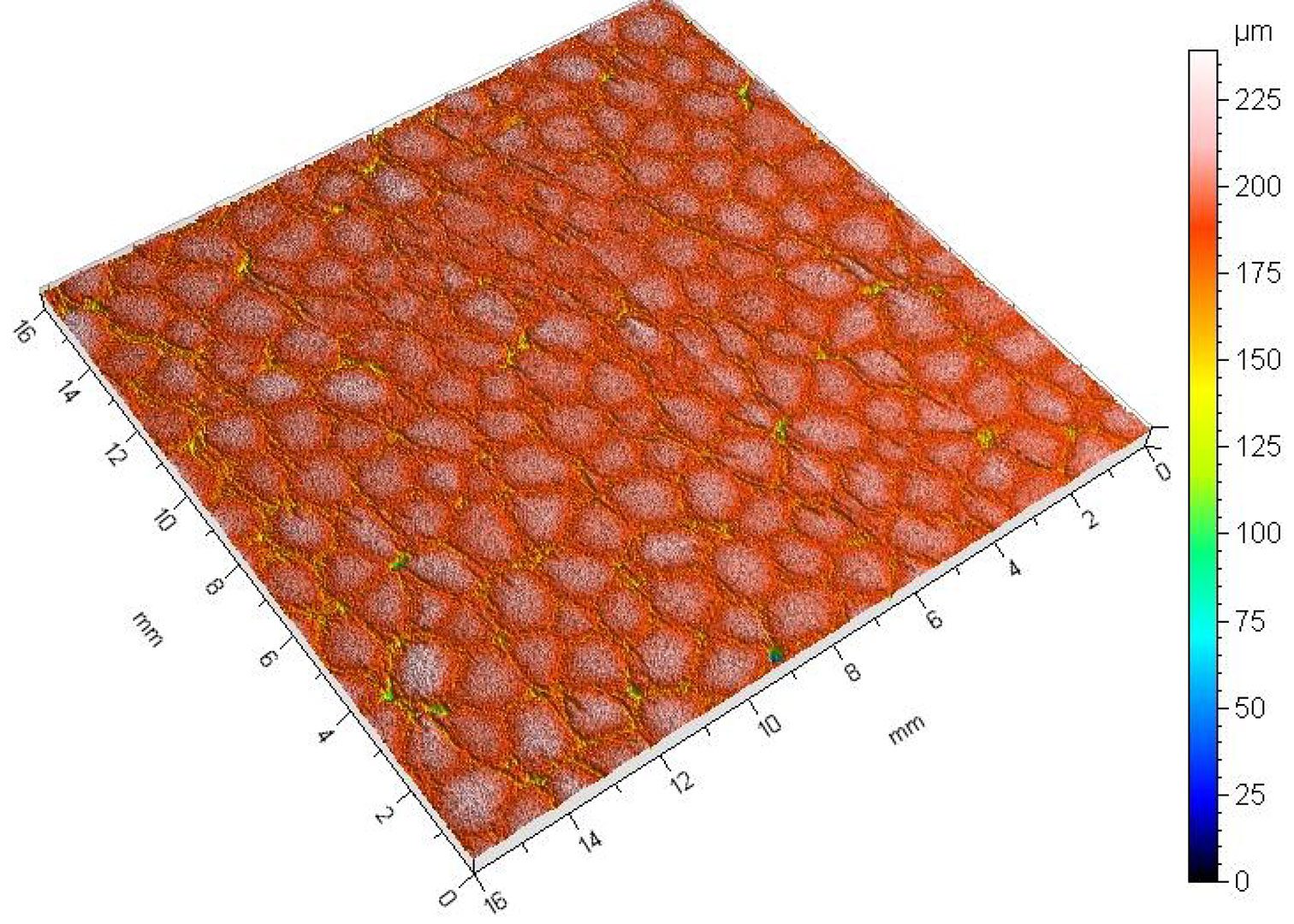
通过使用获得的三维地形数据,可以分析每个晶粒的体积、高度、峰值、长宽比和一般形状信息。占用的总三维面积:2.525mm3

结论

在这个应用中,我们展示了NANOVEA 3D非接触式轮廓仪如何精确地表征聚苯乙烯泡沫塑料的表面。统计信息可以在整个感兴趣的表面或单个晶粒上获得,无论它们是峰值还是凹坑。在这个例子中,所有大于用户定义尺寸的晶粒被用来显示面积、周长、直径和高度。这里显示的特征对天然和预制表面的研究和质量控制至关重要,范围包括生物医学和微加工应用以及许多其他应用。 

使用NANOVEA的轮廓仪进行轮廓测量

轮胎胎面深度和橡胶表面粗糙度测量 | 3D 光学轮廓仪

轮胎花纹深度和橡胶表面粗糙度测量 使用 3D 光学轮廓仪

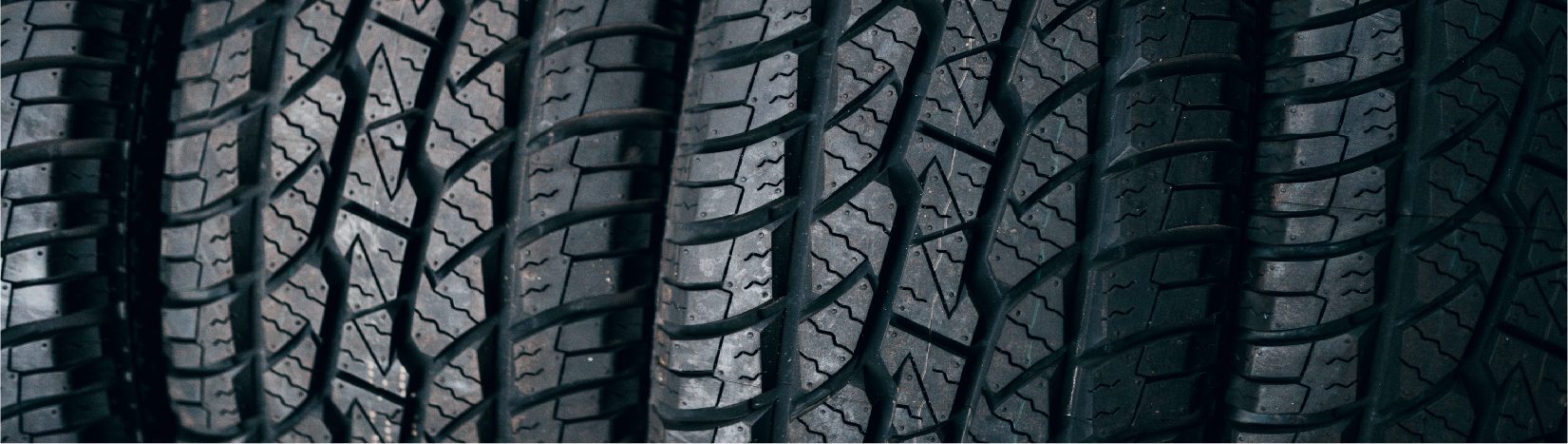
显示多种汽车轮胎花纹的轮胎花纹深度测量参考资料

编写者

安德里亚-赫尔曼

轮胎花纹深度通常使用手持式测量仪进行测量,以确保消费者安全,但工业研发和轮胎制造商需要更先进的方法。本应用说明展示了三维光学轮廓仪如何为高精度研究提供精确的轮胎花纹深度测量、轮廓测绘和橡胶表面粗糙度分析。.

简介

与所有材料一样,橡胶的摩擦系数在一定程度上与其表面粗糙度有关。在汽车轮胎中,胎面深度和表面粗糙度直接影响牵引、制动和磨损性能。本研究使用三维非接触式轮廓仪分析了橡胶表面和胎面的粗糙度和尺寸。.
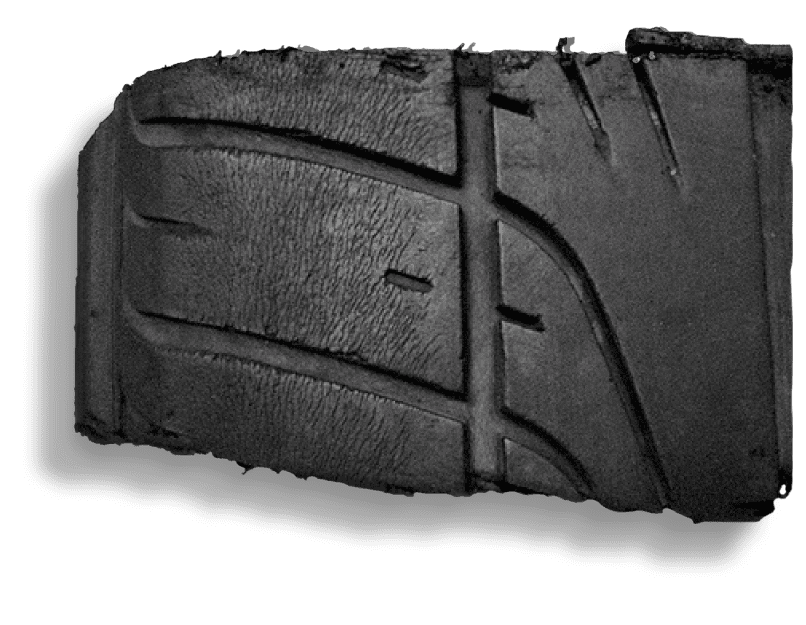
用于测量胎面深度和橡胶表面粗糙度的轮胎样品

例子

三维非接触式轮廓测量法对轮胎胎面深度测量的重要性

与触摸探针或干涉测量法等其他技术不同、, NANOVEA 的 3D 非接触式光学轮廓仪 使用轴向色差来测量几乎任何表面。

Profiler 系统的开放式分期允许使用各种尺寸的样品,无需进行样品制备。只需一次扫描,用户就能捕捉到整体轮胎胎面深度和微观表面粗糙度,而不会受到样品反射率或吸收率的影响。此外,这些轮廓仪还具有测量高表面角度的先进能力,无需对结果进行软件处理。.

这种多功能性使 NANOVEA 轮廓仪成为轮胎胎面磨损测试和先进橡胶材料研究的理想选择。.

测量目标

在本应用程序中,我们展示了 纳米氧 ST400, 三维非接触式光学轮廓仪测量轮胎胎面深度、轮廓几何形状和橡胶表面粗糙度。本研究随机选择了一个足以代表整个轮胎表面的样本表面区域。为了量化橡胶的特性,我们使用了 NANOVEA Ultra 3D 分析软件来测量沟槽尺寸、胎面深度、表面粗糙度以及显影面积与投影面积。.

NANOVEA ST400 标准
光学 3D 轮廓仪

分析。 轮胎胎面
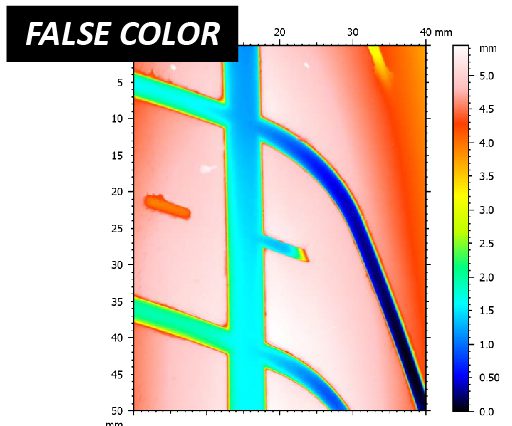
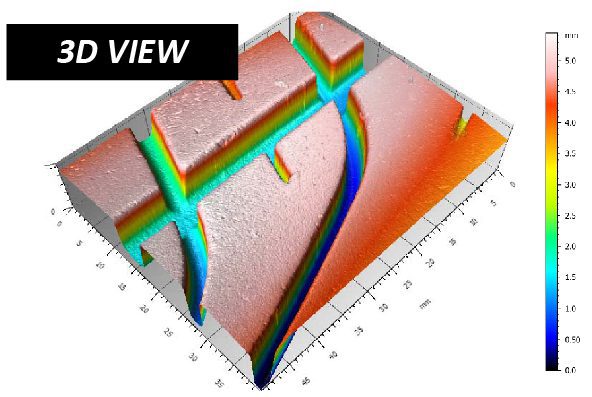
胎面的三维视图和假色视图显示了映射三维表面设计的价值。这为工程师从多个角度评估胎面深度均匀性、沟槽设计和磨损提供了直接的工具。高级轮廓分析和台阶高度分析都是非常强大的工具,用于测量样品形状和设计的精确尺寸。.
轮胎胎面深度和沟槽几何形状的假彩三维光学轮廓测量技术
测量轮胎胎面深度的 3D 轮廓仪表面视图

高级轮廓分析

利用三维轮廓测量法对轮胎胎面沟槽进行高级轮廓分析

台阶高度分析

利用 3D 光学轮廓仪测量轮胎胎面深度的台阶高度分析
三维轮廓仪阶梯高度剖面显示轮胎花纹深度测量结果
分析。 橡胶表面
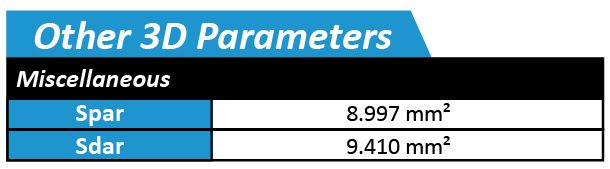
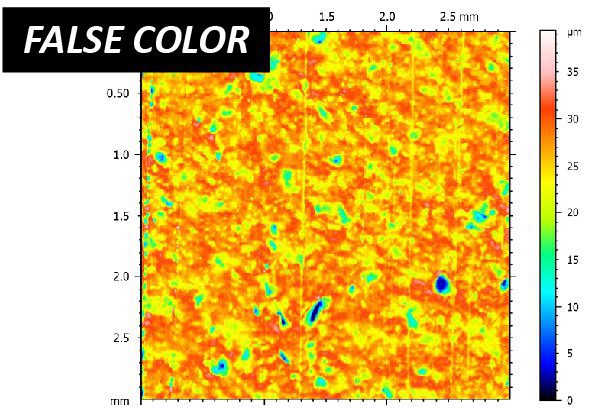
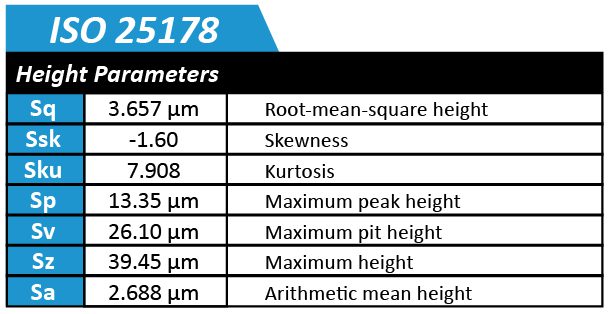
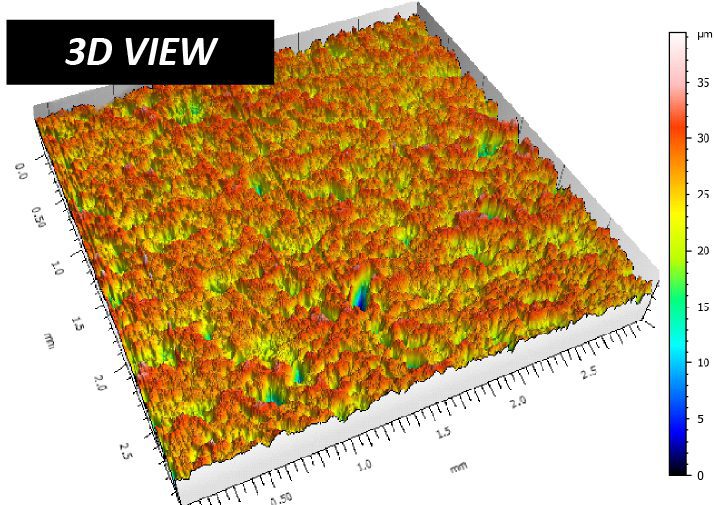
如下图所示,可以使用内置软件工具对橡胶表面进行多种量化。可以看出,表面粗糙度为 2.688 μm,显影面积与投影面积之比为 9.410 mm² 与 8.997 mm²。这些结果表明了橡胶表面粗糙度对牵引力和性能的影响,可以对不同橡胶配方或不同表面磨损程度进行比较。.
利用 3D 光学轮廓仪分析橡胶表面粗糙度
ISO 25178 轮胎橡胶表面的高度参数
橡胶表面粗糙度和显影面积的 3D 光学轮廓测量视图
轮胎橡胶表面轮廓仪参数

结论

在这一应用中,我们展示了 NANOVEA 3D 非接触式光学轮廓仪如何精确表征轮胎胎面深度、轮廓尺寸和橡胶表面粗糙度。数据显示表面粗糙度为 2.69 µm,显影面积为 9.41 mm²,投影面积为 9 mm²。此外,还测量了橡胶胎面的各种尺寸和半径。这些信息可供轮胎制造商、汽车研究人员和材料工程师用于比较胎面设计、橡胶配方或不同磨损程度的轮胎。此处显示的数据仅代表 Ultra 3D 分析软件中的部分计算结果。.
机加工零件质量控制

机加工零件检查

机械零件

使用三维轮廓测量法根据CAD模型进行检测

作者。

李端杰,博士

订正

Jocelyn Esparza

用轮廓仪检测机械加工件

简介

各个行业对能够创造复杂几何形状的精密加工的需求一直在上升。从航空航天、医疗和汽车,到科技齿轮、机械和乐器,不断的创新和演变将期望和精度标准推向新的高度。因此,我们看到对严格的检测技术和仪器的需求上升,以确保产品的最高质量。

三维非接触式轮廓仪在零件检测中的重要性

将加工好的零件的属性与它们的CAD模型进行比较,对于验证公差和对生产标准的遵守是至关重要的。在服务期间的检查也是至关重要的,因为零件的磨损可能需要更换。及时发现任何偏离所需规格的情况将有助于避免昂贵的维修、生产停顿和声誉受损。

与接触式探针技术不同,NANOVEA 光学轮廓仪 以零接触方式执行 3D 表面扫描,从而以最高精度快速、精确、无损地测量复杂形状。

测量目标

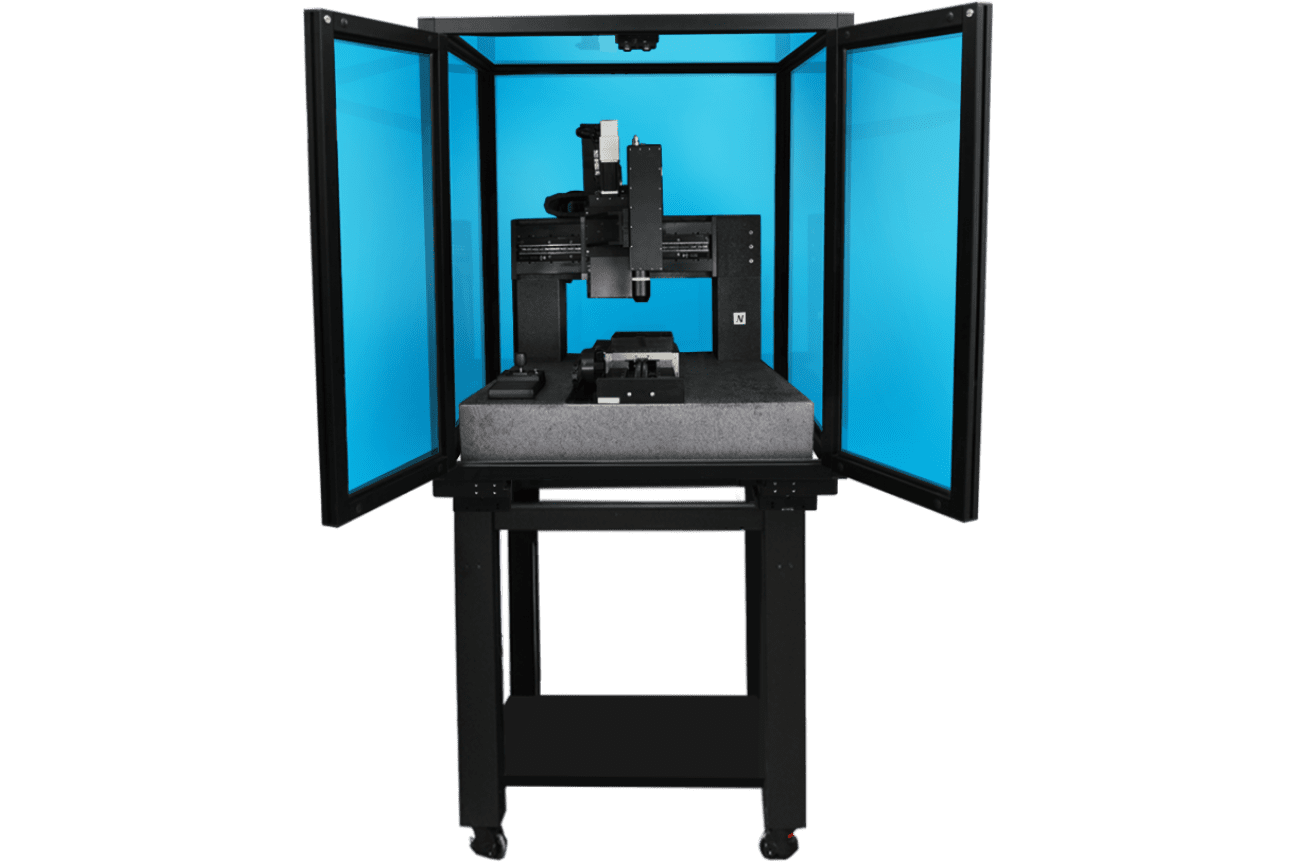
在这个应用中,我们展示了NANOVEA HS2000,一个带有高速传感器的三维非接触式轮廓仪,进行尺寸、半径和粗糙度的全面表面检测。 

所有这些都在40秒内完成。

NANOVEA

HS2000

CAD模型

对加工件的尺寸和表面粗糙度的精确测量对于确保其符合所需的规格、公差和表面光洁度至关重要。下面是要检测的零件的三维模型和工程图。 

错误的颜色视图

CAD模型的假彩色视图和扫描的加工零件表面在图3中进行了比较。 样品表面的高度变化可以通过颜色的变化来观察。

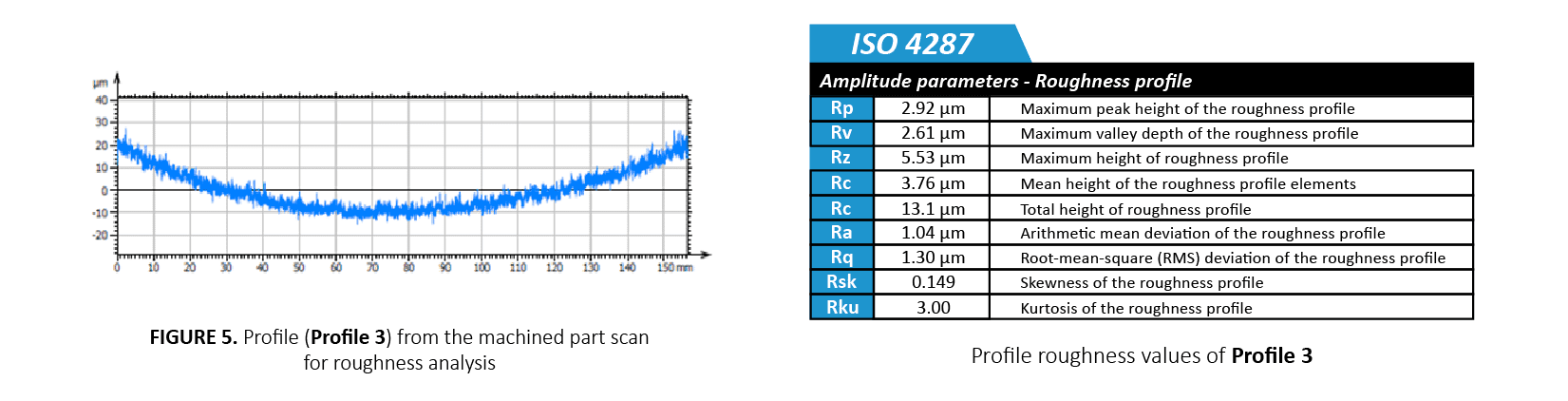
如图2所示,从三维表面扫描中提取三个二维轮廓,以进一步验证加工件的尺寸公差。

概况比较和结果

图3至图5中显示了轮廓1至3。通过将测量的轮廓与CAD模型进行比较来进行定量公差检查,以维护严格的制造标准。轮廓1和轮廓2测量弯曲加工件上不同区域的半径。轮廓2的高度变化在156毫米的长度上为30微米,符合所需的±125微米的公差要求。 

通过设置公差限值,分析软件可以自动确定加工件的合格或不合格。

用轮廓仪检测机器零件

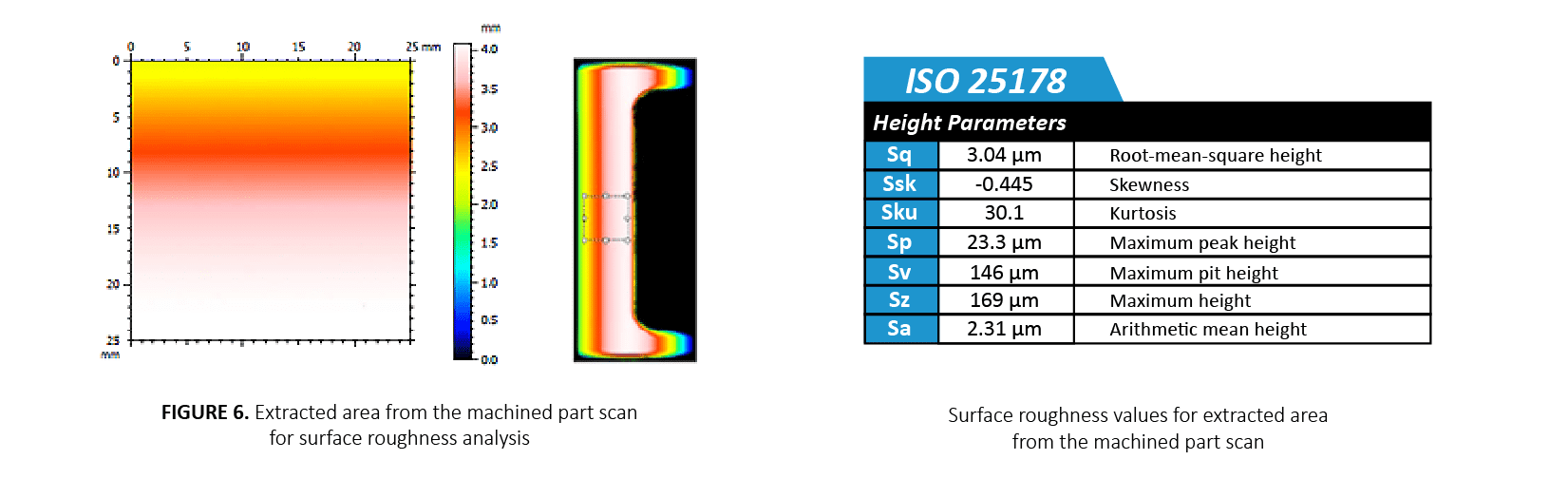
被加工零件表面的粗糙度和均匀性对保证其质量和功能起着重要作用。图6是从被加工零件的母扫描中提取的表面积,用于量化表面光洁度。平均表面粗糙度(Sa)为2.31 μ m。

结论

在这项研究中,我们展示了配备了高速传感器的NANOVEA HS2000非接触式轮廓仪是如何进行尺寸和粗糙度的全面表面检测的。 

高分辨率扫描使用户能够测量加工零件的详细形态和表面特征,并将其与CAD模型进行定量比较。该仪器还能够检测到任何缺陷,包括划痕和裂纹。 

先进的轮廓分析作为一个无与伦比的工具,不仅可以确定加工的零件是否满足设定的规格,还可以评估磨损部件的故障机制。

这里显示的数据只代表了每个NANOVEA光学剖面仪所配备的高级分析软件所能进行的部分计算。

 
牙科-螺钉-三维测量-使用三维测径仪

牙科工具。尺寸和表面粗糙度分析


简介


精确的尺寸和最佳的表面粗糙度对于牙科螺钉的功能至关重要。许多牙科螺钉尺寸需要高精度,例如半径、角度、距离和台阶高度。了解局部表面粗糙度对于插入人体内部的任何医疗工具或部件以最大限度地减少滑动摩擦也非常重要。


用于尺寸研究的非接触式轮廓测量


纳诺瓦 3D 非接触式轮廓仪 使用基于色光的技术来测量任何材料表面:透明、不透明、镜面、漫射、抛光或粗糙。与接触式探针技术不同,非接触式技术可以在狭小的区域内进行测量,并且不会由于尖端按压较软的塑料材料而导致变形而增加任何固有误差。与焦点变化技术相比,基于色光的技术还提供卓越的横向和高度精度。 Nanovea Profiler 可以直接扫描大型表面,无需缝合,并在几秒钟内对零件的长度进行轮廓分析。由于轮廓仪能够测量表面,无需任何复杂的算法来处理结果,因此可以测量纳米到宏观范围的表面特征和高表面角度。


测量目标


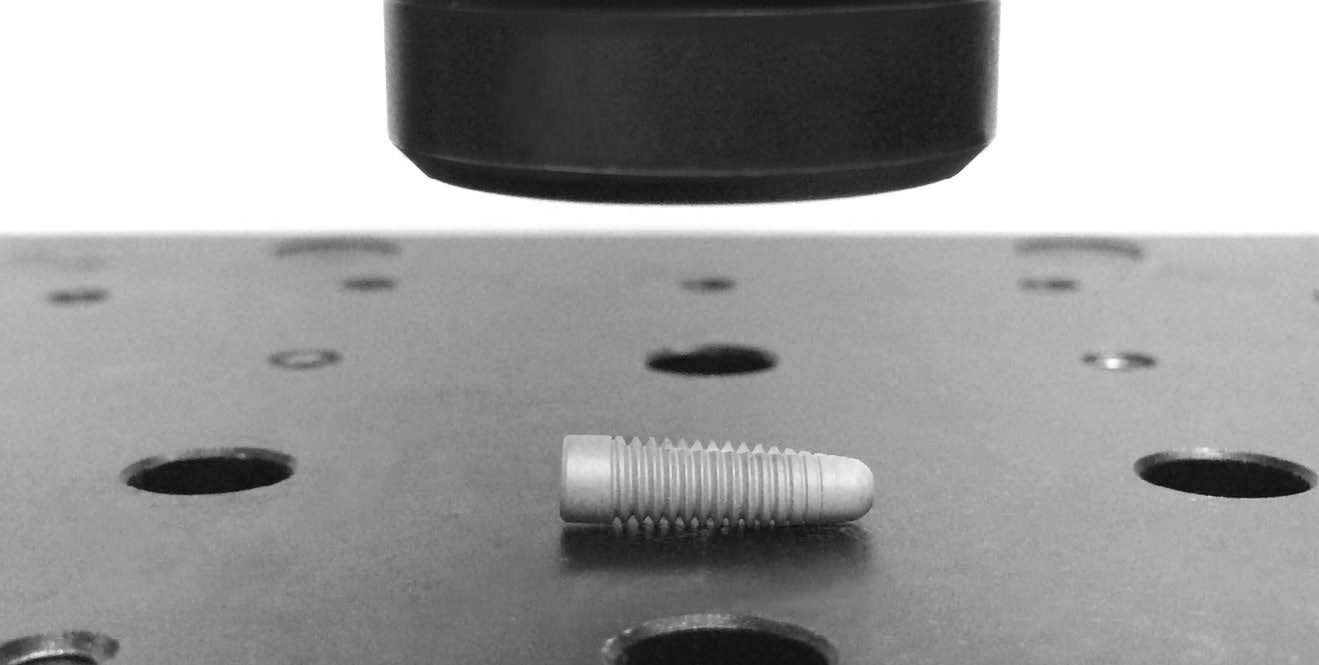
在此应用中,使用 Nanovea ST400 光学轮廓仪在单次测量中沿着平面和螺纹特征测量牙科螺钉。从平坦区域计算表面粗糙度,并确定螺纹特征的各种尺寸。


牙科螺钉质量控制

牙科螺丝样本分析 NANOVEA 光学轮廓仪。


分析牙科螺钉样品。


结果


三维表面

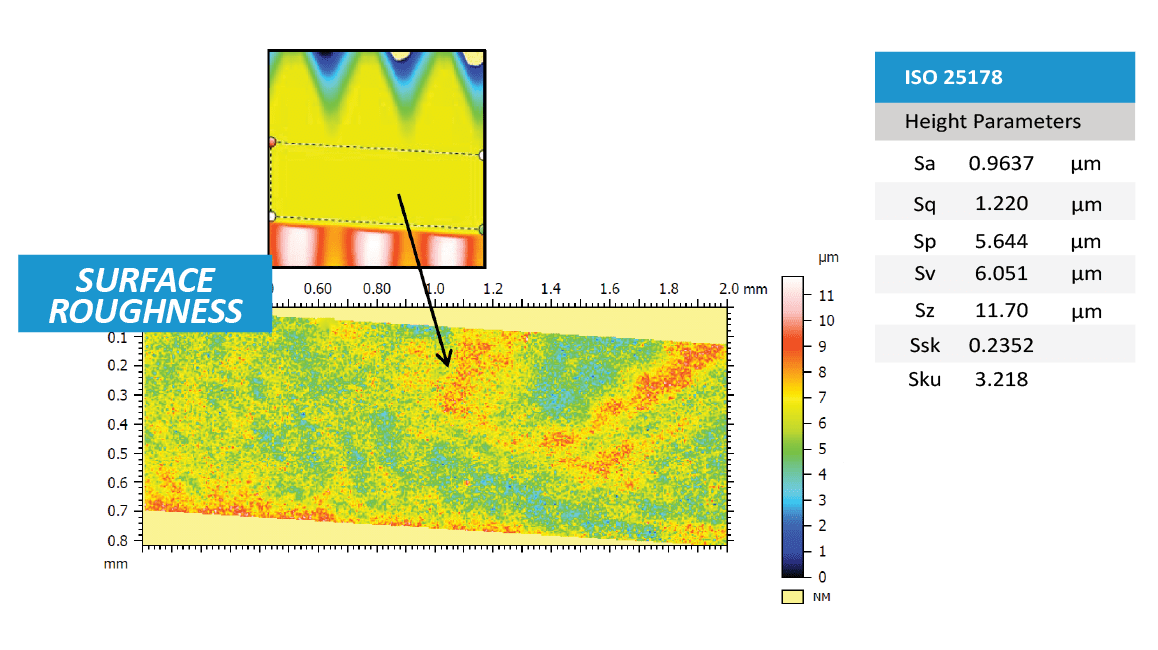
牙科螺钉的 3D 视图和假色视图显示了一个平坦区域,螺纹从两侧开始。它为用户提供了一个简单的工具,可以从不同角度直接观察螺钉的形态。从全扫描中提取平坦区域以测量其表面粗糙度。


2D 表面分析

还可以从表面提取线轮廓以显示螺钉的横截面图。轮廓分析和台阶高度研究用于测量螺钉上特定位置的精确尺寸。


结论


在此应用中,我们展示了 Nanovea 3D 非接触式轮廓仪在单次扫描中精确计算局部表面粗糙度和测量大尺寸特征的能力。

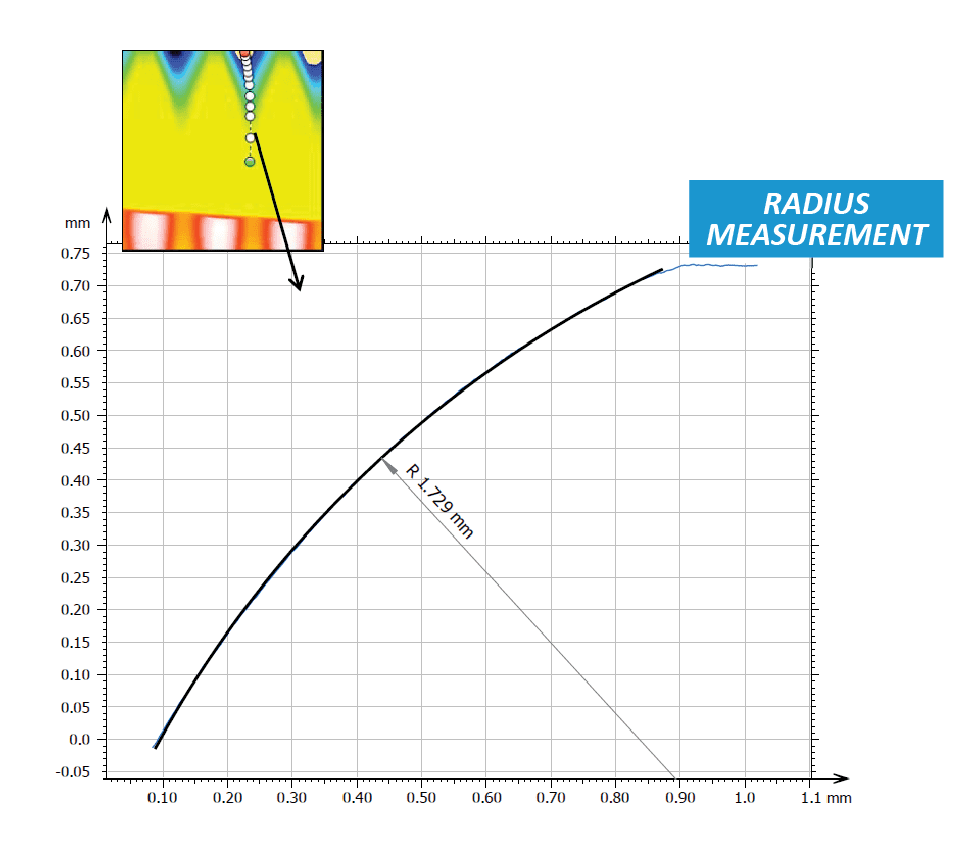
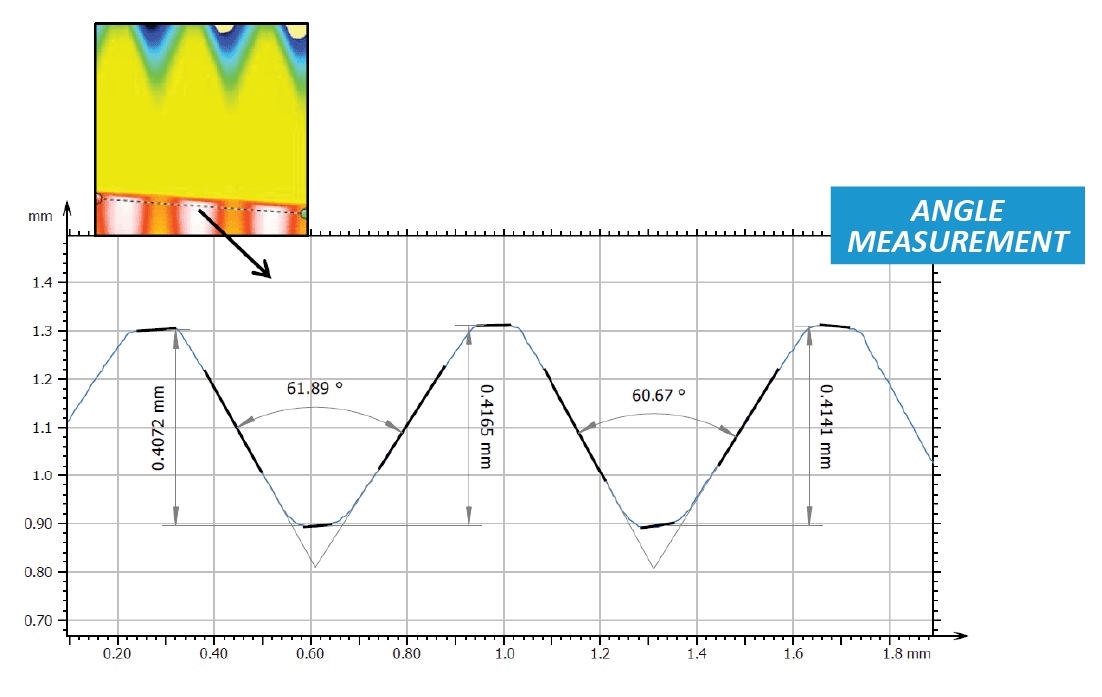
数据显示局部表面粗糙度为 0.9637 μm。螺纹之间的螺钉半径为 1.729 毫米,螺纹平均高度为 0.413 毫米。螺纹之间的平均角度被确定为61.3°。

这里显示的数据仅代表分析软件中可用的一部分计算结果。


编写者
李端杰博士、乔纳森·托马斯和皮埃尔·勒鲁