미국/글로벌: +1-949-461-9292
EUROPE: +39-011-3052-794
문의하기

카테고리: 프로파일 측정 | 기하학 및 도형


stent coating adhesion testing failure analysis drug eluting stent coating

Stent Coating Adhesion and Delamination Analysis Using Nano Scratch Testing

Application Note | Stent Coating Adhesion Testing

Stent Coating Adhesion and Delamination Analysis Using Nano Scratch Testing

Quantifying Coating Failure and Adhesion Performance on Drug-Eluting Stents

stent coating adhesion testing nano scratch delamination critical load

Research & Experimental Testing

Duanjie Li, PhD

Visual Design & Editorial

앤드류 쇼어

소개

Blood is carried through arteries from the heart to the rest of the body. Any weakening or blockage of these vessels can pose significant health risks and may become life-threatening. A stent is a small mesh tube inserted into the lumen of a blood vessel to treat narrowed or weakened arteries. Stent implantation is now a widely used procedure to support the arterial wall and restore blood flowᶦ.
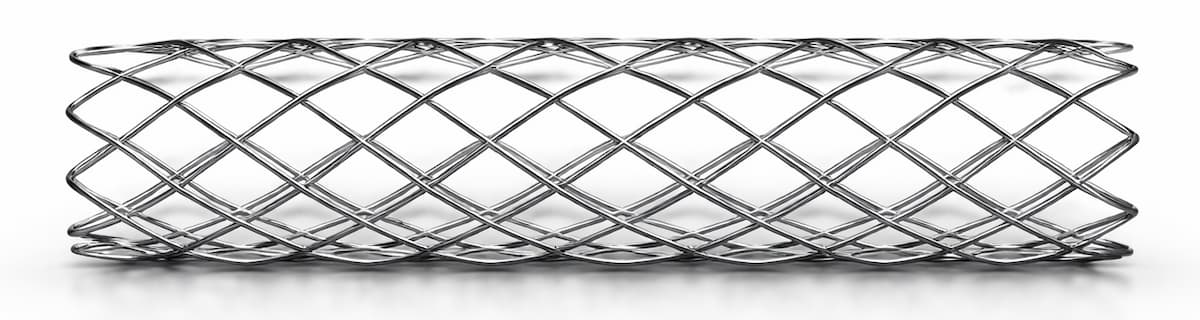
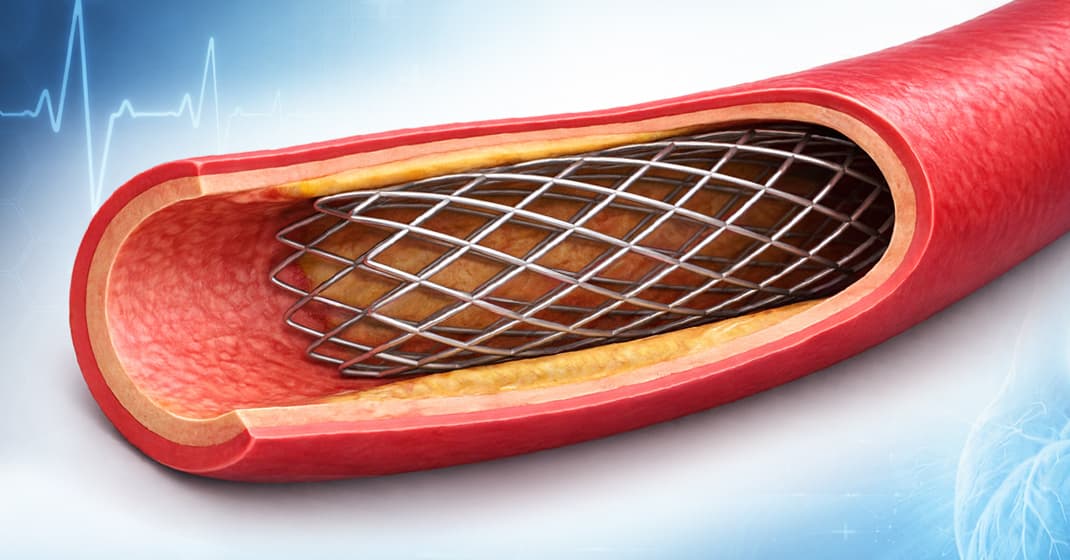
Metal stent mesh geometry illustrating the structural complexity of vascular implant design.

Why coating adhesion matters in drug-eluting stents

Drug-eluting stents represent a major advancement in stent technology. They incorporate a biodegradable, biocompatible polymer coating that enables controlled drug release at the arterial site, helping to inhibit intimal thickening and reduce the risk of restenosisᶦᶦ.

A critical concern in these systems is the delamination of the polymer coating from the metallic stent substrate. This coating carries the drug-eluting layer, and its adhesion directly impacts device performance and reliability.

To improve coating adhesion, stents are often designed with complex geometries. In this study, the polymer coating is located at the bottom of grooves within the stent mesh. This configuration presents a significant challenge for adhesion measurement.

A reliable method is required to quantitatively evaluate the interfacial strength between the polymer coating and the metal substrate. The small diameter of the stent mesh, comparable to a human hair, combined with its three-dimensional geometry, requires:

  • ultrafine X-Y positioning accuracy
  • precise control of applied load
  • accurate depth measurement during testing
Measurement Method

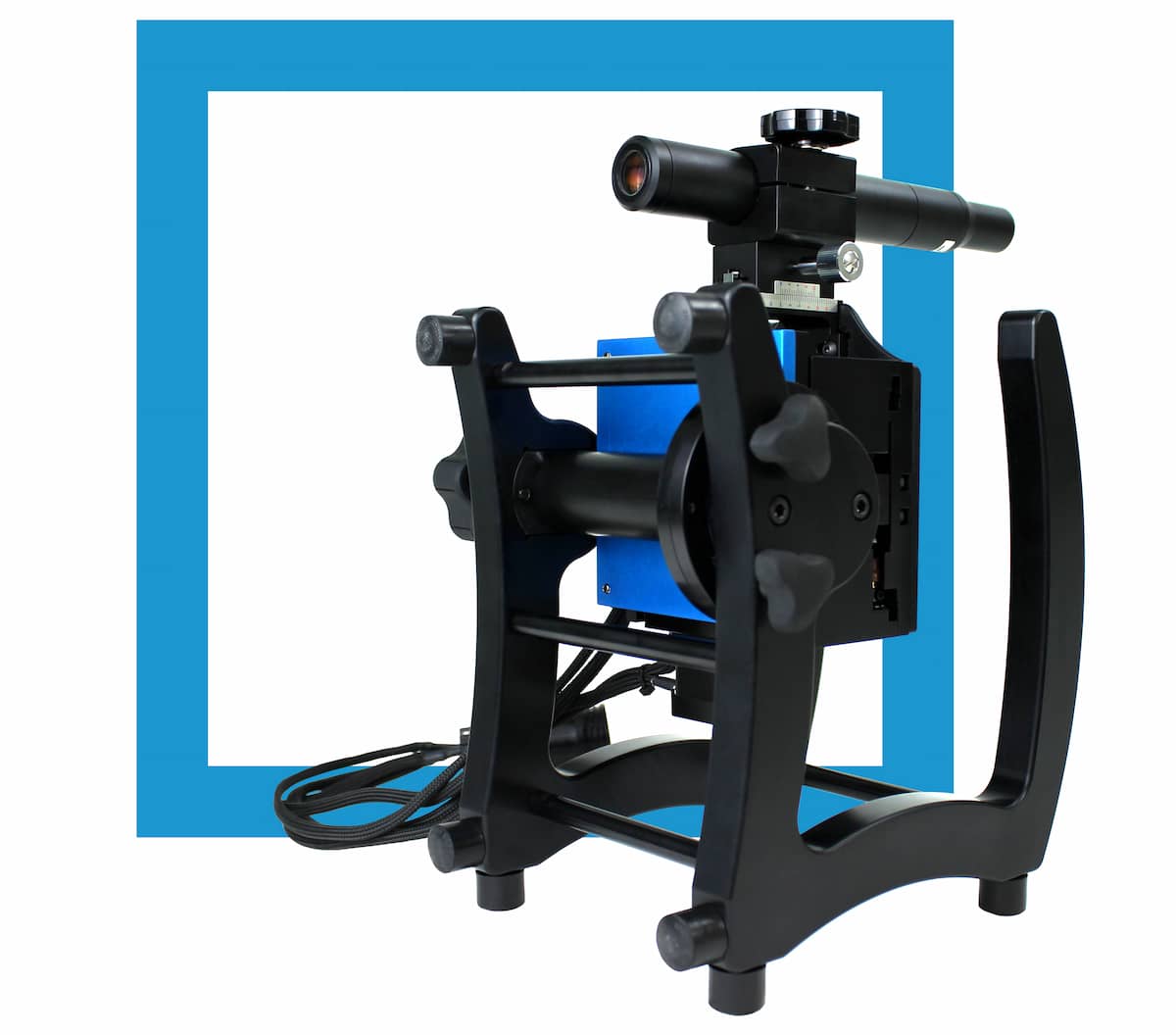
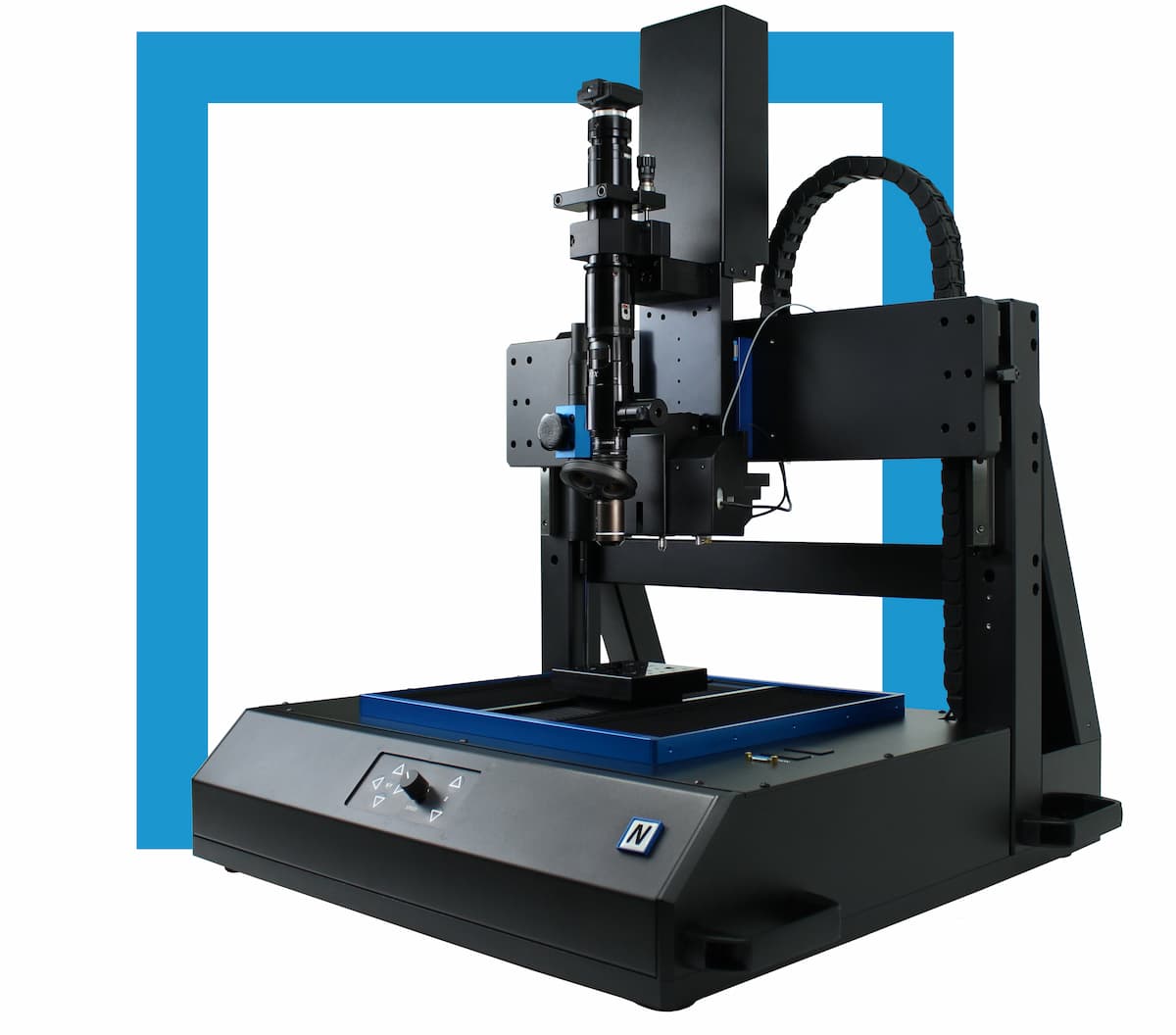
Nano scratch testing is performed using the 나노베아 PB1000 기계식 테스터, in Nano Scratch Mode, to evaluate the cohesive and adhesive strength of the polymer coating on the metal mesh of stent samples.
Controlled scratch measurements are carried out on stent geometries with dimensions comparable to a human hair, enabling precise evaluation of coating adhesion on complex stent structures.

나노비아 PB1000 Advanced

기계 테스터

테스트 조건

1. Regular Stent Samples

The stent is fixed on the sample stage, with a support wire inserted inside the stent tube to ensure stability during nano scratch testing. The NANOVEA Mechanical Tester is used to perform nano scratch measurements using the parameters summarized in Table 1, to evaluate the cohesive and adhesive strength of the polymer coating on the metal substrate.

ParameterValue
Load type프로그레시브
Initial load0.05 mN
Final load300 and 100 mN
Sliding speed0.5 mm/min
Sliding distance0.5 mm
Indenter geometry원뿔형
Indenter material (tip)다이아몬드
들여쓰기 팁 반경20 µm
온도24°C (room)

표 1: Test parameters for nano scratch measurements on regular stent samples

2. Grooved Stent Samples

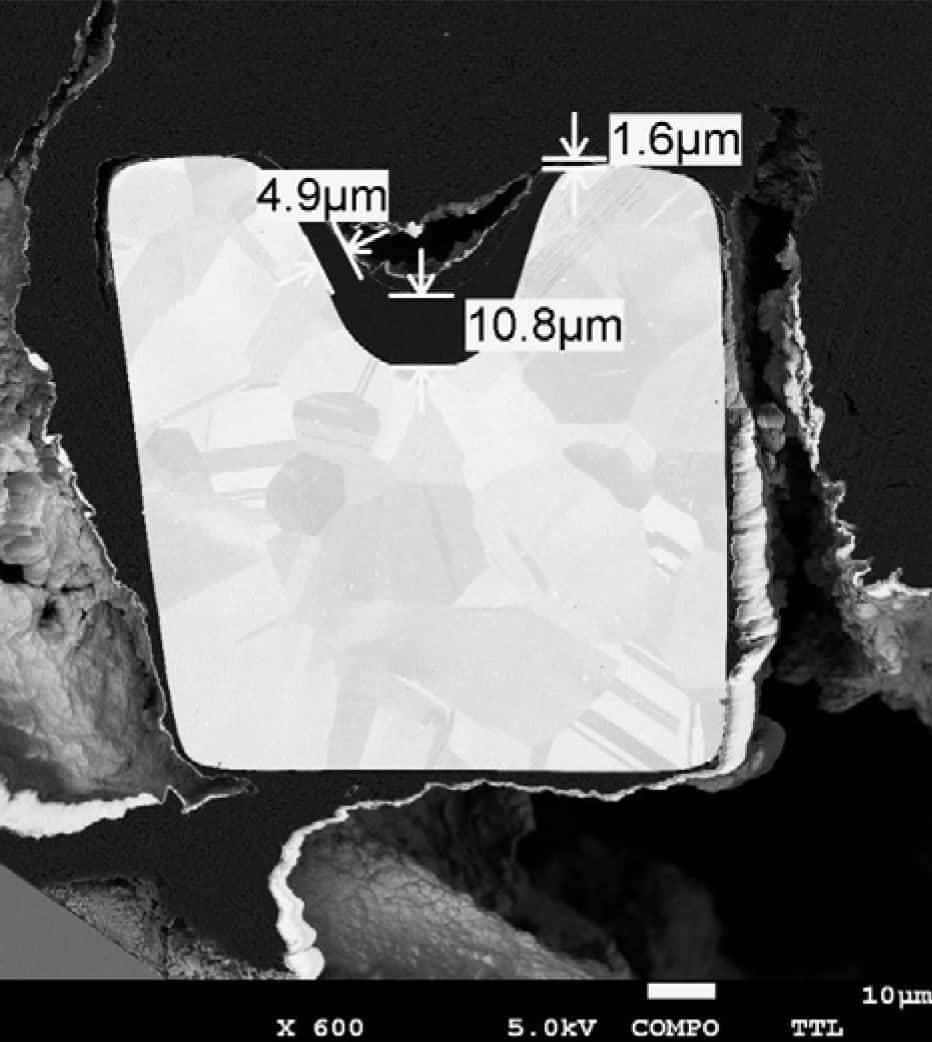
The SEM image in Fig. 1 shows the cross-section of the stent sample. The stent features a groove with a depth of approximately 30 µm. The polymer coating, with a thickness of 10.8 µm, is located at the bottom of the groove.

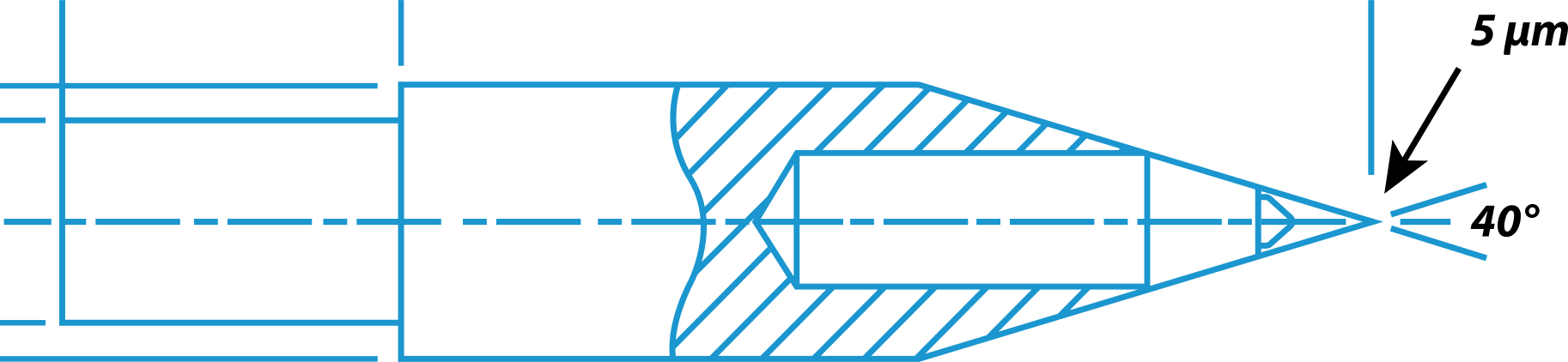
Standard 60° conical diamond tips are not sharp enough to reach the bottom of the groove without contacting the sidewalls. Therefore, a sharper 40° conical diamond tip is used in this study (Fig. 2).

Nano scratch measurements are performed using the parameters summarized in Table 2.

Parameter Value
Load type 프로그레시브
Initial load 0.1 mN
Final load 300 mN
로딩 속도 300 mN/min
Scratch length 0.25 mm
Scratch speed 0.25 mm/min
Indenter geometry 40° cone
Indenter material (tip) 다이아몬드
들여쓰기 팁 반경 5 µm

Table 2: Test parameters for nano scratch measurements on grooved stent samples

stent groove cross section polymer coating thickness adhesion analysis nano scratch testing
Fig. 1: SEM cross-section of a grooved stent showing polymer coating located at the bottom of the groove, highlighting the challenge of coating adhesion measurement in recessed geometries.

nano scratch diamond tip 40 degree stent groove coating adhesion testing schematic
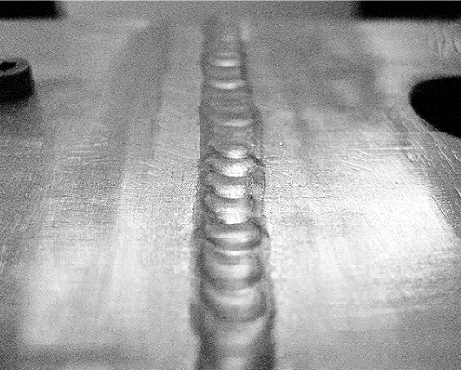
Fig. 2: Schematic of a 40° conical diamond tip designed for nano scratch testing inside stent grooves, enabling accurate adhesion measurement without sidewall interference.
결과 및 토론

The stent mesh has a diameter of approximately 100 μm, comparable to a human hair. Precise positioning is therefore critical to ensure the scratch test is performed at the center of the stent mesh. The NANOVEA Mechanical Tester provides X–Y positioning accuracy down to 0.25 μm, enabling accurate test placement under the integrated optical microscope.

1. Regular Stent Samples

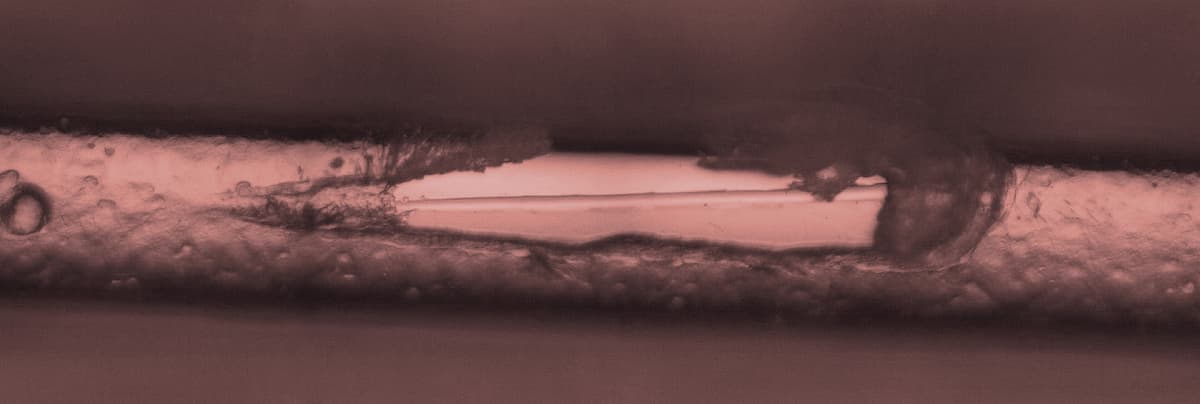
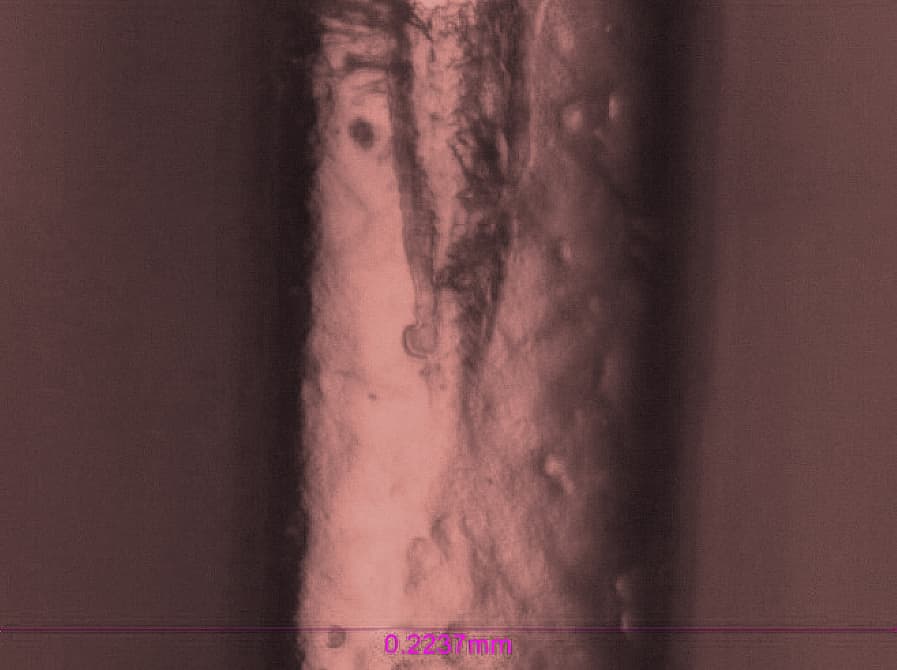
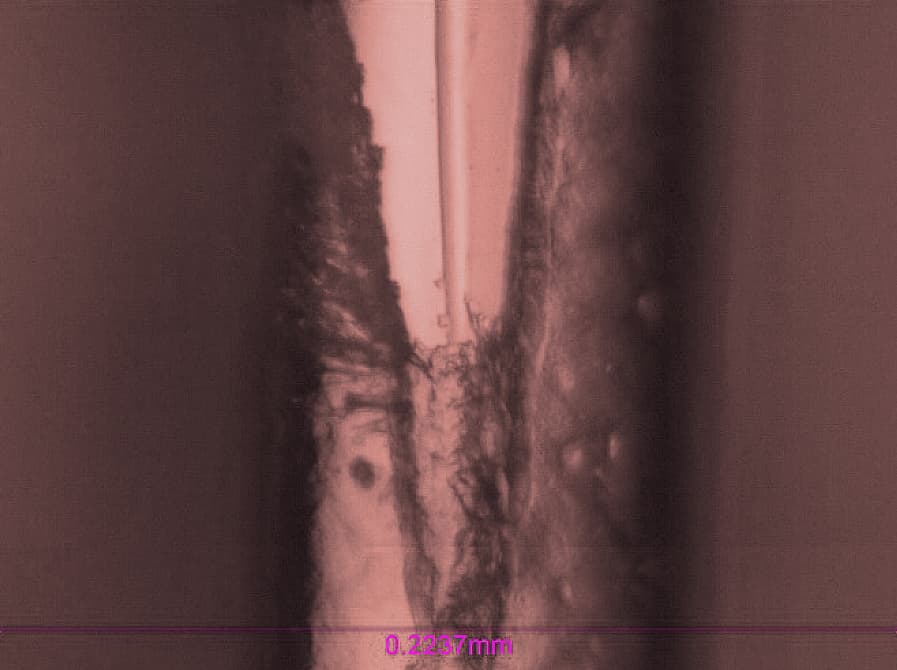
Nano scratch testing is performed with a progressively increasing load up to 300 mN. The full scratch track on the stent is shown in Fig. 3a, while failure behavior at different stages is presented in Fig. 3b and 3c.
Two critical loads are identified:

  • Lc1: the load at which the first visible damage appears on the coating
  • Lc2: the load at which the coating is fully removed and the substrate is exposed
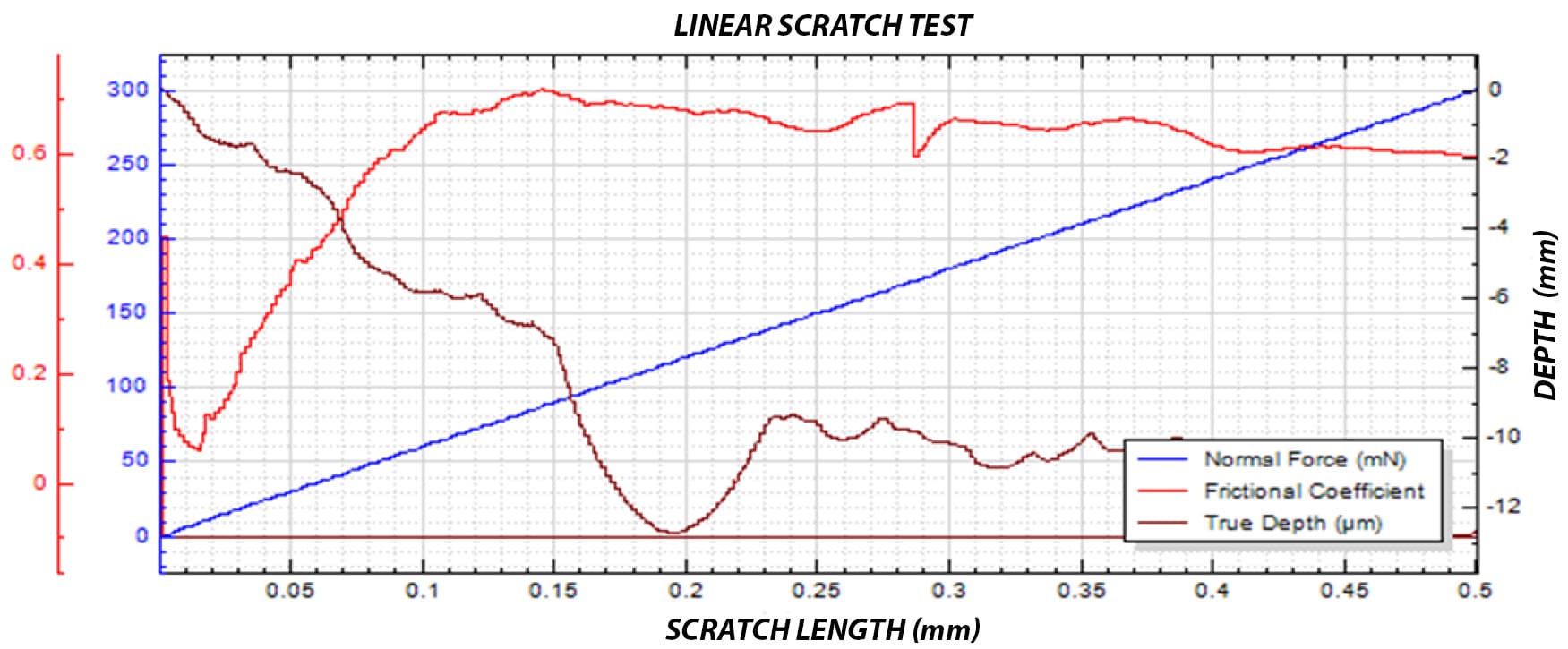
The evolution of coefficient of friction (COF) and penetration depth is shown in Fig. 4, providing insight into the progression of coating failure during the test.

The first signs of coating damage appear at Lc1 ≈ 14.5 mN. As the applied load increases, the diamond tip progressively penetrates the polymer coating, resulting in a wider and deeper scratch track. During this phase, the COF increases from approximately 0.05 to 0.7.

At Lc2 ≈ 78.1 mN, the coating is fully delaminated from the metal substrate. Beyond this point, as the load continues to increase, both COF and penetration depth remain relatively stable due to the mechanical support of the underlying metal substrate.

nano scratch track stent coating progressive load adhesion testing
(a) Full Scratch Track

(b) Lc1 ≈ 14.5 mN

stent coating delamination lc2 nano scratch 78.1 mN adhesion testing

(c) Lc2 ≈ 78.1 mN

Fig. 3: Nano scratch track on a stent coating under progressively increasing load, showing (a) full scratch path, (b) initial coating failure at Lc1 ≈ 14.5 mN, and (c) complete coating delamination at Lc2 ≈ 78.1 mN.

nano scratch testing stent coating coefficient of friction depth progression adhesion failure
Fig. 4: Evolution of coefficient of friction (COF) and penetration depth during nano scratch testing of a stent coating under progressively increasing load, showing the progression of coating failure and transition to substrate support.
Failures during nano scratch testing up to a maximum load of 300 mN occur at critical loads below 100 mN. To enable a more quantitative comparison of coating performance, additional tests are performed with a maximum load of 100 mN on two stent samples, referred to as Sample 1 and Sample 2.

Fig. 5 compares the scratch tracks of Sample 1 and Sample 2 after nano scratch testing. Sample 1 exhibits the first sign of coating damage at a critical load of Lc1 ≈ 13.2 mN, while Sample 2 shows initial failure at a higher load of Lc1 ≈ 21.1 mN.

Coating delamination occurs at 62.5 mN for Sample 1. In contrast, the coating on Sample 2 remains intact throughout the test, continuing to protect the metal substrate under the same loading conditions.

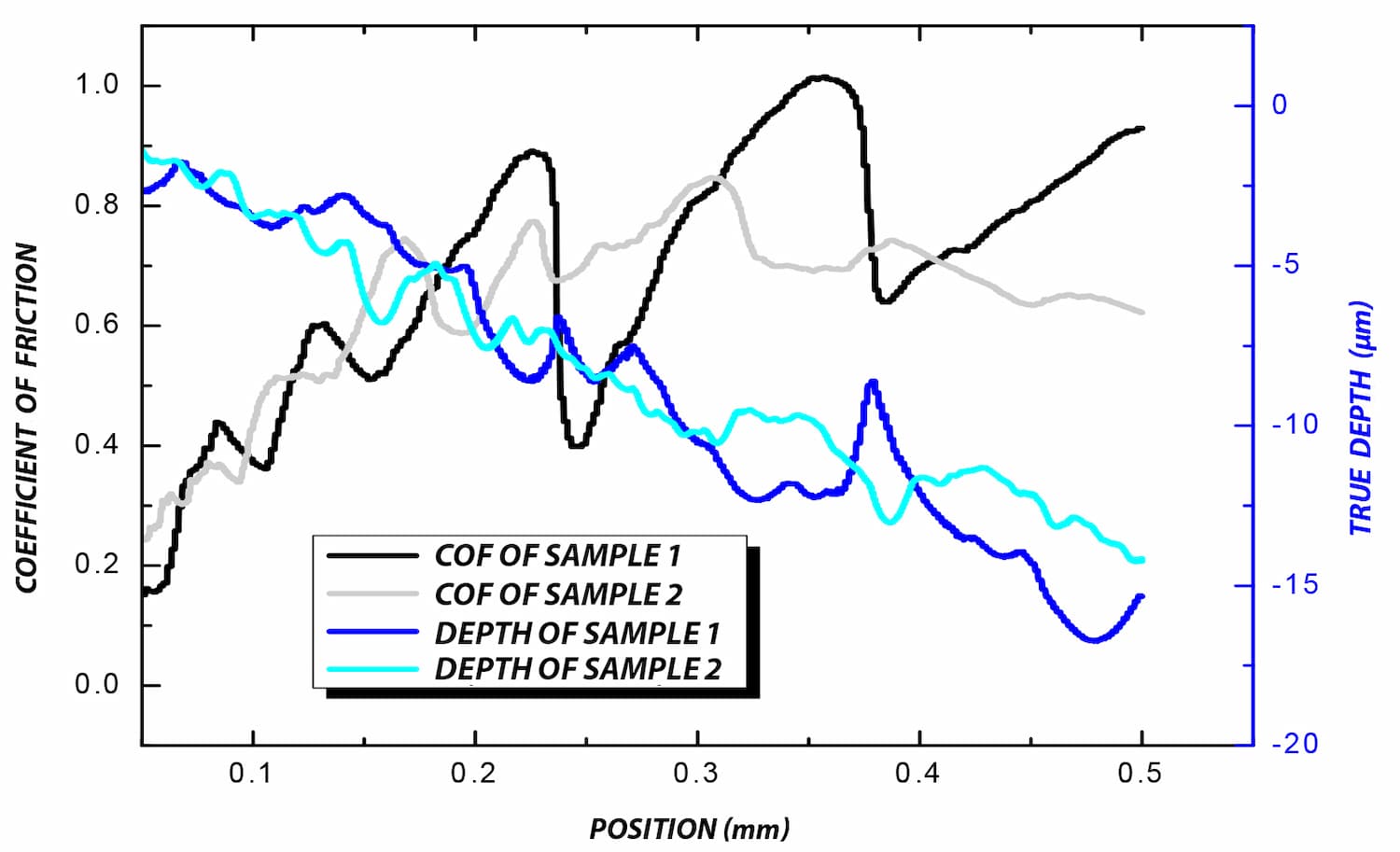
This behavior is further reflected in the evolution of coefficient of friction (COF) and penetration depth, as shown in Fig. 6. When the diamond tip penetrates through the coating and contacts the metal substrate in Sample 1, the COF reaches a peak while the penetration depth decreases due to the increased stiffness of the underlying substrate.

stent coating sample 1 early failure nano scratch track delamination adhesion testing

(a) Sample 1 – Early Coating Failure

stent coating sample 2 high adhesion nano scratch track minimal damage testing

(b) Sample 2 – Improved Coating Integrity

Fig. 5: Comparison of nano scratch tracks for two stent coatings, showing (a) early coating failure and delamination in Sample 1, and (b) improved coating integrity in Sample 2 under the same loading conditions.

nano scratch testing stent coating COF depth comparison sample 1 sample 2 adhesion performance

Fig. 6: Comparison of coefficient of friction (COF) and penetration depth for Sample 1 and Sample 2 during nano scratch testing, showing earlier substrate contact and higher friction response in Sample 1, indicating weaker coating adhesion.

2. Grooved Stent Samples

As shown in Fig. 1 and Fig. 7, the grooved stent mesh has a diameter of approximately 90 μm, comparable to a human hair. The groove has a width of ~50 μm and a depth of 30 μm. This geometry presents a significant challenge for nano scratch testing, particularly for evaluating coating adhesion at the bottom of the groove.

Precise positioning is critical to locate the scratch test within the groove. The nano scratch test is performed with a progressively increasing load up to 300 mN. The full scratch tracks of grooved stent Samples 3 and 4 are compared in Fig. 7.

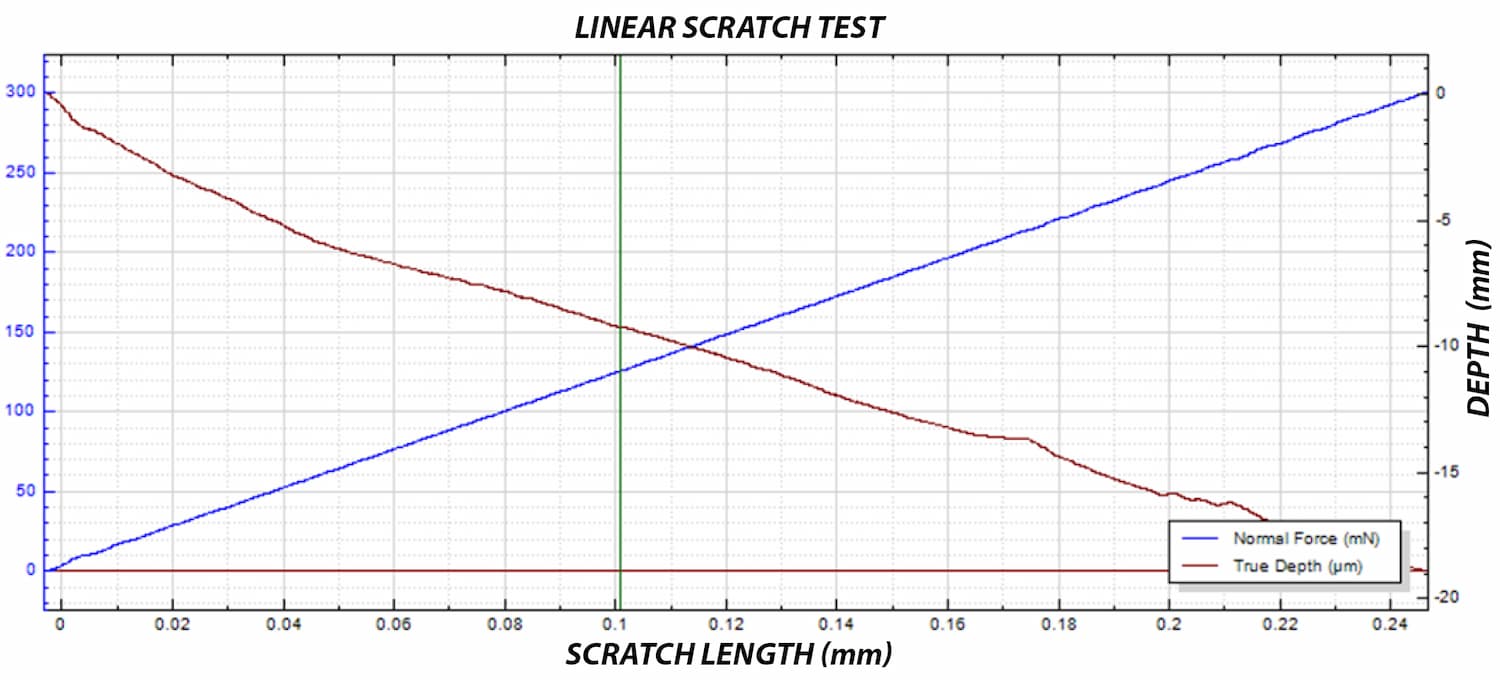
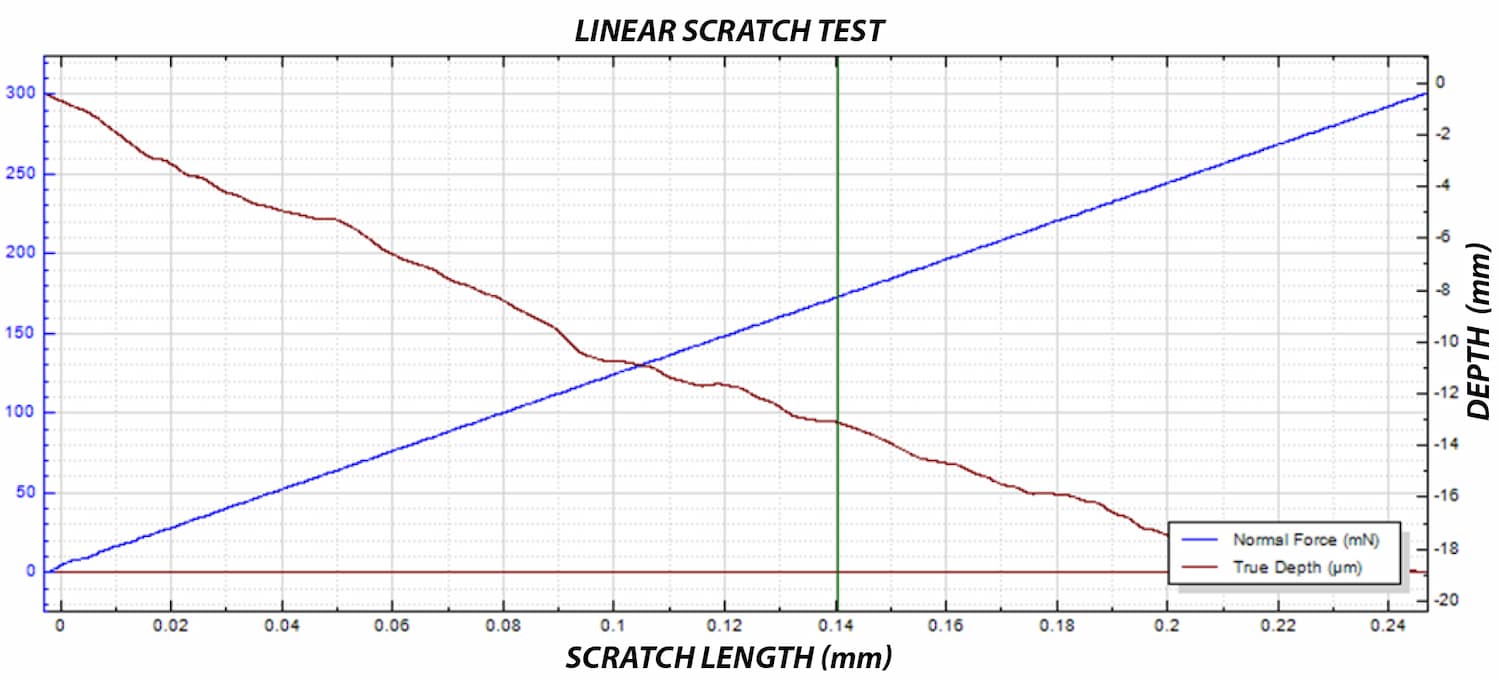
The critical load Lc is defined as the load at which the coating fails and the substrate becomes exposed. The evolution of normal load and penetration depth, shown in Fig. 8, provides further insight into the progression of coating failure during testing.

As the applied load increases, the diamond tip progressively penetrates the polymer coating, resulting in a deeper scratch track. When the critical load Lc is reached, the coating delaminates from the metal substrate.

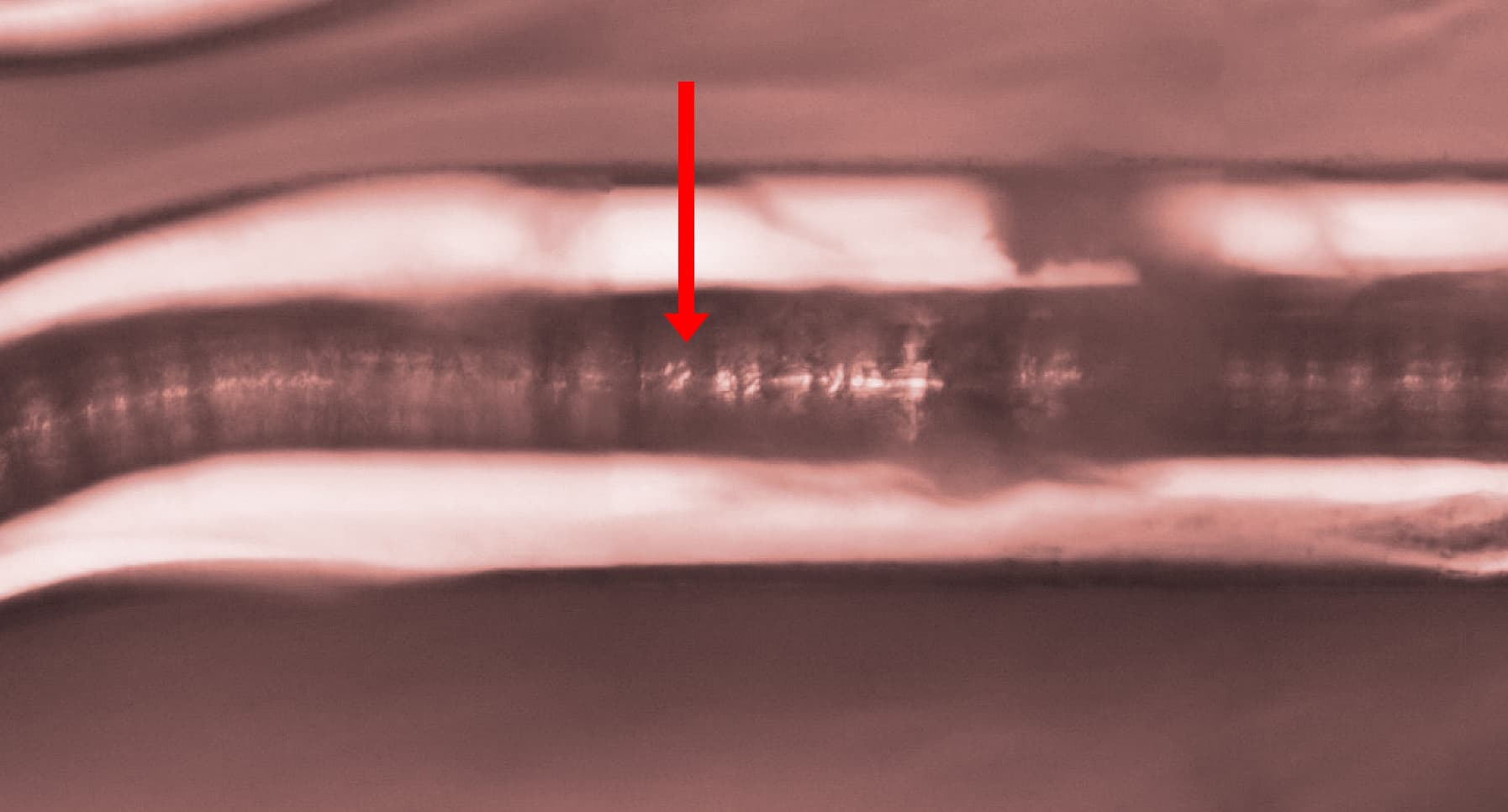
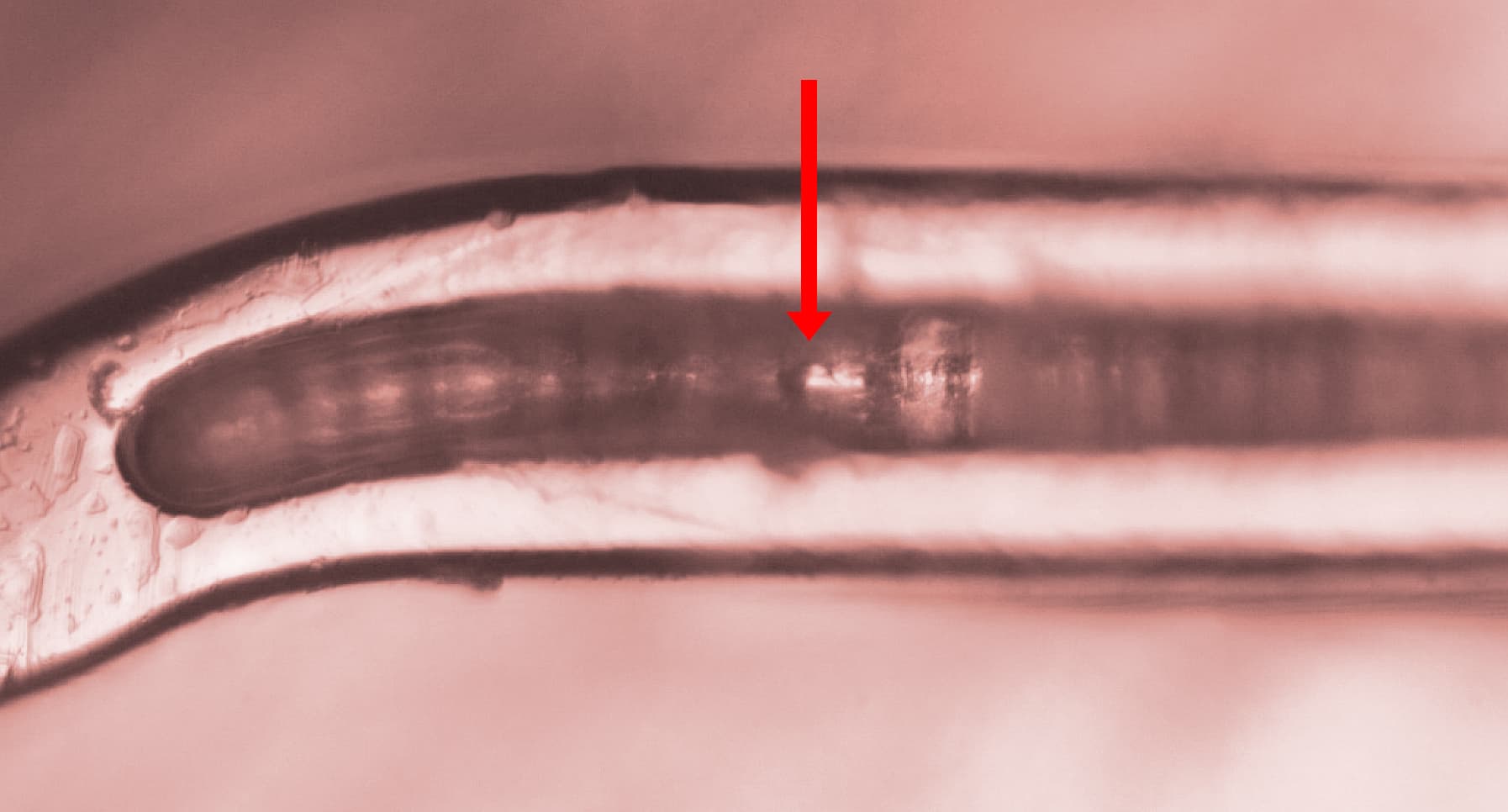
Sample 3 exhibits coating failure at Lc ≈ 126 mN, while Sample 4 fails at a higher load of Lc ≈ 173 mN. This difference indicates stronger adhesion of the coating in Sample 4.

The measured critical loads enable quantitative comparison of coating adhesion performance. Under the same testing conditions, the coating on Sample 4 demonstrates higher resistance to delamination, making it the better-performing candidate in this study.

stent groove coating failure sample 3 nano scratch 126 mN adhesion testing

(c) Sample 3 – Coating Failure in Groove (Lc ≈ 126 mN)

stent groove coating adhesion sample 4 nano scratch 173 mN minimal failure testing

(d) Sample 4 – Higher Adhesion in Groove (Lc ≈ 173 mN)

Fig. 7: Nano scratch tracks inside stent grooves for Samples 3 and 4, showing (c) coating failure at Lc ≈ 126 mN in Sample 3 and (d) higher adhesion with delayed failure at Lc ≈ 173 mN in Sample 4.

(a) Sample 3 – Earlier Coating Failure (Lc ≈ 126 mN)

(b) Sample 4 – Delayed Failure and Higher Adhesion (Lc ≈ 173 mN)

Fig. 8: Evolution of normal load and penetration depth during nano scratch testing inside stent grooves for Samples 3 and 4, showing earlier coating failure in Sample 3 and delayed failure at higher load in Sample 4. The vertical green line indicates the critical load (Lc) where coating delamination occurs.

결론

This study demonstrates the ability of the NANOVEA Mechanical Tester to quantitatively evaluate the cohesive and adhesive strength of polymer coatings on both regular and grooved stent geometries using nano scratch testing.

The recessed geometry of the stent grooves, approximately 50 μm wide and 30 μm deep, presents a significant challenge for coating adhesion measurement. The high X–Y positioning accuracy of 0.25 μm enables precise placement of the scratch test within these confined regions, allowing direct evaluation of coating performance where failure is most critical.

By applying a controlled, progressively increasing load, critical loads associated with coating failure can be identified and compared across samples. This approach enables reliable differentiation of coating adhesion performance and interfacial integrity, even on small, complex stent structures.

참조

[I] http://www.nhlbi.nih.gov/health/health-topics/topics/stents
[II] http://www.scielo.org.mx/scielo.php?script=sci_arttext&pid=S1405-99402006000300008

Frequently Asked Questions About Stent Coating Adhesion Testing

What is stent coating adhesion testing?

Stent coating adhesion testing evaluates how strongly a polymer coating is bonded to the metal substrate of a stent. Techniques such as nano scratch testing quantify the load at which coating damage and delamination occur, providing measurable indicators of adhesion strength.

What is critical load (Lc) in nano scratch testing?

Critical load (Lc) is the applied load at which a coating fails during a scratch test.

  • Lc1 corresponds to the first visible damage in the coating
  • Lc2 indicates complete coating removal and exposure of the substrate

These values are used to quantify and compare coating adhesion performance.

Why is coating adhesion important in drug-eluting stents?

Coating adhesion directly affects the reliability of drug-eluting stents. Poor adhesion can lead to coating delamination, which may compromise controlled drug release and increase the risk of device failure.

How do you measure coating adhesion inside stent grooves?

Measuring adhesion inside stent grooves requires high positioning accuracy and appropriate indenter geometry. Nano scratch testing with sharp diamond tips allows access to recessed coating regions, enabling direct evaluation of adhesion within complex stent geometries.

What does coefficient of friction (COF) indicate in scratch testing?

The coefficient of friction (COF) reflects changes in surface interaction during the scratch test. A sudden increase in COF often indicates coating failure and contact between the indenter and the underlying metal substrate.

How can nano scratch testing compare different coating formulations?

Nano scratch testing enables direct comparison of coatings by measuring critical loads under controlled conditions. Higher critical loads indicate stronger adhesion and improved resistance to delamination, allowing selection of better-performing coating systems.

Dentist holding dental model for tooth surface roughness analysis and 3D reconstruction

Dental Surface Roughness Measurement & 3D Tooth Topography

Application Note | Dental Surface Characterization

Dental Surface Roughness Measurement and Full 3D Tooth Topography

Surface Roughness Analysis Using Non-Contact Optical Profilometry

Dental surface roughness measurement and 3D molar reconstruction using optical profilometry

작성자

Walter Alabiso, PhD; Davide Morrone, MPhys; Andrew Shore, MA

소개

The ability to accurately characterize tooth surfaces, including micro-roughness and 3D surface topography at the nanometer scale, enables advanced research and applications in orthodontics and dental materials science. Non-contact optical profilometry provides a precise method for measuring dental surface roughness and analyzing tooth surface morphology without damaging delicate structures. These measurements support the development of composite dental materials that replicate the natural surface roughness of enamel, as well as the design and fabrication of patient-specific dental casts and restorative components.

Low surface roughness plays a primary role in limiting bacterial adhesion and plaque formation, thereby reducing the risk of cavities. An increase in average roughness (Ra) above 2 µm leads to a steep increase in biofilm formation in vivo.¹ An Ra of 0.2 µm is considered the threshold value below which no further reduction in bacterial adhesion can be expected.²

Reconstruction of the tooth’s 3D surface topography enables the fabrication of dental casts, which are essential for accurate diagnosis, treatment planning, and the fabrication of dental appliances.

Non-Contact Optical Profilometry for Dental Surface Analysis

The present study illustrates the potential of NANOVEA’s high-precision non-contact optical profilometers for dental surface roughness measurement and 3D tooth topography analysis. Chromatic Light technology offers significant advantages over classical touch probe techniques. It acquires data points from deep crevices and complex geometries without introducing measurement errors or artifacts caused by local plastic deformation and without requiring extensive data manipulation.

Compared to focus variation systems, single-point optical sensing provides superior lateral and height accuracy, with X/Y resolution below 0.5 µm, maximum vertical resolution of 1.9 nm, and the ability to measure surface angles up to 87°. The technique is effective on transparent, opaque, specular, diffusive, polished, and rough dental surfaces, making it well suited for comprehensive dental surface characterization.

Measurement Method

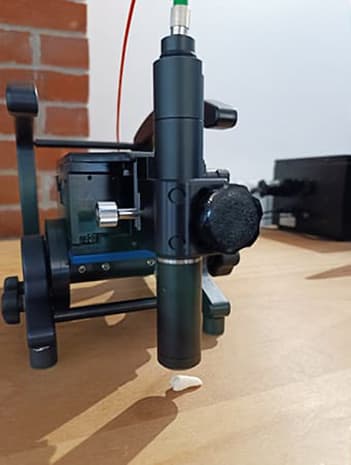
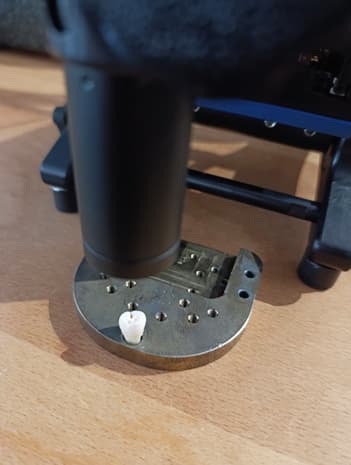
이 애플리케이션에서는 NANOVEA JR25 Non-Contact Optical Profiler was used to analyze the surface roughness and 3D surface topography of an adult human molar previously affected by tooth decay. The side of the tooth was scanned using a PS2–MG140 single-point optical sensor to measure surface roughness parameters over a defined region of interest and along multiple line profiles.

The crown of the tooth was then scanned and reconstructed using a PS5–MG35 single-point optical sensor, which is suited for larger-area acquisition and full 3D tooth topography measurement.


나노비아 JR25 Portable
광학 프로파일로미터

Surface Measurement Using NANOVEA Optical Profilometer

Surface roughness measurements were performed on the lateral side of the molar crown, followed by full 3D reconstruction of the crown surface. Separate single-point optical sensors were used to optimize measurement accuracy for both localized roughness analysis and large-area surface topography acquisition.

PS2 – MG140

Surface roughness analysis by area and parallel line profiles on the side of the tooth’s crown.

PS5 – MG35

Full 3D surface reconstruction of the tooth’s crown.

측정 매개변수

The following measurement parameters were used for localized surface roughness analysis and full 3D surface reconstruction of the molar crown using NANOVEA single-point optical sensors.

ParameterRoughness Analysis (Area)Roughness Analysis (Profiles)Full 3D Reconstruction
Optical PenPS2-MG140PS2-MG140PS5-MG35
Z-Range [µm]30030010000
X-Distance [mm]2.003.007.50
X-Step Size [µm]1.701.7010.00
Y-Distance [mm]2.001.007.00
Y-Step Size [µm]1.70100.0010.00
Average (Avg)111
Measurement TypeDirectDirectDirect
Acquisition ModeSingle FrequencySingle FrequencyDouble Frequency
Acquisition Rate [Hz]200200100–400
Light Intensity [%]100100100

Optical Profilometry Results

Surface Roughness Analysis (Area)

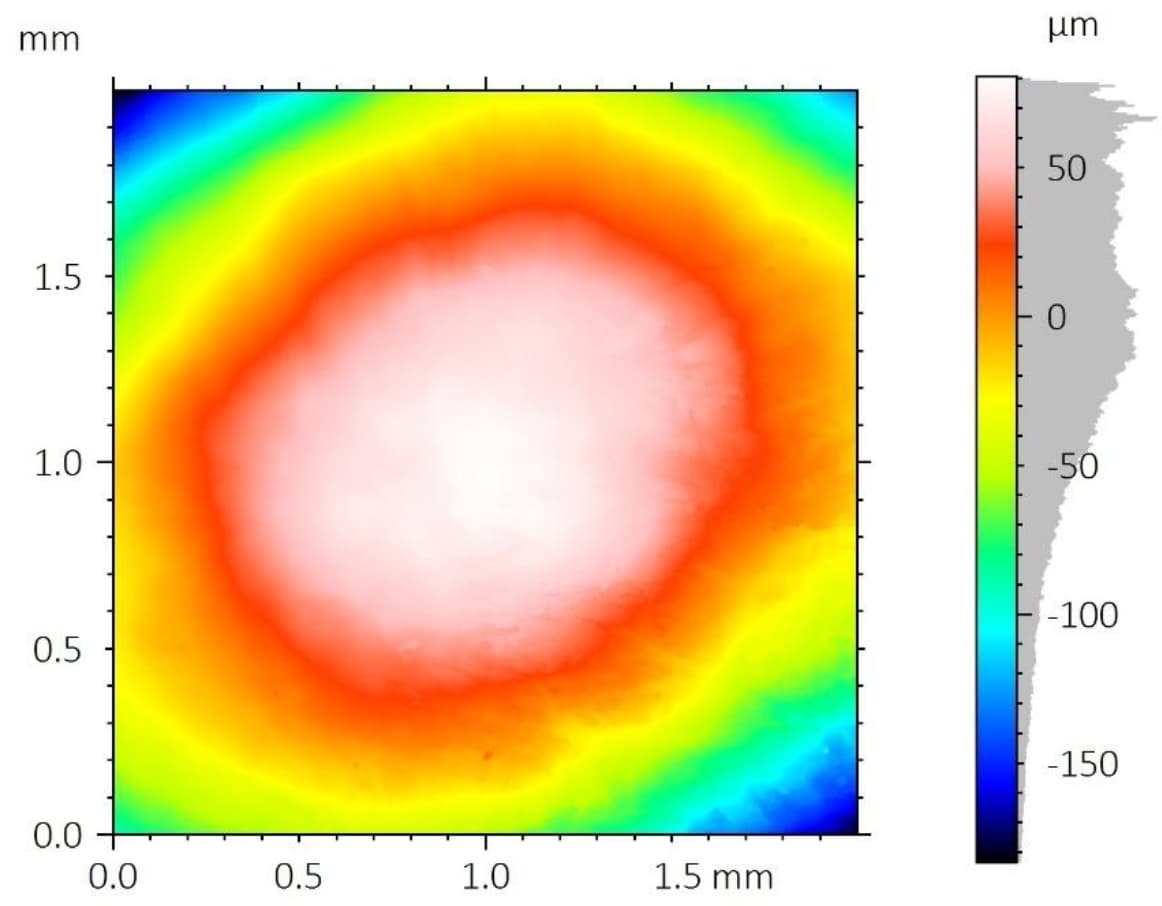
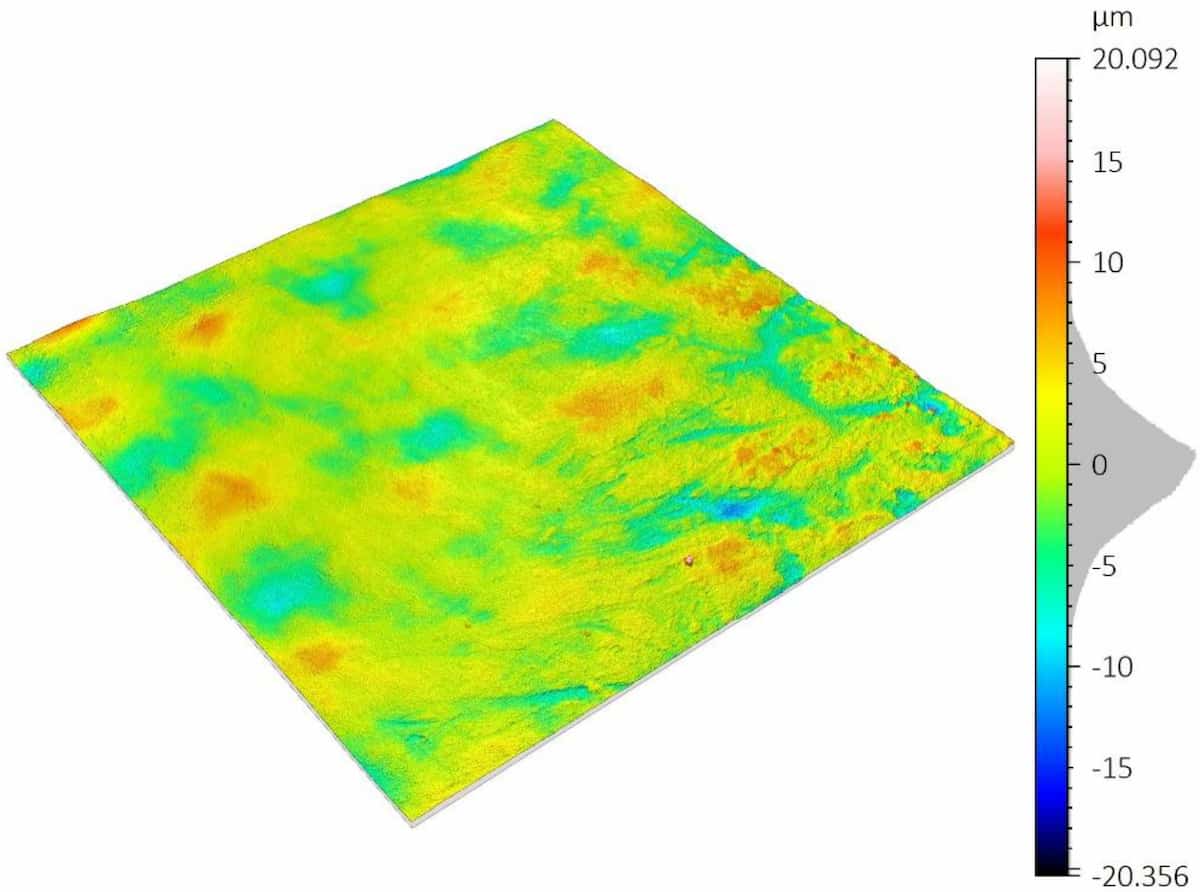
The PS2 single-point optical sensor was used to investigate fine surface features on the side of the tooth. The image below shows a false-color 2D surface map of the scanned region obtained by non-contact optical profilometry.

False-color 2D height map of scanned tooth surface region

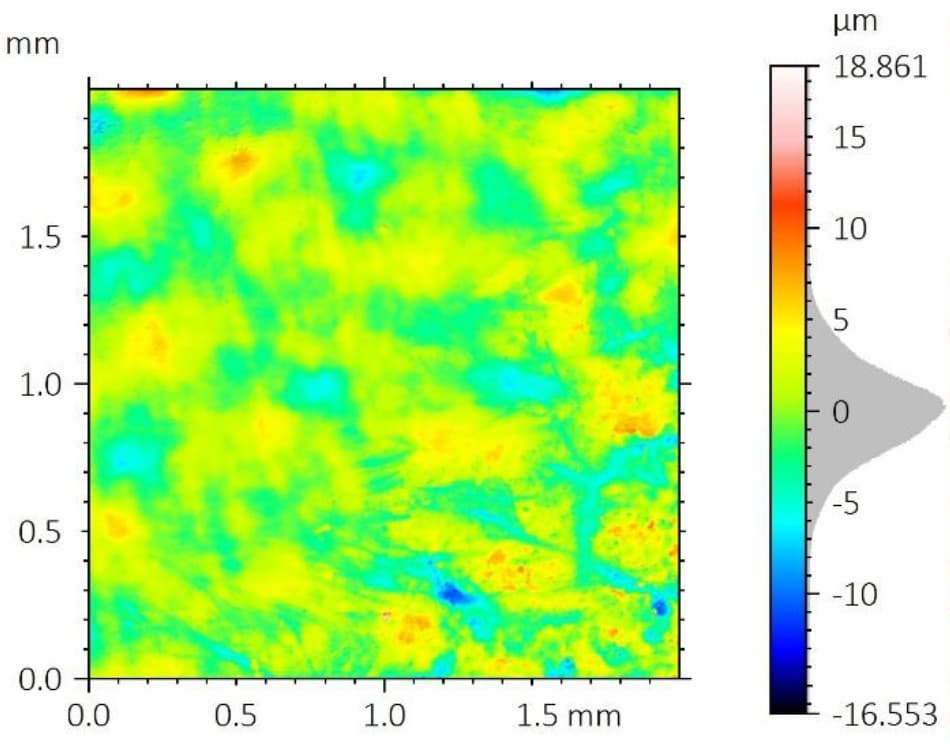
A least-squares degree-8 polynomial form removal was applied to isolate the surface roughness component. The roughness filters S-Gaussian 2.5 µm and L-Gaussian 0.8 mm were then applied according to ISO 25178. The resulting filtered surface and corresponding roughness parameters are presented below.

ISO 25178 – Roughness (S-L)
S-filter (λs): Gaussian, 2.5 µm
F: [Workflow] Form removed (LS-poly 8)
L-filter (λc): Gaussian, 0.8 mm
Height Parameters
Sq2.433µm제곱 평균 제곱근 높이
Ssk-0.102 기울기
SKU3.715 첨도
Sp18.861µm최대 피크 높이
Sv16.553µmMaximum pit depth
Sz35.414µm최대 높이
Sa1.888µm산술 평균 높이

The average surface roughness Sa is 1.888 µm, while the peak-to-valley height Sz reaches 35.414 µm.

A 3D surface rendering of the filtered area is shown below for visualization.

3D rendering of ISO 25178 filtered tooth surface roughness

Roughness Analysis (Profiles)

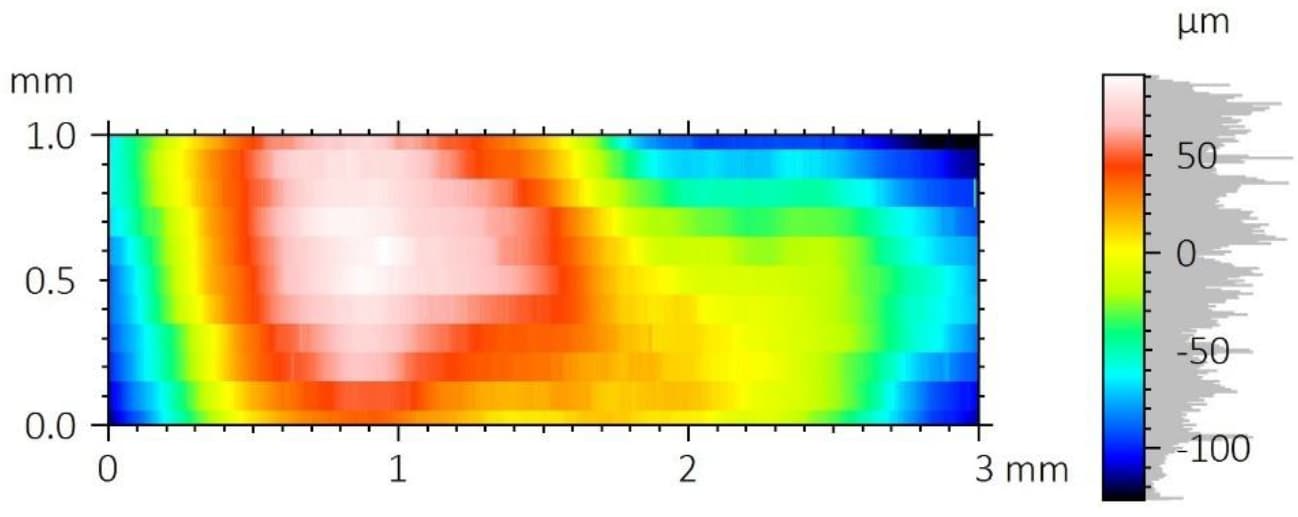
Surface roughness profiles were measured using a series of 11 parallel line scans along the X direction on the side of the tooth. The false-color 2D surface map of the raw scan is shown below.

False-color 2D raw scan of tooth surface for line roughness profiles

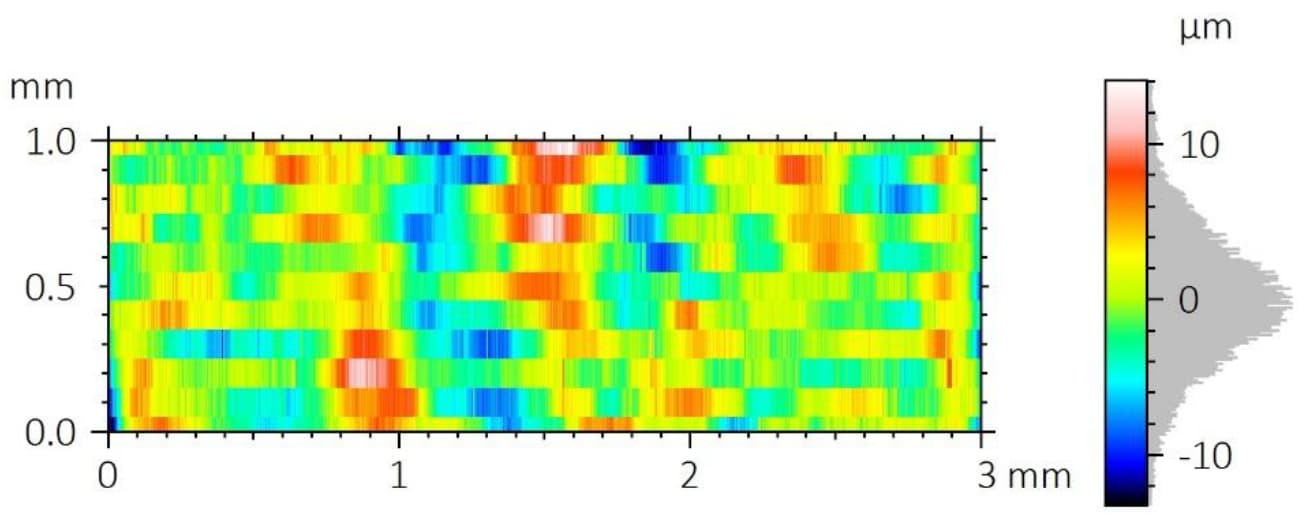
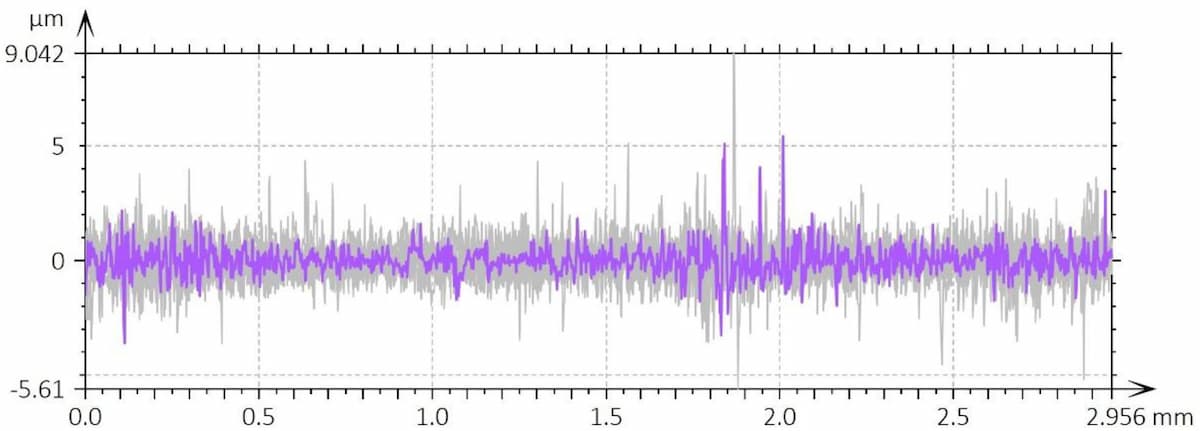
The surface form was removed using a least-squares 8-degree polynomial prior to applying the metrological filters, leaving the residual surface shown below.

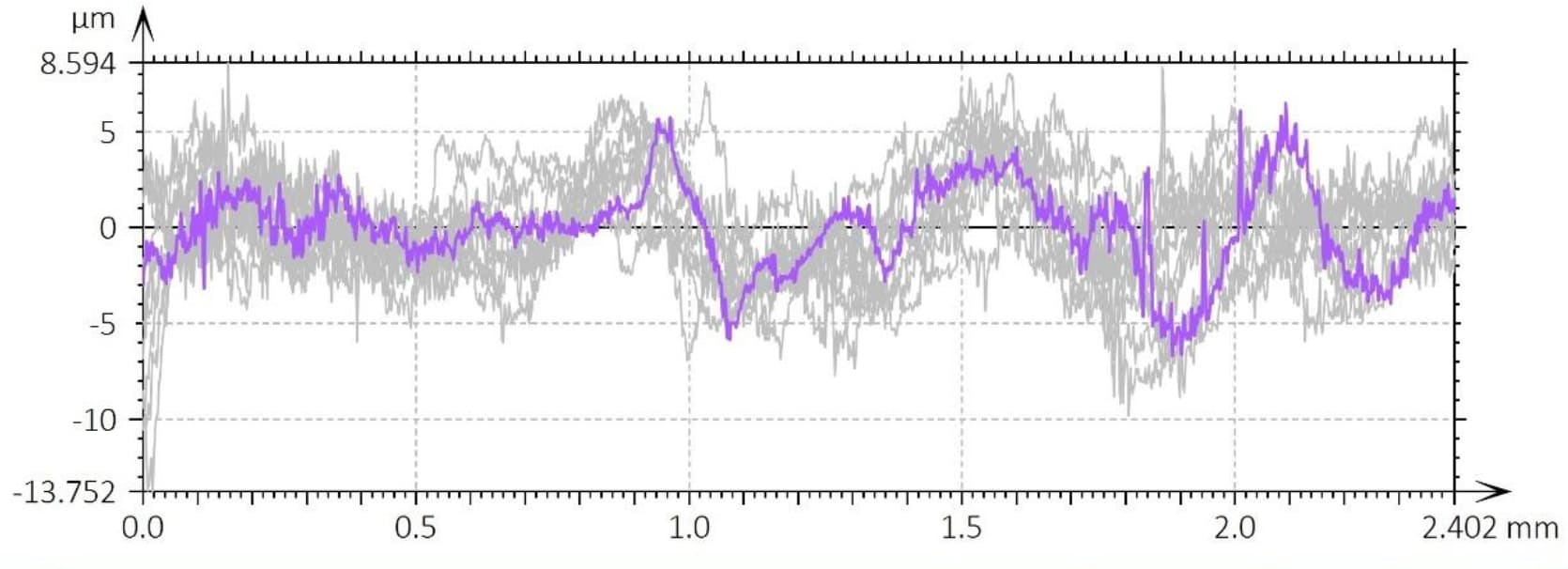
A statistical analysis of the measured surface roughness profiles reveals the following line roughness parameters.

Overlay of multiple tooth surface roughness profiles for statistical analysis

ISO 4287 – Roughness (S-L)
F: 없음
S-filter (λs): Gaussian, 2.5 µm
L-filter (λc): Gaussian, 0.8 mm
Evaluation length: All λc (3)
Amplitude Parameters – Roughness Profile
  DescriptionMeanStd devMinMax
RpµmMaximum peak height of the roughness profile5.6830.7614.3156.610
RvµmMaximum valley depth of the roughness profile6.2421.0094.7018.438
RzµmMaximum height of roughness profile11.9251.6769.12315.048
RaµmArithmetic mean deviation of the roughness profile2.0630.2971.7102.629
RqµmRoot-mean-square (RMS) deviation of the roughness profile2.5230.3612.0573.175

ISO 4287 – Roughness (S-L)
F: 없음
S-filter (λs): Gaussian, 2.5 µm
L-filter (λc): Gaussian, 0.8 mm
Evaluation length: All λc (3)
Amplitude Parameters – Roughness Profile
Rpµm
Maximum peak height of the roughness profile
Mean5.683
Std dev0.761
Min4.315
Max6.610
Rvµm
Maximum valley depth of the roughness profile
Mean6.242
Std dev1.009
Min4.701
Max8.438
Rzµm
Maximum height of roughness profile
Mean11.925
Std dev1.676
Min9.123
Max15.048
Raµm
Arithmetic mean deviation of the roughness profile
Mean2.063
Std dev0.297
Min1.710
Max2.629
Rqµm
Root-mean-square (RMS) deviation of the roughness profile
Mean2.523
Std dev0.361
Min2.057
Max3.175

The value of Ra is consistent with the Sa value extracted from the surface area measurement.

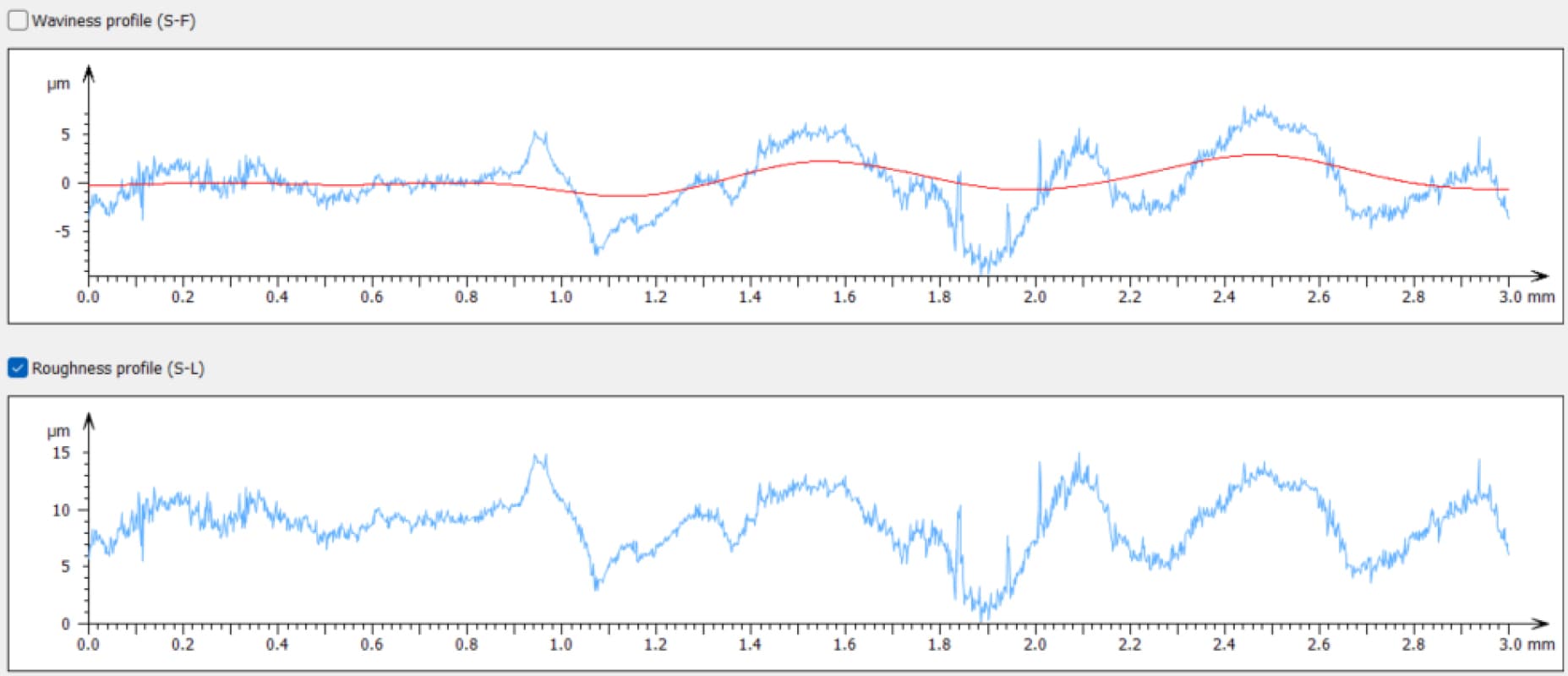
Different metrological filters can be applied to distinguish between macroscopic waviness and microscopic surface roughness. For example, a coarser filter cut-off, such as the 8 mm cut-off used with the Robust Gaussian order-2 filter, produces a smoother waviness profile (red) that is less sensitive to sharp local variations and follows the original surface profile more loosely.

Comparison of waviness and roughness profiles on tooth surface using coarse filter

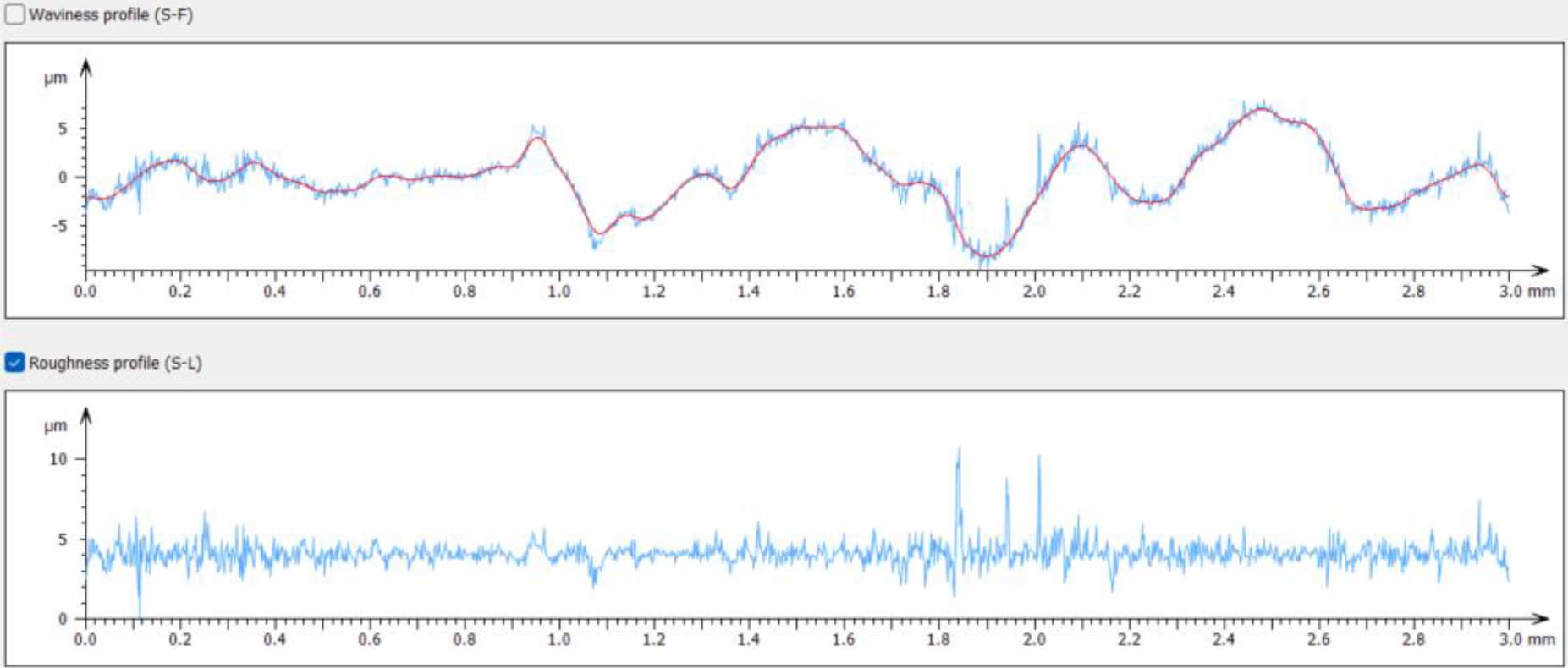
Alternatively, a finer cut-off (e.g., 0.08 mm) enables the analysis of micro-roughness by removing the waviness component that follows the original profile at a larger scale, leaving the finer surface roughness features of the tooth visible.

The microroughness analysis obtained using a 0.08 mm L-Gaussian filter is presented below.

Final microroughness profile of tooth surface after filtering

ISO 4287 – Roughness (S-L)
F: 없음
S-filter (λs): Gaussian, 2.5 µm
L-filter (λc): Gaussian, 0.08 mm
Evaluation length: All λc (37)
Amplitude Parameters – Roughness Profile
  DescriptionMeanStd devMinMax
RpµmMaximum peak height of the roughness profile1.5820.1221.3421.748
RvµmMaximum valley depth of the roughness profile1.4660.1191.2541.661
RzµmMaximum height of roughness profile3.0490.1962.8203.409
RaµmArithmetic mean deviation of the roughness profile0.4950.0470.4230.597
RqµmRoot-mean-square (RMS) deviation of the roughness profile0.6430.0560.5620.762

ISO 4287 – Roughness (S-L)
F: 없음
S-filter (λs): Gaussian, 2.5 µm
L-filter (λc): Gaussian, 0.8 mm
Evaluation length: All λc (3)
Amplitude Parameters – Roughness Profile
Rpµm
Maximum peak height of the roughness profile
Mean5.683
Std dev0.761
Min4.315
Max6.610
Rvµm
Maximum valley depth of the roughness profile
Mean6.242
Std dev1.009
Min4.701
Max8.438
Rzµm
Maximum height of roughness profile
Mean11.925
Std dev1.676
Min9.123
Max15.048
Raµm
Arithmetic mean deviation of the roughness profile
Mean2.063
Std dev0.297
Min1.710
Max2.629
Rqµm
Root-mean-square (RMS) deviation of the roughness profile
Mean2.523
Std dev0.361
Min2.057
Max3.175

Full 3D Tooth Surface Topography Reconstruction

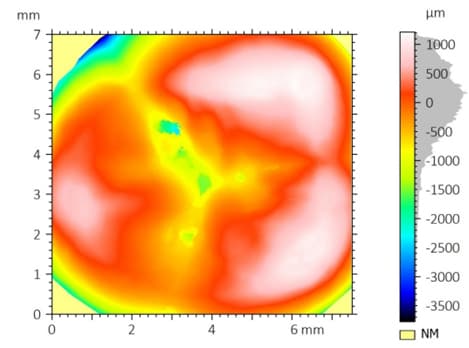
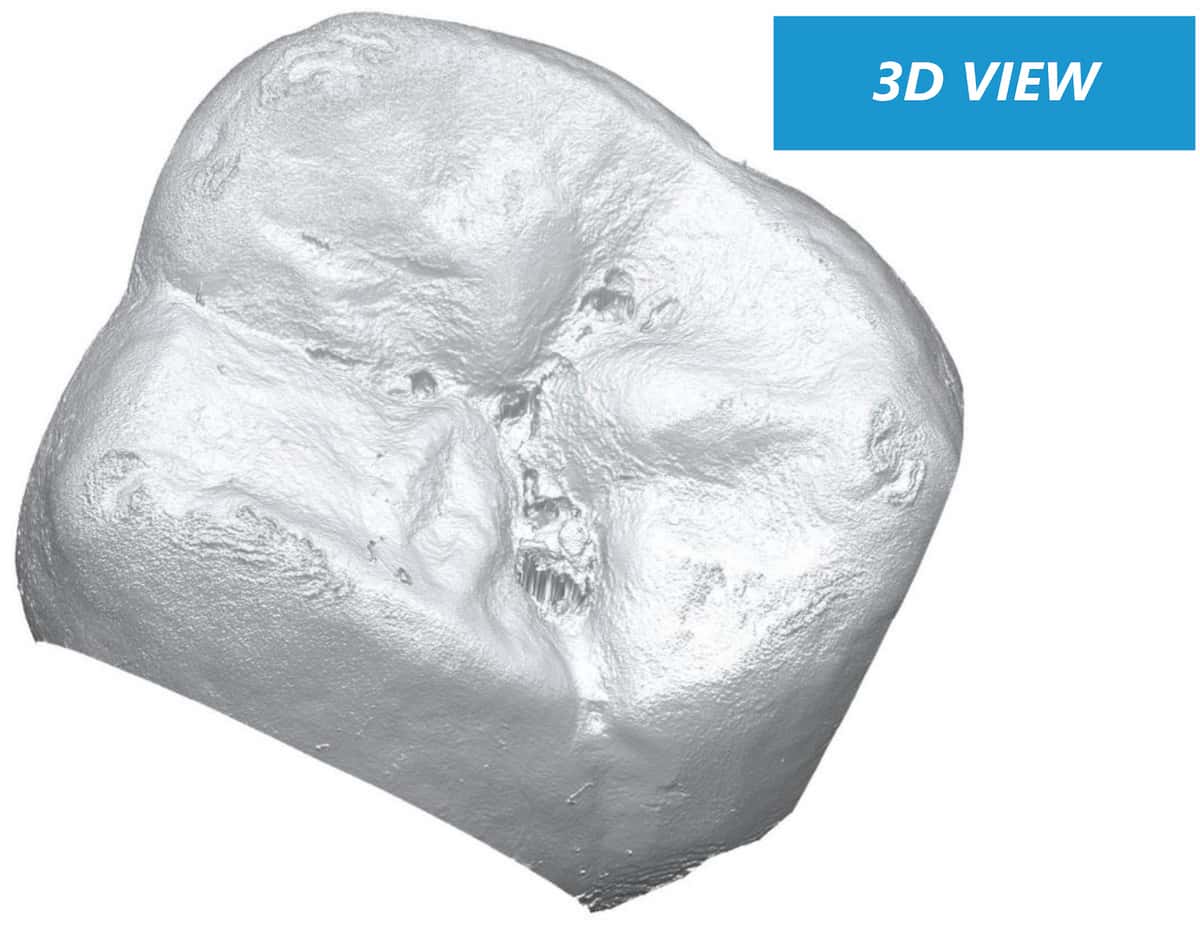
The extended Z-scan range of the PS5 optical sensor enables high-fidelity scanning of the entire tooth crown surface. The resulting 3D surface topography is shown below.

False-color surface topography map of full tooth crown measured with optical profilometer

2D VIEW: 2D surface map of the tooth crown measured with optical profilometry

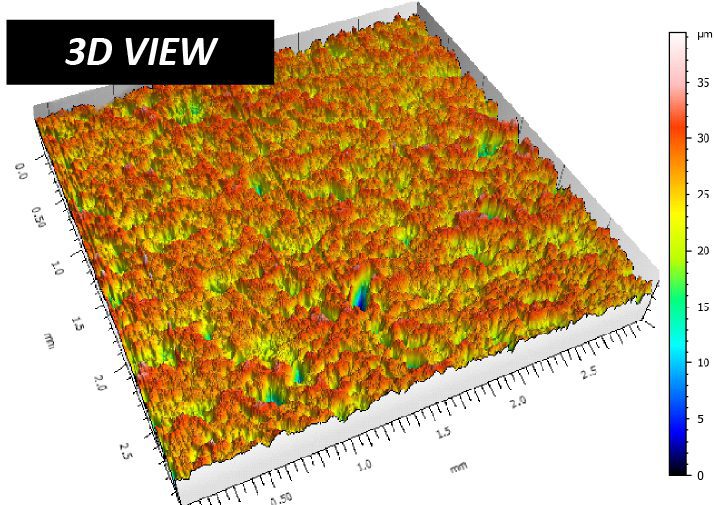
3D surface reconstruction of molar crown from optical profilometer scan

3D VIEW: High-fidelity 3D rendering of the molar crown surface obtained with optical profilometry

결론

In this application, the NANOVEA JR25 Non-Contact Optical Profiler was used to measure the surface roughness and 3D surface topography of an adult human molar.

Both the area scan and the line profile analysis revealed a roughness Rq of approximately 2.5 µm and an Ra of about 1.9–2.0 µm. These values are consistent with results reported in the literature.³ The use of a narrower L-Gaussian filter with an 80 µm cut-off enabled further investigation of micro-roughness, revealing an Rq of 0.643 µm and an Ra of 0.495 µm.

The full 3D surface topography of the molar crown was reconstructed with high fidelity. The high measurement resolution allows detection of fine surface features and crevices. The resulting surface data can be easily processed and exported as STL files, enabling the design and fabrication of customized dental devices and restorative components.

참조

[1] Shin, B.W., et al. Surface Roughness of Prefabricated Pediatric Zirconia Crowns Following Simulated Toothbrushing. Pediatric Dentistry 44.5 (2022): 363–367.
[2] Bollen, C.M.L., Paul Lambrechts, and Marc Quirynen. Comparison of surface roughness of oral hard materials to the threshold surface roughness for bacterial plaque retention: A review of the literature. Dental Materials 13.4 (1997): 258–269.
[3] Suputtamongkol, K., et al. Surface roughness resulting from wear of lithia-disilicate-based posterior crowns. Wear 269.3–4 (2010): 317–322.

Frequently Asked Questions About Dental Surface Roughness Measurement

What is dental surface roughness measurement?

Dental surface roughness measurement quantifies the microscopic texture of tooth surfaces using parameters such as Ra, Rq, and Sa. Optical profilometers measure these features without contacting the surface, allowing accurate analysis of enamel, restorative materials, and dental crowns.

Why use optical profilometry to measure tooth roughness?

Optical profilometry provides non-contact surface measurement with nanometer-scale vertical resolution. It captures 2D surface maps and full 3D surface topography of dental structures without damaging soft or polished surfaces.

What roughness parameters are used for dental surface analysis?

Common roughness parameters include Ra (arithmetic mean roughness), Rq (root mean square roughness), Sa (areal roughness), and Sz (maximum surface height). These parameters help evaluate enamel wear, plaque adhesion risk, and the performance of restorative materials.

Why is surface roughness important in dentistry?

Surface roughness affects plaque retention, wear resistance, and the long-term performance of dental restorations. Controlling micro-roughness can reduce bacterial adhesion and improve the durability of dental materials.

Need Reliable Surface Roughness Measurement for Dental Materials?

휴대용 3D 프로파일로미터를 이용한 용접 표면 검사

용접 표면 검사

휴대용 3D 프로파일로미터 사용

작성자

크레이그 레싱

소개

일반적으로 육안 검사로 수행되는 특정 용접을 극도로 정밀하게 조사하는 것이 중요해질 수 있습니다. 정밀 분석이 필요한 특정 영역에는 후속 검사 절차에 관계없이 표면 균열, 다공성 및 미충진 크레이터가 포함됩니다. 치수/형상, 부피, 거칠기, 크기 등과 같은 용접 특성은 모두 중요한 평가를 위해 측정할 수 있습니다.

용접 표면 검사를 위한 3D 비접촉식 프로파일로미터의 중요성

터치 프로브나 간섭계와 같은 다른 기술과 달리 NANOVEA는 3D 비접촉 프로파일로미터, 축 색수차를 사용하여 거의 모든 표면을 측정할 수 있으며, 개방형 스테이징으로 인해 샘플 크기가 크게 달라질 수 있으며 샘플 준비가 필요하지 않습니다. 나노부터 매크로까지의 범위는 샘플 반사나 흡수의 영향이 전혀 없는 표면 프로필 측정 중에 얻어지며, 높은 표면 각도를 측정하는 고급 기능을 갖추고 있으며 결과를 소프트웨어로 조작할 필요가 없습니다. 투명, 불투명, 반사성, 확산성, 광택성, 거친 재질 등 모든 재료를 쉽게 측정합니다. NANOVEA 휴대용 프로파일로미터의 2D 및 2D 기능은 실험실과 현장 모두에서 전체 용접 표면 검사에 이상적인 장비입니다.

측정 목표

이 애플리케이션에서 나노베아 JR25 휴대용 프로파일러는 용접의 표면 거칠기, 모양 및 부피뿐만 아니라 주변 영역을 측정하는 데 사용됩니다. 이 정보는 용접 및 용접 공정의 품질을 적절히 조사하는 데 중요한 정보를 제공할 수 있습니다.

나노비아

JR25

테스트 결과

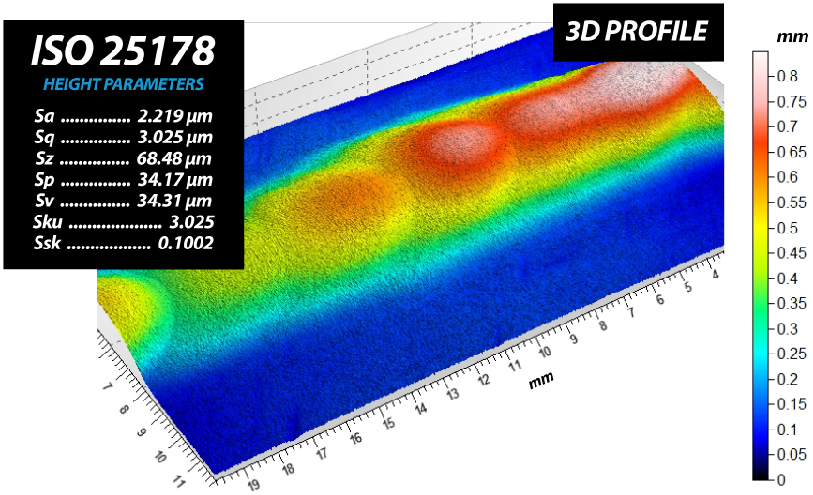
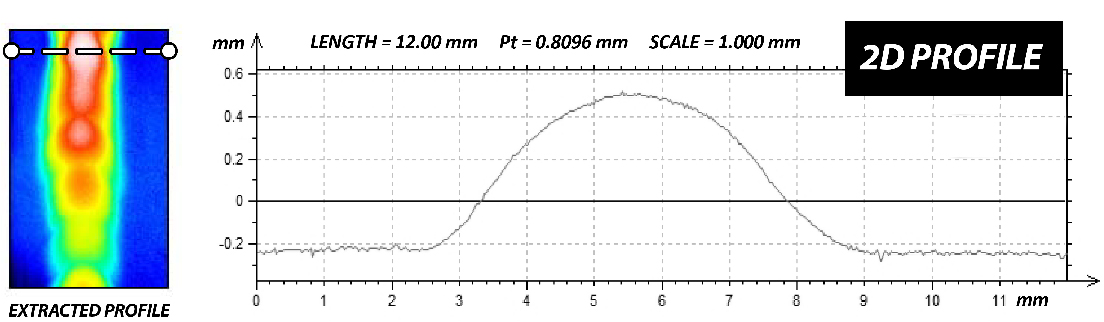
아래 이미지는 용접 및 주변 영역의 전체 3D 보기와 함께 용접의 표면 매개변수만 보여줍니다. 2D 단면 프로필은 아래와 같습니다.

샘플

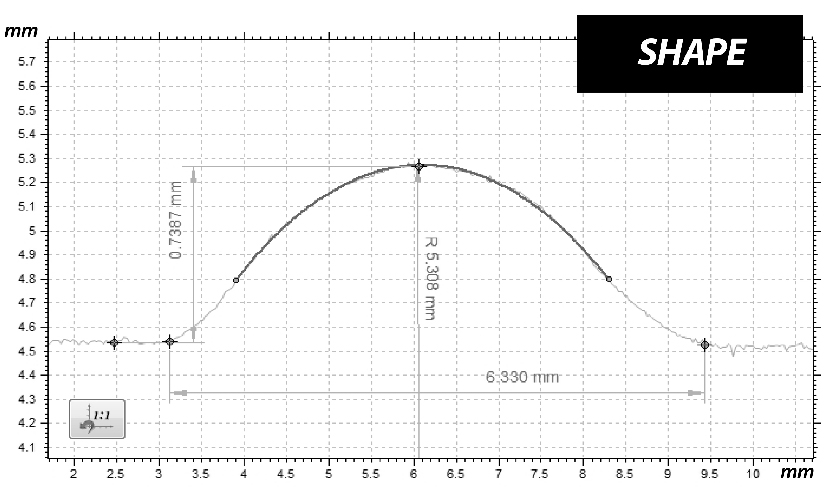
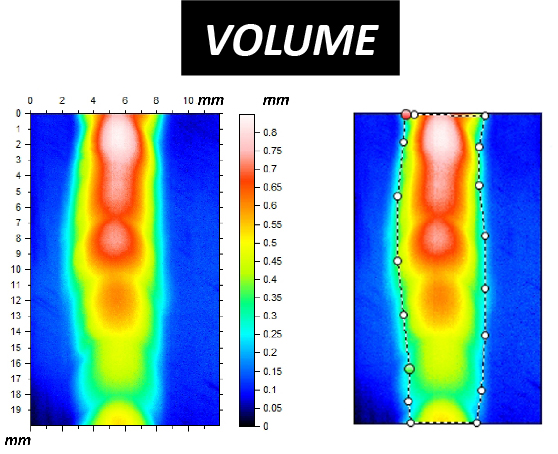
위의 2D 단면 프로필을 3D에서 제거하면 용접의 치수 정보가 아래에서 계산됩니다. 아래는 용접에 대해서만 계산된 재료의 표면적과 부피입니다.

 HOLEPEAK
표면1.01 mm214.0mm2
볼륨8.799e-5 mm323.27 mm3
최대 깊이/높이0.0276 mm0.6195 mm
평균 깊이/높이 0.004024 mm 0.2298 mm

결론

이 애플리케이션에서는 나노베아 3D 비접촉 프로파일러가 용접 및 주변 표면의 중요한 특성을 정밀하게 특성화할 수 있는 방법을 보여주었습니다. 거칠기, 치수 및 부피로부터 품질 및 반복성에 대한 정량적 방법을 결정하거나 추가로 조사할 수 있습니다. 이 앱 노트의 예와 같은 샘플 용접은 사내 또는 현장 테스트를 위한 표준 탁상형 또는 휴대용 나노베아 프로파일러를 사용하여 쉽게 분석할 수 있습니다.

3D 프로파일 측정을 이용한 프랙토그래피 분석

프랙토그래피 분석

3D 프로파일 측정 사용

작성자

크레이그 레싱

소개

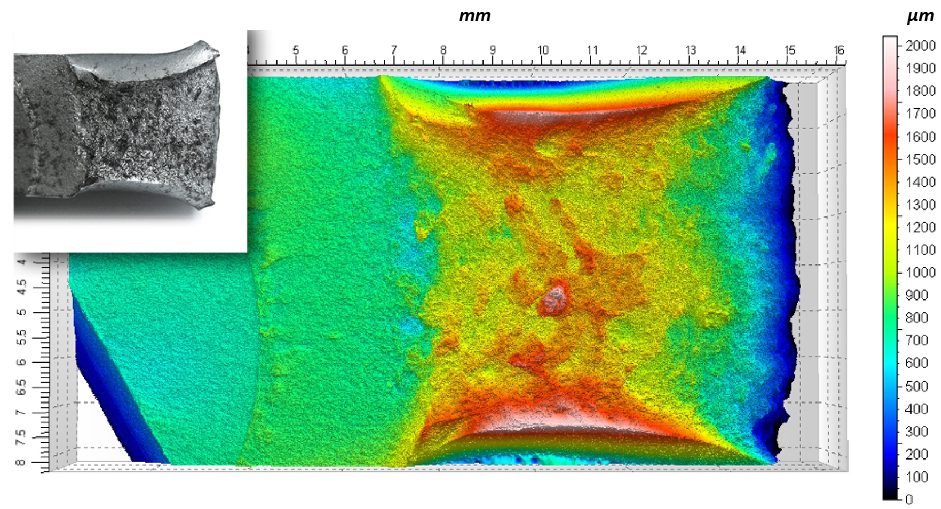
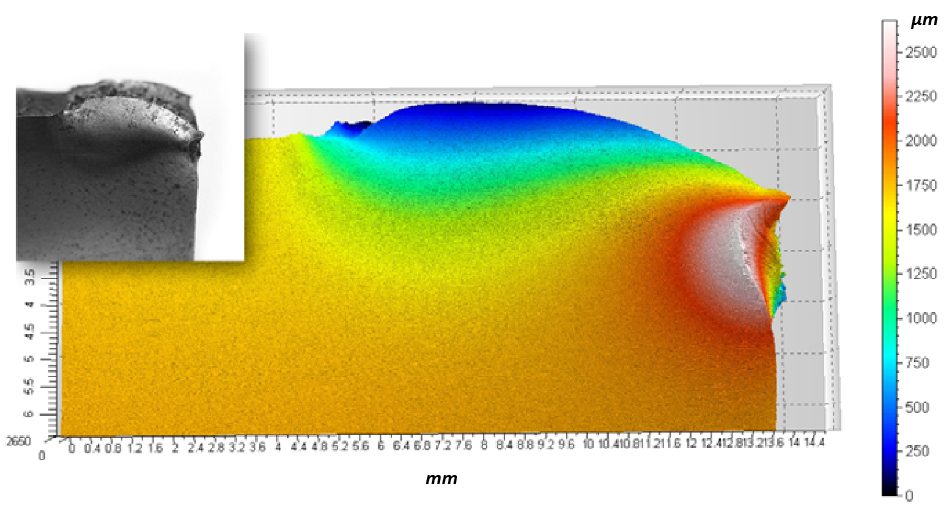
파면분석(Fractography)은 파손된 표면의 특징을 연구하는 것으로 역사적으로 현미경이나 SEM을 통해 조사되어 왔습니다. 피처의 크기에 따라 표면 분석을 위해 현미경(매크로 피처) 또는 SEM(나노 및 마이크로 피처)이 선택됩니다. 두 가지 모두 궁극적으로 파손 메커니즘 유형을 식별할 수 있습니다. 비록 효과적이긴 하지만 현미경은 명확한 한계를 가지고 있으며 원자 수준 분석을 제외한 대부분의 경우 SEM은 파손 표면 측정에 실용적이지 않으며 광범위한 사용 기능이 부족합니다. 광학 측정 기술의 발전으로 NANOVEA는 3D 비접촉 프로파일로미터 이제 거시적 규모의 2D 및 3D 표면 측정을 통해 나노를 제공할 수 있는 능력을 갖춘 최고의 장비로 간주됩니다.

골절 검사를 위한 3D 비접촉식 프로파일로미터의 중요성

3D 비접촉 프로파일로미터는 SEM과 달리 최소한의 시료 준비만으로 거의 모든 표면과 시료 크기를 측정할 수 있으며, 수직/수평 치수도 SEM보다 우수합니다. 프로파일러를 사용하면 시료 반사율의 영향을 받지 않고 나노부터 매크로 범위의 특징을 한 번의 측정으로 캡처할 수 있습니다. 투명, 불투명, 반사, 확산, 광택, 거칠기 등 모든 재료를 쉽게 측정할 수 있습니다. 3D 비접촉 프로파일로미터는 광범위하고 사용자 친화적인 기능을 제공하여 SEM 비용의 일부로 표면 파괴 연구를 극대화할 수 있습니다.

측정 목표

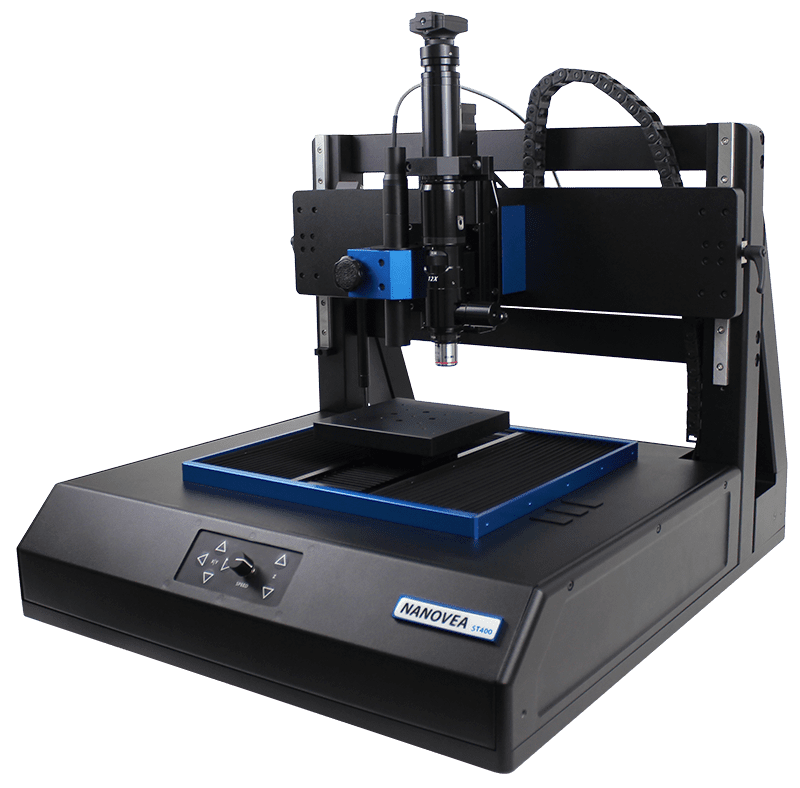
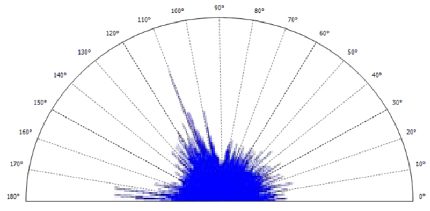
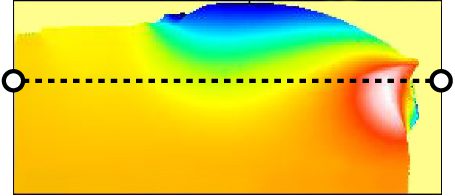
이 애플리케이션에서 나노베아 ST400은 강철 샘플의 파쇄 표면을 측정하는 데 사용됩니다. 이 연구에서는 표면의 3D 영역, 2D 프로파일 추출 및 표면 방향 맵을 소개합니다.

나노비아

ST400

결과

상단 표면

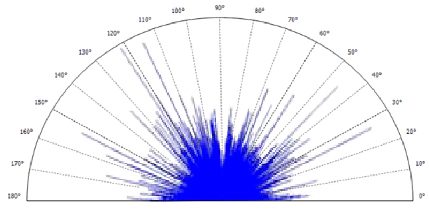
3D 표면 텍스처 방향

등방성51.26%
첫 번째 방향123.2º
두 번째 방향116.3º
세 번째 방향0.1725º

이 추출을 통해 표면적, 부피, 거칠기 등을 자동으로 계산할 수 있습니다.

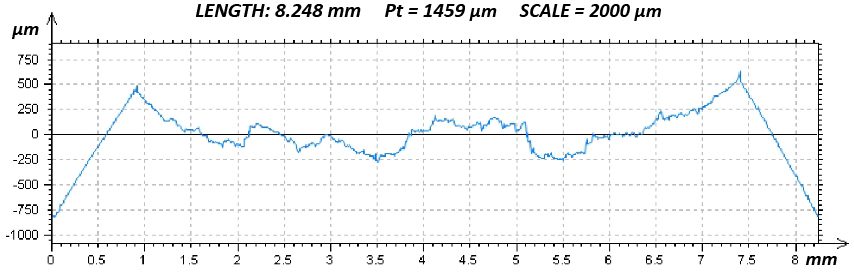
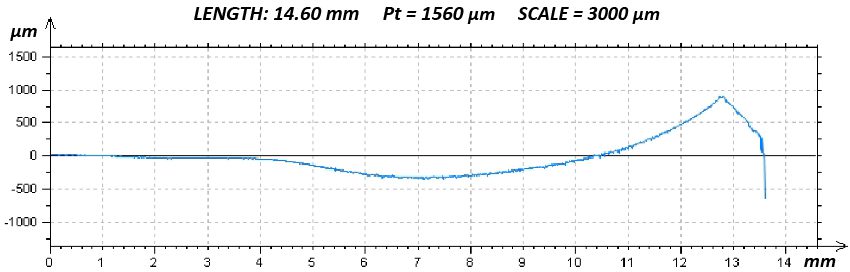
2D 프로파일 추출

결과

측면 표면

3D 표면 텍스처 방향

등방성15.55%
첫 번째 방향0.1617º
두 번째 방향110.5º
세 번째 방향171.5º

이 추출을 통해 표면적, 부피, 거칠기 등을 자동으로 계산할 수 있습니다.

2D 프로파일 추출

결론

이 애플리케이션에서는 나노베아 ST400 3D 비접촉식 프로파일로미터가 어떻게 파손된 표면의 전체 형상(나노, 마이크로 및 매크로 특징)을 정밀하게 특성화할 수 있는지 보여주었습니다. 3D 영역에서 표면을 명확하게 식별하고 무한한 표면 계산 목록으로 하위 영역 또는 프로파일/단면을 빠르게 추출하고 분석할 수 있습니다. 통합된 AFM 모듈로 나노미터 이하의 표면 특징을 추가로 분석할 수 있습니다.

또한, 나노베아는 파단 표면을 움직일 수 없는 현장 연구에 특히 중요한 휴대용 버전을 프로파일로미터 라인업에 포함시켰습니다. 이처럼 광범위한 표면 측정 기능을 갖춘 단일 장비로 파단 표면 분석이 그 어느 때보다 쉽고 편리해졌습니다.

트라이보미터를 사용한 폴리머 벨트 마모 및 마찰

폴리머 벨트

트라이보미터를 사용한 마모 및 마찰

작성자

DUANJIE LI, PhD

소개

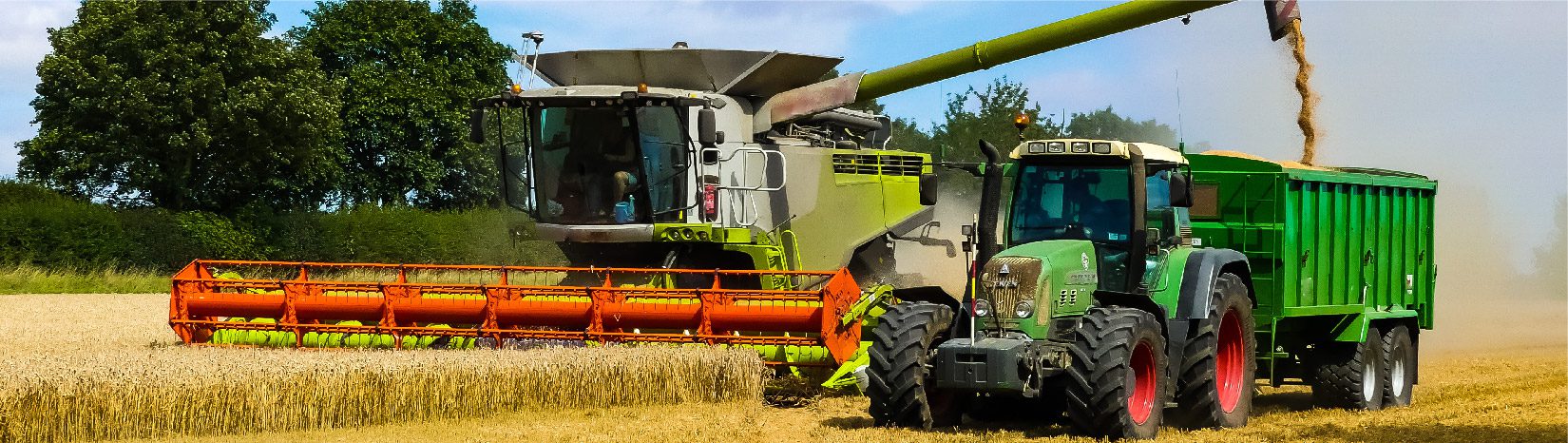
벨트 드라이브는 동력을 전달하고 둘 이상의 회전축 사이의 상대적인 움직임을 추적합니다. 벨트 드라이브는 최소한의 유지보수로 간단하고 경제적인 솔루션으로 벅쏘, 제재소, 탈곡기, 사일로 블로어, 컨베이어 등 다양한 분야에 널리 사용됩니다. 벨트 드라이브는 과부하로부터 기계를 보호할 뿐만 아니라 습기를 차단하고 진동을 차단할 수 있습니다.

마모 평가의 중요성 벨트 드라이브의 경우

벨트 구동 기계의 벨트는 마찰과 마모가 불가피합니다. 충분한 마찰은 미끄러짐 없이 효과적인 동력 전달을 보장하지만 과도한 마찰은 벨트를 빠르게 마모시킬 수 있습니다. 벨트 구동 작동 중에는 피로, 마모, 마찰 등 다양한 유형의 마모가 발생합니다. 벨트의 수명을 연장하고 벨트 수리 및 교체에 드는 비용과 시간을 절감하기 위해서는 벨트의 마모 성능을 신뢰성 있게 평가하여 벨트의 수명, 생산 효율성 및 응용 분야 성능을 개선하는 것이 바람직합니다. 벨트의 마찰 계수 및 마모율을 정확하게 측정하면 벨트 생산의 R&D 및 품질 관리가 용이해집니다.

측정 목표

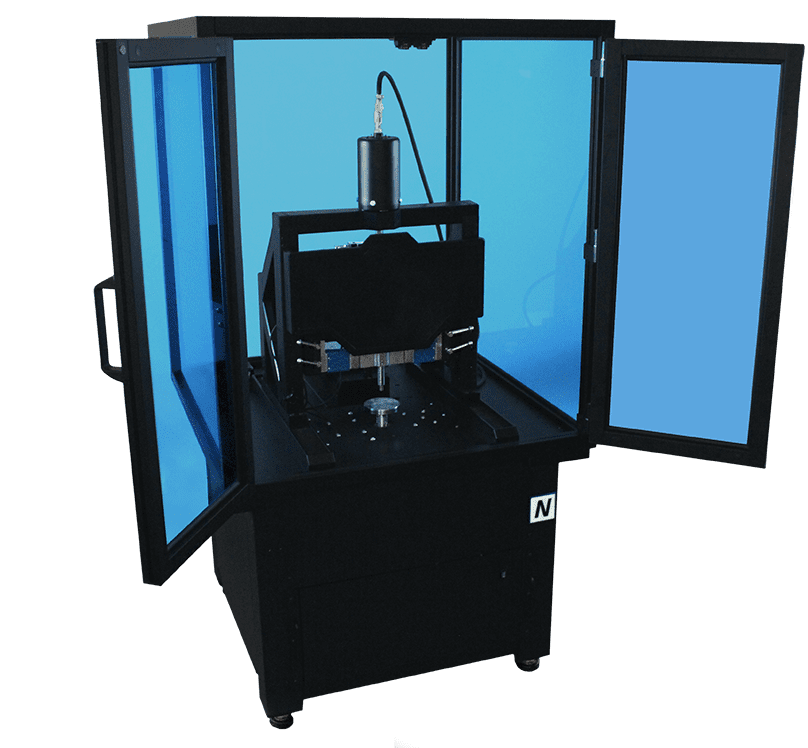
이 연구에서는 다양한 표면 질감을 가진 벨트의 마모 거동을 시뮬레이션하여 비교했습니다. 나노비아 T2000 트라이보미터는 벨트의 마모 과정을 제어 및 모니터링하는 방식으로 시뮬레이션합니다.

나노비아

T2000

테스트 절차

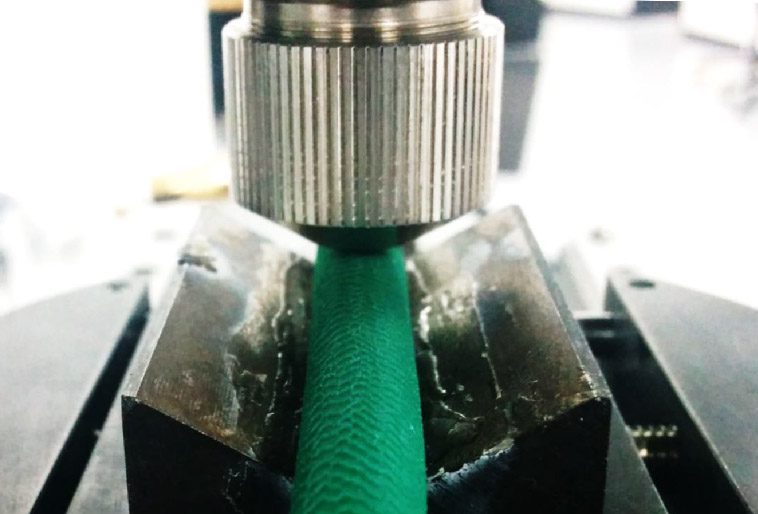
표면 거칠기와 질감이 다른 두 벨트의 마찰 계수, COF 및 내마모성을 다음과 같이 평가했습니다. 나노비아 고부하 트라이보미터 선형 왕복 마모 모듈을 사용합니다. Steel 440 볼(직경 10mm)을 카운터 재료로 사용했습니다. 통합된 측정기를 사용하여 표면 거칠기와 마모 트랙을 검사했습니다. 3D 비접촉 프로파일로미터. 마모율, K는 다음 공식을 사용하여 평가되었습니다. K=Vl(Fxs)여기서 V 는 착용한 볼륨입니다, F 는 정상 부하이고 s 는 슬라이딩 거리입니다.


이 연구에서는 매끄러운 스틸 440 볼을 예로 사용했으며, 실제 적용 상황을 시뮬레이션하기 위해 맞춤형 픽스처를 사용하여 모양과 표면 마감이 다른 모든 고체 소재를 적용할 수 있습니다.

결과 및 토론

텍스처 벨트 및 스무스 벨트의 표면 거칠기 Ra는 각각 33.5 및 8.7 um이며, 분석된 표면 프로파일에 따르면 나노비아 3D 비접촉식 광학 프로파일러. 서로 다른 하중에서 벨트의 마모 거동을 비교하기 위해 테스트한 두 벨트의 COF와 마모율을 각각 10N과 100N에서 측정했습니다.

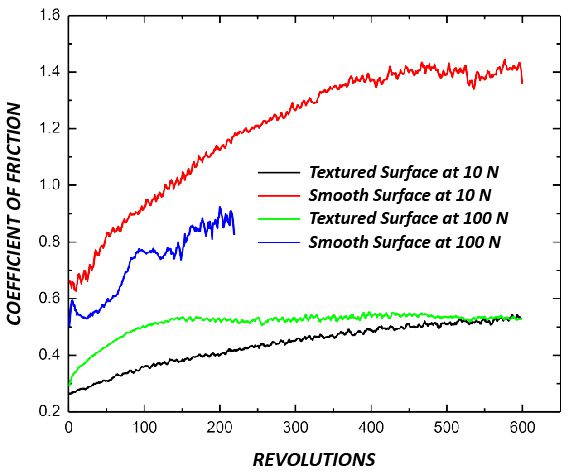
그림 1 은 마모 테스트 중 벨트의 COF 변화를 보여줍니다. 텍스처가 다른 벨트는 상당히 다른 마모 거동을 보입니다. 흥미로운 점은 COF가 점진적으로 증가하는 런인 기간이 지나면 텍스처 벨트는 10N 및 100N의 하중을 사용하여 수행한 두 테스트 모두에서 ~0.5의 낮은 COF에 도달한다는 것입니다. 이에 비해 10N의 하중으로 테스트한 스무스 벨트는 COF가 안정될 때 ~1.4의 상당히 높은 COF를 나타내며 나머지 테스트 동안 이 값 이상을 유지한다는 것입니다. 100N의 하중을 가하여 테스트한 스무스 벨트는 강철 440 볼에 의해 빠르게 마모되어 큰 마모 트랙을 형성했습니다. 따라서 테스트는 220 회전에서 중단되었습니다.

그림 1: 다양한 하중에서 벨트의 COF의 진화.

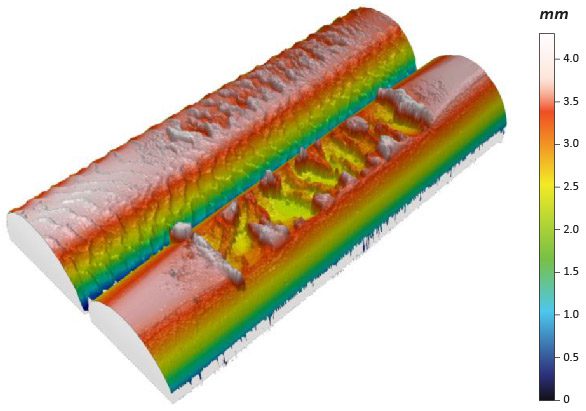
그림 2는 100N에서 테스트 후 3D 마모 트랙 이미지를 비교한 것입니다. 나노베아 3D 비접촉식 프로파일로미터는 마모 트랙의 상세한 형태를 분석할 수 있는 도구를 제공하여 마모 메커니즘에 대한 근본적인 이해에 더 많은 통찰력을 제공합니다.

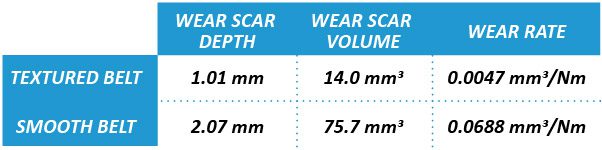
표 1: 마모 트랙 분석 결과.

그림 2:  두 벨트의 3D 보기
100N에서 테스트한 후

3D 마모 트랙 프로파일을 사용하면 표 1과 같이 고급 분석 소프트웨어에서 계산한 마모 트랙 부피를 직접 정확하게 측정할 수 있습니다. 220회전 마모 테스트에서 스무스 벨트는 600회전 마모 테스트 후 텍스처드 벨트의 마모 부피가 14.0mm3인 것에 비해 75.7mm3의 부피로 훨씬 더 크고 깊은 마모 트랙을 가집니다. 스틸 볼에 대한 스무스 벨트의 마찰이 훨씬 더 높기 때문에 텍스쳐드 벨트에 비해 마모율이 15배 더 높습니다.


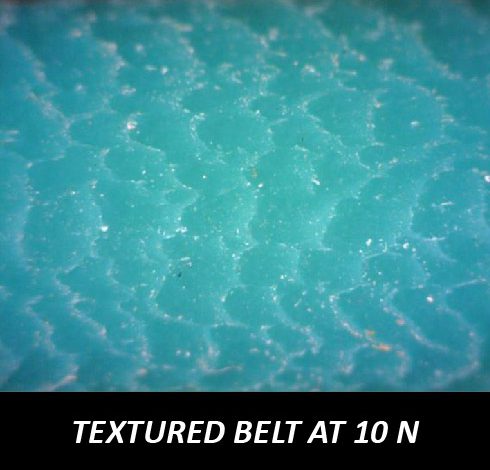
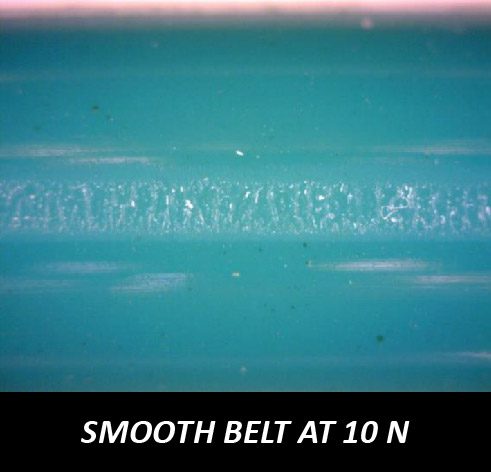
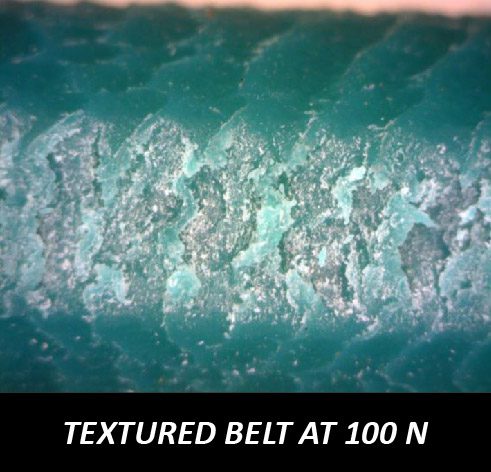
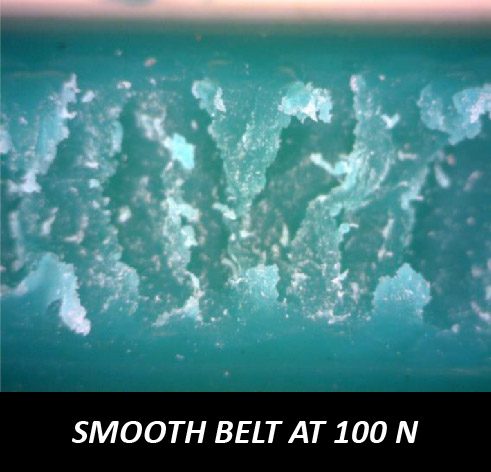
텍스처 벨트와 스무스 벨트 사이의 이러한 급격한 COF 차이는 벨트와 스틸 볼 사이의 접촉 면적 크기와 관련이 있을 수 있으며, 이는 또한 다른 마모 성능으로 이어집니다. 그림 3은 광학 현미경으로 두 벨트의 마모 트랙을 보여줍니다. 마모 트랙 검사는 COF 진화에 대한 관찰과 일치합니다: 0.5의 낮은 COF를 유지하는 텍스처드 벨트는 10N의 하중에서 마모 테스트 후 마모 징후가 나타나지 않습니다. 스무스 벨트는 10N에서 작은 마모 트랙을 보여줍니다. 100N에서 수행한 마모 테스트는 텍스처드 벨트와 스무스 벨트 모두에서 상당히 큰 마모 트랙을 생성하며 다음 단락에서 설명하는 대로 3D 프로파일을 사용하여 마모율을 계산합니다.

그림 3:  광학 현미경으로 트랙을 착용합니다.

결론

이 연구에서는 벨트의 마찰 계수와 마모율을 잘 제어되고 정량적인 방식으로 평가할 수 있는 나노베아 T2000 트라이보미터의 성능을 보여주었습니다. 표면 텍스처는 벨트의 서비스 성능 중 마찰 및 내마모성에 중요한 역할을 합니다. 텍스처가 있는 벨트는 마찰 계수가 0.5 정도로 안정적이며 수명이 길기 때문에 공구 수리 또는 교체에 드는 시간과 비용을 절감할 수 있습니다. 이에 비해 매끄러운 벨트와 스틸 볼의 과도한 마찰은 벨트를 빠르게 마모시킵니다. 또한 벨트에 가해지는 하중은 벨트의 수명을 결정짓는 중요한 요소입니다. 과부하는 매우 높은 마찰을 발생시켜 벨트의 마모를 가속화합니다.

나노베아 T2000 트라이보미터는 ISO 및 ASTM을 준수하는 회전 및 선형 모드를 사용하여 정밀하고 반복 가능한 마모 및 마찰 테스트를 제공하며, 고온 마모, 윤활 및 마찰 부식 모듈을 하나의 사전 통합된 시스템에서 옵션으로 사용할 수 있습니다. 나노베아의 타의 추종을 불허하는 범위는 얇거나 두꺼운, 연질 또는 경질 코팅, 필름 및 기판의 전체 범위의 마찰 특성을 측정하는 데 이상적인 솔루션입니다.

3D 프로파일 측정을 이용한 화석 미세 구조 분석

화석 미세 구조

3D 프로파일 측정 사용

작성자

DUANJIE LI, PhD

소개

화석은 고대 바다, 호수, 강 아래의 퇴적물에 묻혀 있던 식물, 동물, 기타 생물의 흔적이 보존된 유물입니다. 부드러운 신체 조직은 보통 사후에 부패하지만 딱딱한 껍질, 뼈, 치아는 화석화됩니다. 원래 껍질과 뼈의 광물 교체가 일어날 때 미세 구조 표면의 특징이 보존되는 경우가 많으며, 이를 통해 날씨의 진화와 화석의 형성 메커니즘에 대한 통찰력을 얻을 수 있습니다.

화석 검사를 위한 3D 비접촉식 프로파일로미터의 중요성

화석의 3D 프로파일을 통해 화석 샘플의 상세한 표면 특징을 더 가까운 각도에서 관찰할 수 있습니다. NANOVEA 프로파일로미터의 높은 해상도와 정확도는 육안으로는 식별할 수 없습니다. 프로파일로미터의 분석 소프트웨어는 이러한 고유한 표면에 적용할 수 있는 광범위한 연구를 제공합니다. NANOVEA는 터치 프로브와 같은 다른 기술과 달리 3D 비접촉 프로파일로미터 샘플을 건드리지 않고 표면 특징을 측정합니다. 이를 통해 특정 섬세한 화석 샘플의 실제 표면 특징을 보존할 수 있습니다. 또한 휴대용 모델인 Jr25 프로파일로미터를 사용하면 화석 현장에서 3D 측정이 가능하므로 발굴 후 화석 분석 및 보호가 상당히 용이해집니다.

측정 목표

이 연구에서는 두 개의 대표적인 화석 샘플의 표면을 측정하기 위해 나노베아 Jr25 프로파일로미터를 사용했습니다. 각 화석의 전체 표면을 스캔하고 분석하여 거칠기, 윤곽, 텍스처 방향 등 표면의 특징을 파악했습니다.

나노비아

Jr25

브라키오포드 화석

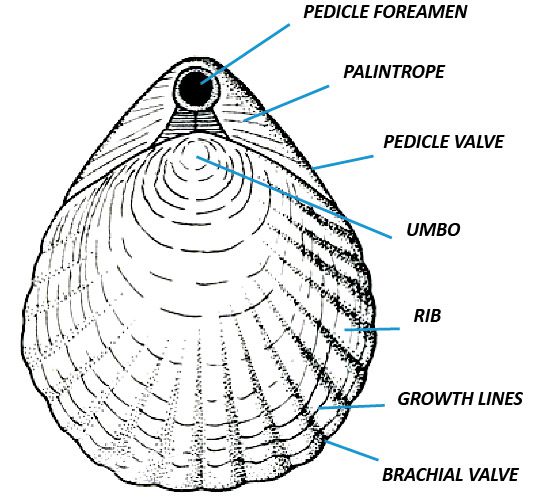
이 보고서에서 소개하는 첫 번째 화석 샘플은 브라키오포드 화석으로, 위아래 표면에 딱딱한 '밸브'(껍질)가 있는 해양 동물에서 나온 화석입니다. 브라키오패드는 5억 5천만 년 전인 캄브리아기에 처음 등장했습니다.

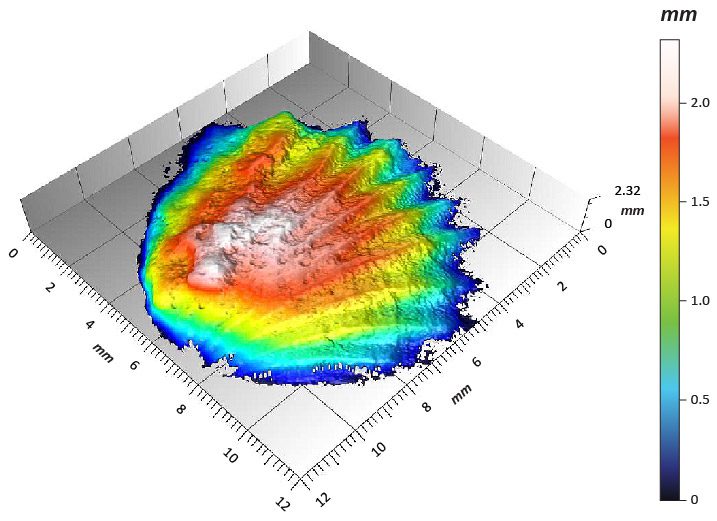
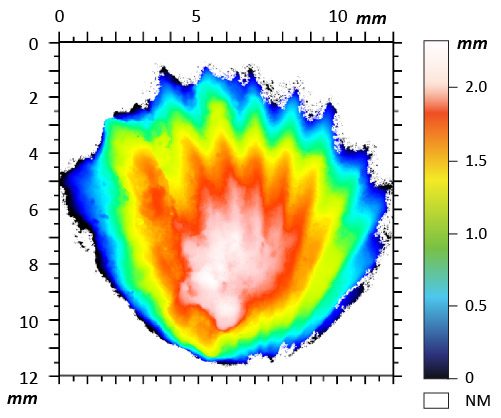
스캔의 3D 보기는 그림 1에 표시되어 있고 가색 보기는 그림 2에 표시되어 있습니다. 

그림 1: 브라키오포드 화석 샘플의 3D 보기.

그림 2: 브라키오포드 화석 샘플의 가색 보기.

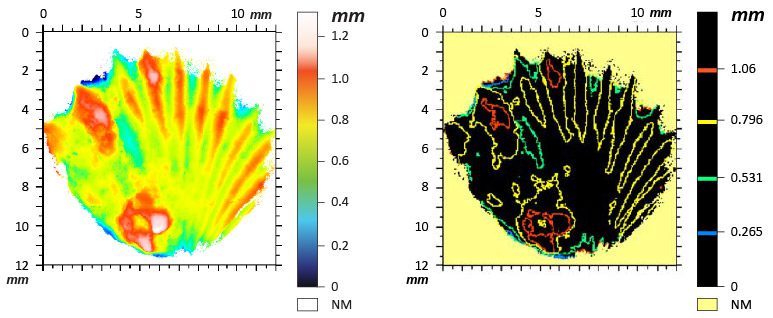
그런 다음 그림 3과 같이 브라키오포드 화석의 국부적인 표면 형태와 윤곽을 조사하기 위해 표면에서 전체적인 형태를 제거했습니다. 이제 브라키오포드 화석 샘플에서 특이한 발산 홈 텍스처를 관찰할 수 있습니다.

그림 3: 양식 제거 후 가색 보기 및 윤곽선 보기.

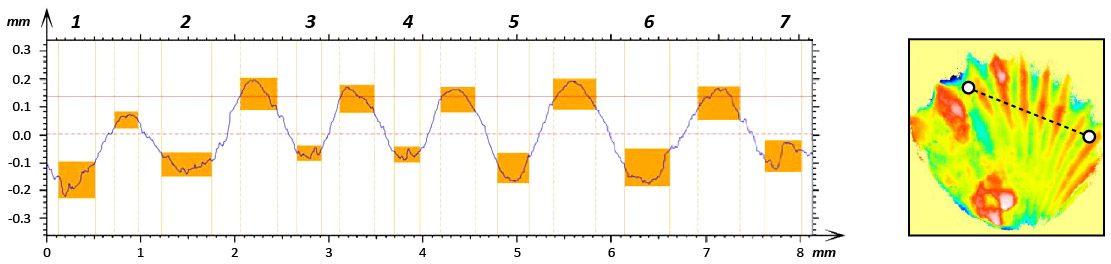
텍스처 영역에서 선 프로파일을 추출하여 화석 표면의 단면도를 그림 4에 표시합니다. 단차 높이 연구는 표면 특징의 정확한 치수를 측정합니다. 홈의 평균 폭은 ~0.38mm, 깊이는 ~0.25mm입니다.

그림 4: 텍스처링된 표면의 선 프로파일 및 스텝 높이 연구.

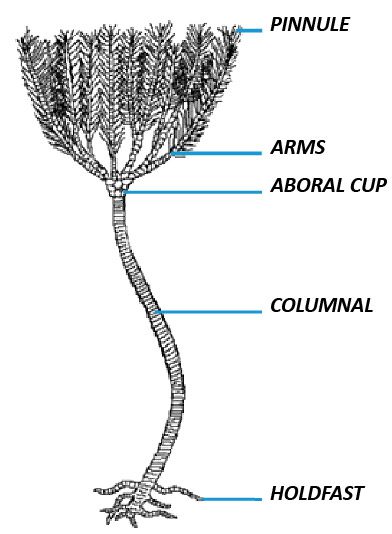
크리노이드 줄기 화석

두 번째 화석 샘플은 크리노이드 줄기 화석입니다. 크리노이드는 공룡보다 약 3억 년 전인 캄브리아기 중기 바다에 처음 등장했습니다. 


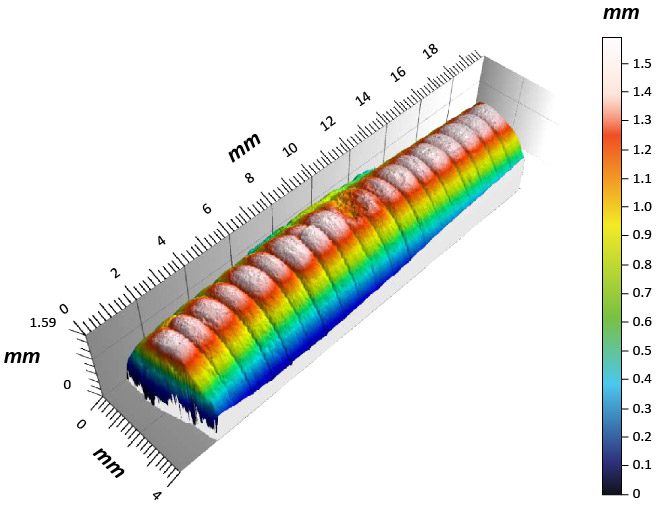
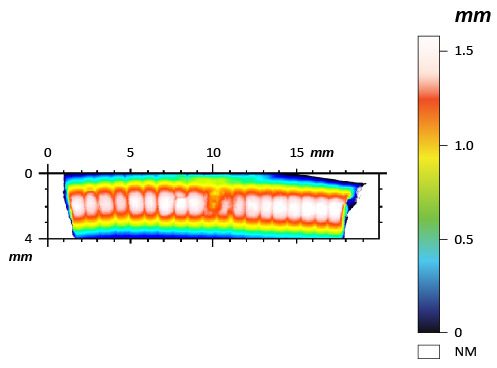
스캔의 3D 보기는 그림 5에 표시되어 있고 가색 보기는 그림 6에 표시되어 있습니다. 

그림 5: 크리노이드 화석 샘플의 3D 보기.

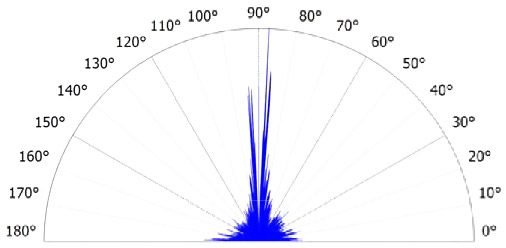
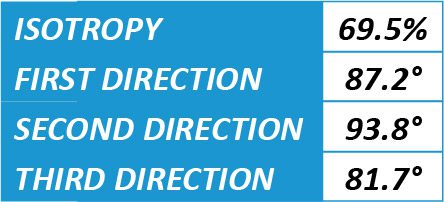
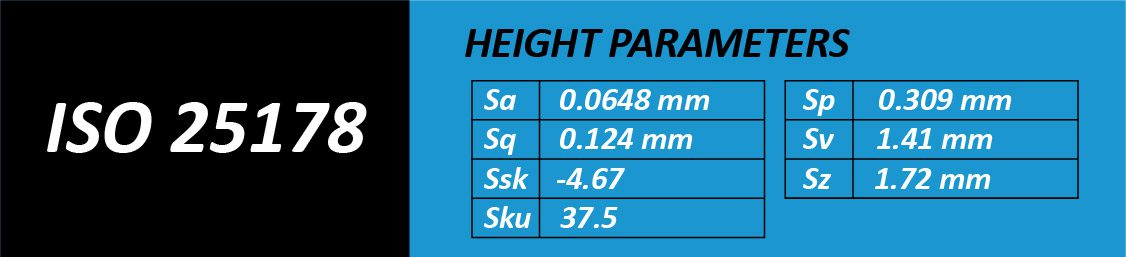
크리노이드 줄기 화석의 표면 질감 등방성 및 거칠기는 그림 7에서 분석됩니다. 

 이 화석은 90°에 가까운 각도에서 텍스처 방향이 선호되어 69%의 텍스처 등방성을 갖습니다.

그림 6: 의 가색 보기 크리노이드 줄기 샘플.


그림 7: 크리노이드 줄기 화석의 표면 텍스처 등방성 및 거칠기.

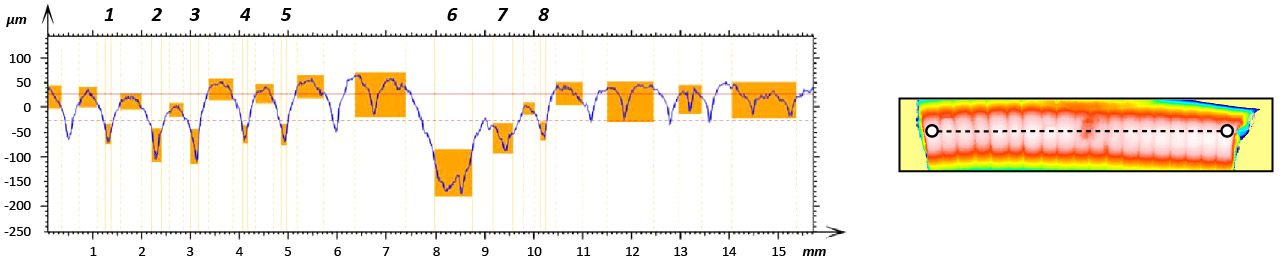
크리노이드 줄기 화석의 축 방향을 따른 2D 프로파일은 그림 8에 나와 있습니다. 

표면 텍스처의 피크 크기는 상당히 균일합니다.

그림 8: 크리노이드 줄기 화석의 2D 프로파일 분석.

결론

이 애플리케이션에서는 휴대용 비접촉식 프로파일로미터인 NANOVEA Jr25를 사용하여 브라키오포드 및 크리노이드 줄기 화석의 3D 표면 특징을 종합적으로 연구했습니다. 이 기기가 화석 샘플의 3D 형태를 정밀하게 특성화할 수 있음을 보여주었습니다. 그런 다음 샘플의 흥미로운 표면 특징과 질감을 추가로 분석합니다. 브라키오포드 샘플은 다양한 홈 텍스처를 가지고 있는 반면, 크리노이드 줄기 화석은 우선적인 텍스처 등방성을 보여줍니다. 상세하고 정밀한 3D 표면 스캔은 고생물학자와 지질학자가 생명의 진화와 화석의 형성을 연구하는 데 이상적인 도구로 입증되었습니다.

여기에 표시된 데이터는 분석 소프트웨어에서 사용할 수 있는 계산의 일부만을 나타냅니다. 나노베아 프로파일로미터는 반도체, 마이크로일렉트로닉스, 태양광, 광섬유, 자동차, 항공우주, 야금, 기계 가공, 코팅, 제약, 생의학, 환경 등 다양한 분야의 거의 모든 표면을 측정합니다.

스티로폼 표면 경계 측정 프로파일로메트리

표면 경계 측정

3D 프로파일 측정을 이용한 표면 경계 측정

자세히 알아보기

표면 경계 측정

3D 프로파일 측정 사용

작성자

크레이그 라이징

소개

표면 특징, 패턴, 모양 등의 인터페이스를 방향에 대해 평가하는 연구에서는 전체 측정 프로파일에서 관심 영역을 빠르게 식별하는 것이 유용합니다. 표면을 중요한 영역으로 세분화하면 경계, 피크, 구덩이, 면적, 부피 등을 빠르게 평가하여 연구 중인 전체 표면 프로파일에서 기능적 역할을 이해할 수 있습니다. 예를 들어 금속의 입자 경계 이미징과 같이 분석에서 중요한 것은 많은 구조의 인터페이스와 전체적인 방향입니다. 각 관심 영역을 이해함으로써 전체 영역 내의 결함 또는 이상을 식별할 수 있습니다. 입자 경계 이미징은 일반적으로 프로파일로미터 기능을 능가하는 범위에서 연구되며 2D 이미지 분석에 불과하지만, 3D 표면 측정의 장점과 함께 더 큰 규모로 표시되는 개념을 설명하는 데 유용한 참고 자료가 됩니다.

표면 분리 연구를 위한 3D 비접촉식 프로파일로미터의 중요성

터치 프로브나 간섭계와 같은 다른 기술과 달리 3D 비접촉 프로파일로미터, 축 색수차를 사용하여 거의 모든 표면을 측정할 수 있으며, 개방형 스테이징으로 인해 샘플 크기가 크게 달라질 수 있으며 샘플 준비가 필요하지 않습니다. 나노부터 매크로까지의 범위는 샘플 반사나 흡수의 영향이 전혀 없는 표면 프로필 측정 중에 얻어지며, 높은 표면 각도를 측정하는 고급 기능을 갖추고 있으며 결과를 소프트웨어로 조작할 필요가 없습니다. 투명, 불투명, 반사, 확산, 광택, 거친 등 모든 재료를 쉽게 측정합니다. 비접촉 프로파일로미터 기술은 표면 경계 분석이 필요할 때 표면 연구를 극대화할 수 있는 이상적이고 광범위하며 사용자 친화적인 기능을 제공합니다. 2D 및 3D 기능 결합의 이점도 함께 제공됩니다.

측정 목표

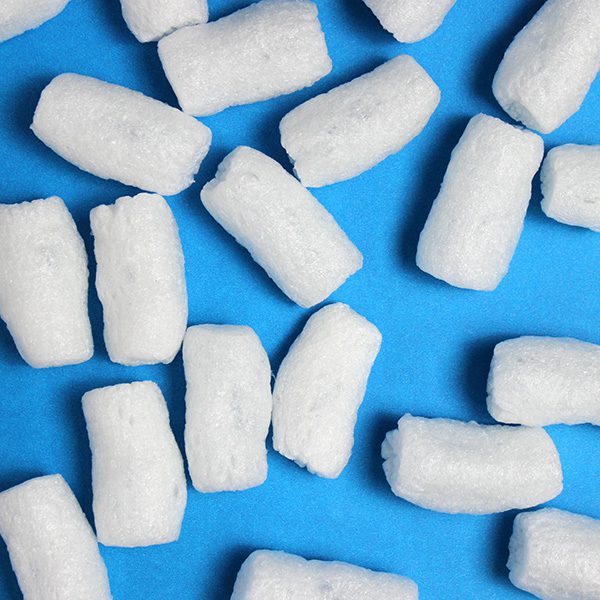
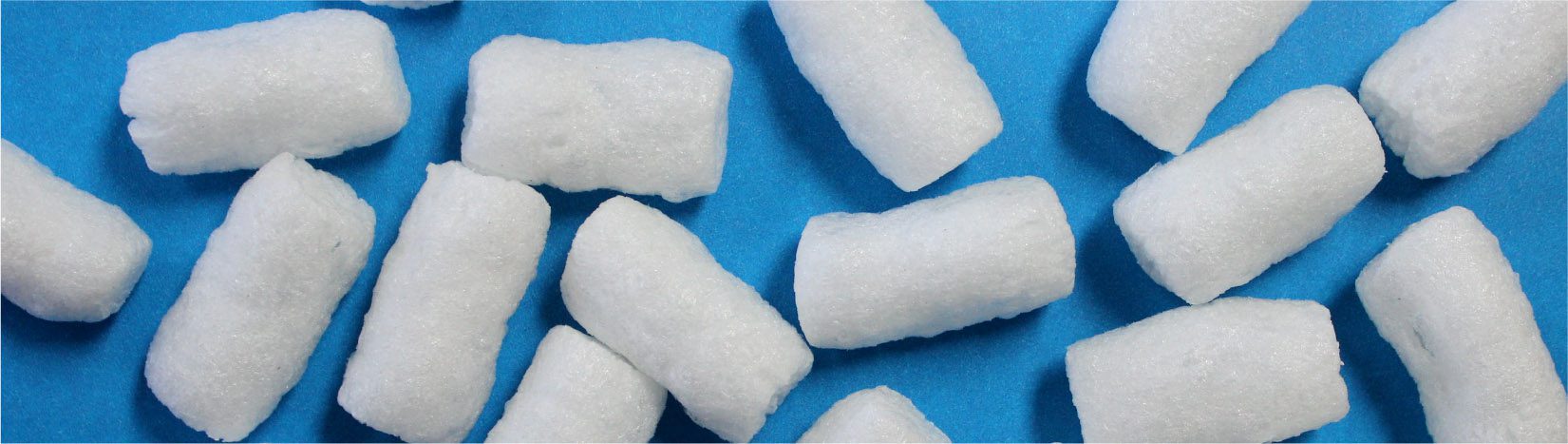
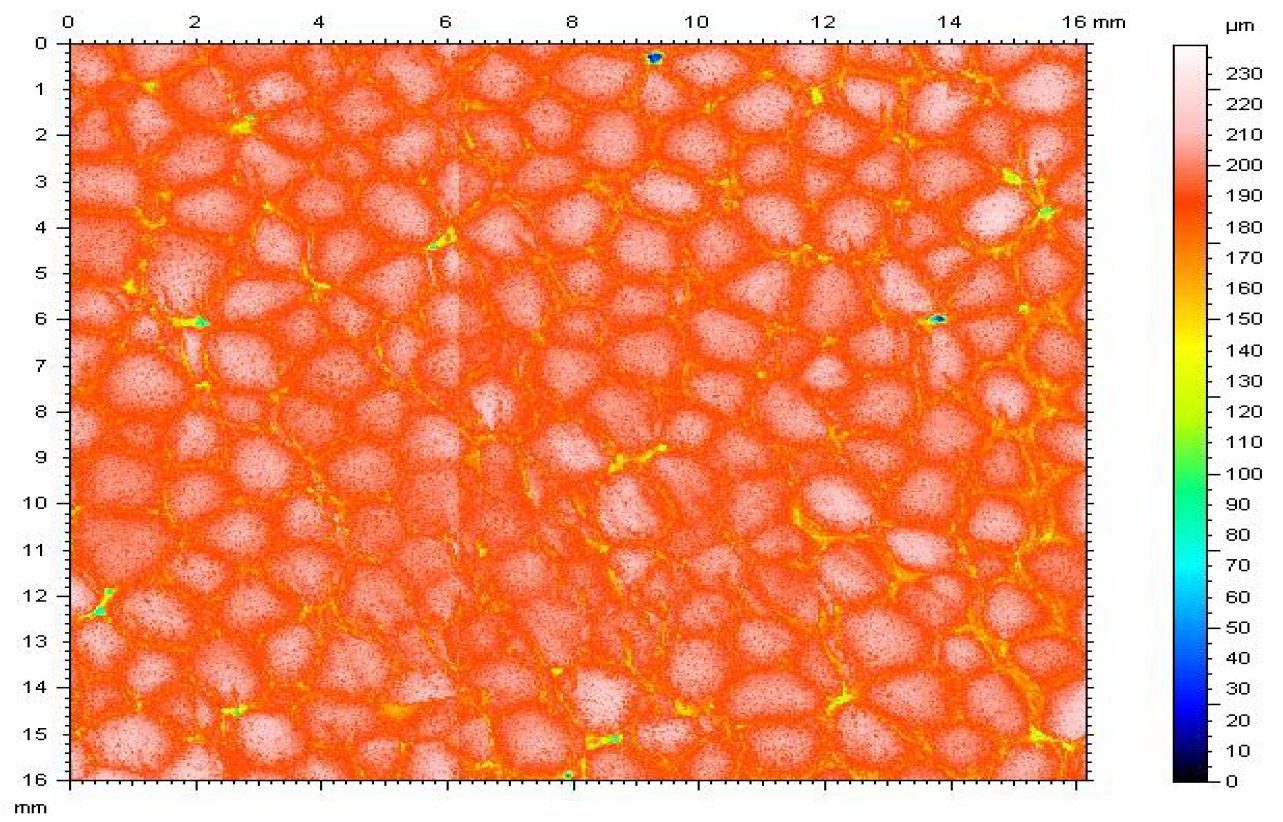
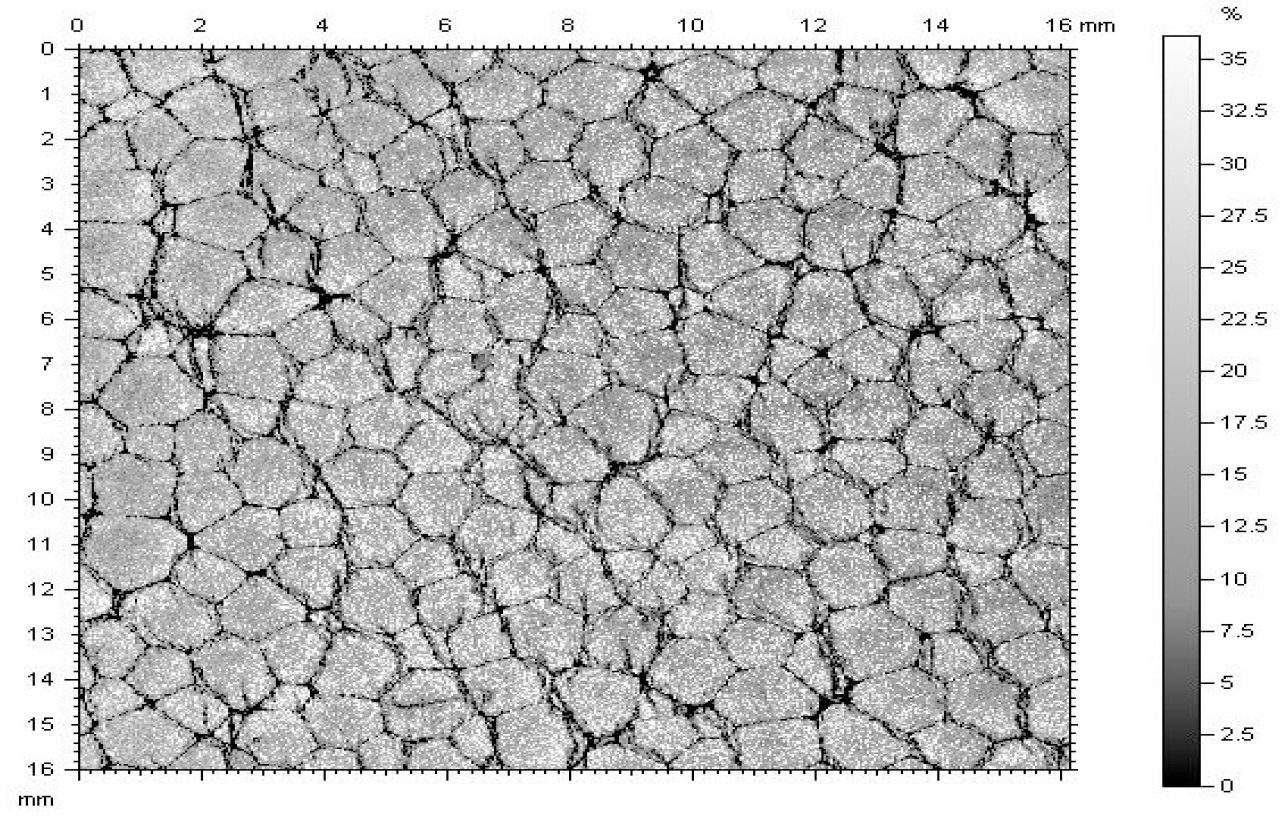
이 애플리케이션에서는 나노베아 ST400 프로파일로미터를 사용하여 스티로폼의 표면적을 측정합니다. 나노베아 ST400을 사용하여 동시에 획득한 지형과 함께 반사된 강도 파일을 결합하여 경계를 설정했습니다. 그런 다음 이 데이터를 사용하여 각 스티로폼 "입자"의 다양한 모양과 크기 정보를 계산했습니다.

나노비아

ST400

결과 및 토론: 2D 표면 경계 측정

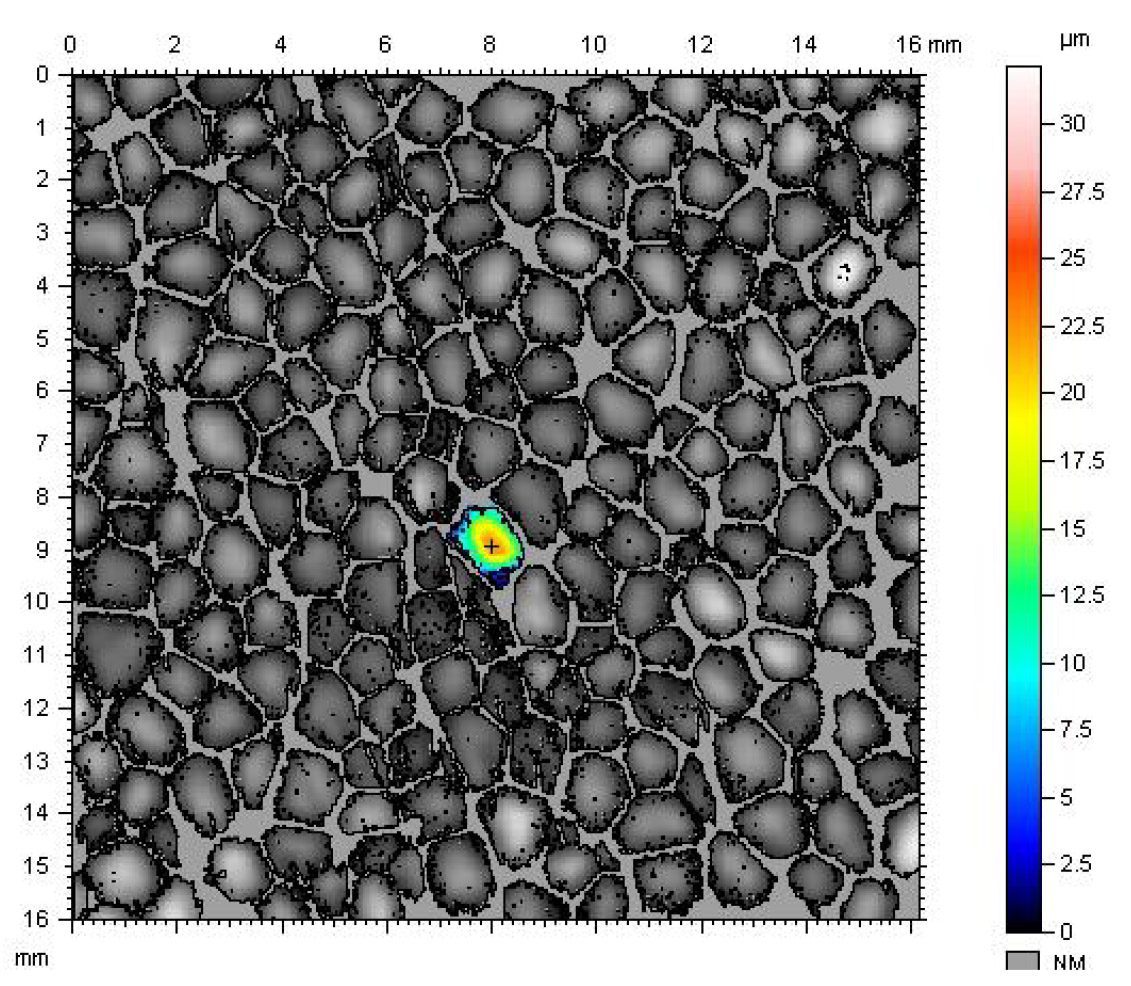
지형 이미지(왼쪽 아래)를 반사된 강도 이미지(오른쪽 아래)로 마스킹하여 입자 경계를 명확하게 정의합니다. 필터를 적용하여 직경 565µm 이하의 모든 입자는 무시되었습니다.

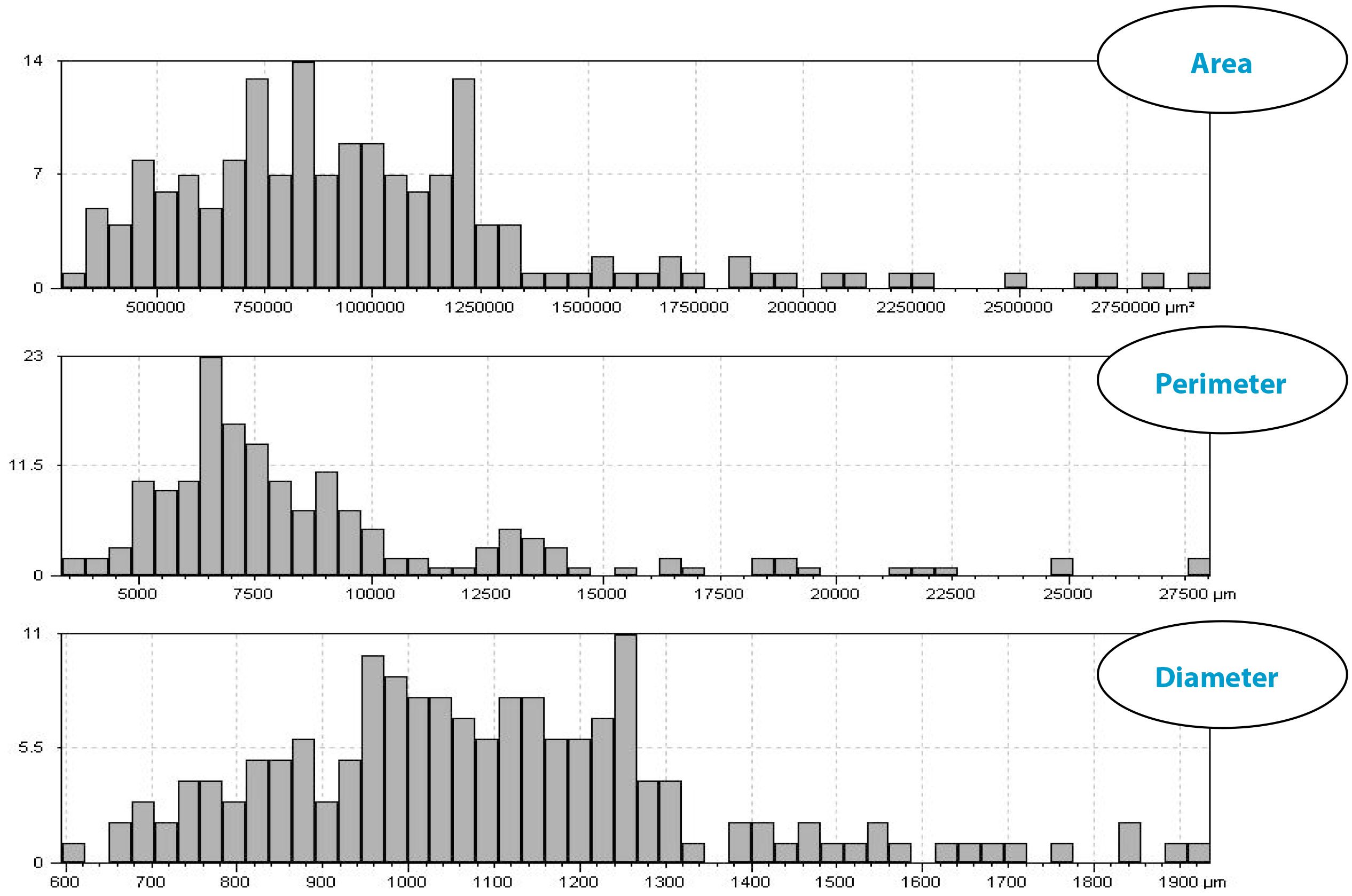
총 곡물 수: 167
곡물이 차지하는 총 투영 면적: 166.917mm²(64.5962 %)
경계가 차지하는 총 예상 면적: (35.4038 %)
입자의 밀도: 0.646285 입자/mm2

면적 = 0.999500 mm² +/- 0.491846 mm²
둘레 = 9114.15 µm +/- 4570.38 µm
등가 직경 = 1098.61 µm +/- 256.235 µm
평균 직경 = 945.373 µm +/- 248.344 µm
최소 직경 = 675.898 µm +/- 246.850 µm
최대 직경 = 1312.43 µm +/- 295.258 µm

결과 및 토론: 3D 표면 경계 측정

획득한 3D 지형 데이터를 사용하여 각 입자의 부피, 높이, 피크, 종횡비 및 일반 형상 정보를 분석할 수 있습니다. 총 3D 면적: 2.525mm3

결론

이 애플리케이션에서는 나노베아 3D 비접촉식 프로파일로미터가 스티로폼 표면을 정밀하게 특성화할 수 있는 방법을 보여주었습니다. 관심 있는 전체 표면 또는 개별 입자(피크 또는 피트)에 대한 통계 정보를 얻을 수 있습니다. 이 예에서는 사용자가 정의한 크기보다 큰 모든 입자를 사용하여 면적, 둘레, 지름 및 높이를 표시했습니다. 여기에 표시된 기능은 바이오 의료에서 미세 가공 응용 분야에 이르기까지 다양한 자연 표면 및 사전 가공된 표면의 연구 및 품질 관리에 중요할 수 있습니다. 

나노베아의 프로파일로미터를 이용한 윤곽 측정

타이어 트레드 깊이 및 고무 표면 거칠기 측정 | 3D 광학 프로파일러

타이어 트레드 깊이 및 고무 표면 거칠기 측정 3D 광학 프로파일러 사용

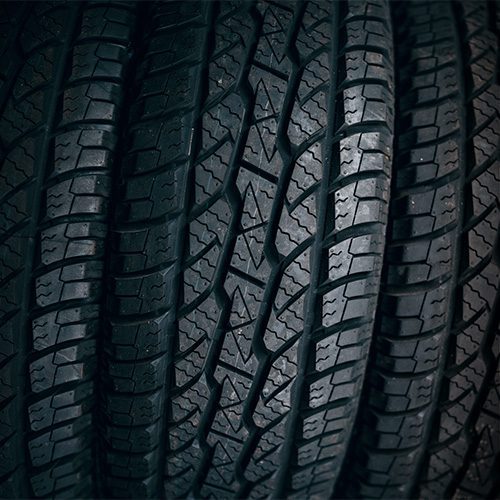
다양한 자동차 타이어 트레드 패턴을 보여주는 타이어 트레드 깊이 측정 기준

작성자

안드레아 헤르만

소비자 안전을 위해 타이어 트레드 깊이는 일반적으로 휴대용 계측기로 측정되지만, 산업 연구개발 및 타이어 제조업체는 보다 정교한 방법이 필요합니다. 본 애플리케이션 노트는 3D 광학 프로파일로미터가 고정밀 연구를 위해 타이어 트레드 깊이 측정, 등고선 매핑 및 고무 표면 거칠기 분석을 어떻게 정밀하게 수행하는지 보여줍니다.

소개

모든 재료와 마찬가지로 고무의 마찰 계수는 부분적으로 표면 거칠기와 관련이 있습니다. 차량 타이어에서는 트레드 깊이와 표면 거칠기 모두 접지력, 제동 성능 및 마모 성능에 직접적인 영향을 미칩니다. 본 연구에서는 3D 비접촉식 프로파일로메트리를 사용하여 고무 표면과 트레드의 거칠기 및 치수를 분석합니다.
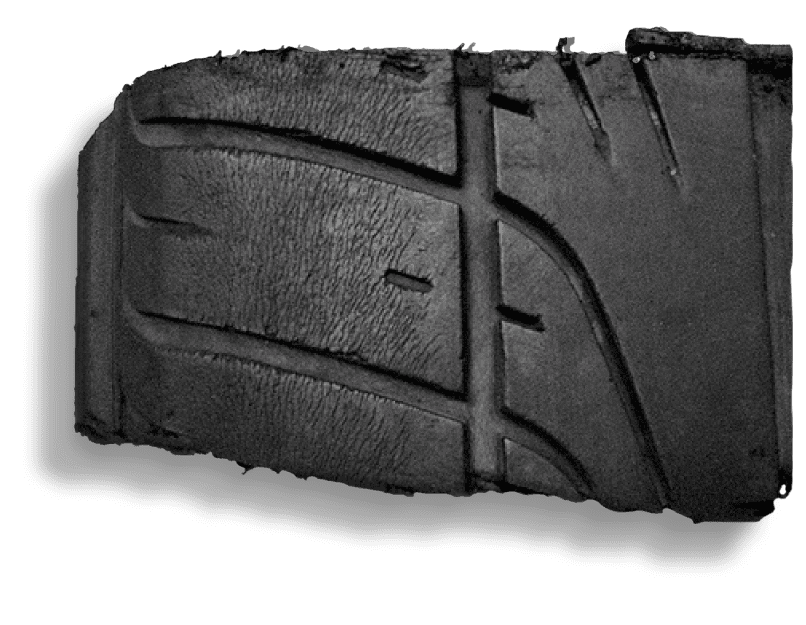
트레드 깊이 및 고무 표면 거칠기 측정에 사용되는 타이어 샘플

샘플

타이어 트레드 깊이 측정을 위한 3D 비접촉식 프로파일로메트리의 중요성

터치 프로브나 간섭계와 같은 다른 기술과 달리, 나노비아의 3D 비접촉 광학 프로파일러 축 색수차를 사용하여 거의 모든 표면을 측정합니다.

프로파일러 시스템의 개방형 스테이징은 다양한 샘플 크기를 허용하며 별도의 샘플 전처리 과정이 필요하지 않습니다. 단일 스캔으로 사용자는 타이어 트레드 깊이 전체와 미세 수준의 표면 거칠기를 동시에 측정할 수 있으며, 샘플의 반사율이나 흡수율에 전혀 영향을 받지 않습니다. 또한 이 프로파일러는 소프트웨어로 결과를 조작할 필요 없이 높은 표면 각도까지 측정할 수 있는 고급 기능을 갖추고 있습니다.

이러한 다용도성 덕분에 NANOVEA 프로파일러는 타이어 트레드 마모 테스트와 고급 고무 재료 연구 모두에 이상적입니다.

측정 목표

이 애플리케이션에서는 다음과 같은 기능을 선보입니다. 나노베아 ST400, 타이어 트레드 깊이, 윤곽 형상 및 고무 표면 거칠기를 측정하는 3D 비접촉식 광학 프로파일러입니다. 본 연구에서는 타이어 전체 표면을 대표할 수 있을 만큼 충분히 큰 표면 영역을 무작위로 선정하였습니다. 고무 특성을 정량화하기 위해 NANOVEA Ultra 3D 분석 소프트웨어를 사용하여 홈 치수, 트레드 깊이, 표면 거칠기 및 개발 면적 대 예상 면적을 측정하였습니다.

나노비아 ST400 표준
광학 3D 프로파일로미터

분석: 타이어 트레드
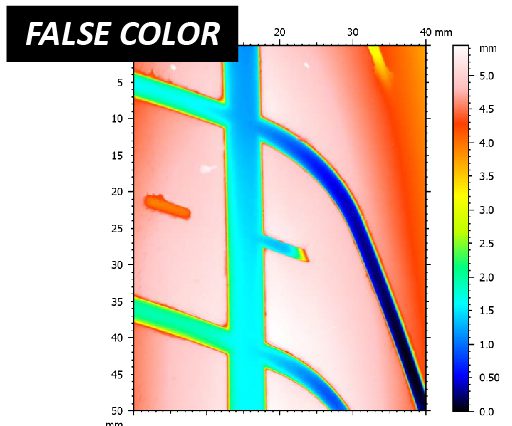
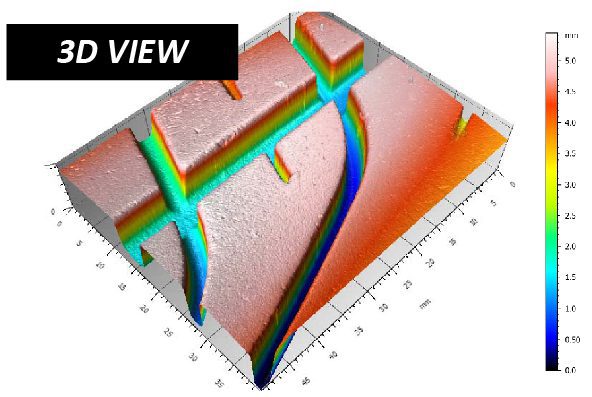
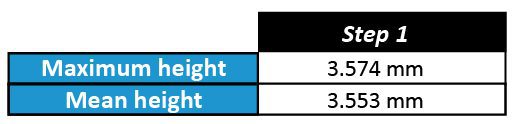
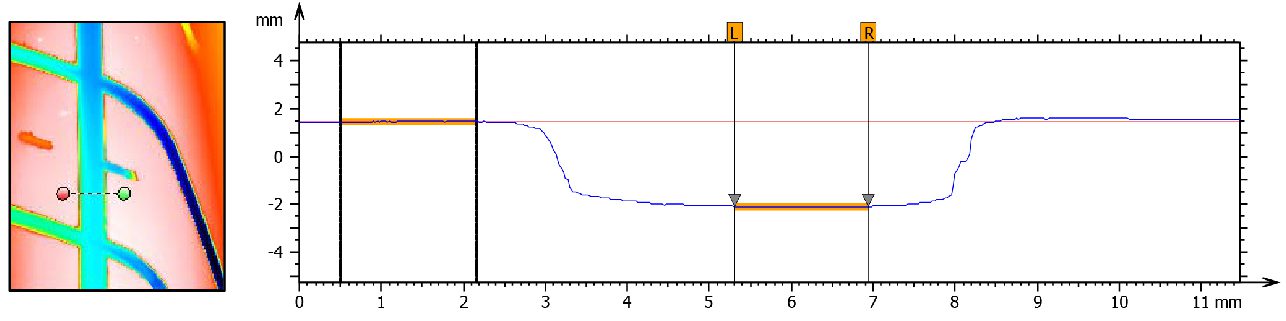
트레드의 3D 뷰와 가색 뷰는 3D 표면 설계 매핑의 가치를 보여줍니다. 이는 엔지니어에게 트레드 깊이 균일성, 그루브 설계 및 마모를 다양한 각도에서 평가할 수 있는 직관적인 도구를 제공합니다. 고급 등고선 분석과 계단 높이 분석은 모두 샘플 형상과 설계의 정밀한 치수를 측정하는 매우 강력한 도구입니다.
타이어 트레드 깊이와 홈 형상 측정을 위한 가색 3D 광학 프로파일링
타이어 트레드 깊이 측정을 위한 3D 프로파일로미터 표면 뷰

고급 윤곽 분석

3D 프로파일로메트리를 이용한 타이어 트레드 그루브의 고급 윤곽 분석

스텝 높이 분석

3D 광학 프로파일러를 이용한 타이어 트레드 깊이 측정을 위한 계단 높이 분석
타이어 트레드 깊이 측정을 보여주는 3D 프로파일로메트리 단차 프로파일
분석: 고무 표면
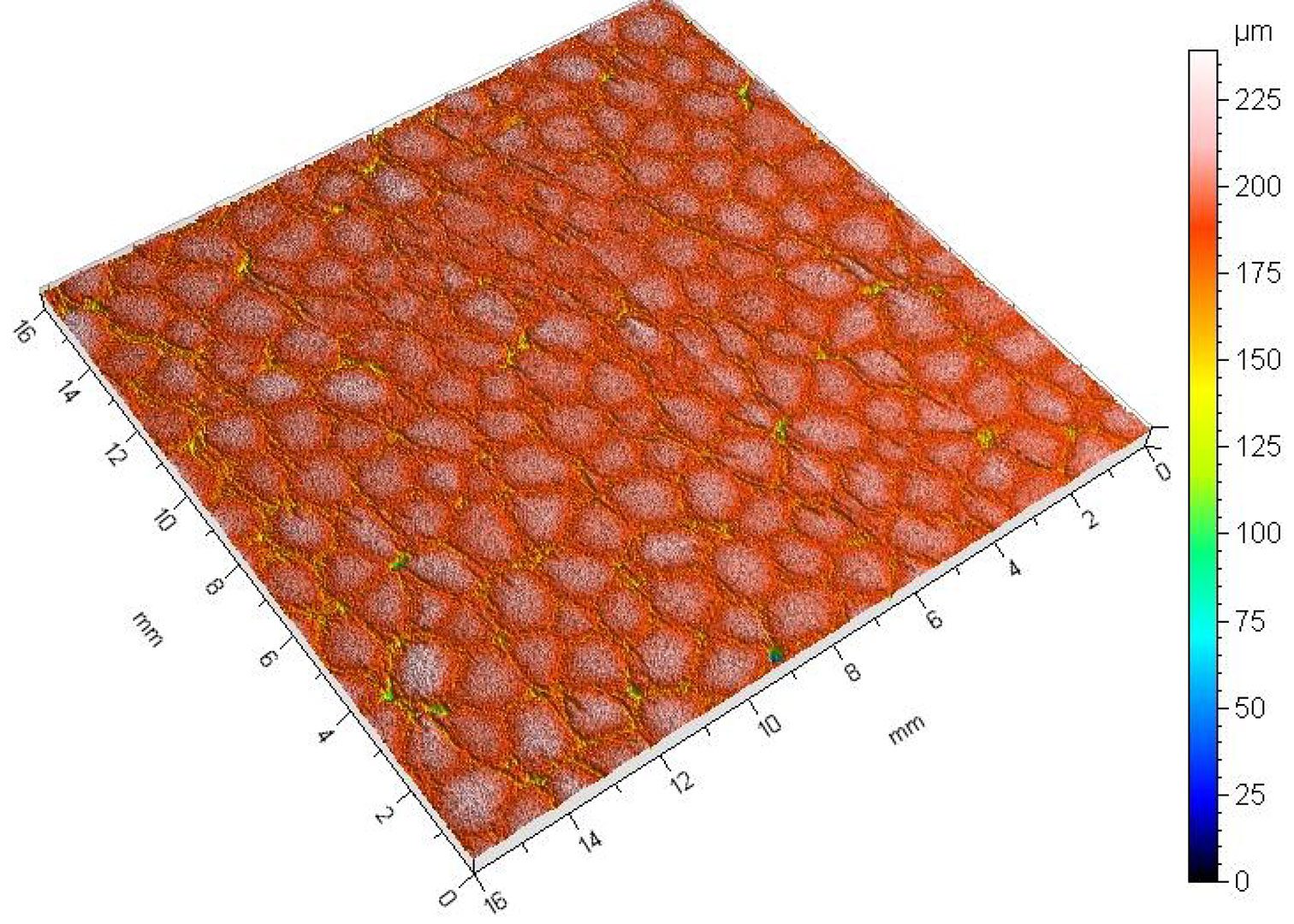
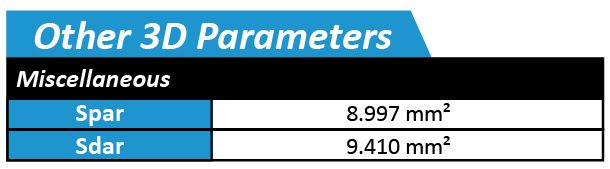
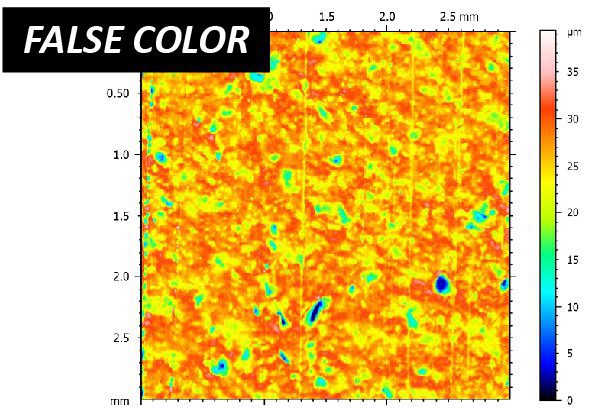
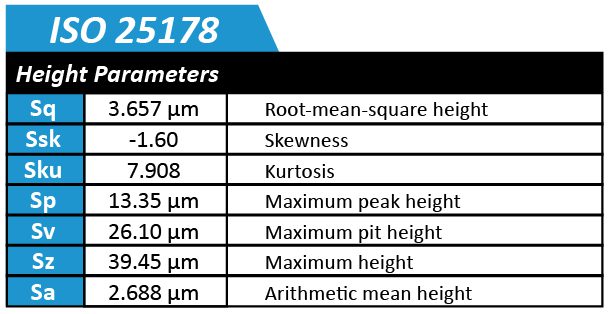
고무 표면은 다음 그림과 같이 내장 소프트웨어 도구를 사용하여 다양한 방식으로 정량화할 수 있습니다. 표면 거칠기는 2.688 μm이며, 전개 면적 대 투영 면적은 각각 9.410 mm² 대 8.997 mm²임을 확인할 수 있습니다. 이러한 결과는 고무 표면 거칠기가 접지력과 성능에 미치는 영향을 보여주며, 서로 다른 고무 배합이나 다양한 수준의 표면 마모 상태 간 비교를 가능하게 합니다.
3D 광학 프로파일러를 이용한 고무 표면 거칠기 분석
ISO 25178 타이어 고무 표면의 높이 매개변수
고무 표면 거칠기와 전개 영역의 3D 광학 프로파일 측정법 시각화
타이어 고무 표면 프로파일러 매개변수

결론

본 애플리케이션에서는 NANOVEA 3D 비접촉 광학 프로파일러가 타이어 트레드 깊이, 윤곽 치수 및 고무 표면 거칠기를 정밀하게 특성화하는 방법을 보여주었습니다. 데이터에 따르면 표면 거칠기는 2.69 µm, 전개 면적은 9.41 mm²이며 투영 면적은 9 mm²입니다. 고무 트레드의 다양한 치수와 반경도 측정되었습니다. 이 정보는 타이어 제조사, 자동차 연구원 및 재료 엔지니어가 트레드 설계, 고무 배합 또는 다양한 마모 정도를 가진 타이어를 비교하는 데 활용될 수 있습니다. 여기에 제시된 데이터는 Ultra 3D 분석 소프트웨어에서 가능한 계산의 일부만을 나타냅니다.
가공 부품 QC

가공 부품 검사

기계 부품

3D 프로파일 측정을 사용한 CAD 모델 검사

작성자:

Duanjie Li, PhD

개정자

조슬린 에스파르자

프로파일로미터를 이용한 가공 부품 검사

소개

복잡한 형상을 만들 수 있는 정밀 가공에 대한 수요는 다양한 산업 분야에서 증가하고 있습니다. 항공우주, 의료, 자동차부터 기술 기어, 기계, 악기에 이르기까지 지속적인 혁신과 진화로 인해 기대치와 정확도 기준이 새로운 차원으로 높아지고 있습니다. 이에 따라 제품의 최고 품질을 보장하기 위한 엄격한 검사 기술과 기기에 대한 수요가 증가하고 있습니다.

부품 검사를 위한 3D 비접촉식 프로파일 측정의 중요성

공차 및 생산 표준 준수 여부를 확인하려면 가공된 부품의 특성을 CAD 모델과 비교하는 것이 필수적입니다. 부품의 마모로 인해 교체가 필요할 수 있으므로 서비스 기간 동안의 검사도 매우 중요합니다. 필요한 사양에서 벗어난 부분을 적시에 식별하면 비용이 많이 드는 수리, 생산 중단 및 평판 손상을 방지하는 데 도움이 됩니다.

NANOVEA는 터치 프로브 방식과 달리 광학 프로파일러 접촉 없이 3D 표면 스캔을 수행하여 가장 높은 정확도로 복잡한 형상을 빠르고 정밀하며 비파괴적으로 측정할 수 있습니다.

측정 목표

이 애플리케이션에서는 치수, 반경 및 거칠기에 대한 포괄적인 표면 검사를 수행하는 고속 센서가 장착된 3D 비접촉식 프로파일러인 NANOVEA HS2000을 소개합니다. 

40초 이내에 모두 완료됩니다.

나노비아

HS2000

CAD 모델

가공된 부품이 원하는 사양, 공차 및 표면 마감을 충족하는지 확인하려면 부품의 치수와 표면 거칠기를 정밀하게 측정하는 것이 중요합니다. 검사 대상 부품의 3D 모델과 엔지니어링 도면이 아래에 제시되어 있습니다. 

거짓 색상 보기

CAD 모델과 스캔한 가공 부품 표면의 가색 보기를 그림 3에서 비교합니다. 샘플 표면의 높이 변화는 색상의 변화로 확인할 수 있습니다.

그림 2에 표시된 대로 3D 표면 스캔에서 3개의 2D 프로파일을 추출하여 가공된 부품의 치수 공차를 추가로 확인합니다.

프로필 비교 및 결과

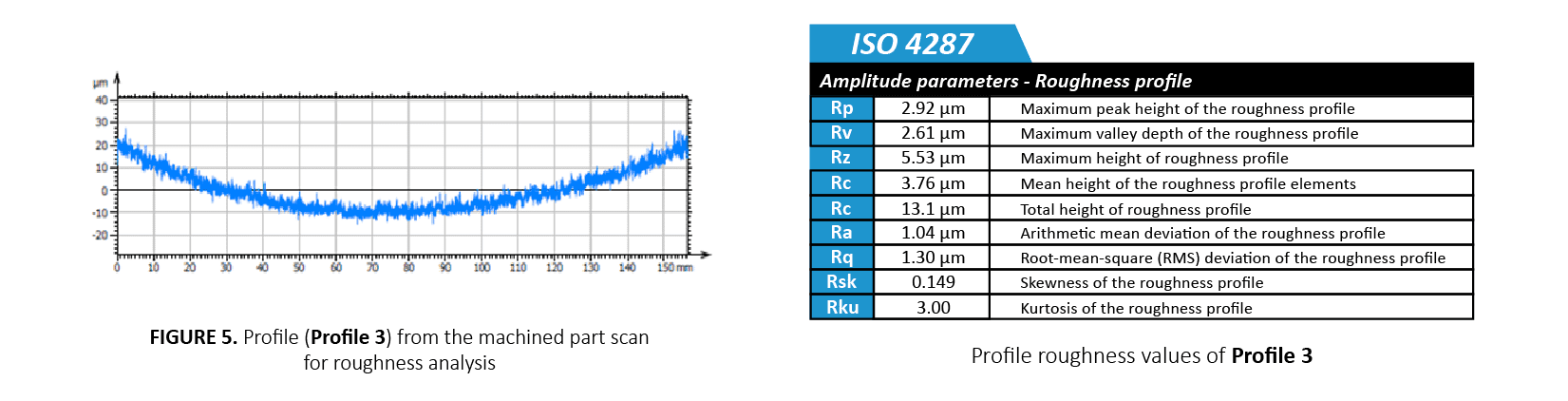
프로파일 1 ~ 3은 그림 3 ~ 5에 나와 있습니다. 정량적 공차 검사는 엄격한 제조 표준을 준수하기 위해 측정된 프로파일을 CAD 모델과 비교하여 수행됩니다. 프로파일 1과 프로파일 2는 곡면 가공 부품에서 서로 다른 영역의 반경을 측정합니다. 프로파일 2의 높이 변화는 156mm 길이에 걸쳐 30µm로 원하는 ±125µm 공차 요건을 충족합니다. 

공차 한계값을 설정하면 분석 소프트웨어가 가공된 부품의 합격 여부를 자동으로 판단할 수 있습니다.

프로파일로미터를 이용한 기계 부품 검사

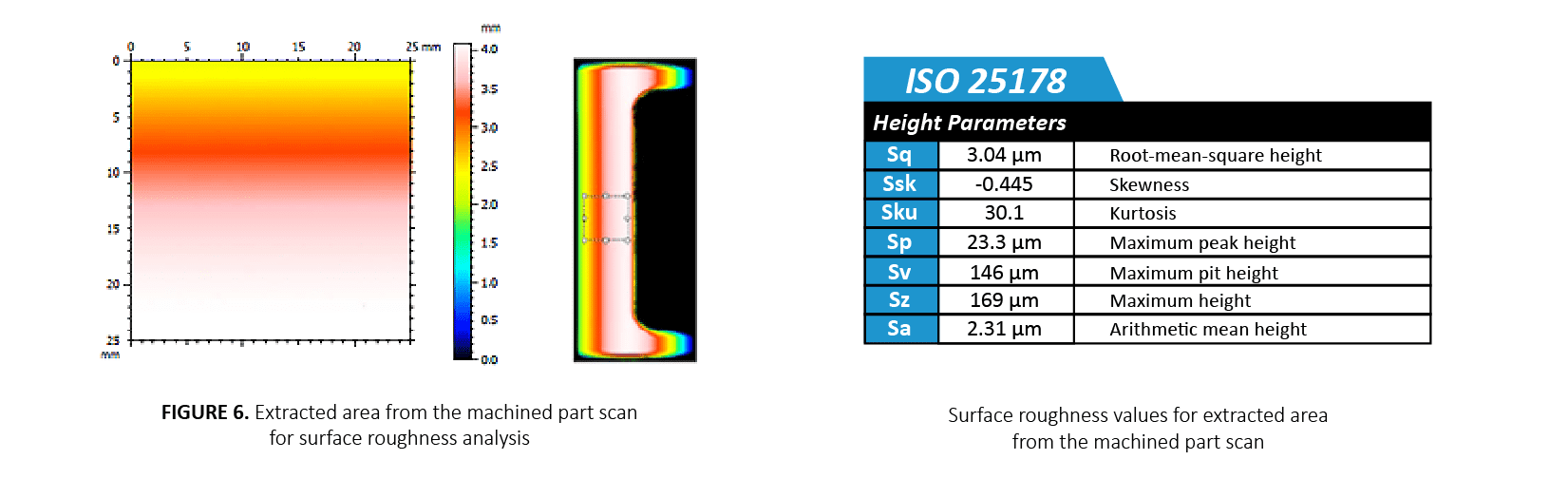
가공된 부품 표면의 거칠기와 균일성은 품질과 기능을 보장하는 데 중요한 역할을 합니다. 그림 6은 표면 조도를 정량화하는 데 사용된 가공된 부품의 상위 스캔에서 추출한 표면 영역입니다. 평균 표면 거칠기(Sa)는 2.31µm로 계산되었습니다.

결론

이 연구에서는 고속 센서가 장착된 나노베아 HS2000 비접촉식 프로파일러가 치수 및 거칠기에 대한 포괄적인 표면 검사를 수행하는 방법을 보여주었습니다. 

고해상도 스캔을 통해 사용자는 가공된 부품의 세부적인 형태와 표면 특징을 측정하고 이를 CAD 모델과 정량적으로 비교할 수 있습니다. 또한 이 기기는 스크래치 및 균열을 포함한 모든 결함을 감지할 수 있습니다. 

고급 윤곽 분석은 가공된 부품이 설정된 사양을 충족하는지 여부를 판단할 뿐만 아니라 마모된 부품의 고장 메커니즘을 평가하는 데도 탁월한 도구로 사용됩니다.

여기에 표시된 데이터는 모든 나노베아 광학 프로파일러에 장착된 고급 분석 소프트웨어로 가능한 계산의 일부에 불과합니다.

 
치과용 나사-치수-측정-3D-프로파일로미터 사용

치과용 공구: 치수 및 표면 거칠기 분석


소개


정확한 치수와 최적의 표면 거칠기를 갖는 것은 치과용 나사의 기능에 매우 중요합니다. 많은 치과용 나사 치수에는 반경, 각도, 거리, 계단 높이 등 높은 정밀도가 필요합니다. 미끄러지는 마찰을 최소화하기 위해 인체 내부에 삽입되는 의료 도구나 부품의 경우 국부적인 표면 거칠기를 이해하는 것도 매우 중요합니다.


차원 연구를 위한 비접촉 프로파일 측정


나노베아 3D 비접촉 프로파일러 유채색광 기반 기술을 사용하여 투명, 불투명, 반사, 확산, 광택 또는 거친 재료 표면을 측정합니다. 터치 프로브 기술과 달리 비접촉 기술은 좁은 영역 내부를 측정할 수 있으며 팁이 부드러운 플라스틱 재료를 눌렀을 때 발생하는 변형으로 인해 본질적인 오류가 추가되지 않습니다. 또한 색광 기반 기술은 초점 변형 기술에 비해 뛰어난 측면 및 높이 정확도를 제공합니다. Nanovea Profilers는 스티칭 없이 직접 큰 표면을 스캔하고 몇 초 안에 부품 길이의 프로파일을 생성할 수 있습니다. 결과를 조작하는 복잡한 알고리즘 없이 표면을 측정하는 프로파일러의 기능으로 인해 나노부터 매크로 범위의 표면 특징과 높은 표면 각도를 측정할 수 있습니다.


측정 목표


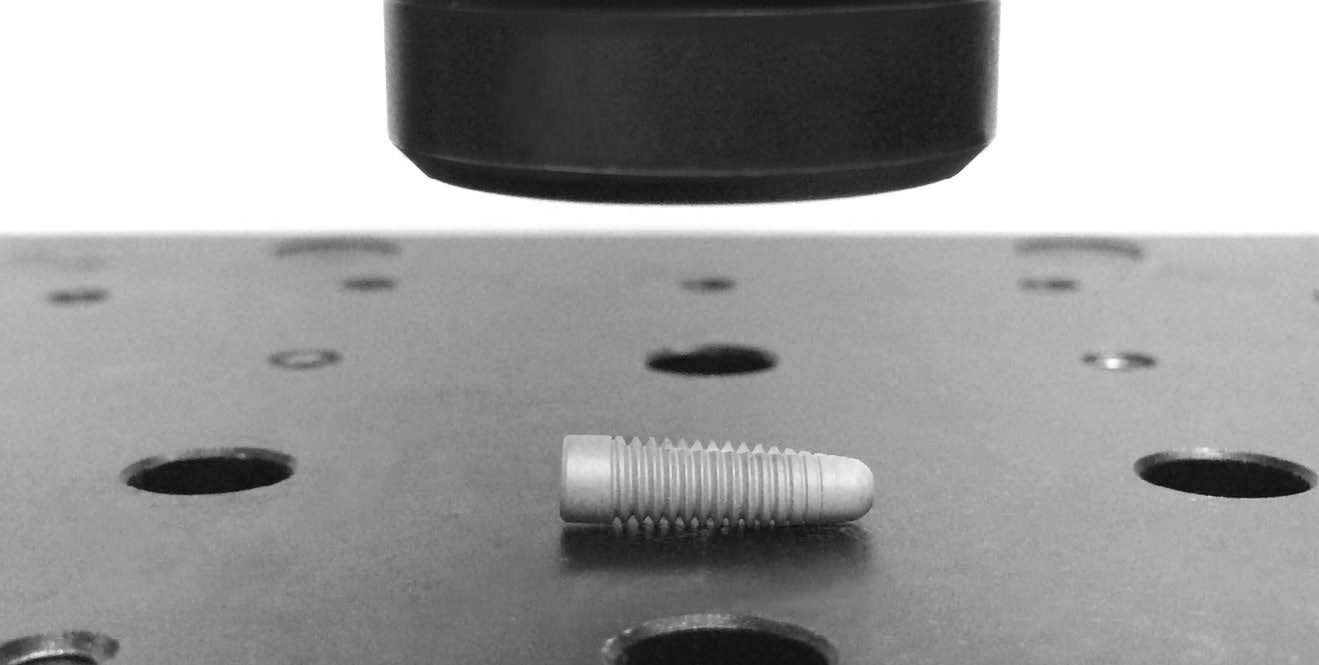
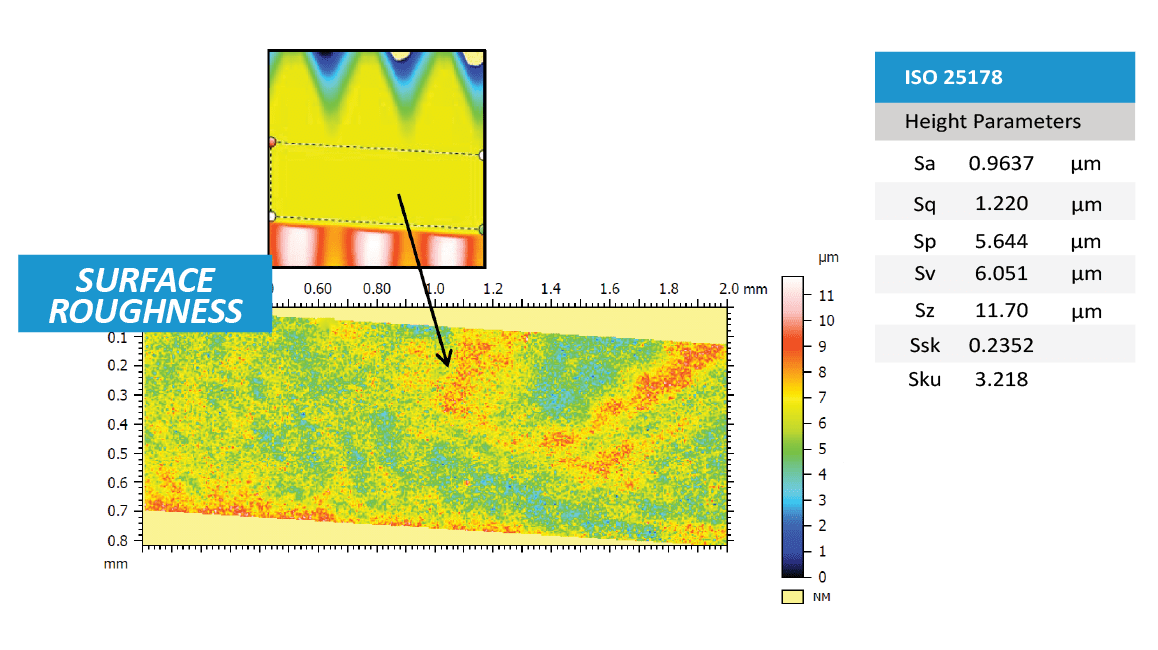
이 응용 분야에서는 Nanovea ST400 광학 프로파일러를 사용하여 단일 측정으로 평면 및 나사산 형상을 따라 치과용 나사를 측정했습니다. 평평한 면적으로부터 표면 거칠기를 계산하고 나사산 형상의 다양한 치수를 결정했습니다.


치과용 나사 품질 관리

치과용 나사 샘플을 분석한 결과 나노비아 광학 프로파일러.


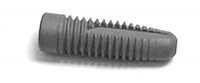
치과용 나사 샘플이 분석되었습니다.


결과


3D 표면

치과용 나사의 3D 보기 및 가색상 보기에는 나사산이 양쪽에서 시작되는 평평한 영역이 표시됩니다. 이는 사용자에게 다양한 각도에서 나사의 형태를 직접 관찰할 수 있는 간단한 도구를 제공합니다. 표면 거칠기를 측정하기 위해 전체 스캔에서 평평한 영역을 추출했습니다.


2D 표면 분석

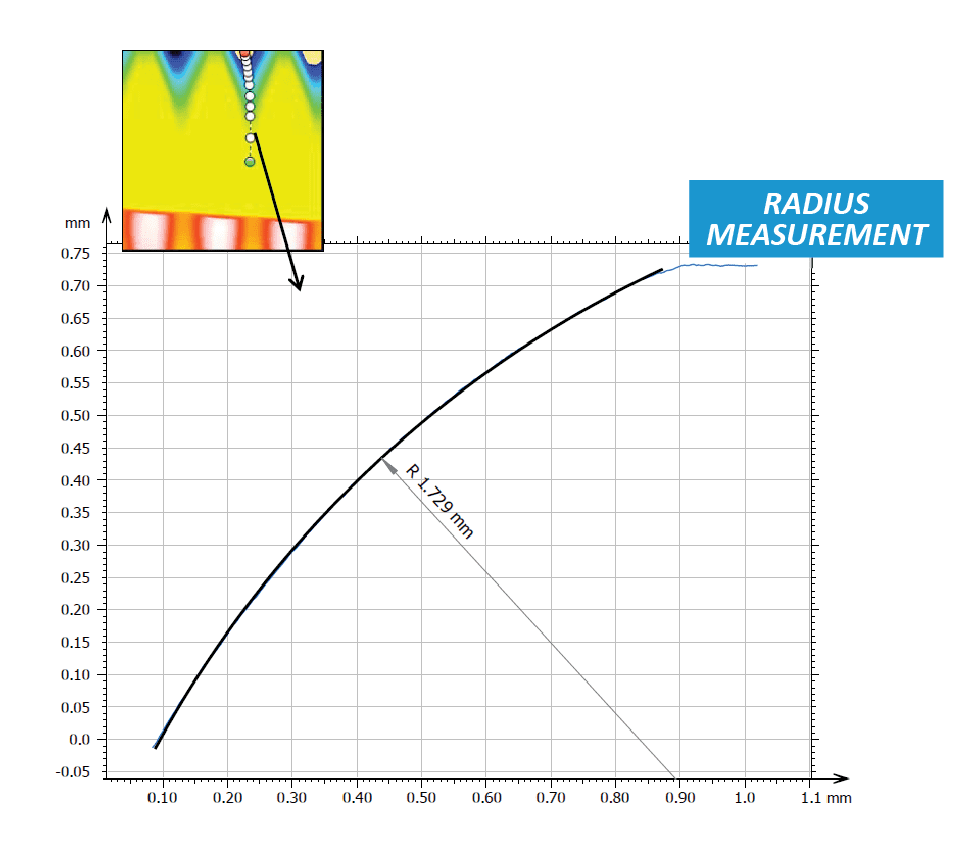
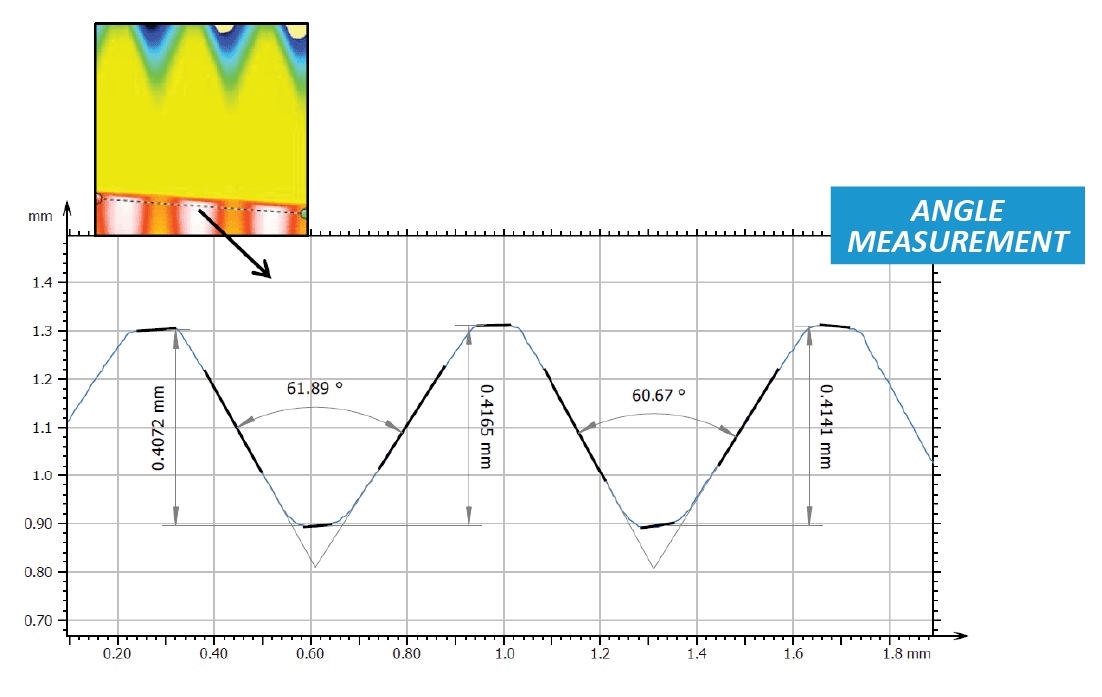
나사의 단면도를 표시하기 위해 표면에서 선 프로파일을 추출할 수도 있습니다. 윤곽 분석 및 계단 높이 연구를 사용하여 나사의 특정 위치에서 정확한 치수를 측정했습니다.


결론


이 응용 프로그램에서는 단일 스캔으로 국소 표면 거칠기를 정확하게 계산하고 큰 차원 특징을 측정하는 Nanovea 3D 비접촉 프로파일러의 기능을 선보였습니다.

데이터는 0.9637μm의 국부적인 표면 거칠기를 보여줍니다. 나사산 사이의 나사 반경은 1.729mm로 나타났으며, 나사산의 평균 높이는 0.413mm로 나타났다. 나사산 사이의 평균 각도는 61.3°로 결정되었습니다.

여기에 표시된 데이터는 분석 소프트웨어에서 사용할 수 있는 계산의 일부에 불과합니다.


작성자
Duanjie Li 박사, Jonathan Thomas, Pierre Leroux