アメリカ/グローバル: +1-949-461-9292
ヨーロッパ+39-011-3052-794
お問い合わせ

カテゴリープロフィロメトリー検査


stent coating adhesion testing failure analysis drug eluting stent coating

Stent Coating Adhesion and Delamination Analysis Using Nano Scratch Testing

Application Note | Stent Coating Adhesion Testing

Stent Coating Adhesion and Delamination Analysis Using Nano Scratch Testing

Quantifying Coating Failure and Adhesion Performance on Drug-Eluting Stents

stent coating adhesion testing nano scratch delamination critical load

Research & Experimental Testing

Duanjie Li, PhD

Visual Design & Editorial

アンドリュー・ショア

はじめに

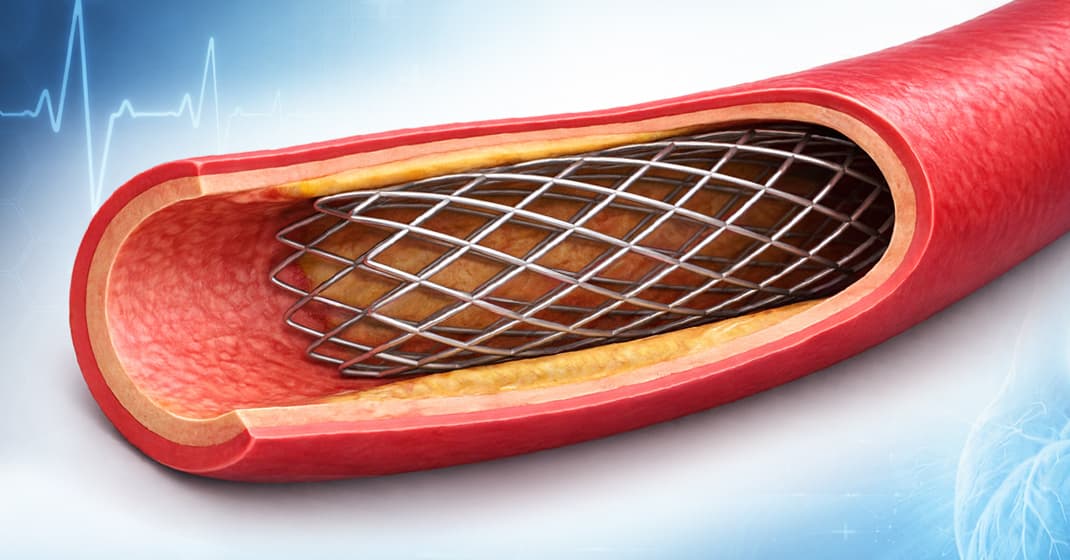
Blood is carried through arteries from the heart to the rest of the body. Any weakening or blockage of these vessels can pose significant health risks and may become life-threatening. A stent is a small mesh tube inserted into the lumen of a blood vessel to treat narrowed or weakened arteries. Stent implantation is now a widely used procedure to support the arterial wall and restore blood flowᶦ.
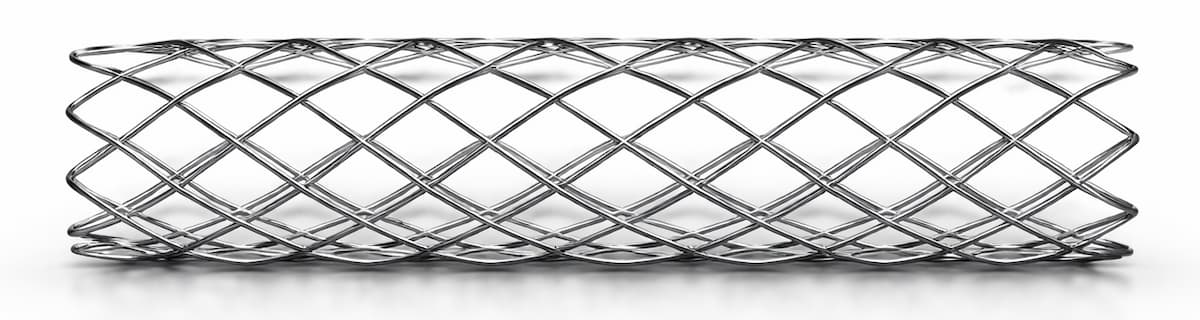
Metal stent mesh geometry illustrating the structural complexity of vascular implant design.

Why coating adhesion matters in drug-eluting stents

Drug-eluting stents represent a major advancement in stent technology. They incorporate a biodegradable, biocompatible polymer coating that enables controlled drug release at the arterial site, helping to inhibit intimal thickening and reduce the risk of restenosisᶦᶦ.

A critical concern in these systems is the delamination of the polymer coating from the metallic stent substrate. This coating carries the drug-eluting layer, and its adhesion directly impacts device performance and reliability.

To improve coating adhesion, stents are often designed with complex geometries. In this study, the polymer coating is located at the bottom of grooves within the stent mesh. This configuration presents a significant challenge for adhesion measurement.

A reliable method is required to quantitatively evaluate the interfacial strength between the polymer coating and the metal substrate. The small diameter of the stent mesh, comparable to a human hair, combined with its three-dimensional geometry, requires:

  • ultrafine X-Y positioning accuracy
  • precise control of applied load
  • accurate depth measurement during testing
Measurement Method

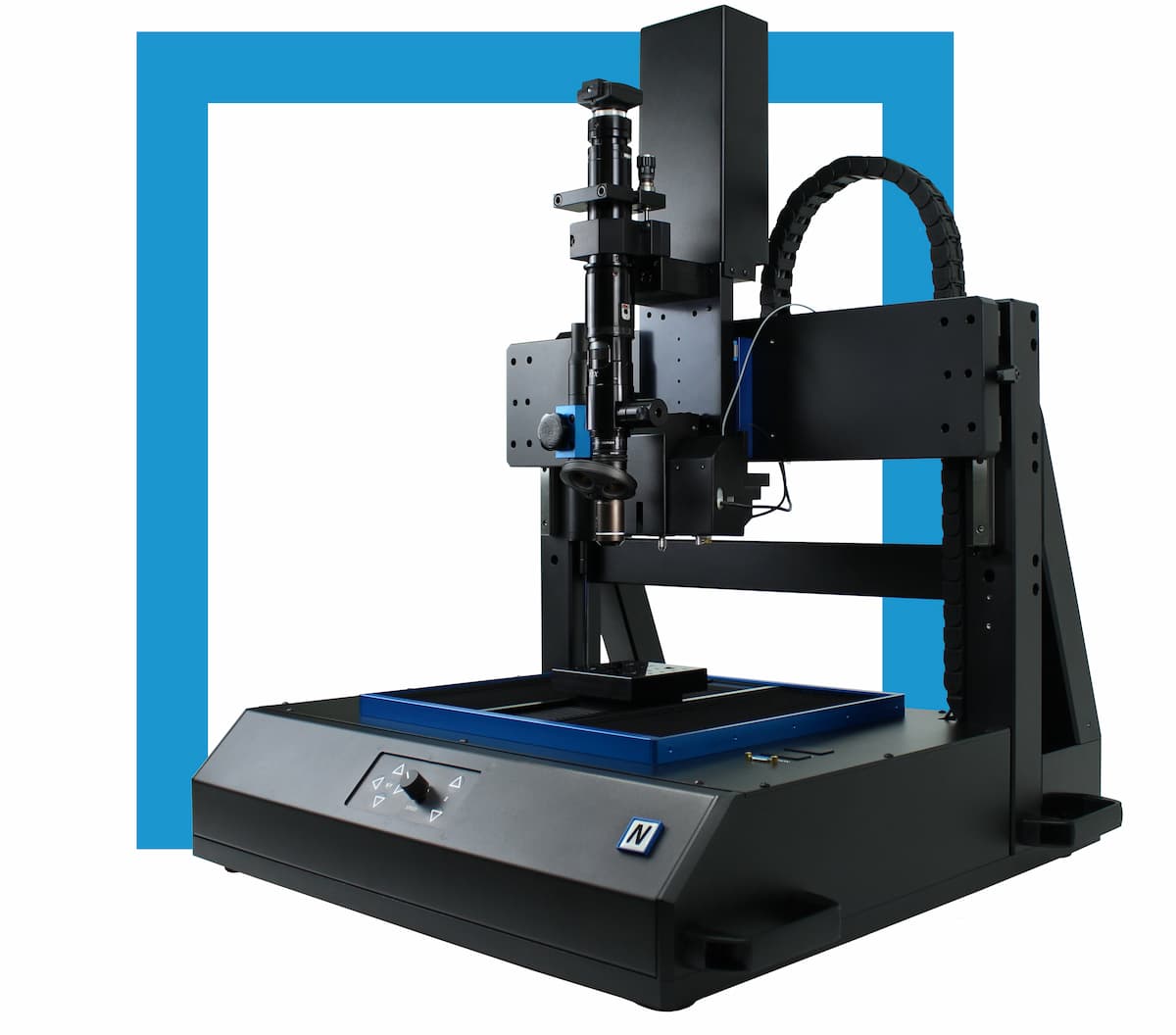
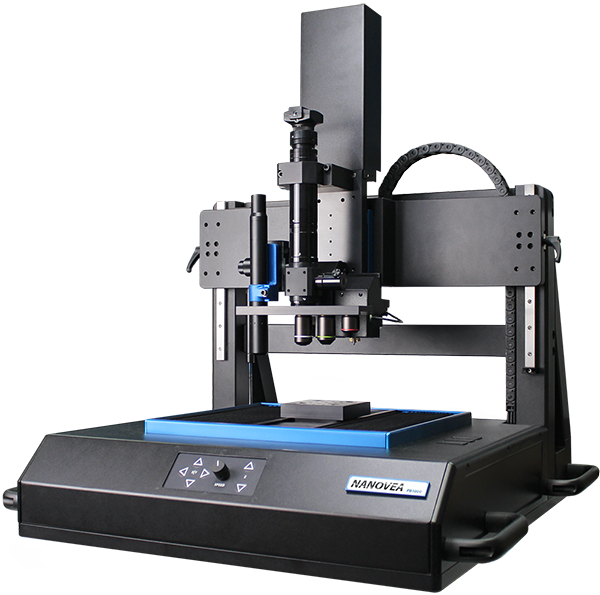
Nano scratch testing is performed using the NANOVEA PB1000 メカニカルテスター, in Nano Scratch Mode, to evaluate the cohesive and adhesive strength of the polymer coating on the metal mesh of stent samples.
Controlled scratch measurements are carried out on stent geometries with dimensions comparable to a human hair, enabling precise evaluation of coating adhesion on complex stent structures.

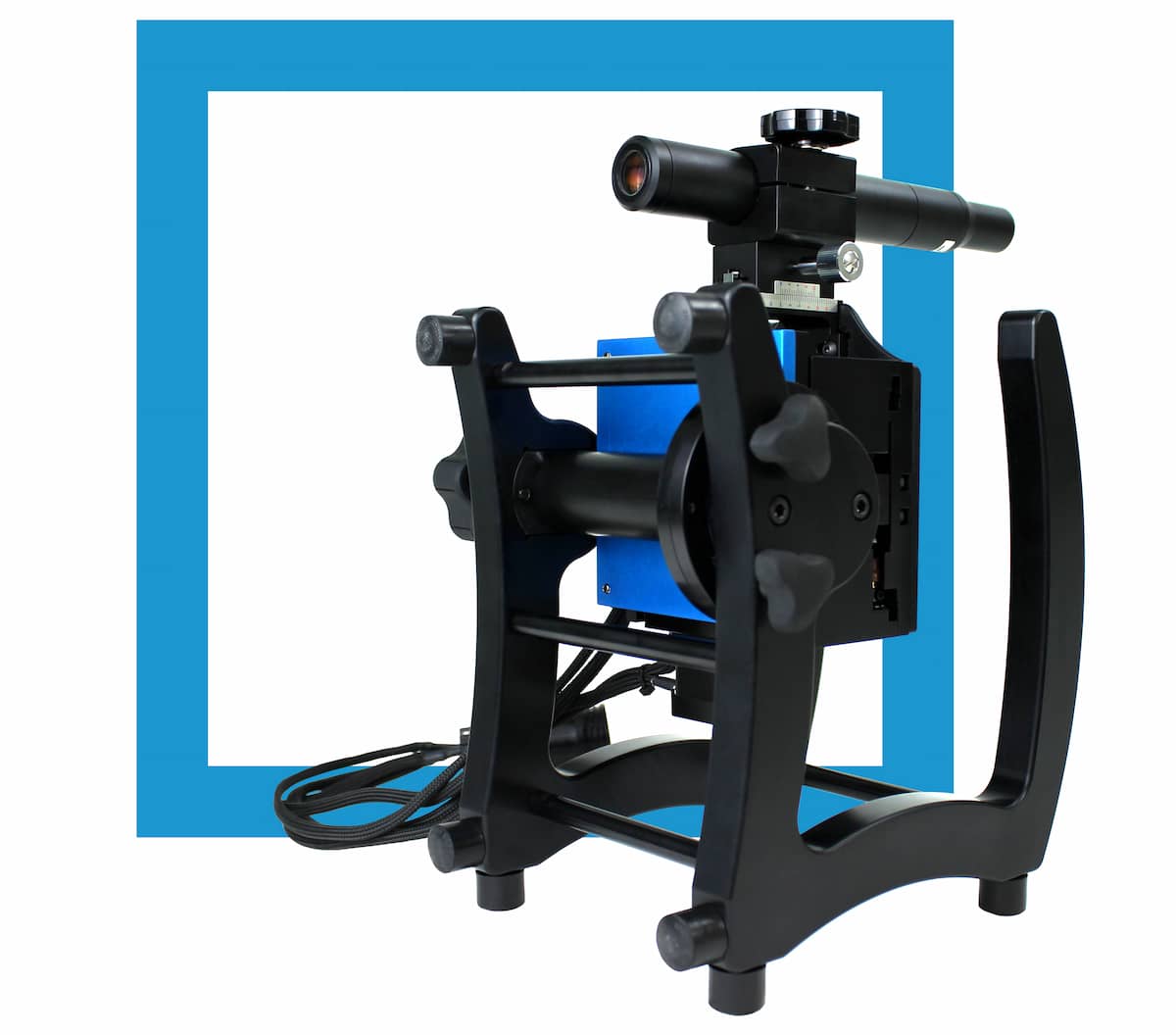
ナノビア PB1000 Advanced

メカニカルテスター

テスト条件

1. Regular Stent Samples

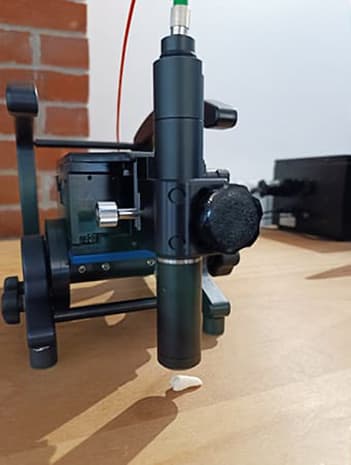
The stent is fixed on the sample stage, with a support wire inserted inside the stent tube to ensure stability during nano scratch testing. The NANOVEA Mechanical Tester is used to perform nano scratch measurements using the parameters summarized in Table 1, to evaluate the cohesive and adhesive strength of the polymer coating on the metal substrate.

ParameterValue
Load typeプログレッシブ
Initial load0.05 mN
Final load300 and 100 mN
Sliding speed0.5 mm/min
Sliding distance0.5 mm
Indenter geometry円錐形(コニカル)
Indenter material (tip)ダイヤモンド
圧子先端半径20 µm
温度24°C (room)

表1: Test parameters for nano scratch measurements on regular stent samples

2. Grooved Stent Samples

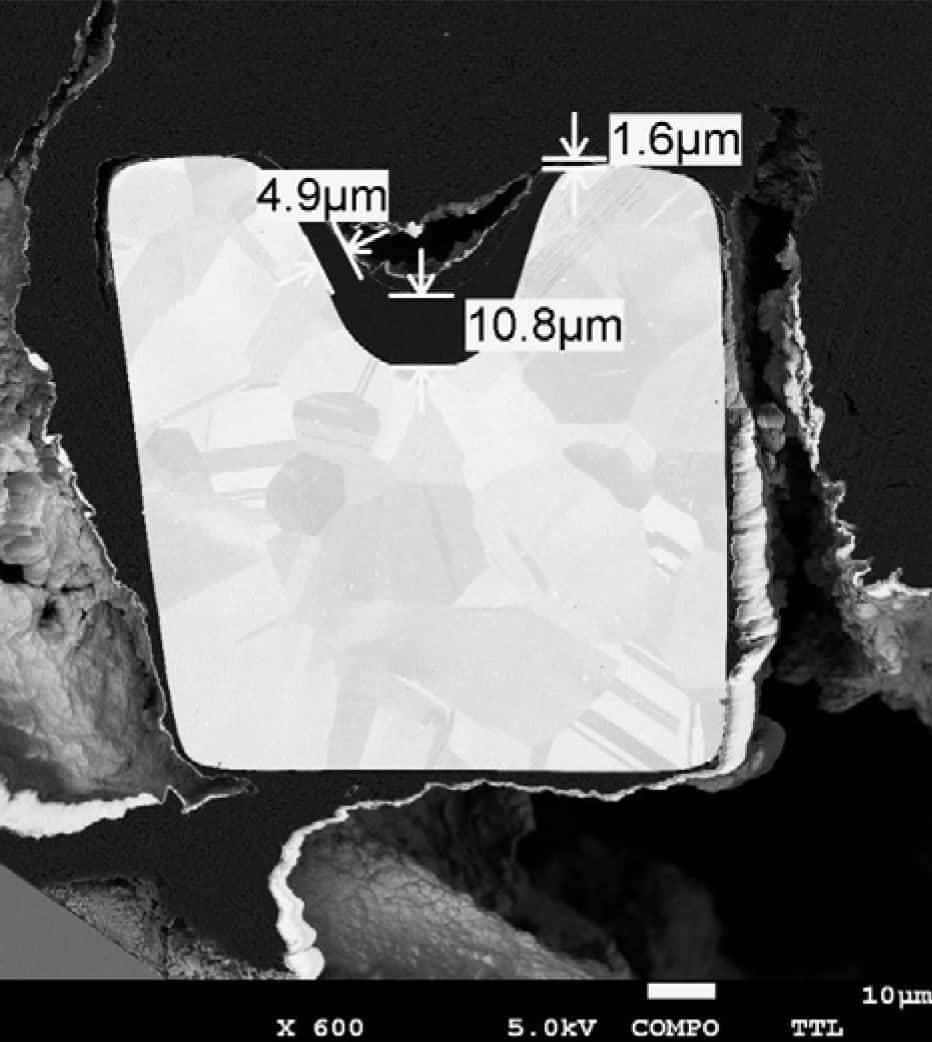
The SEM image in Fig. 1 shows the cross-section of the stent sample. The stent features a groove with a depth of approximately 30 µm. The polymer coating, with a thickness of 10.8 µm, is located at the bottom of the groove.

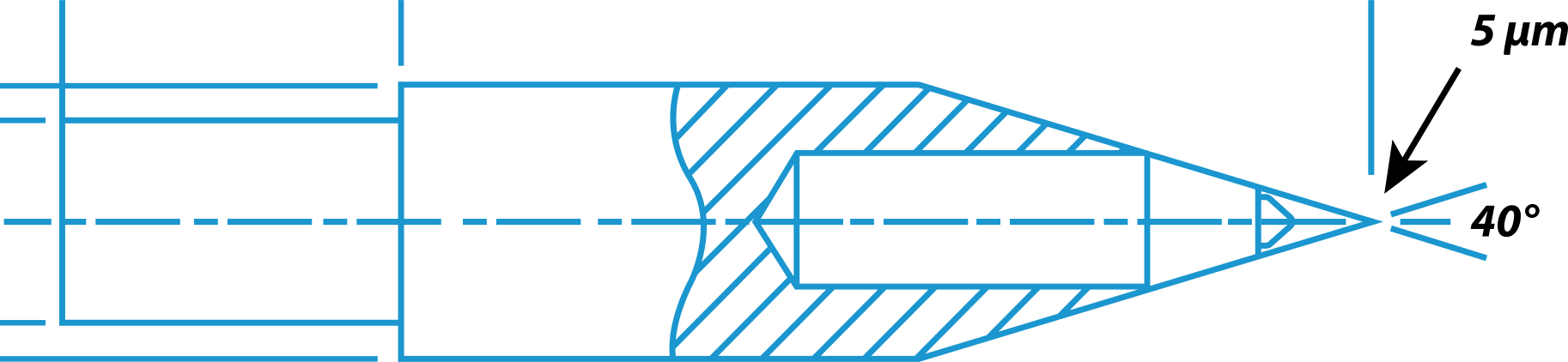
Standard 60° conical diamond tips are not sharp enough to reach the bottom of the groove without contacting the sidewalls. Therefore, a sharper 40° conical diamond tip is used in this study (Fig. 2).

Nano scratch measurements are performed using the parameters summarized in Table 2.

Parameter Value
Load type プログレッシブ
Initial load 0.1 mN
Final load 300 mN
積載率 300 mN/min
Scratch length 0.25 mm
Scratch speed 0.25 mm/min
Indenter geometry 40° cone
Indenter material (tip) ダイヤモンド
圧子先端半径 5 µm

Table 2: Test parameters for nano scratch measurements on grooved stent samples

stent groove cross section polymer coating thickness adhesion analysis nano scratch testing
Fig. 1: SEM cross-section of a grooved stent showing polymer coating located at the bottom of the groove, highlighting the challenge of coating adhesion measurement in recessed geometries.

nano scratch diamond tip 40 degree stent groove coating adhesion testing schematic
Fig. 2: Schematic of a 40° conical diamond tip designed for nano scratch testing inside stent grooves, enabling accurate adhesion measurement without sidewall interference.
結果および考察

The stent mesh has a diameter of approximately 100 μm, comparable to a human hair. Precise positioning is therefore critical to ensure the scratch test is performed at the center of the stent mesh. The NANOVEA Mechanical Tester provides X–Y positioning accuracy down to 0.25 μm, enabling accurate test placement under the integrated optical microscope.

1. Regular Stent Samples

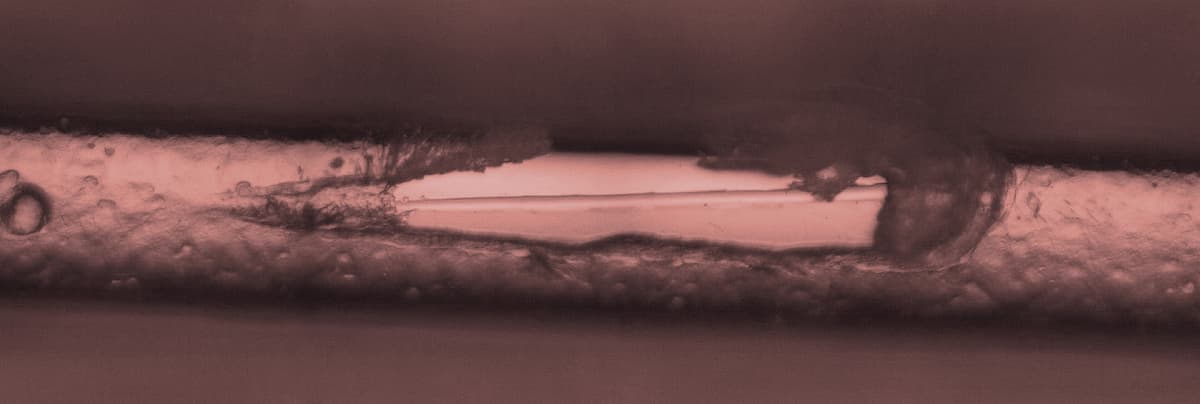
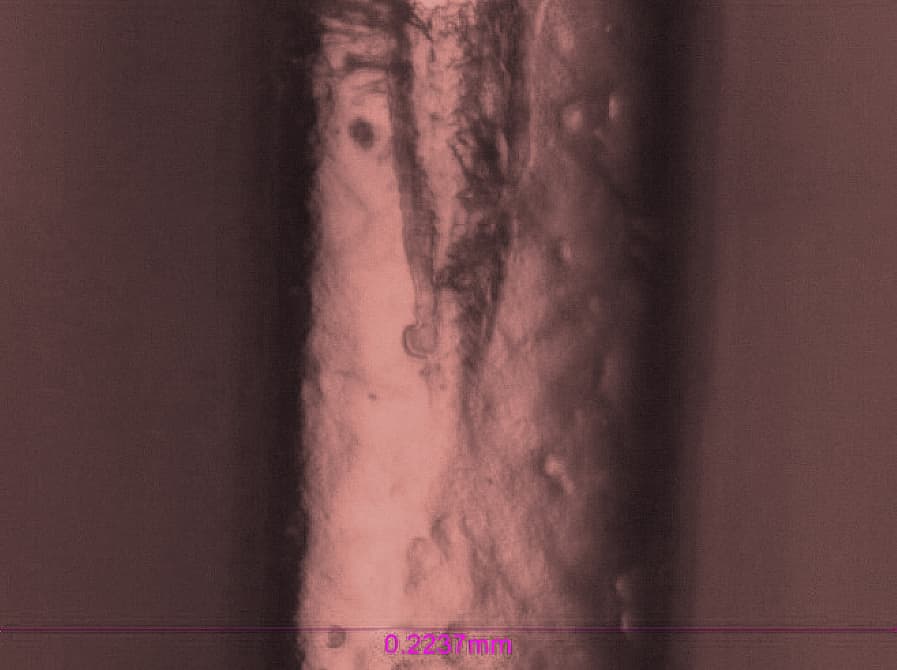
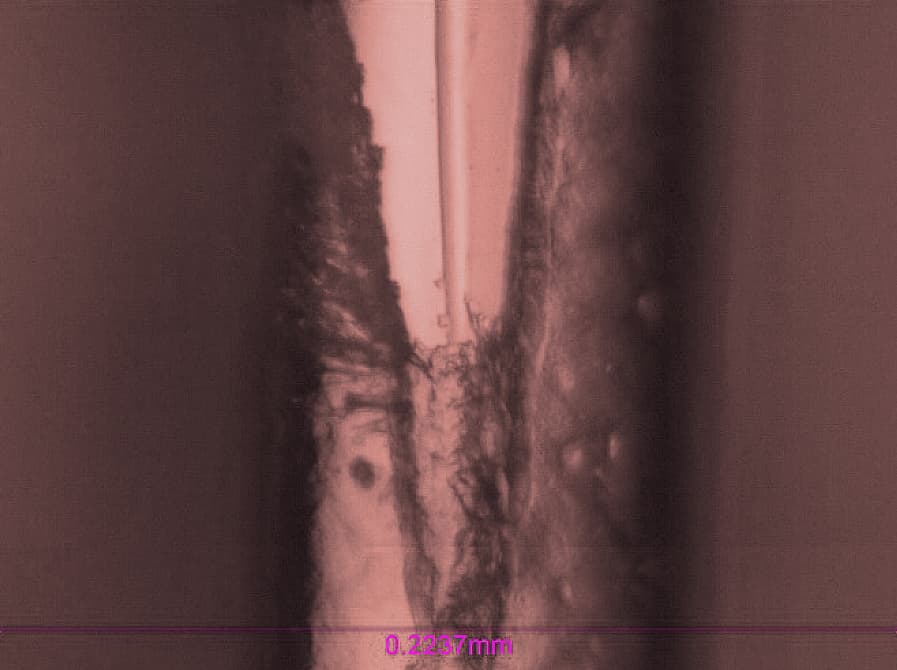
Nano scratch testing is performed with a progressively increasing load up to 300 mN. The full scratch track on the stent is shown in Fig. 3a, while failure behavior at different stages is presented in Fig. 3b and 3c.
Two critical loads are identified:

  • Lc1: the load at which the first visible damage appears on the coating
  • Lc2: the load at which the coating is fully removed and the substrate is exposed

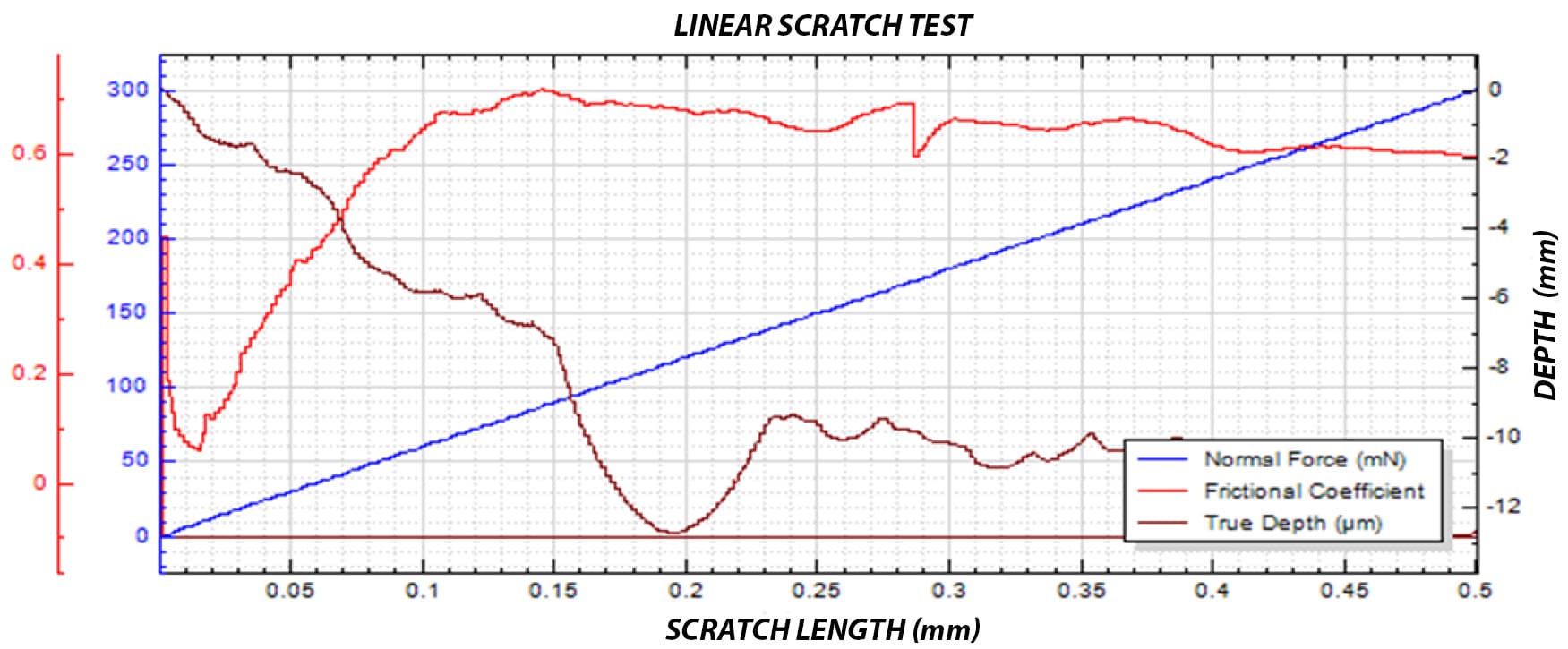
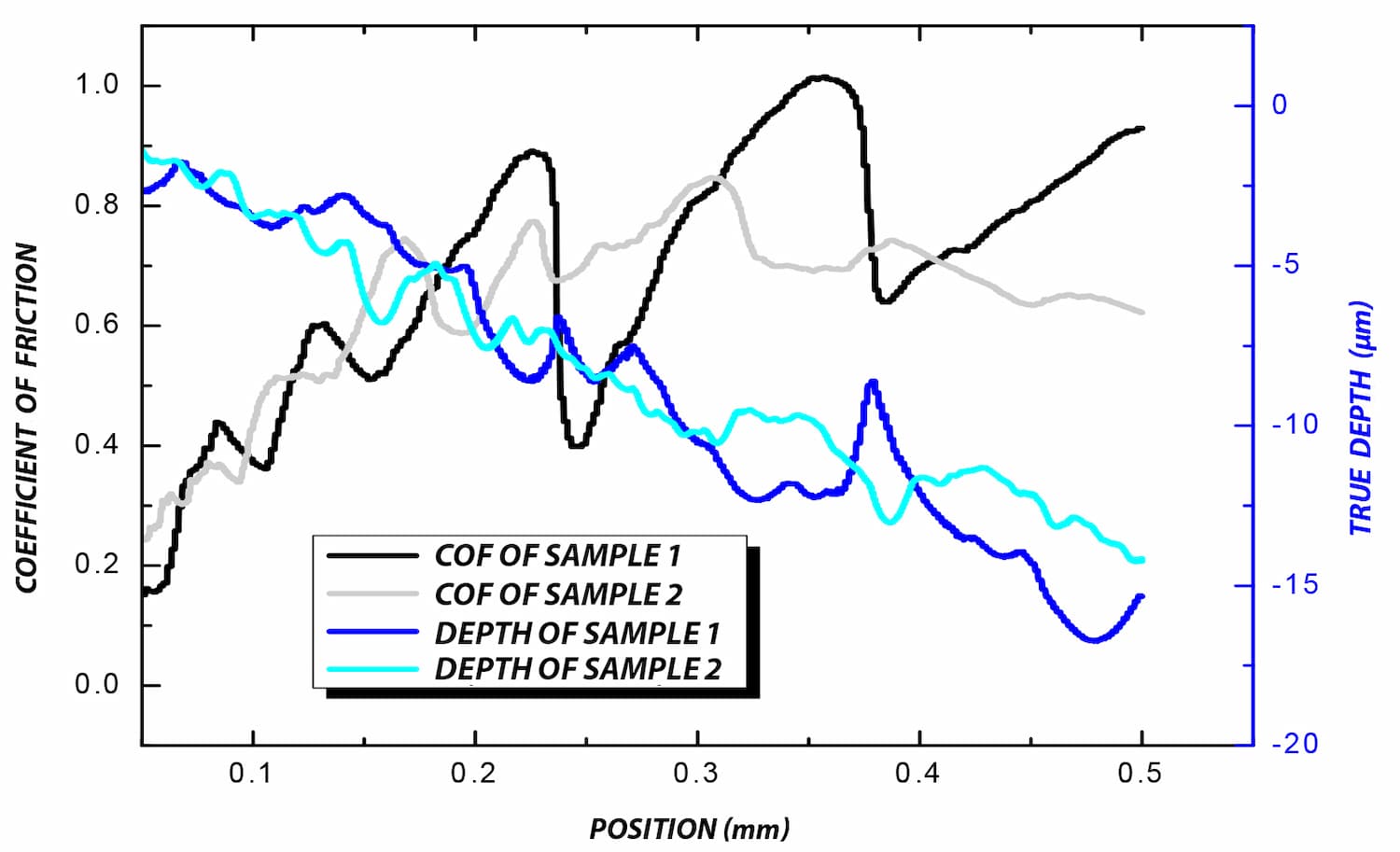
The evolution of coefficient of friction (COF) and penetration depth is shown in Fig. 4, providing insight into the progression of coating failure during the test.

The first signs of coating damage appear at Lc1 ≈ 14.5 mN. As the applied load increases, the diamond tip progressively penetrates the polymer coating, resulting in a wider and deeper scratch track. During this phase, the COF increases from approximately 0.05 to 0.7.

At Lc2 ≈ 78.1 mN, the coating is fully delaminated from the metal substrate. Beyond this point, as the load continues to increase, both COF and penetration depth remain relatively stable due to the mechanical support of the underlying metal substrate.

nano scratch track stent coating progressive load adhesion testing
(a) Full Scratch Track

(b) Lc1 ≈ 14.5 mN

stent coating delamination lc2 nano scratch 78.1 mN adhesion testing
(c) Lc2 ≈ 78.1 mN

Fig. 3: Nano scratch track on a stent coating under progressively increasing load, showing (a) full scratch path, (b) initial coating failure at Lc1 ≈ 14.5 mN, and (c) complete coating delamination at Lc2 ≈ 78.1 mN.

nano scratch testing stent coating coefficient of friction depth progression adhesion failure
Fig. 4: Evolution of coefficient of friction (COF) and penetration depth during nano scratch testing of a stent coating under progressively increasing load, showing the progression of coating failure and transition to substrate support.
Failures during nano scratch testing up to a maximum load of 300 mN occur at critical loads below 100 mN. To enable a more quantitative comparison of coating performance, additional tests are performed with a maximum load of 100 mN on two stent samples, referred to as Sample 1 and Sample 2.

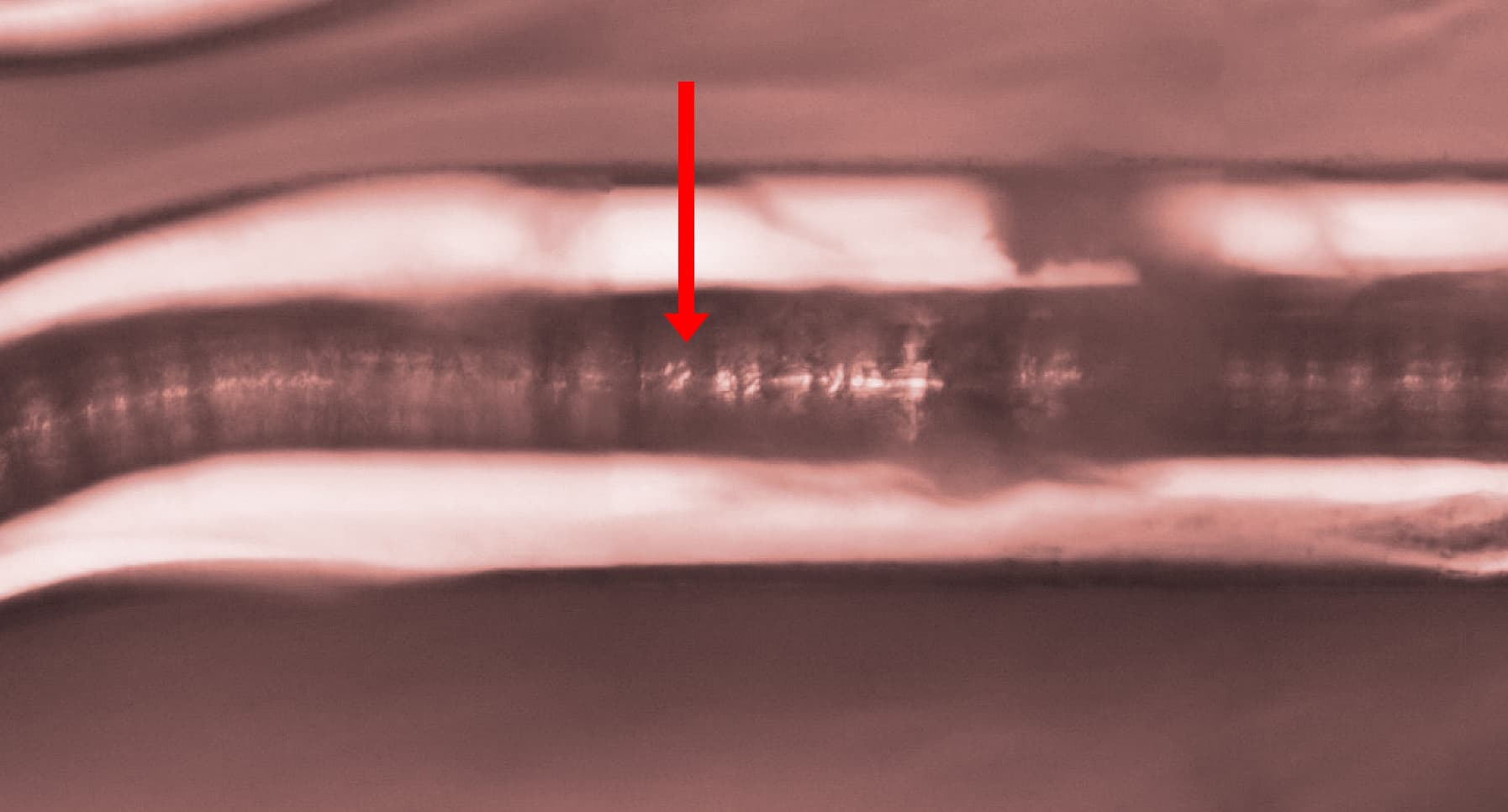
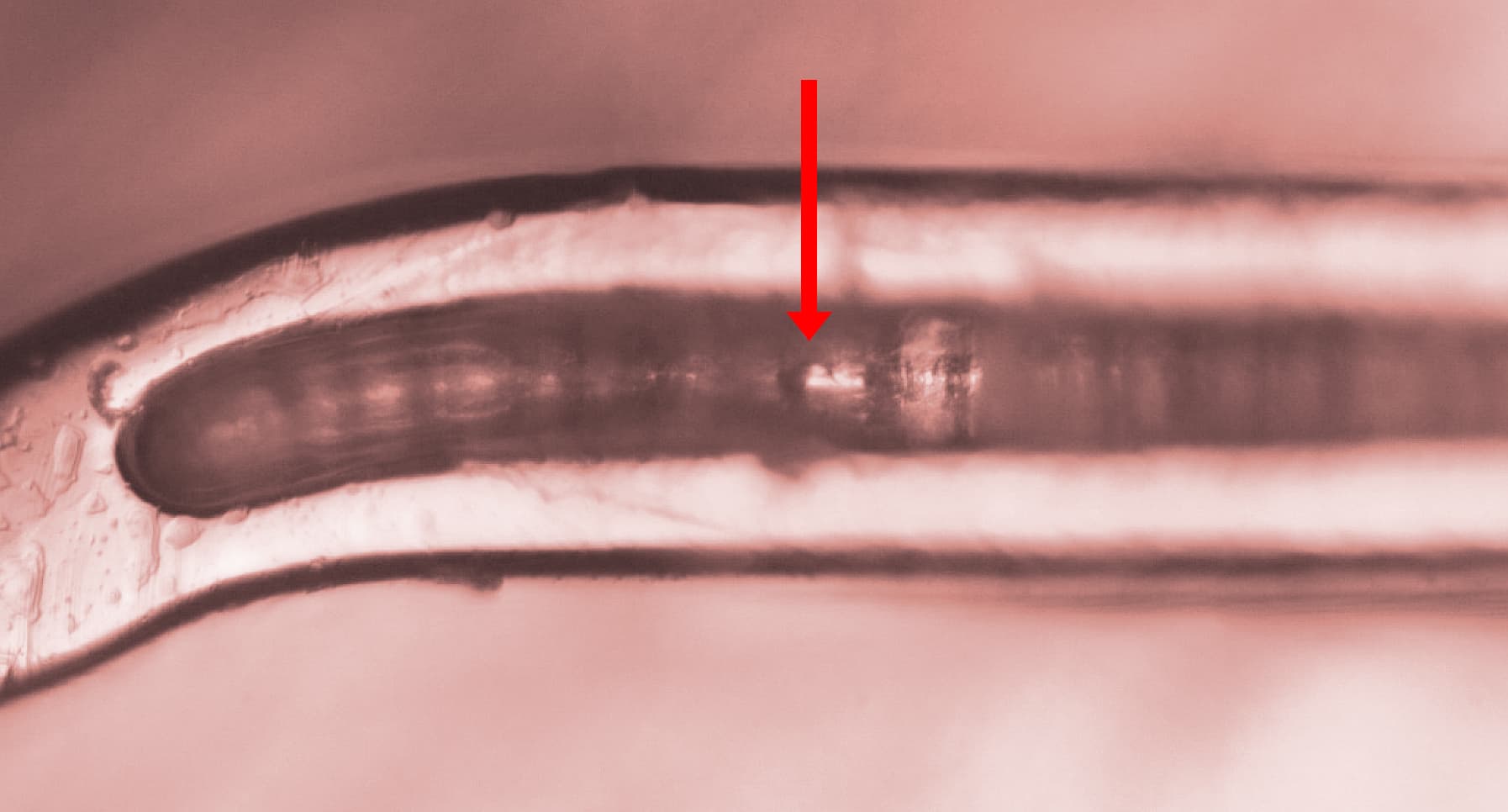
Fig. 5 compares the scratch tracks of Sample 1 and Sample 2 after nano scratch testing. Sample 1 exhibits the first sign of coating damage at a critical load of Lc1 ≈ 13.2 mN, while Sample 2 shows initial failure at a higher load of Lc1 ≈ 21.1 mN.

Coating delamination occurs at 62.5 mN for Sample 1. In contrast, the coating on Sample 2 remains intact throughout the test, continuing to protect the metal substrate under the same loading conditions.

This behavior is further reflected in the evolution of coefficient of friction (COF) and penetration depth, as shown in Fig. 6. When the diamond tip penetrates through the coating and contacts the metal substrate in Sample 1, the COF reaches a peak while the penetration depth decreases due to the increased stiffness of the underlying substrate.

stent coating sample 1 early failure nano scratch track delamination adhesion testing

(a) Sample 1 – Early Coating Failure

stent coating sample 2 high adhesion nano scratch track minimal damage testing

(b) Sample 2 – Improved Coating Integrity

Fig. 5: Comparison of nano scratch tracks for two stent coatings, showing (a) early coating failure and delamination in Sample 1, and (b) improved coating integrity in Sample 2 under the same loading conditions.

nano scratch testing stent coating COF depth comparison sample 1 sample 2 adhesion performance

Fig. 6: Comparison of coefficient of friction (COF) and penetration depth for Sample 1 and Sample 2 during nano scratch testing, showing earlier substrate contact and higher friction response in Sample 1, indicating weaker coating adhesion.

2. Grooved Stent Samples

As shown in Fig. 1 and Fig. 7, the grooved stent mesh has a diameter of approximately 90 μm, comparable to a human hair. The groove has a width of ~50 μm and a depth of 30 μm. This geometry presents a significant challenge for nano scratch testing, particularly for evaluating coating adhesion at the bottom of the groove.

Precise positioning is critical to locate the scratch test within the groove. The nano scratch test is performed with a progressively increasing load up to 300 mN. The full scratch tracks of grooved stent Samples 3 and 4 are compared in Fig. 7.

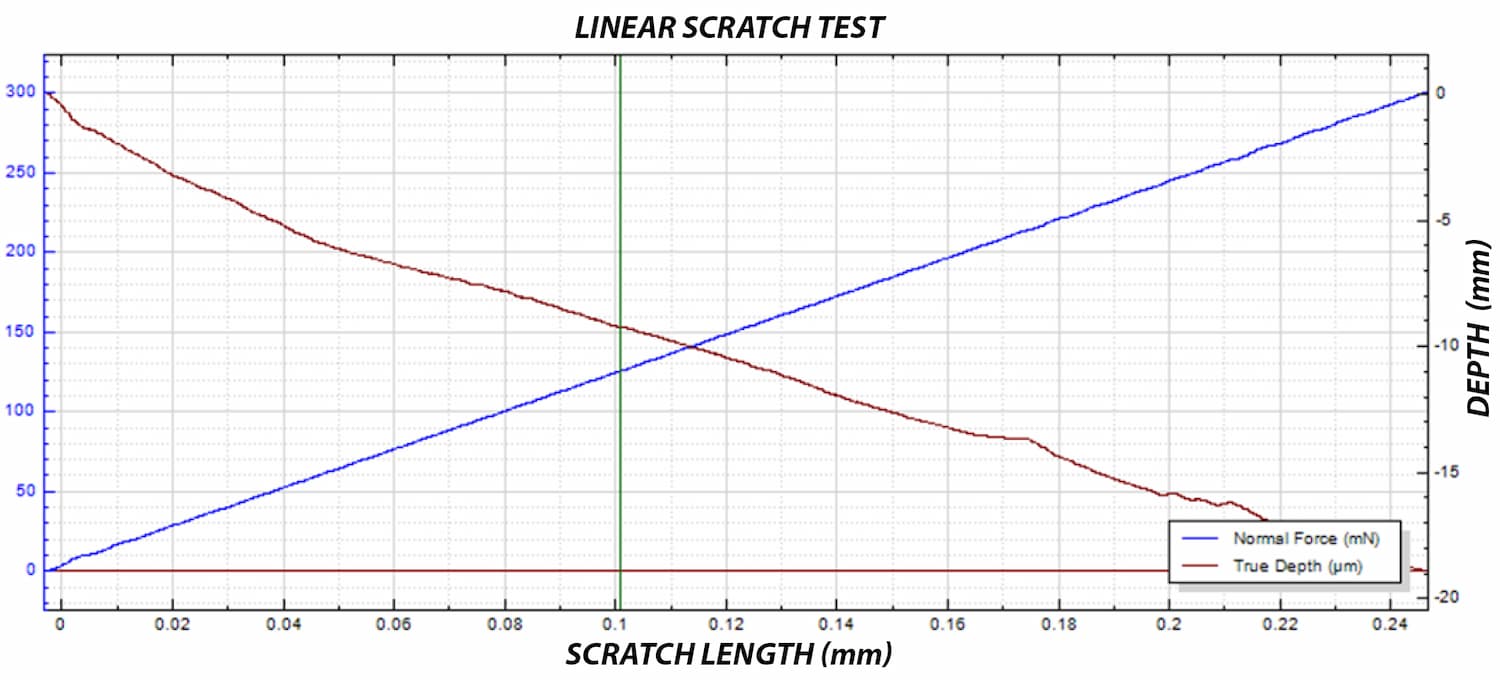
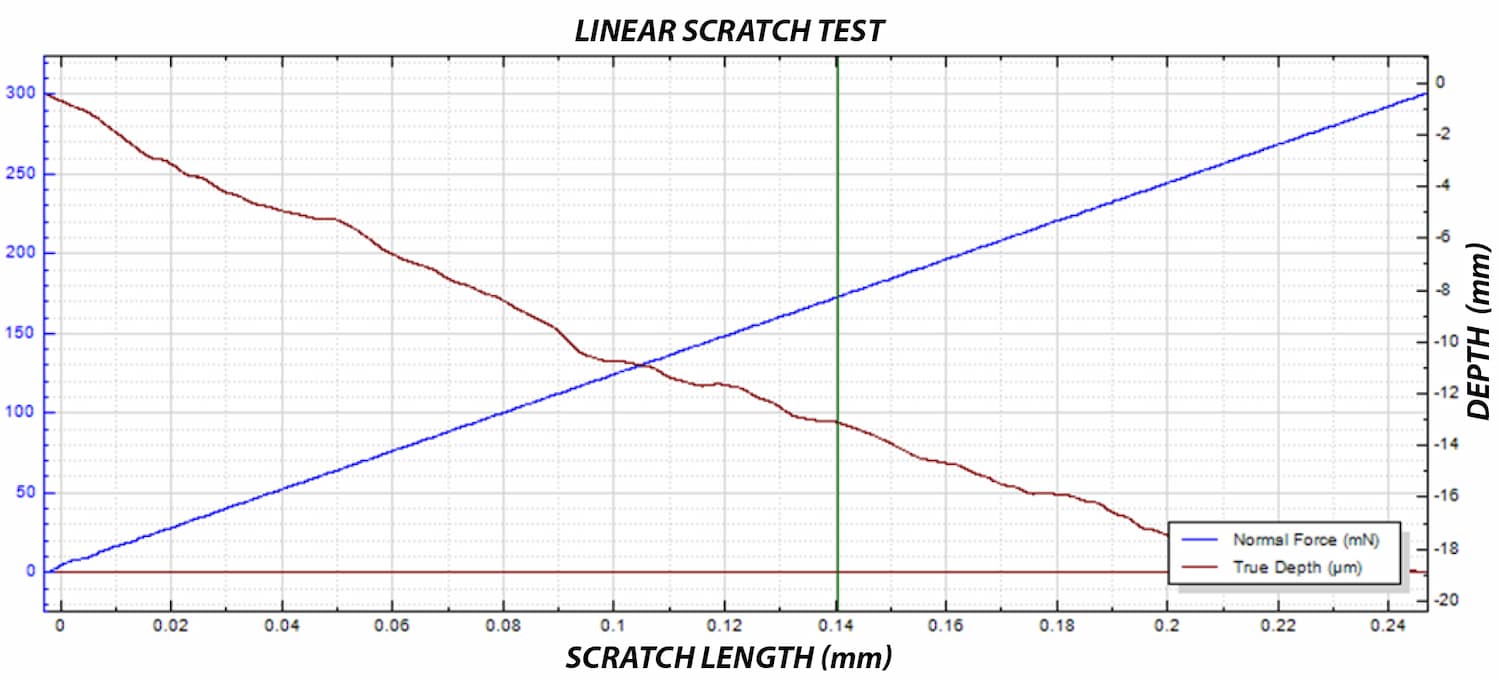
The critical load Lc is defined as the load at which the coating fails and the substrate becomes exposed. The evolution of normal load and penetration depth, shown in Fig. 8, provides further insight into the progression of coating failure during testing.

As the applied load increases, the diamond tip progressively penetrates the polymer coating, resulting in a deeper scratch track. When the critical load Lc is reached, the coating delaminates from the metal substrate.

Sample 3 exhibits coating failure at Lc ≈ 126 mN, while Sample 4 fails at a higher load of Lc ≈ 173 mN. This difference indicates stronger adhesion of the coating in Sample 4.

The measured critical loads enable quantitative comparison of coating adhesion performance. Under the same testing conditions, the coating on Sample 4 demonstrates higher resistance to delamination, making it the better-performing candidate in this study.

stent groove coating failure sample 3 nano scratch 126 mN adhesion testing

(c) Sample 3 – Coating Failure in Groove (Lc ≈ 126 mN)

stent groove coating adhesion sample 4 nano scratch 173 mN minimal failure testing

(d) Sample 4 – Higher Adhesion in Groove (Lc ≈ 173 mN)

Fig. 7: Nano scratch tracks inside stent grooves for Samples 3 and 4, showing (c) coating failure at Lc ≈ 126 mN in Sample 3 and (d) higher adhesion with delayed failure at Lc ≈ 173 mN in Sample 4.

(a) Sample 3 – Earlier Coating Failure (Lc ≈ 126 mN)

(b) Sample 4 – Delayed Failure and Higher Adhesion (Lc ≈ 173 mN)

Fig. 8: Evolution of normal load and penetration depth during nano scratch testing inside stent grooves for Samples 3 and 4, showing earlier coating failure in Sample 3 and delayed failure at higher load in Sample 4. The vertical green line indicates the critical load (Lc) where coating delamination occurs.

結論

This study demonstrates the ability of the NANOVEA Mechanical Tester to quantitatively evaluate the cohesive and adhesive strength of polymer coatings on both regular and grooved stent geometries using nano scratch testing.

The recessed geometry of the stent grooves, approximately 50 μm wide and 30 μm deep, presents a significant challenge for coating adhesion measurement. The high X–Y positioning accuracy of 0.25 μm enables precise placement of the scratch test within these confined regions, allowing direct evaluation of coating performance where failure is most critical.

By applying a controlled, progressively increasing load, critical loads associated with coating failure can be identified and compared across samples. This approach enables reliable differentiation of coating adhesion performance and interfacial integrity, even on small, complex stent structures.

参考文献

[I] http://www.nhlbi.nih.gov/health/health-topics/topics/stents
[II] http://www.scielo.org.mx/scielo.php?script=sci_arttext&pid=S1405-99402006000300008

Frequently Asked Questions About Stent Coating Adhesion Testing

What is stent coating adhesion testing?

Stent coating adhesion testing evaluates how strongly a polymer coating is bonded to the metal substrate of a stent. Techniques such as nano scratch testing quantify the load at which coating damage and delamination occur, providing measurable indicators of adhesion strength.

What is critical load (Lc) in nano scratch testing?

Critical load (Lc) is the applied load at which a coating fails during a scratch test.

  • Lc1 corresponds to the first visible damage in the coating
  • Lc2 indicates complete coating removal and exposure of the substrate

These values are used to quantify and compare coating adhesion performance.

Why is coating adhesion important in drug-eluting stents?

Coating adhesion directly affects the reliability of drug-eluting stents. Poor adhesion can lead to coating delamination, which may compromise controlled drug release and increase the risk of device failure.

How do you measure coating adhesion inside stent grooves?

Measuring adhesion inside stent grooves requires high positioning accuracy and appropriate indenter geometry. Nano scratch testing with sharp diamond tips allows access to recessed coating regions, enabling direct evaluation of adhesion within complex stent geometries.

What does coefficient of friction (COF) indicate in scratch testing?

The coefficient of friction (COF) reflects changes in surface interaction during the scratch test. A sudden increase in COF often indicates coating failure and contact between the indenter and the underlying metal substrate.

How can nano scratch testing compare different coating formulations?

Nano scratch testing enables direct comparison of coatings by measuring critical loads under controlled conditions. Higher critical loads indicate stronger adhesion and improved resistance to delamination, allowing selection of better-performing coating systems.

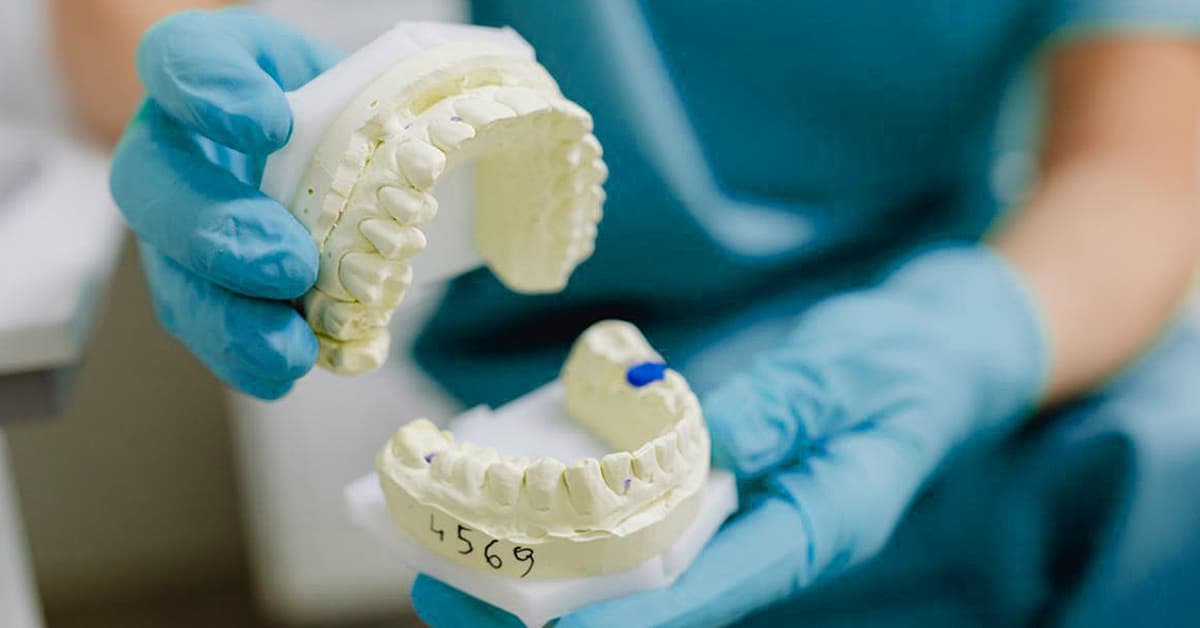
Dentist holding dental model for tooth surface roughness analysis and 3D reconstruction

Dental Surface Roughness Measurement & 3D Tooth Topography

Application Note | Dental Surface Characterization

Dental Surface Roughness Measurement and Full 3D Tooth Topography

Surface Roughness Analysis Using Non-Contact Optical Profilometry

Dental surface roughness measurement and 3D molar reconstruction using optical profilometry

作成者

Walter Alabiso, PhD; Davide Morrone, MPhys; Andrew Shore, MA

はじめに

The ability to accurately characterize tooth surfaces, including micro-roughness and 3D surface topography at the nanometer scale, enables advanced research and applications in orthodontics and dental materials science. Non-contact optical profilometry provides a precise method for measuring dental surface roughness and analyzing tooth surface morphology without damaging delicate structures. These measurements support the development of composite dental materials that replicate the natural surface roughness of enamel, as well as the design and fabrication of patient-specific dental casts and restorative components.

Low surface roughness plays a primary role in limiting bacterial adhesion and plaque formation, thereby reducing the risk of cavities. An increase in average roughness (Ra) above 2 µm leads to a steep increase in biofilm formation in vivo.¹ An Ra of 0.2 µm is considered the threshold value below which no further reduction in bacterial adhesion can be expected.²

Reconstruction of the tooth’s 3D surface topography enables the fabrication of dental casts, which are essential for accurate diagnosis, treatment planning, and the fabrication of dental appliances.

Non-Contact Optical Profilometry for Dental Surface Analysis

The present study illustrates the potential of NANOVEA’s high-precision non-contact optical profilometers for dental surface roughness measurement and 3D tooth topography analysis. Chromatic Light technology offers significant advantages over classical touch probe techniques. It acquires data points from deep crevices and complex geometries without introducing measurement errors or artifacts caused by local plastic deformation and without requiring extensive data manipulation.

Compared to focus variation systems, single-point optical sensing provides superior lateral and height accuracy, with X/Y resolution below 0.5 µm, maximum vertical resolution of 1.9 nm, and the ability to measure surface angles up to 87°. The technique is effective on transparent, opaque, specular, diffusive, polished, and rough dental surfaces, making it well suited for comprehensive dental surface characterization.

Measurement Method

このアプリケーションでは NANOVEA JR25 Non-Contact Optical Profiler was used to analyze the surface roughness and 3D surface topography of an adult human molar previously affected by tooth decay. The side of the tooth was scanned using a PS2–MG140 single-point optical sensor to measure surface roughness parameters over a defined region of interest and along multiple line profiles.

The crown of the tooth was then scanned and reconstructed using a PS5–MG35 single-point optical sensor, which is suited for larger-area acquisition and full 3D tooth topography measurement.


ナノビア JR25 Portable
光学式表面形状計

Surface Measurement Using NANOVEA Optical Profilometer

Surface roughness measurements were performed on the lateral side of the molar crown, followed by full 3D reconstruction of the crown surface. Separate single-point optical sensors were used to optimize measurement accuracy for both localized roughness analysis and large-area surface topography acquisition.

PS2 – MG140

Surface roughness analysis by area and parallel line profiles on the side of the tooth’s crown.

PS5 – MG35

Full 3D surface reconstruction of the tooth’s crown.

測定パラメータ

The following measurement parameters were used for localized surface roughness analysis and full 3D surface reconstruction of the molar crown using NANOVEA single-point optical sensors.

ParameterRoughness Analysis (Area)Roughness Analysis (Profiles)Full 3D Reconstruction
Optical PenPS2-MG140PS2-MG140PS5-MG35
Z-Range [µm]30030010000
X-Distance [mm]2.003.007.50
X-Step Size [µm]1.701.7010.00
Y-Distance [mm]2.001.007.00
Y-Step Size [µm]1.70100.0010.00
Average (Avg)111
Measurement TypeDirectDirectDirect
Acquisition ModeSingle FrequencySingle FrequencyDouble Frequency
Acquisition Rate [Hz]200200100–400
Light Intensity [%]100100100

Optical Profilometry Results

Surface Roughness Analysis (Area)

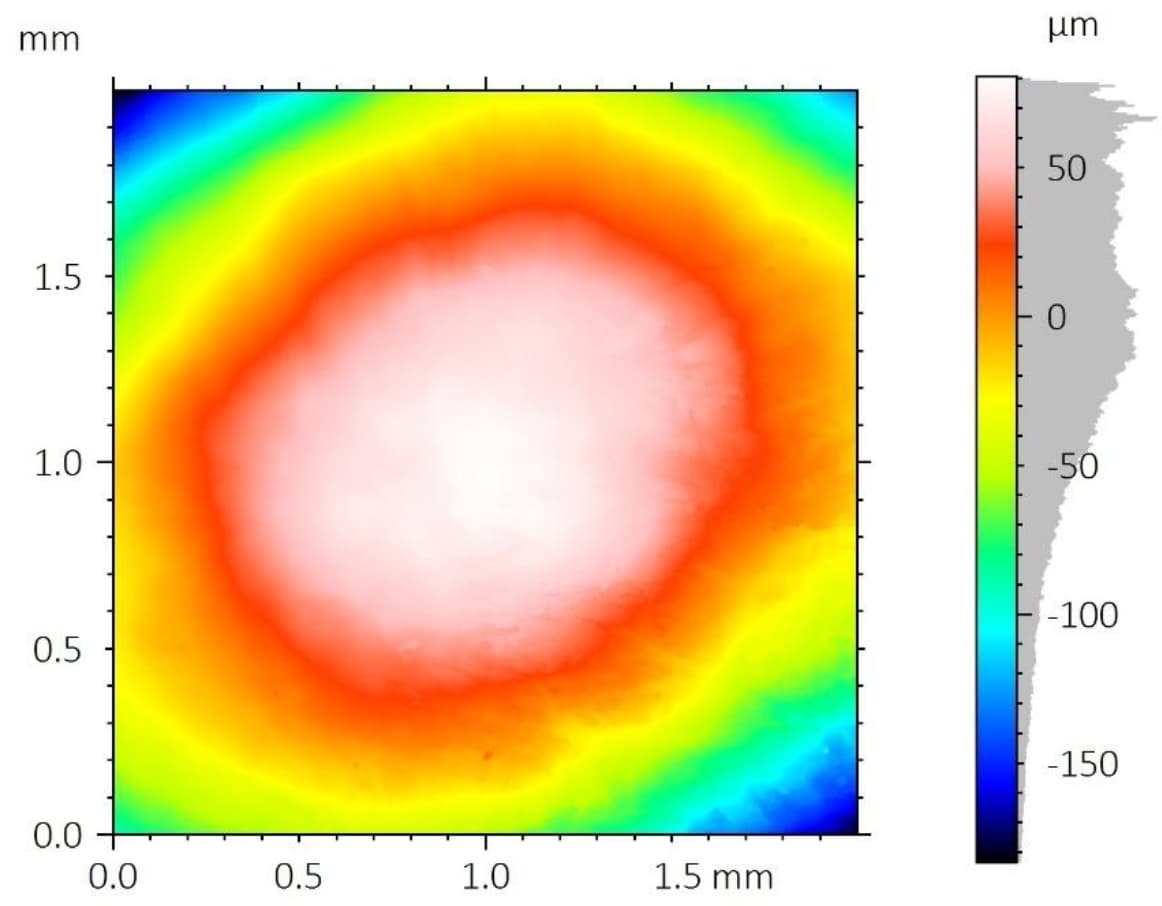
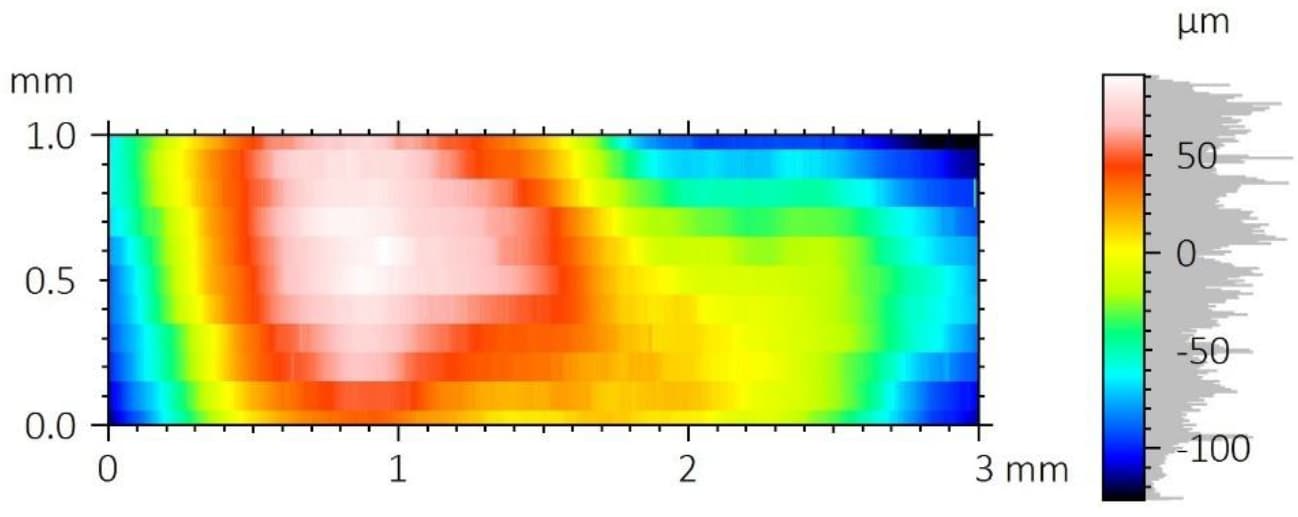
The PS2 single-point optical sensor was used to investigate fine surface features on the side of the tooth. The image below shows a false-color 2D surface map of the scanned region obtained by non-contact optical profilometry.

False-color 2D height map of scanned tooth surface region

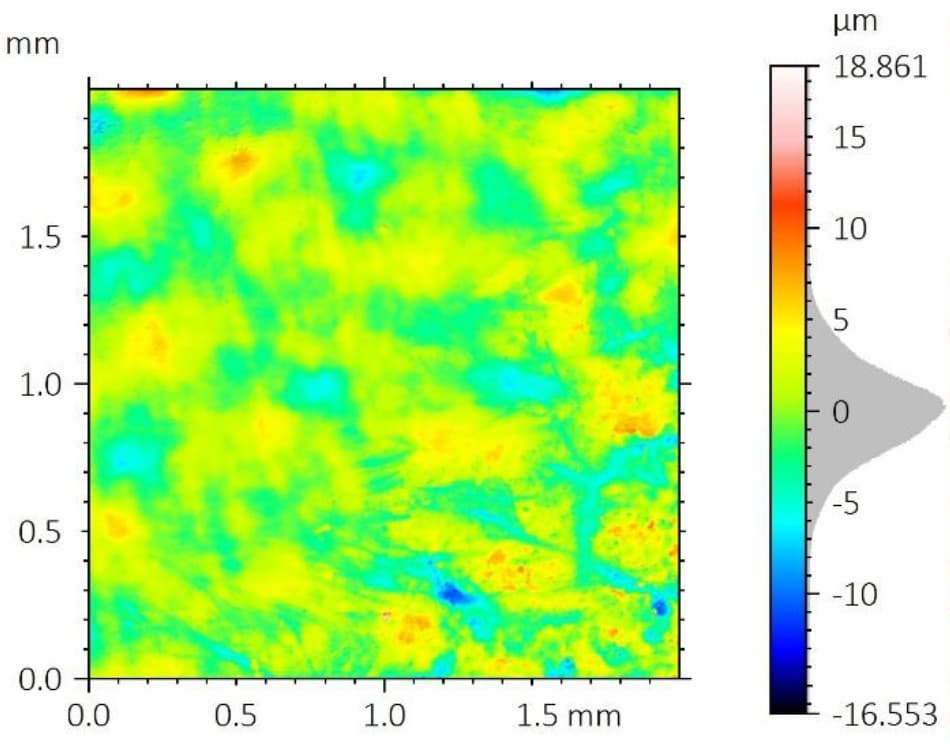
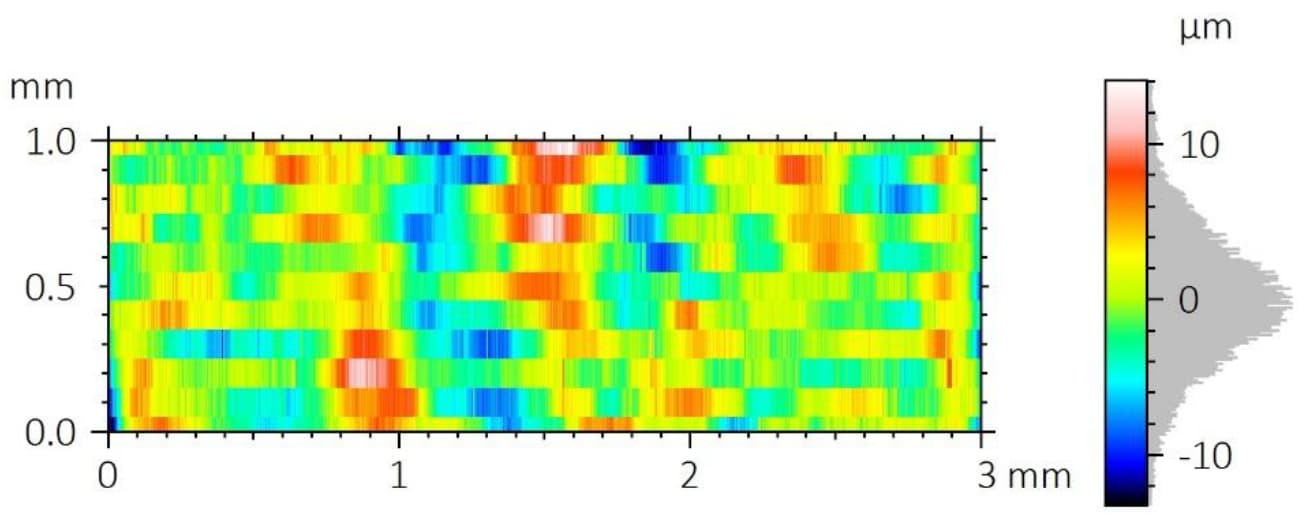
A least-squares degree-8 polynomial form removal was applied to isolate the surface roughness component. The roughness filters S-Gaussian 2.5 µm and L-Gaussian 0.8 mm were then applied according to ISO 25178. The resulting filtered surface and corresponding roughness parameters are presented below.

ISO 25178 – Roughness (S-L)
S-filter (λs): Gaussian, 2.5 µm
F: [Workflow] Form removed (LS-poly 8)
L-filter (λc): Gaussian, 0.8 mm
Height Parameters
スク2.433µm二乗平均平方根の高さ
エスケープ-0.102 歪度
スクー3.715 クルトーシス
Sp18.861µm最大ピーク高さ
エスブイ16.553µmMaximum pit depth
エスエス35.414µm最高高さ
1.888µm算術平均身長

The average surface roughness Sa is 1.888 µm, while the peak-to-valley height Sz reaches 35.414 µm.

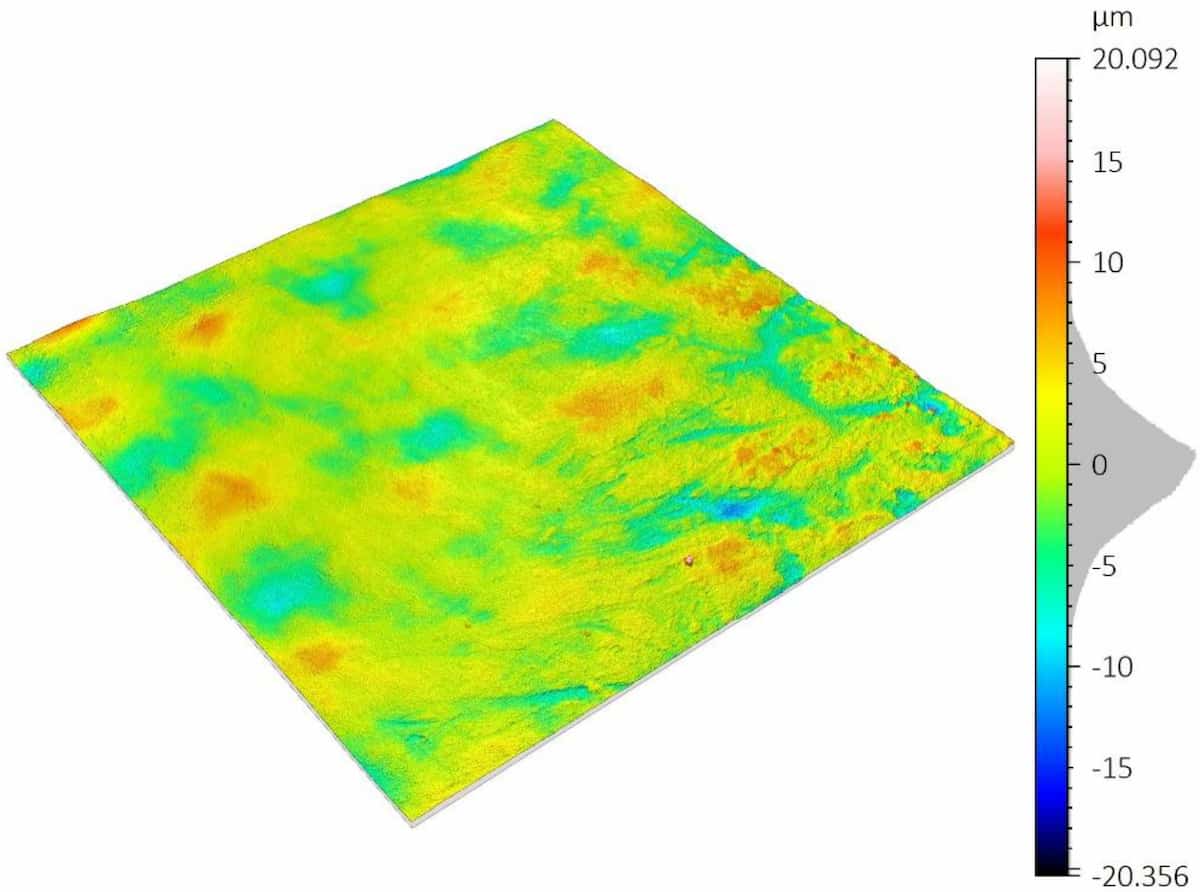
A 3D surface rendering of the filtered area is shown below for visualization.

3D rendering of ISO 25178 filtered tooth surface roughness

Roughness Analysis (Profiles)

Surface roughness profiles were measured using a series of 11 parallel line scans along the X direction on the side of the tooth. The false-color 2D surface map of the raw scan is shown below.

False-color 2D raw scan of tooth surface for line roughness profiles

The surface form was removed using a least-squares 8-degree polynomial prior to applying the metrological filters, leaving the residual surface shown below.

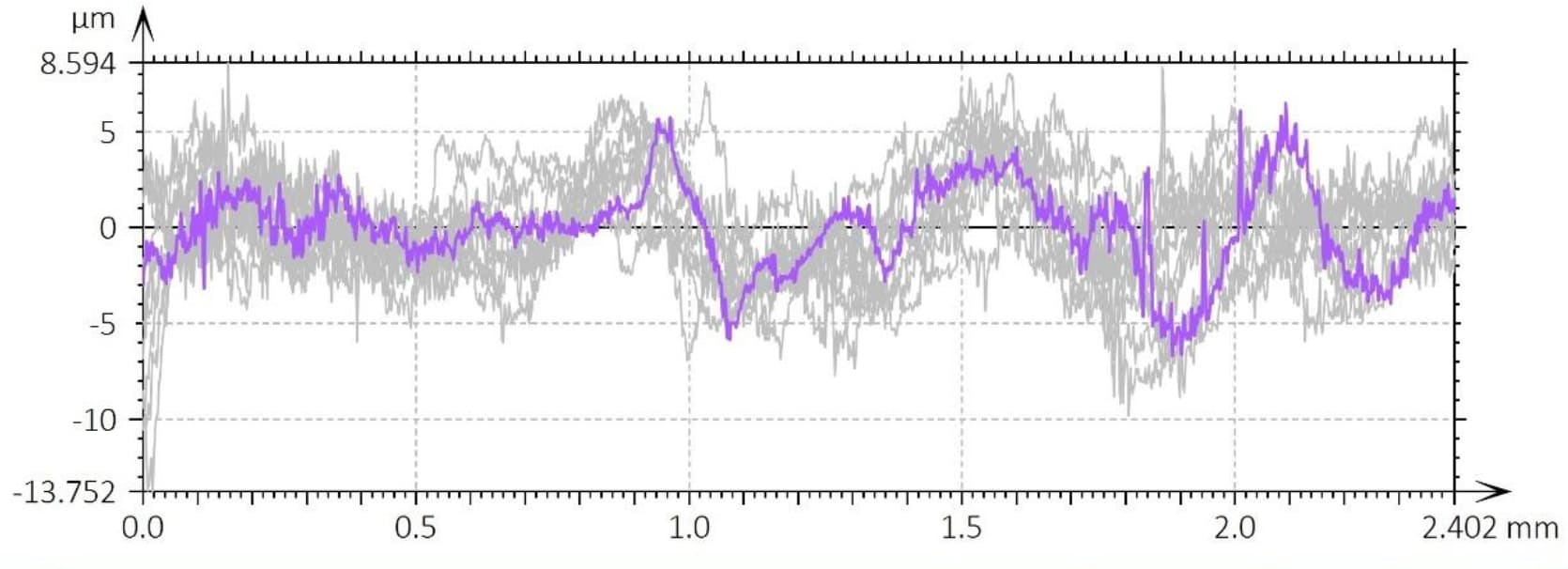
A statistical analysis of the measured surface roughness profiles reveals the following line roughness parameters.

Overlay of multiple tooth surface roughness profiles for statistical analysis

ISO 4287 – Roughness (S-L)
F: なし
S-filter (λs): Gaussian, 2.5 µm
L-filter (λc): Gaussian, 0.8 mm
Evaluation length: All λc (3)
Amplitude Parameters – Roughness Profile
  DescriptionMeanStd devMinMax
RpµmMaximum peak height of the roughness profile5.6830.7614.3156.610
RvµmMaximum valley depth of the roughness profile6.2421.0094.7018.438
RzµmMaximum height of roughness profile11.9251.6769.12315.048
RaµmArithmetic mean deviation of the roughness profile2.0630.2971.7102.629
RqµmRoot-mean-square (RMS) deviation of the roughness profile2.5230.3612.0573.175

ISO 4287 – Roughness (S-L)
F: なし
S-filter (λs): Gaussian, 2.5 µm
L-filter (λc): Gaussian, 0.8 mm
Evaluation length: All λc (3)
Amplitude Parameters – Roughness Profile
Rpµm
Maximum peak height of the roughness profile
Mean5.683
Std dev0.761
Min4.315
Max6.610
Rvµm
Maximum valley depth of the roughness profile
Mean6.242
Std dev1.009
Min4.701
Max8.438
Rzµm
Maximum height of roughness profile
Mean11.925
Std dev1.676
Min9.123
Max15.048
Raµm
Arithmetic mean deviation of the roughness profile
Mean2.063
Std dev0.297
Min1.710
Max2.629
Rqµm
Root-mean-square (RMS) deviation of the roughness profile
Mean2.523
Std dev0.361
Min2.057
Max3.175

The value of Ra is consistent with the Sa value extracted from the surface area measurement.

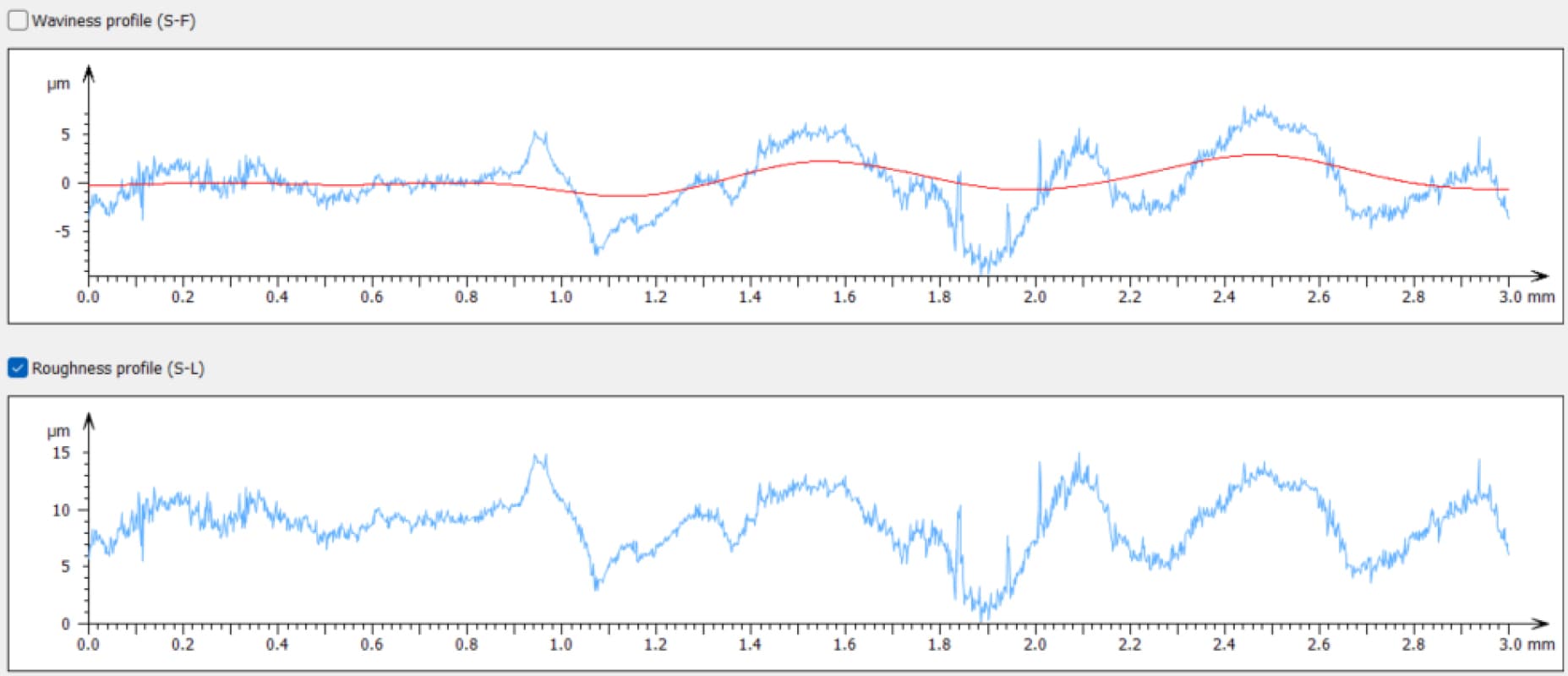
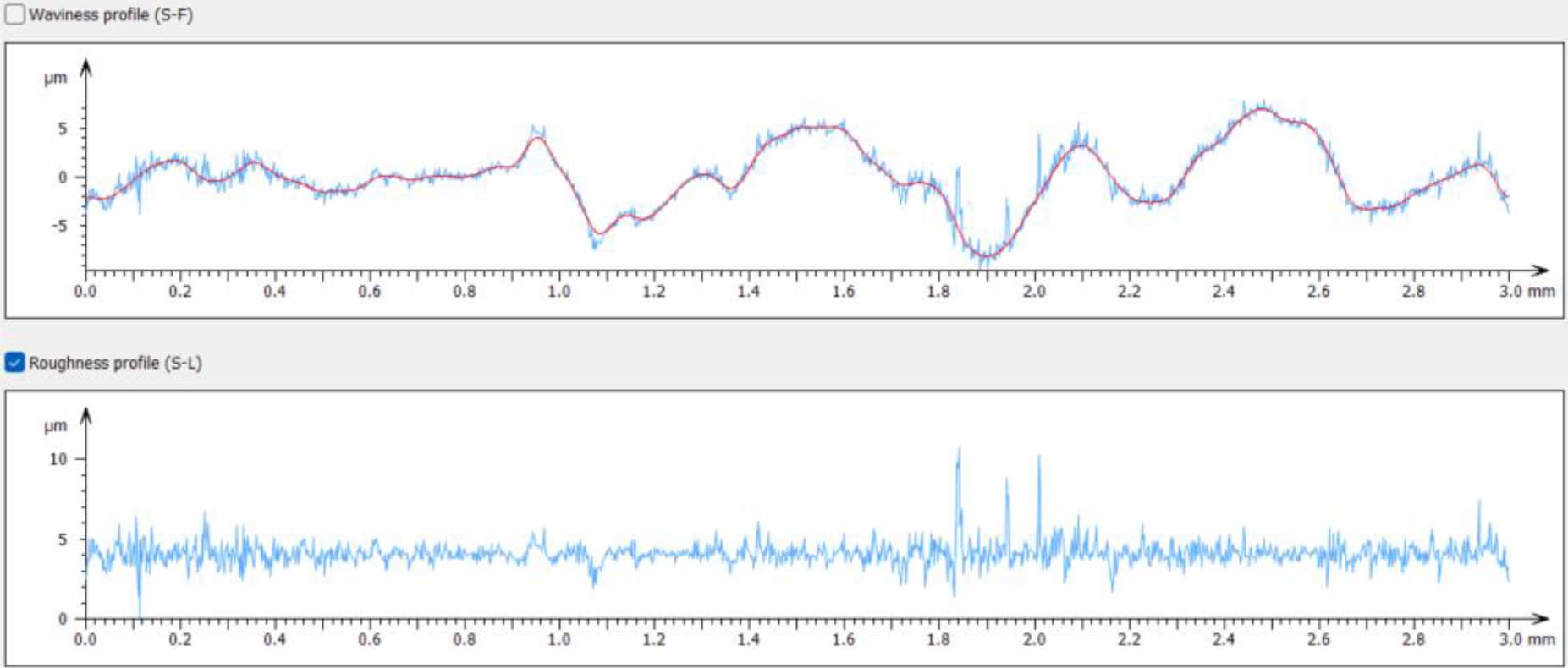
Different metrological filters can be applied to distinguish between macroscopic waviness and microscopic surface roughness. For example, a coarser filter cut-off, such as the 8 mm cut-off used with the Robust Gaussian order-2 filter, produces a smoother waviness profile (red) that is less sensitive to sharp local variations and follows the original surface profile more loosely.

Comparison of waviness and roughness profiles on tooth surface using coarse filter

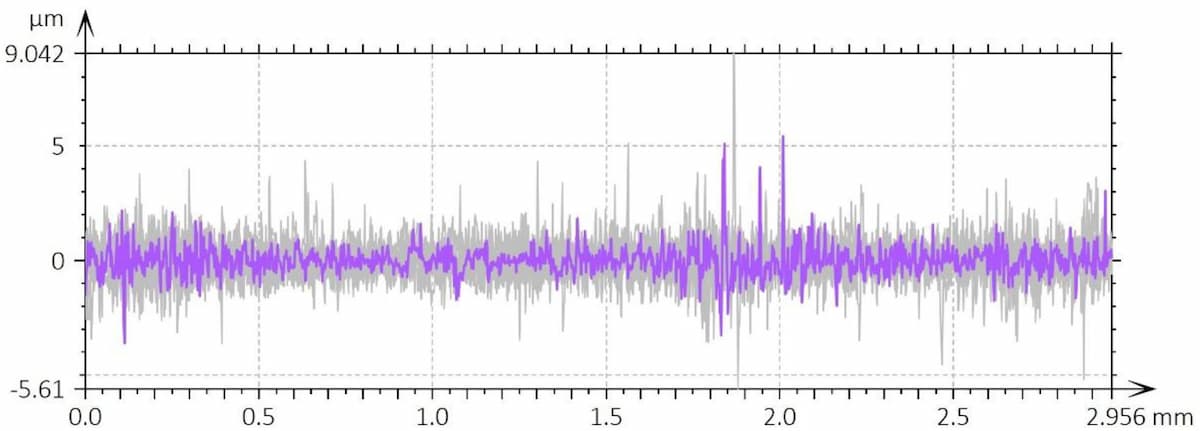
Alternatively, a finer cut-off (e.g., 0.08 mm) enables the analysis of micro-roughness by removing the waviness component that follows the original profile at a larger scale, leaving the finer surface roughness features of the tooth visible.

The microroughness analysis obtained using a 0.08 mm L-Gaussian filter is presented below.

Final microroughness profile of tooth surface after filtering

ISO 4287 – Roughness (S-L)
F: なし
S-filter (λs): Gaussian, 2.5 µm
L-filter (λc): Gaussian, 0.08 mm
Evaluation length: All λc (37)
Amplitude Parameters – Roughness Profile
  DescriptionMeanStd devMinMax
RpµmMaximum peak height of the roughness profile1.5820.1221.3421.748
RvµmMaximum valley depth of the roughness profile1.4660.1191.2541.661
RzµmMaximum height of roughness profile3.0490.1962.8203.409
RaµmArithmetic mean deviation of the roughness profile0.4950.0470.4230.597
RqµmRoot-mean-square (RMS) deviation of the roughness profile0.6430.0560.5620.762

ISO 4287 – Roughness (S-L)
F: なし
S-filter (λs): Gaussian, 2.5 µm
L-filter (λc): Gaussian, 0.8 mm
Evaluation length: All λc (3)
Amplitude Parameters – Roughness Profile
Rpµm
Maximum peak height of the roughness profile
Mean5.683
Std dev0.761
Min4.315
Max6.610
Rvµm
Maximum valley depth of the roughness profile
Mean6.242
Std dev1.009
Min4.701
Max8.438
Rzµm
Maximum height of roughness profile
Mean11.925
Std dev1.676
Min9.123
Max15.048
Raµm
Arithmetic mean deviation of the roughness profile
Mean2.063
Std dev0.297
Min1.710
Max2.629
Rqµm
Root-mean-square (RMS) deviation of the roughness profile
Mean2.523
Std dev0.361
Min2.057
Max3.175

Full 3D Tooth Surface Topography Reconstruction

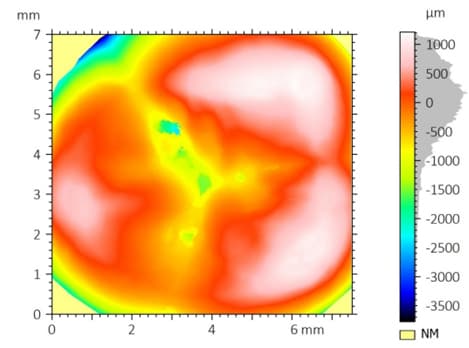
The extended Z-scan range of the PS5 optical sensor enables high-fidelity scanning of the entire tooth crown surface. The resulting 3D surface topography is shown below.

False-color surface topography map of full tooth crown measured with optical profilometer

2D VIEW: 2D surface map of the tooth crown measured with optical profilometry

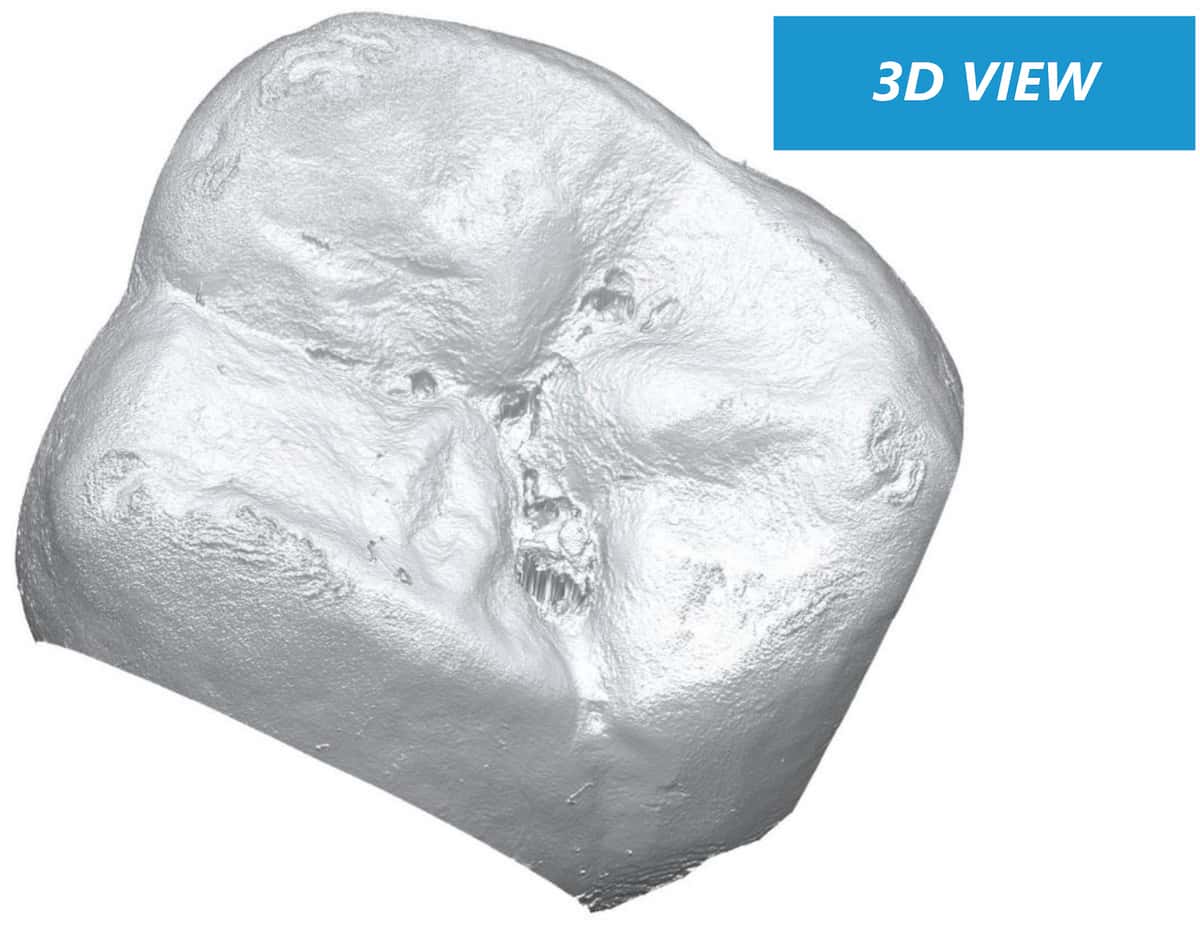
3D surface reconstruction of molar crown from optical profilometer scan

3D VIEW: High-fidelity 3D rendering of the molar crown surface obtained with optical profilometry

結論

In this application, the NANOVEA JR25 Non-Contact Optical Profiler was used to measure the surface roughness and 3D surface topography of an adult human molar.

Both the area scan and the line profile analysis revealed a roughness Rq of approximately 2.5 µm and an Ra of about 1.9–2.0 µm. These values are consistent with results reported in the literature.³ The use of a narrower L-Gaussian filter with an 80 µm cut-off enabled further investigation of micro-roughness, revealing an Rq of 0.643 µm and an Ra of 0.495 µm.

The full 3D surface topography of the molar crown was reconstructed with high fidelity. The high measurement resolution allows detection of fine surface features and crevices. The resulting surface data can be easily processed and exported as STL files, enabling the design and fabrication of customized dental devices and restorative components.

参考文献

[1] Shin, B.W., et al. Surface Roughness of Prefabricated Pediatric Zirconia Crowns Following Simulated Toothbrushing. Pediatric Dentistry 44.5 (2022): 363–367.
[2] Bollen, C.M.L., Paul Lambrechts, and Marc Quirynen. Comparison of surface roughness of oral hard materials to the threshold surface roughness for bacterial plaque retention: A review of the literature. Dental Materials 13.4 (1997): 258–269.
[3] Suputtamongkol, K., et al. Surface roughness resulting from wear of lithia-disilicate-based posterior crowns. Wear 269.3–4 (2010): 317–322.

Frequently Asked Questions About Dental Surface Roughness Measurement

What is dental surface roughness measurement?

Dental surface roughness measurement quantifies the microscopic texture of tooth surfaces using parameters such as Ra, Rq, and Sa. Optical profilometers measure these features without contacting the surface, allowing accurate analysis of enamel, restorative materials, and dental crowns.

Why use optical profilometry to measure tooth roughness?

Optical profilometry provides non-contact surface measurement with nanometer-scale vertical resolution. It captures 2D surface maps and full 3D surface topography of dental structures without damaging soft or polished surfaces.

What roughness parameters are used for dental surface analysis?

Common roughness parameters include Ra (arithmetic mean roughness), Rq (root mean square roughness), Sa (areal roughness), and Sz (maximum surface height). These parameters help evaluate enamel wear, plaque adhesion risk, and the performance of restorative materials.

Why is surface roughness important in dentistry?

Surface roughness affects plaque retention, wear resistance, and the long-term performance of dental restorations. Controlling micro-roughness can reduce bacterial adhesion and improve the durability of dental materials.

Need Reliable Surface Roughness Measurement for Dental Materials?

ショットピーニング表面分析

ショットピーニングされた表面分析

3D非接触形状測定器の使用

作成者

CRAIG LEISING

はじめに

ショットピーニングは、表面に可塑性を誘発することを目的とした力で、球状の金属、ガラス、またはセラミックのビーズ (一般に「ショット」と呼ばれます) を基材に衝突させるプロセスです。ピーニング前後の特性を分析することで、プロセスの理解と制御を強化するための重要な洞察が得られます。表面粗さとショットによって残されたディンプルの範囲は、特に注目すべき興味深い点です。

ショットピーニング表面分析における 3D 非接触表面形状計の重要性

従来、ショットピーニングされた表面分析に使用されてきた従来の接触式形状計とは異なり、3D 非接触測定では完全な 3D 画像が提供され、対象エリアと表面トポグラフィーをより包括的に理解できます。 3D 機能がなければ、検査は 2D 情報のみに依存することになり、表面を特徴付けるには不十分です。 3D で地形、適用範囲、粗さを理解することは、ピーニング プロセスを制御または改善するための最良のアプローチです。ナノベアの 3D非接触形状計 機械加工およびピーニングされた表面に見られる急角度を測定する独自の機能を備えたクロマティック ライト テクノロジーを利用しています。さらに、プローブの接触、表面の変化、角度、または反射率により、他の技術が信頼できるデータを提供できない場合でも、NANOVEA 表面形状計は成功します。

測定目的

このアプリケーションでは、NANOVEA ST400 非接触表面形状計を使用して、原材料と 2 つの異なるピーニング処理を施した表面を比較レビューのために測定します。 3D 表面スキャン後に自動的に計算できる表面パラメータのリストは無限にあります。ここでは、3D 表面を確認し、粗さ、ディンプル、表面積の定量化と調査など、さらなる分析のために対象領域を選択します。

ナノビア ST400スタンダード
光学式3Dプロフィロメーター

標本、見本

ショットピーニング表面試験

結果

スチール表面

ショットピーニング処理表面粗さ
ショットピーニング表面特性評価

ISO25178 3D粗さパラメータ

SA 0.399μm 平均粗さ
スク 0.516μm RMS粗さ
エスエス 5.686μm 最大の山から谷まで
Sp 2.976μm 最大ピーク高
エスブイ 2.711μm 最大ピット深さ
スクー 3.9344 クルトーシス
エスケープ -0.0113 歪度
サル 0.0028mm 自己相関長
Str 0.0613 テクスチャのアスペクト比
スダール 26.539 mm² 表面積
SVK 0.589μm 谷の深さの減少
 

結果

ピーニングされた表面 1

ショットピーニング処理表面プロファイル
ショットピーニング表面プロファイル測定

表面被覆率 98.105%

ショットピーニング表面の研究

ISO25178 3D粗さパラメータ

4.102μm 平均粗さ
スク 5.153μm RMS粗さ
エスエス 44.975μm 最大の山から谷まで
Sp 24.332μm 最大ピーク高
エスブイ 20.644μm 最大ピット深さ
スクー 3.0187 クルトーシス
エスケープ 0.0625 歪度
サル 0.0976mm 自己相関長
Str 0.9278 テクスチャのアスペクト比
スダール 29.451 mm² 表面積
SVK 5.008μm 谷の深さの減少

結果

ピーニングされた表面 2

ショットピーニング表面試験
ショットピーニング処理表面の分析

表面被覆率 97.366%

ショットピーニング表面計測学

ISO25178 3D粗さパラメータ

4.330μm 平均粗さ
スク 5.455μm RMS粗さ
エスエス 54.013μm 最大の山から谷まで
Sp 25.908μm 最大ピーク高
エスブイ 28.105μm 最大ピット深さ
スクー 3.0642 クルトーシス
エスケープ 0.1108 歪度
サル 0.1034mm 自己相関長
Str 0.9733 テクスチャのアスペクト比
スダール 29.623 mm² 表面積
SVK 5.167μm 谷の深さの減少

まとめ

このショットピーニング表面解析アプリケーションでは、NANOVEA ST400 3D 非接触プロファイラーがどのようにピーニング表面のトポグラフィーとナノメートルの詳細の両方を正確に特徴付けるかを実証しました。原材料と比較すると、表面 1 と表面 2 の両方が、ここで報告されているすべてのパラメータに大きな影響を与えていることは明らかです。画像を簡単に視覚的に検査すると、表面間の違いが明らかになります。これは、カバーエリアとリストされたパラメータを観察することによってさらに確認されます。表面 2 と比較すると、表面 1 は平均粗さ (Sa) が低く、凹み (Sv) が浅く、表面積 (Sdar) が減少していますが、被覆面積はわずかに高くなります。

これらの 3D 表面測定から、対象領域を容易に特定し、粗さ、仕上げ、質感、形状、トポグラフィー、平坦度、反り、平面性、体積、段差の高さなどを含む包括的な一連の測定を行うことができます。詳細な分析のために 2D 断面をすばやく選択できます。この情報により、あらゆる種類の表面測定リソースを利用して、ピーニングされた表面の包括的な調査が可能になります。統合された AFM モジュールを使用して、特定の関心領域をさらに調べることができます。 NANOVEA 3D 表面形状計は、最大 200 mm/s の速度を実現します。サイズ、速度、スキャン機能の点でカスタマイズでき、クラス 1 クリーン ルーム規格に準拠することもできます。インデックスコンベヤやインラインまたはオンライン使用のための統合などのオプションも利用できます。

本ノートに掲載のサンプルを提供してくださったIMFのヘイデン氏に深く感謝いたします。Industrial Metal Finishing Inc. | indmetfin.com

同じようなアプリケーションをお持ちですか?

塗装表面の形態

塗装表面の形態

自動化されたリアルタイムの進化モニタリング
ナノベア3D形状計を使用

塗装表面の形態

作成者

DUANJIE LI, PhD

はじめに

塗料の保護および装飾特性は、自動車、海洋、軍事、建築などさまざまな産業で重要な役割を果たしている。耐食性、紫外線保護、耐摩耗性など、望ましい特性を実現するために、塗料の配合や構造は注意深く分析され、改良され、最適化されます。

乾燥塗料表面の形態解析における3D非接触プロフィロメータの重要性

塗料は通常、液状で塗布され、溶剤を蒸発させ、液状の塗料を固体の膜に変化させる乾燥工程を経る。乾燥の過程で、塗料の表面は徐々にその形や質感を変えていく。添加剤を用いて塗料の表面張力や流動特性を変化させることで、さまざまな表面仕上げや質感を作り出すことができる。しかし、塗料の配合が不十分であったり、表面処理が不適切であったりした場合には、塗料の表面に望ましくない不具合が生じることがある。

乾燥期間中の塗料表面の形態をその場で正確にモニタリングすることで、乾燥メカニズムについての直接的な洞察が得られます。さらに、表面形態のリアルタイムの進化は、3D プリンティングなどのさまざまなアプリケーションにおいて非常に役立つ情報です。ナノベア 3D非接触形状計 サンプルに触れることなく材料の塗装表面の形態を測定し、スライドスタイラスなどの接触技術によって引き起こされる可能性のある形状の変化を回避します。

測定目的

このアプリケーションでは、高速ライン光学センサーを搭載したNANOVEA ST500非接触型プロフィロメーターを使用して、1時間の乾燥期間中の塗料表面の形態をモニターしています。連続的に形状が変化する材料の3Dプロファイルをリアルタイムで自動測定できるNANOVEA非接触型プロフィロメータの能力を紹介します。

ナノビア ST500 大面積
光学式3Dプロフィロメーター

結果・考察

金属板の表面に塗料を塗布した後、直ちに高速ラインセンサーを搭載したNANOVEA ST500非接触型プロフィロメーターを用いて、乾燥中の塗料の形態変化をその場で自動測定した。特定の時間間隔(0分、5分、10分、20分、30分、40分、50分、60分)で3D表面形態を自動的に測定・記録するマクロがプログラムされている。この自動化されたスキャン手順により、ユーザーは設定された手順を順番に実行することでスキャン作業を自動的に行うことができ、手作業によるテストや繰り返しスキャンと比較して、労力、時間、起こりうるユーザーエラーを大幅に削減することができる。この自動化は、異なる時間間隔での複数のスキャンを含む長期的な測定に非常に有用であることが証明されている。

光ラインセンサーは、図1に示すように、192点からなる輝線を生成する。この192個の光点が試料表面を同時にスキャンするため、スキャン速度が大幅に向上します。これにより、各3Dスキャンが迅速に完了し、個々のスキャン中に表面が大幅に変化するのを防ぎます。

3Dプロフィロメーターによる塗膜解析

図1: 乾燥中の塗料の表面をスキャンする光学式ラインセンサー。

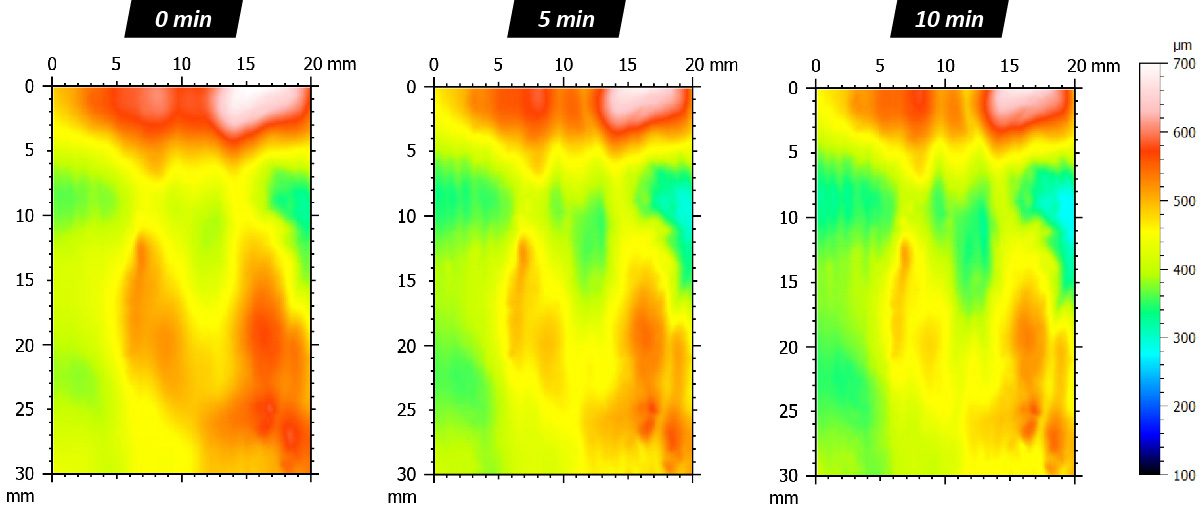
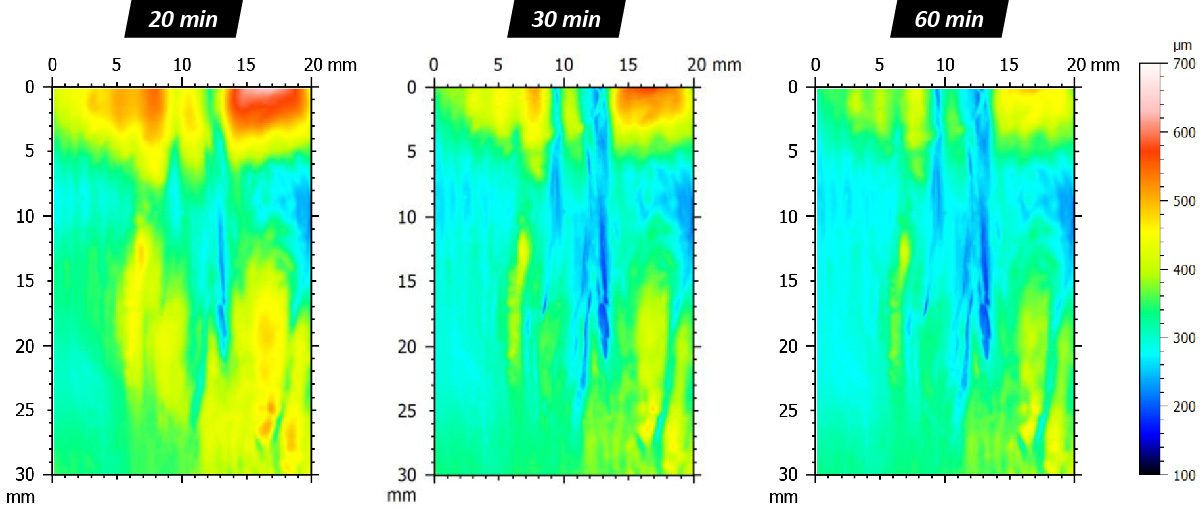
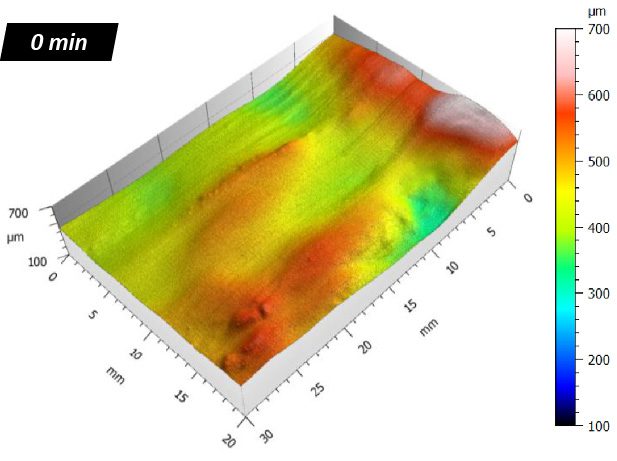
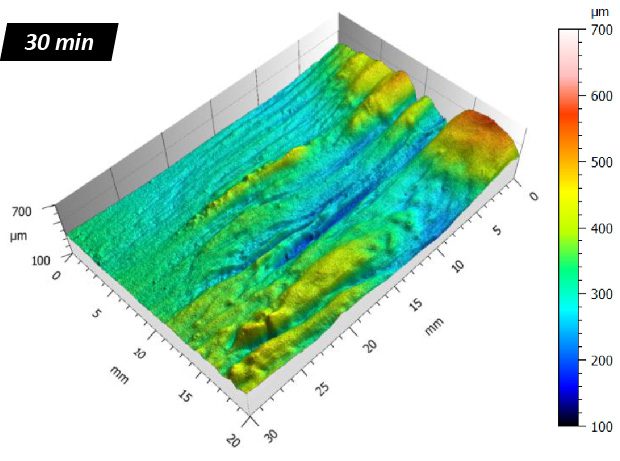
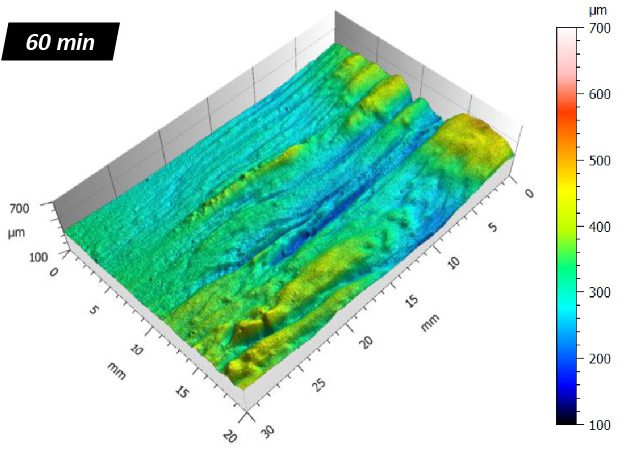
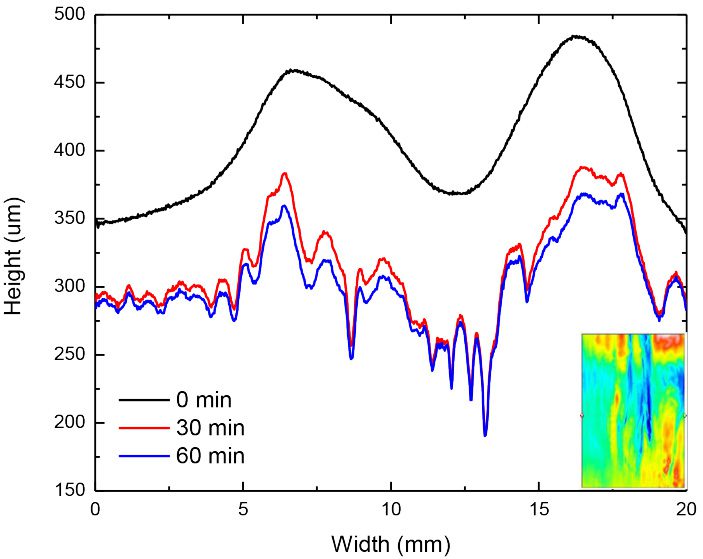
図2、図3、および図4に、それぞれ代表的な時間における乾燥塗膜トポグラフィのフォールスカラー図、3D図、および2Dプロファイルを示す。画像の偽色は、容易に識別できない特徴の検出を容易にする。異なる色は、サンプル表面の異なる領域にわたる高さの変化を表しています。3Dビューは、ユーザーがさまざまな角度から塗装表面を観察するための理想的なツールを提供します。最初の30分間は、塗膜表面の偽色が暖色系から寒色系へと徐々に変化し、この間に時間の経過とともに高さが徐々に低くなっていくことを示しています。30分後と60分後の塗料を比較すると、色の変化が穏やかであることがわかる。

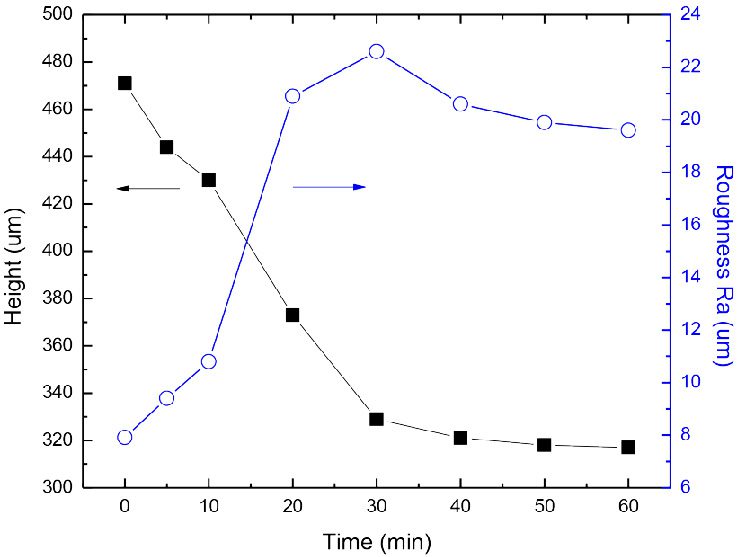
乾燥時間0分、30分、60分後の塗膜の全粗度分析を表1に示す。塗膜表面の平均高さは、最初の30分間の乾燥で471μmから329μmへと急速に減少していることが観察される。溶媒が気化すると同時に表面のテクスチャーが発達し、粗さSa値は7.19から22.6µmに増加した。その後、塗膜の乾燥は緩やかになり、60分後の試料高さは317 µm、Sa値は19.6 µmまで徐々に減少した。

この研究では、NANOVEA 3D非接触型プロフィロメーターが、乾燥中の塗料の3D表面変化をリアルタイムでモニタリングできることを明らかにし、塗料の乾燥プロセスに関する貴重な知見を提供します。サンプルに触れることなく表面形状を測定することで、スライディングスタイラスのような接触技術で起こりうる未乾燥塗料の形状変化を避けることができます。この非接触アプローチにより、乾燥中の塗料の表面形状を正確かつ確実に分析することができます。

塗装表面の形態
塗装形態学

図2: 乾燥時間の違いによる塗料表面の形態の変化。

塗料表面の特性評価
塗装面形状
塗装表面分析

図3: 異なる乾燥時間における塗料表面の変化の3Dビュー。

塗装表面形状測定

図4: 異なる乾燥時間後の塗料サンプルの2Dプロファイル。

塗装面の研究

図5: 塗料の乾燥時間による試料の平均高さと粗さSaの変化。

ISO 25178 - 表面テクスチャパラメータ

乾燥時間(分) 0 5 10 20 30 40 50 60
正方形(μm) 7.91 9.4 10.8 20.9 22.6 20.6 19.9 19.6
スクー 26.3 19.8 14.6 11.9 10.5 9.87 9.83 9.82
Sp (µm) 97.4 105 108 116 125 118 114 112
Sv (µm) 127 70.2 116 164 168 138 130 128
Sz (µm) 224 175 224 280 294 256 244 241
Sa (µm) 4.4 5.44 6.42 12.2 13.3 12.2 11.9 11.8

平方メートル 二乗平均平方根の高さ | スクー クルトーシス | Sp 最大ピーク高さ | Sv ピットの最大高さ | Sz 最高高さ | Sv 算術平均身長

表1: 乾燥時間の違いによる塗膜の粗さ。

まとめ

このアプリケーションでは、NANOVEA ST500 3D非接触型プロフィロメーターの能力を、乾燥過程における塗料表面の形態変化をモニターすることで紹介しました。サンプル表面を同時にスキャンする192個の光スポットからなるラインを生成する高速光学ラインセンサーにより、比類のない精度を確保しながら、時間効率の高い研究が可能になりました。

取得ソフトウェアのマクロ機能は、その場で3D表面形状の自動測定をプログラミングすることを可能にし、特定の目標時間間隔で複数のスキャンを含む長期測定に特に有用である。これにより、時間、労力、ユーザーエラーの可能性が大幅に削減される。表面形状の漸進的な変化は、塗料が乾燥するにつれてリアルタイムで連続的にモニター・記録されるため、塗料の乾燥メカニズムに関する貴重な知見が得られます。

ここに示したデータは、解析ソフトウェアで利用可能な計算のほんの一部です。NANOVEAプロフィロメーターは、透明、暗色、反射性、不透明を問わず、事実上あらゆる表面を測定することができます。

同じようなアプリケーションをお持ちですか?

トライボメータを用いたフローリングの経時的摩耗マッピング

フローリング摩耗試験

プロフィロメータ一体型トライボメータによるフローリングの漸進的摩耗マッピング

フローリング摩耗試験

作成者

フランク・リウ(FRANK LIU

はじめに

床材は耐久性があるように設計されていますが、移動や家具の使用などの日常活動によって磨耗することがよくあります。耐久性を確保するために、ほとんどの種類のフローリングには損傷を防ぐ保護摩耗層が付いています。ただし、摩耗層の厚さと耐久性は、床材の種類や歩行量によって異なります。さらに、UV コーティング、装飾層、釉薬など、フローリング構造内のさまざまな層の摩耗率は異なります。そこで、プログレッシブ ウェア マッピングが登場します。統合された NANOVEA T2000 トライボメーターを使用する 3D非接触形状測定装置床材の性能と寿命を正確に監視、分析することができます。さまざまな床材の摩耗挙動に関する詳細な洞察を提供することで、科学者や技術専門家は、新しい床材システムを選択および設計する際に、より多くの情報に基づいた意思決定を行うことができます。

フロアパネルにおけるプログレッシブ・ウェア・マッピングの重要性

床材の試験では、従来、摩耗に対する耐久性を判断するために、サンプルの摩耗率を中心にしてきました。しかし、プログレッシブ摩耗マッピングでは、試験中のサンプルの摩耗率を分析し、その摩耗挙動に関する貴重な知見を得ることができます。この詳細な分析により、摩擦データと摩耗率の相関関係が明らかになり、摩耗の根本原因を特定することができます。摩耗試験において、摩耗量は一定ではないことに留意する必要があります。そのため、摩耗の進行を観察することで、試料の摩耗をより正確に評価することができます。従来の試験方法を超えて、プログレッシブ摩耗マッピングの採用は、床材試験の分野で大きな進歩に寄与しています。

統合された 3D 非接触表面形状計を備えた NANOVEA T2000 トライボメーターは、摩耗試験と体積損失測定のための画期的なソリューションです。ピンと表面形状計の間を正確に移動できる機能により、摩耗トラックの半径や位置の偏差が排除され、結果の信頼性が保証されます。しかし、それだけではありません。3D 非接触表面形状計の高度な機能により、高速表面測定が可能になり、スキャン時間がわずか数秒に短縮されます。 NANOVEA T2000 は、最大 2,000 N の荷重を加え、最大 5,000 rpm の回転速度を達成する能力を備えています。 トライボメータ 評価プロセスに多用途性と正確性を提供します。この装置がプログレッシブウェアマッピングにおいて重要な役割を果たしているのは明らかです。

 
トライボメータによるフローリング摩耗試験
プロフィロメーターによる床材の摩耗試験

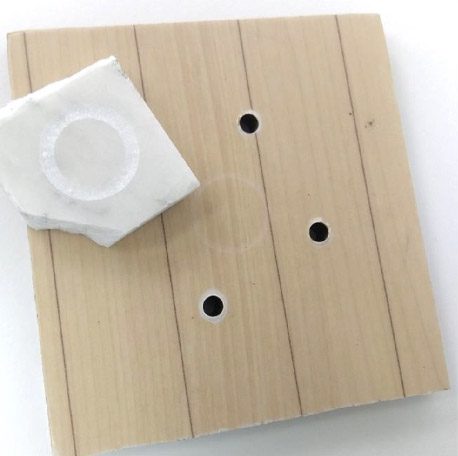
図1: 摩耗試験前のサンプルのセットアップ (左)と摩耗試験後の摩耗痕のプロフィル測定(右)。

測定目的

石材と木材の2種類の床材を対象に、漸進的摩耗マッピング試験を実施しました。各サンプルは、2、4、8、20、40、60、120秒と試験時間を延ばしながら、合計7回の試験サイクルを行い、経時的な摩耗を比較することができるようにしました。各試験サイクル終了後、NANOVEA 3D非接触型プロフィロメーターを用いて摩耗痕をプロファイリングしました。プロファイラで収集したデータから、NANOVEA Tribometerソフトウェアまたは当社の表面分析ソフトウェアMountainsの統合機能を使用して、穴の体積と摩耗率を分析することができます。

ナノビア T2000 高負荷
空気圧式トライボメーター

THE SAMPLES

摩耗マッピングテスト サンプル 木と石

ウェアマッピング試験パラメータ

LOAD40 N
テスト期間さまざま
スピード200rpm
ラジアス10mm
距離(DISTANCEさまざま
ボール材質タングステンカーバイド
ボール径10mm

7サイクルで使用したテスト時間は以下の通りです。 2秒、4秒、8秒、20秒、40秒、60秒、120秒をそれぞれ設定した。 移動した距離は 0.40, 0.81, 1.66, 4.16, 8.36, 12.55, 25.11 メートル。

ウェアマッピングの結果

フローリング

テストサイクル最大COFMin COFAvg.COF
10.3350.1240.275
20.3370.2070.295
30.3800.2290.329
40.3930.2650.354
50.3520.2050.314
60.3450.1990.312
70.3150.2110.293


ラジアル方向

テストサイクル総量損失(μm3トータルディスタンス
走行距離 (m)
摩耗率
(mm/Nm) x10-5
瞬時磨耗量
(mm/Nm) x10-5
12962476870.401833.7461833.746
23552452271.221093.260181.5637
35963713262.88898.242363.1791
48837477677.04530.629172.5496
5120717995115.40360.88996.69074
6147274531827.95293.32952.89311
7185131921053.06184.34337.69599
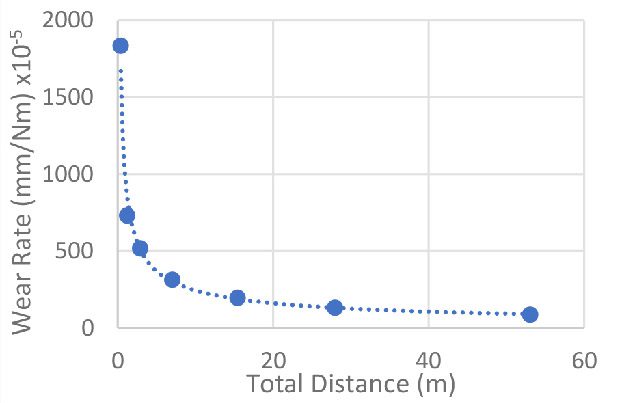
ウッドプログレッシブ摩耗率 vs トータルディスタンス
ウッドフロアの磨耗率

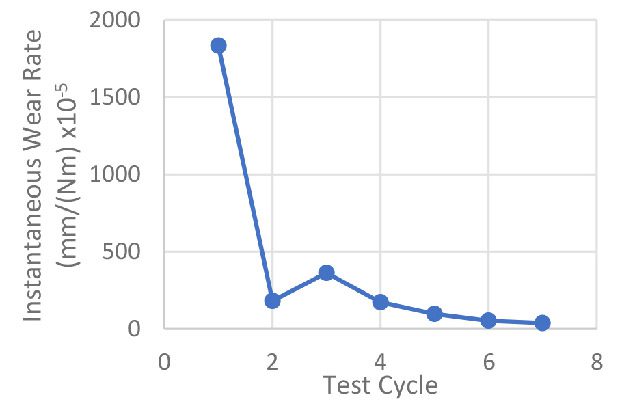
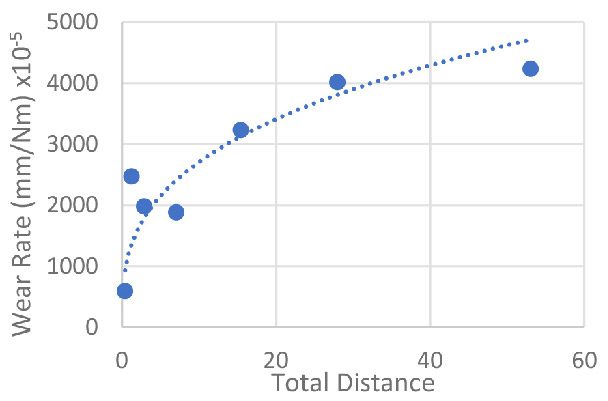
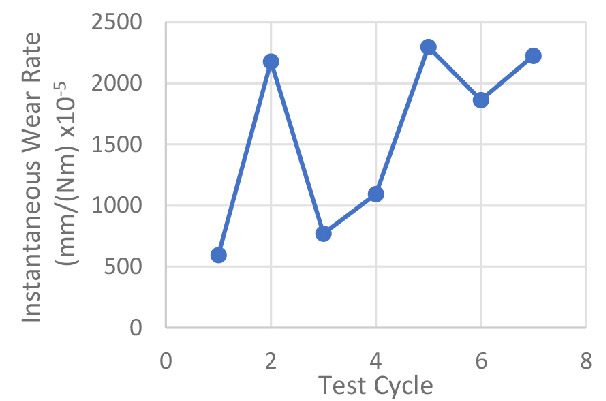
図2: 摩耗量と総走行距離の比較(左図)
と、フローリングの試験サイクルに対する瞬時摩耗率(右)。

フローリング摩擦係数試験
フローリングフロアのプログレッシブウェアマッピング

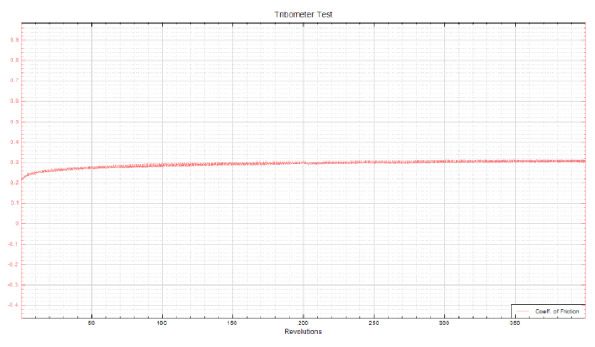
図3: #7試験によるフローリングでのCOFグラフと摩耗痕の3D表示。

ウェアマッピング抽出されたプロファイル
フローリング摩耗試験結果
フローリング表面の特性評価

図4: #7試験による木材摩耗痕の断面解析

プログレッシブ・ウェア・マッピングのボリュームとエリア分析

図5: 木材サンプル試験#7における摩耗痕の体積・面積解析。

ウェアマッピングの結果

ストーン・フローリング

テストサイクル最大COFMin COFAvg.COF
10.2490.0350.186
20.3490.1970.275
30.2940.1540.221
40.5030.1240.273
50.5480.1060.390
60.5100.1290.434
70.5270.1810.472


ラジアル方向

テストサイクル総量損失(μm3トータルディスタンス
走行距離 (m)
摩耗率
(mm/Nm) x10-5
瞬時磨耗量
(mm/Nm) x10-5
1962788460.40595.957595.9573
28042897311.222475.1852178.889
313161478552.881982.355770.9501
431365302157.041883.2691093.013
51082173218015.403235.1802297.508
62017496034327.954018.2821862.899
74251206342053.064233.0812224.187
石床摩耗率と距離の比較
ストーンフローリング 瞬間摩耗率チャート

図6: 装着率 vs 総走行距離(左)
と試験サイクルに対する瞬時摩耗率(右)(石材用フローリング

フローリング摩耗トライボロジー試験
石の床 3dプロファイルの摩耗トラック

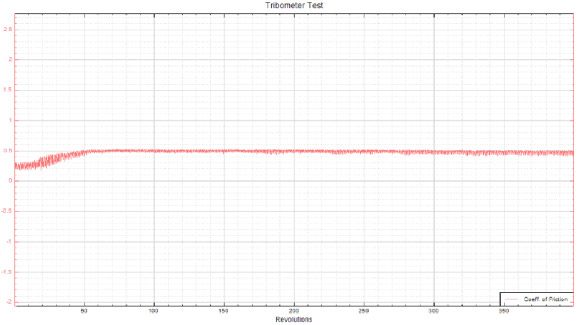
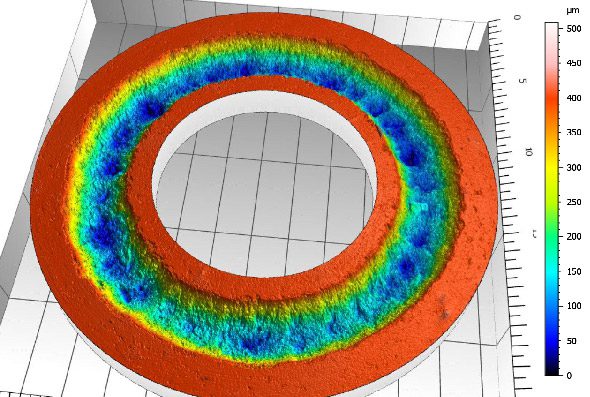
図7: #7試験による石床でのCOFグラフと摩耗痕の3Dビュー。

石床プログレッシブウェアマッピング抽出されたプロファイル
ストーンフローリング抽出プロファイルの最大奥行きと高さ穴とピークの領域
フローリングのトライボロジー試験

図8: 試験#7の石材摩耗痕の断面解析。

ウッドフロアのプログレッシブウェアマッピングのボリューム分析

図9: 石材サンプルテスト#7における摩耗痕の体積・面積解析。

ディスカション

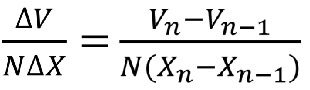
瞬時磨耗率は、以下の式で算出されます:
フローリングのプログレッシブウェアマッピング

Vは穴の体積、Nは荷重、Xは総距離で、この式は試験サイクル間の摩耗率を記述しています。瞬間的な摩耗率を用いることで、試験期間中の摩耗率の変化をより明確にすることができます。

どちらのサンプルも、摩耗の挙動が大きく異なっています。木質フローリングは、最初は高い摩耗率で始まりますが、すぐに小さくなり、安定した値になっていきます。ストーンフローリングでは、摩耗率は低い値から始まり、サイクルの経過とともに高い値へと推移しているように見えます。また、瞬間的な摩耗率も、ほとんど一貫性がありません。この差の具体的な理由は定かではありませんが、サンプルの構造に起因している可能性があります。石材のフローリングは、木目のような緩い粒子で構成されており、木材のコンパクトな構造とは異なる摩耗をすると思われます。このような摩耗現象の原因を明らかにするためには、さらなる試験と研究が必要である。

摩擦係数(COF)のデータは、観察された摩耗挙動と一致しているようです。木質フローリングのCOFグラフは、サイクルを通して一貫しており、安定した摩耗率を補完しているように見えます。石材用フローリングでは、平均COFがサイクルを通して増加し、摩耗速度がサイクルによって増加するのと同様です。また、摩擦グラフの形状に明らかな変化が見られ、ボールと石材サンプルの相互作用の変化を示唆しています。これは、サイクル2とサイクル4で最も顕著に現れています。

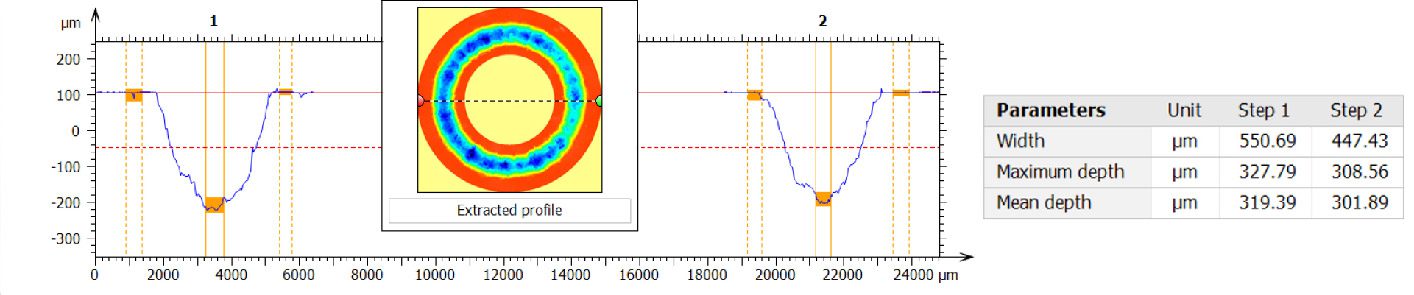
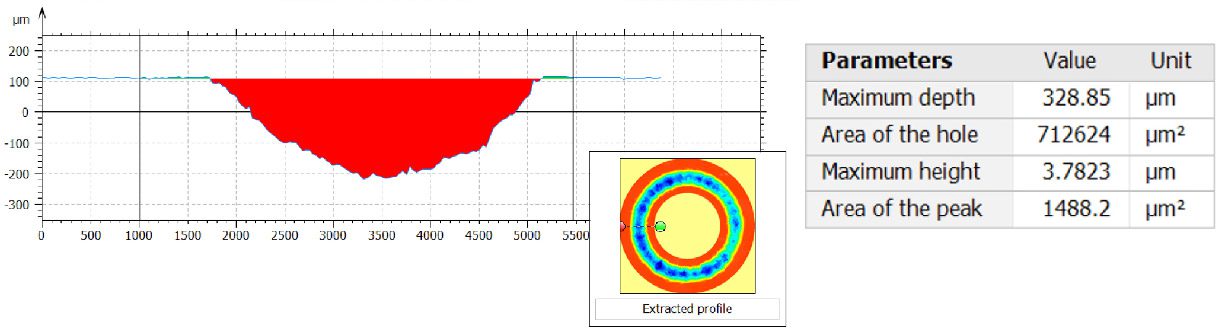
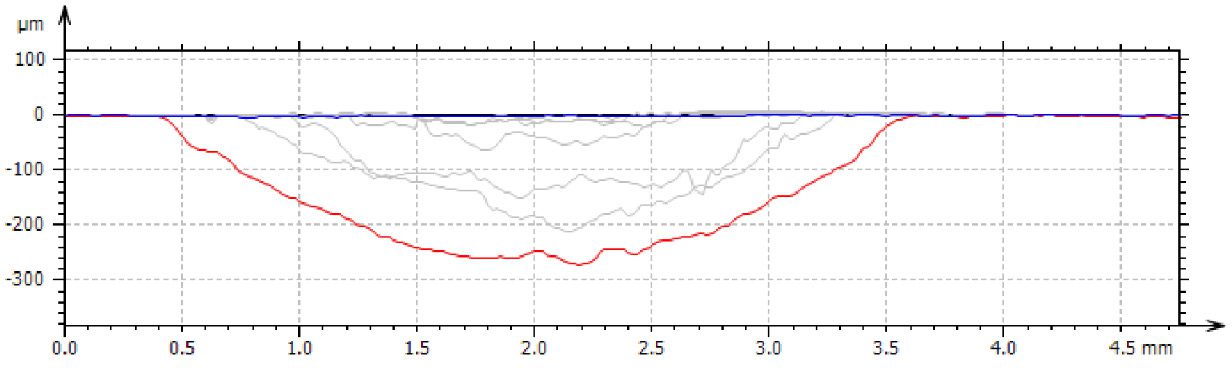
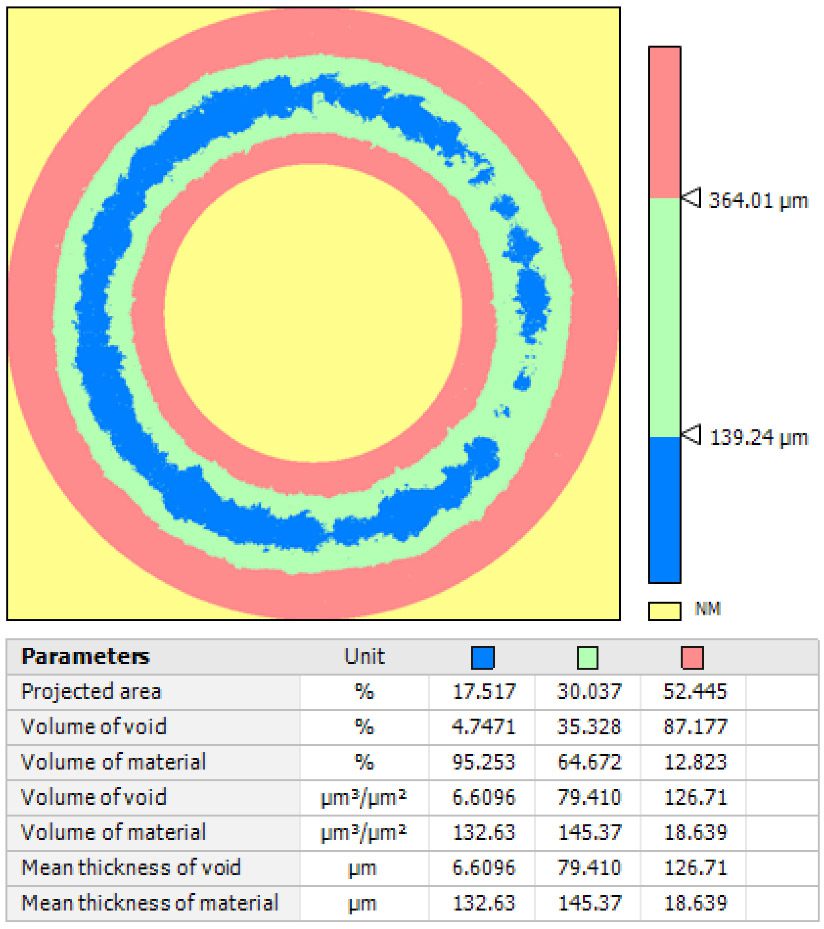
まとめ

NANOVEA T2000トライボメーターは、2つの異なる床材サンプル間の摩耗率を分析することで、プログレッシブ摩耗マッピングを行う能力を披露しています。連続摩耗試験を一時停止し、NANOVEA 3D非接触型プロフィロメーターで表面をスキャンすると、材料の経時的な摩耗挙動に関する貴重な知見が得られます。

3D非接触プロフィロメーターを内蔵したNANOVEA T2000トライボメーターは、COF(摩擦係数)データ、表面測定、深さ測定、表面の可視化、体積損失、摩耗率など、様々なデータを提供します。この包括的な情報セットにより、ユーザーはシステムとサンプルの相互作用についてより深く理解することができます。制御された負荷、高精度、使いやすさ、高負荷、広い速度範囲、追加の環境モジュールなど、NANOVEA T2000トライボメータはトライボロジーを次のレベルへ導きます。

同じようなアプリケーションをお持ちですか?

3Dプロフィロメトリーによるラフネスマッピング検査

アバウトマッピングインスペクション

3Dプロフィロメトリーによる

作成者

DUANJIE, PhD

はじめに

表面粗さとテクスチャーは、製品の最終的な品質と性能に影響を与える重要な要素です。表面の粗さ、質感、一貫性を十分に理解することは、最適な加工や管理手段を選択するために不可欠です。不良品を迅速に特定し、生産ラインの条件を最適化するために、製品表面の迅速かつ定量的で信頼性の高いインライン検査が必要とされています。

インライン表面検査における3D非接触プロフィロメータの重要性

製品の表面欠陥は、材料の加工や製品の製造に起因します。インライン表面品質検査により、最終製品の最も厳密な品質管理が保証されます。ナノベア 3D非接触光学式プロファイラー 非接触でサンプルの粗さを測定する独自の機能を備えたクロマティック ライト テクノロジーを利用します。ラインセンサーにより、大面積の3次元形状を高速にスキャンできます。解析ソフトウェアによってリアルタイムで計算される粗さのしきい値は、高速かつ信頼性の高い合否判定ツールとして機能します。

測定目的

本研究では、高速センサーを搭載したNANOVEA ST400を用いて、欠陥のあるテフロン試料の表面を検査し、NANOVEAの機能を紹介する。

生産ラインでの表面検査を迅速かつ確実に行うための非接触型プロファイラーです。

ナノビア

ST400

結果・考察

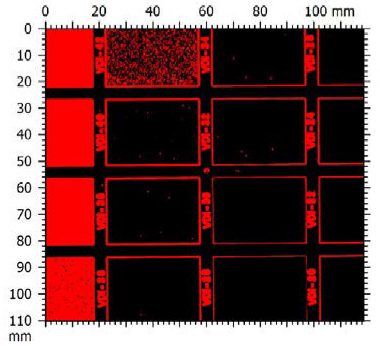
の3次元表面解析 ラフネス標準試料

図1に示すように、192点の輝線を生成する高速センサーを搭載したNANOVEA ST400を用いて、ラフネススタンダードの表面をスキャンしています。この192点の輝線が試料表面を同時にスキャンするため、スキャン速度が大幅に向上しました。

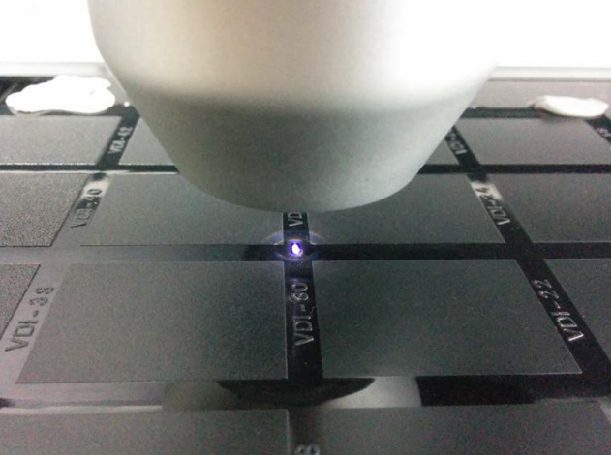
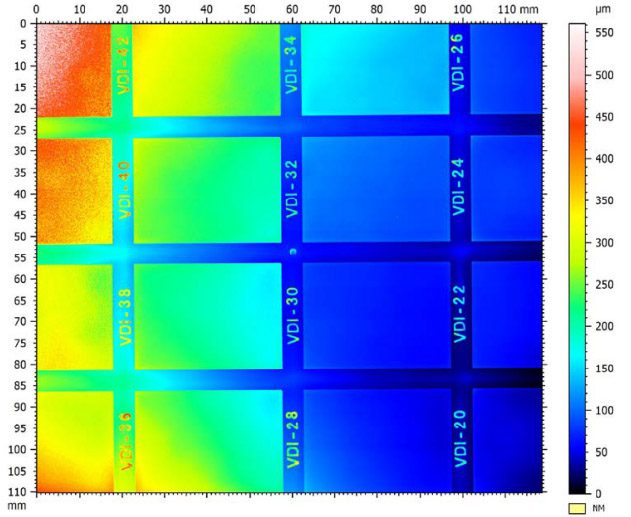
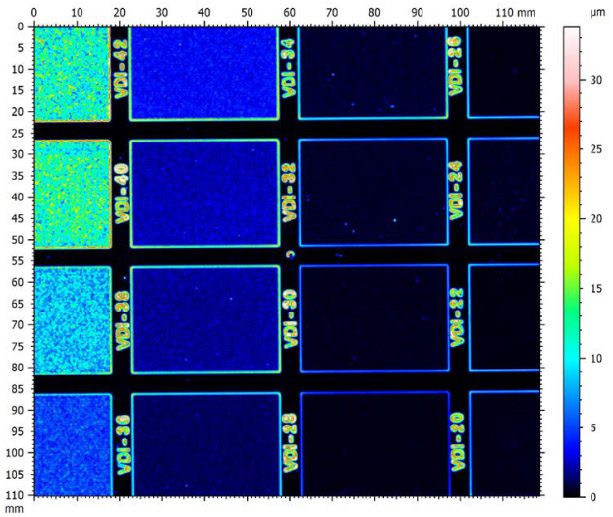
図2は、粗さ標準サンプルの表面高さマップおよび粗さ分布マップの偽色図を示す。図2aにおいて、粗さ標準試料は、標準粗さブロックの各々において変化した色の勾配によって表されるように、わずかに傾斜した表面を示している。図2bでは、均質な粗さ分布がディファレンシャル粗さブロックに示されており、その色はブロック内の粗さを表している。

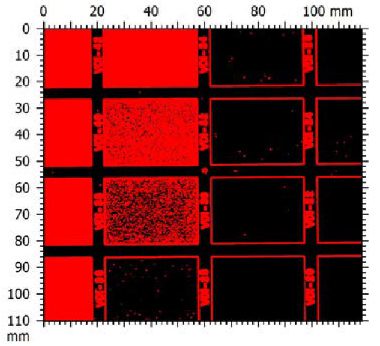
図3は、粗さの閾値を変えて解析ソフトウェアが生成した合否判定マップの例である。表面粗さがある設定された閾値以上の場合、粗さブロックが赤くハイライトされる。これは、ユーザーがサンプルの表面仕上げの品質を判断するための粗さ閾値を設定するためのツールを提供するものである。

図1: ラフネススタンダードサンプルの光ラインセンサースキャニング

a. サーフェスハイトマップ:

b. ラフネスマップ:

図2: 粗さ基準サンプルの表面高さマップと粗さ分布マップのフォールスカラー図です。

図3: ラフネス閾値に基づく合否判定マップ。

欠陥のあるテフロン試料の表面検査

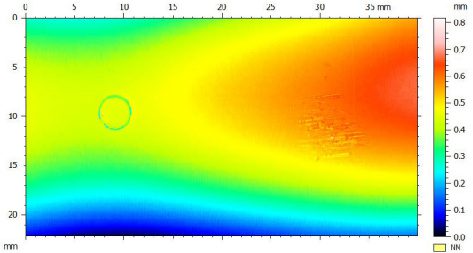
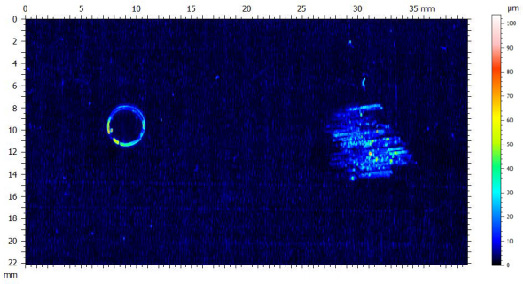
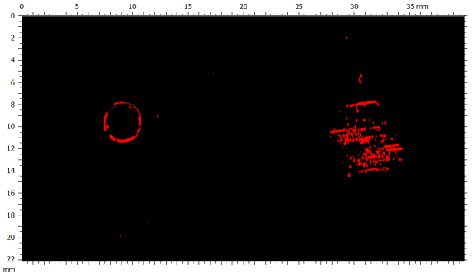
図4にTelonサンプル表面の表面高さマップ、粗さ分布マップ、合否判定粗さ閾値マップを示します。Telonサンプルは、表面高さマップに示すように、サンプルの右側中央に隆起が形成されている。

a. サーフェスハイトマップ:

図4bのパレットの異なる色は、局所的な表面の粗さ値を表しています。ラフネスマップは、テフロンサンプルの無傷の領域で均一な粗さを示している。しかし、凹んだリングや摩耗痕のような欠陥は明るい色で強調されています。ユーザーは、図4cに示すように、表面欠陥の位置を特定するための合否判定用粗さ閾値を簡単に設定することができます。このようなツールにより、ユーザーは生産ラインにおける製品の表面品質をその場で監視し、不良品を時間内に発見することができます。製品がインライン光学センサーを通過する際に、リアルタイムの粗さ値が計算され記録されるため、品質管理のための高速かつ信頼性の高いツールとして機能することができます。

b. ラフネスマップ:

c. 合否判定用ラフネス閾値マップ:

図4: サーフェスハイトマップ、ラフネスディストリビューションマップ、そして Telonサンプル表面の合否判定用粗さ閾値マップ。

まとめ

このアプリケーションでは、光ラインセンサーを搭載したNANOVEA ST400 3D非接触光プロファイラーが、信頼性の高い品質管理ツールとして、効果的かつ効率的に機能することを示しました。

光学式ラインセンサーは、192点の輝線を発生させてサンプル表面を同時にスキャンするため、スキャン速度の大幅な向上につながる。生産ラインに設置することで、製品の表面粗さをその場でモニターすることができます。粗さのしきい値は、製品の表面品質を判断する信頼できる基準として機能するため、ユーザーは不良品にいち早く気付くことができます。

ここに示したデータは、解析ソフトウェアで利用可能な計算の一部に過ぎません。ナノベアプロフィロメーターは、半導体、マイクロエレクトロニクス、太陽電池、光ファイバー、自動車、航空宇宙、冶金、機械加工、コーティング、医薬品、バイオメディカル、環境などの分野で、ほぼすべての表面を測定します。

同じようなアプリケーションをお持ちですか?

ポータブル3Dプロフィロメータによる溶接面検査

溶接表面検査

ポータブル3Dプロフィロメーターによる

作成者

CRAIG LEISING

はじめに

通常目視検査で行われる特定の溶接を、極めて高い精度で調査することが重要になる場合があります。精密分析の対象となる特定の領域には、その後の検査手順に関係なく、表面の亀裂、気孔、未充填のクレーターが含まれます。寸法・形状、体積、粗さ、サイズなどの溶接の特性はすべて、重要な評価のために測定することが可能です。

溶接面検査における3D非接触プロフィロメータの重要性

タッチプローブや干渉計などの他の技術とは異なり、NANOVEA 3D非接触形状計軸色収差を使用するため、ほぼすべての表面を測定でき、オープンステージングによりサンプルサイズは大きく変化する可能性があり、サンプルの前処理は必要ありません。ナノからマクロの範囲は、サンプルの反射率や吸収の影響を受けずに表面プロファイル測定中に得られ、高い表面角度を測定する高度な機能を備えており、結果をソフトウェアで操作する必要はありません。透明、不透明、鏡面、拡散、研磨、粗いなど、あらゆる材質を簡単に測定できます。NANOVEA ポータブル表面形状計の 2D および 2D 機能により、実験室と現場の両方で完全な溶接表面検査を行うための理想的な機器となります。

測定目的

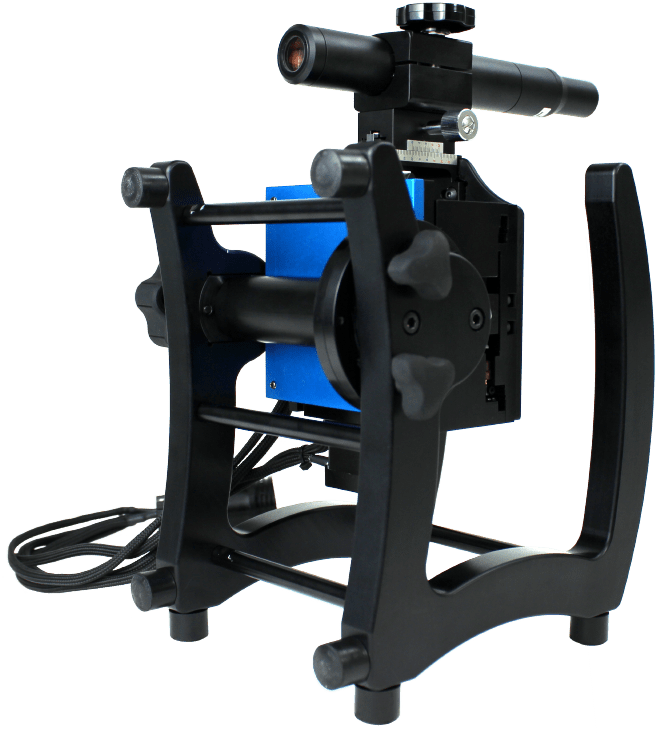
このアプリケーションでは、ナノビアJR25 ポータブルプロファイラを使用して溶接部の表面粗さ、形状、体積、およびその周辺を測定しています。この情報は、溶接と溶接プロセスの品質を適切に調査するための重要な情報を提供することができます。

ナノビア

JR25

測定結果

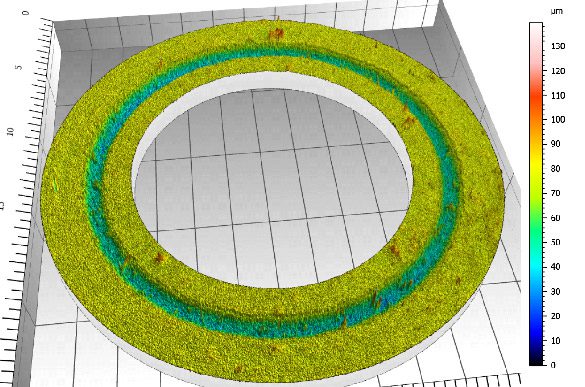
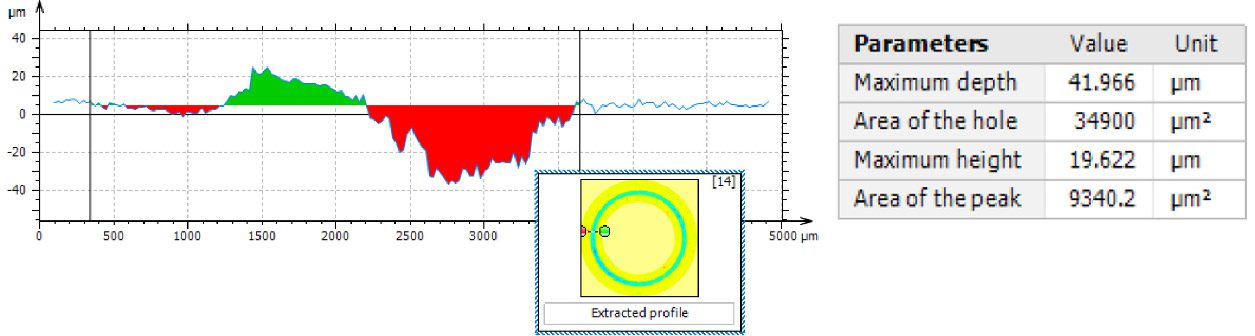
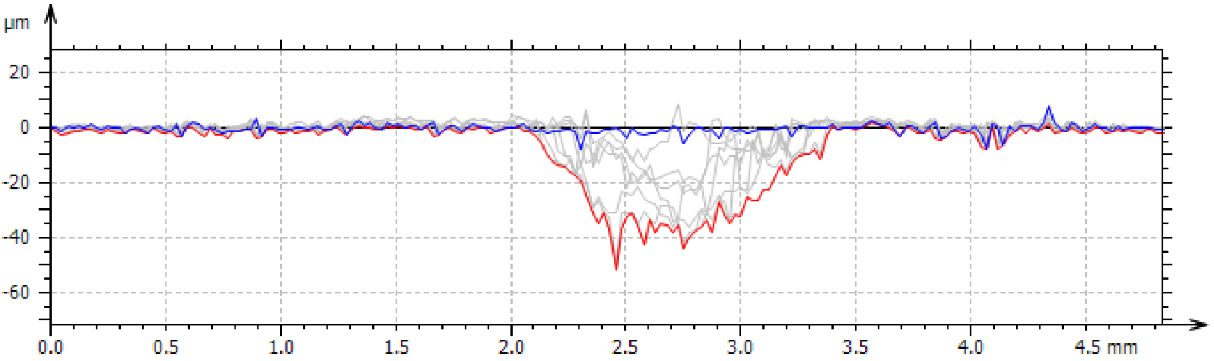
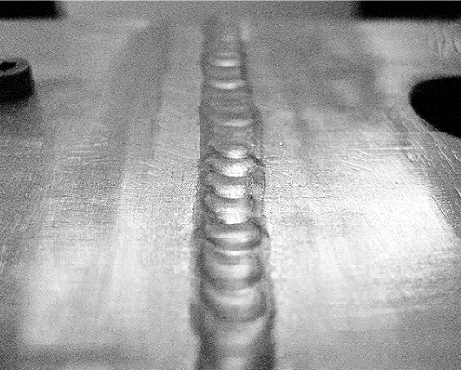
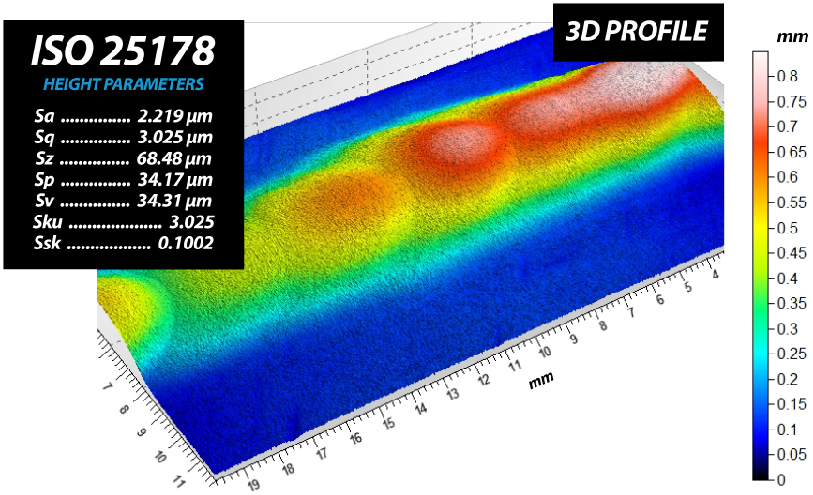
下の画像は、溶接部とその周辺の完全な3Dビューと、溶接部のみの表面パラメータを表示したものです。2D断面プロファイルは以下の通りです。

試供品

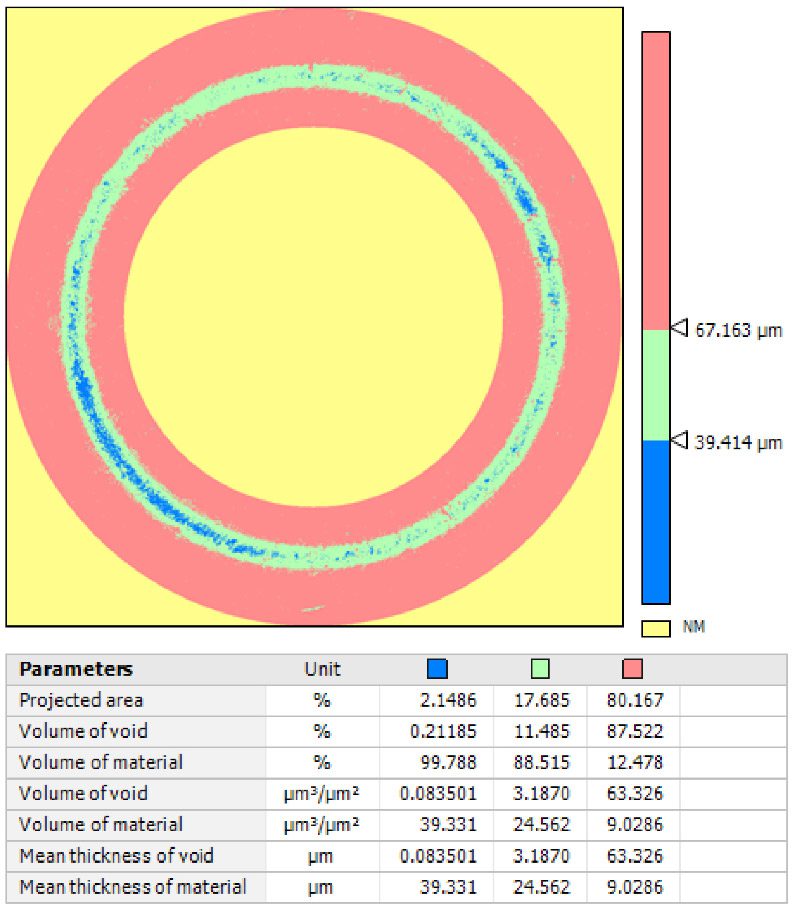
上記の2次元断面形状を3次元から削除し溶接部の寸法情報を以下に計算します。溶接部のみの表面積と材料の体積を計算します。

 ホールピーク
表面1.01mm214.0 mm2
容積8.799e-5 mm323.27 mm3
最大深さ/高さ0.0276 mm0.6195 mm
平均深度・平均高さ 0.004024 mm 0.2298 mm

まとめ

このアプリケーションでは、ナノビア3D非接触プロファイラが溶接部とその周辺表面領域の重要な特性を正確に評価できることを示しました。粗さ、寸法、体積から、品質と再現性の定量的な方法を決定し、またはさらに調査することができます。このアプリケーションノートの例のようなサンプル溶接は、社内またはフィールドテスト用の標準的なナノビア卓上又はポータブルプロファイラで簡単に分析することができます。

同じようなアプリケーションをお持ちですか?

工業用コーティング剤の傷と摩耗の評価

工業用コーティング

トライボメータによる傷や摩耗の評価

作成者

DUANJIE LI, PhD & ANDREA HERRMANN

はじめに

アクリルウレタン塗料は、速乾性の保護塗料の一種で、床用塗料や自動車用塗料など様々な工業用途に広く使用されています。床用塗料として使用する場合、歩道、縁石、駐車場など、足やゴム車の通行量が多い場所に使用することができます。

品質管理におけるスクラッチテストと摩耗テストの重要性

従来、アクリルウレタン床用塗料の耐摩耗性評価には、ASTM D4060規格に準拠したテーバー摩耗試験が行われてきた。しかし、規格にあるように「材料によっては、試験中にホイールの研磨特性が変化するため、テーバー摩耗試験でばらつきが生じることがある」1ため、試験結果の再現性が低く、異なる試験所からの報告値を比較することが困難な場合があります。また、Taber摩耗試験では、耐摩耗性は指定された摩耗回数における重量減少として計算される。しかし、アクリルウレタン系床用塗料の推奨乾燥膜厚は37.5~50μm2である。

テーバーアブレーザーによる激しい摩耗は、アクリルウレタン塗膜を素早く摩耗させ、基材に質量損失を生じさせ、塗膜の重量減少の計算に大きな誤差を生じさせます。また、摩耗試験中に塗料に研磨粒子が混入することも、誤差の原因となります。したがって、塗膜の摩耗評価を再現性よく行うためには、十分に制御された定量的で信頼性の高い測定が重要です。さらに、その スクラッチテスト は、実際のアプリケーションで早期の接着剤/粘着剤の不具合を検出することができます。

測定目的

この研究では、NANOVEA を紹介します。 トライボメータ メカニカルテスター 工業用コーティングの評価と品質管理に最適です。

トップコートの異なるアクリルウレタン床用塗料の摩耗プロセスをナノビアトライボメータを用いて制御・監視しながらシミュレートしています。マイクロスクラッチ試験により、塗膜の凝集破壊や接着破壊を引き起こすのに必要な荷重を測定します。

ナノビア T100

コンパクトな空気圧式トライボメータ

ナノビア PB1000

大型プラットフォーム・メカニカルテスター

試験方法

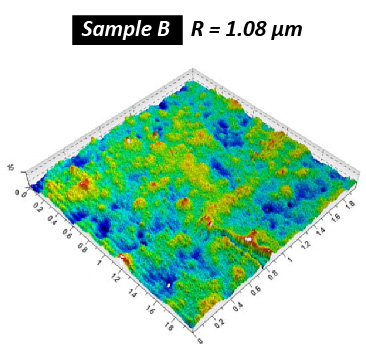
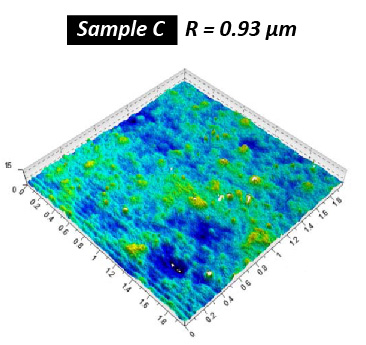
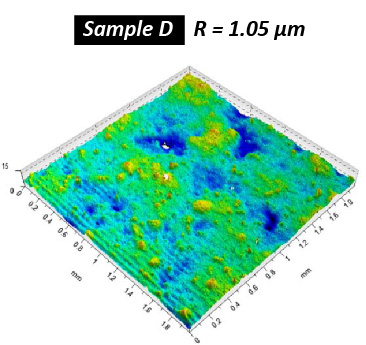
この研究では,耐久性を向上させる目的で,同じ下塗り剤(ベースコート)と同じ処方の上塗り剤を持つ市販の4つの水性アクリル床用塗料を評価しました。これらの4つの塗料は,試料A,B,C,Dとします。

摩耗試験

NANOVEA トライボメーターは、摩擦係数、COF、耐摩耗性などのトライボロジー挙動を評価するために適用されました。 SS440 ボールチップ (直径 6 mm、グレード 100) を試験対象の塗料に適用しました。 COF はその場で記録されました。摩耗率 K は、式 K=V/(F×s)=A/(F×n) を使用して評価されました。ここで、V は摩耗量、F は垂直荷重、s は滑り距離、A は摩耗痕跡の断面積、n は回転数です。表面粗さと摩耗痕跡は NANOVEA によって評価されました 光学式表面形状計、摩耗跡の形態を光学顕微鏡を使用して検査しました。

摩耗試験パラメータ

ノーマルフォース

20 N

スピード

15m/分

試験期間

100サイクル、150サイクル、300サイクル、800サイクル

スクラッチテスト

ロックウェルCダイヤモンドスタイラス(半径200μm)を搭載したナノベアメカニカルテスターを用い、マイクロスクラッチテスターモードで塗装サンプルの順荷重スクラッチ試験を実施しました。最終荷重は2種類使用しました。最終荷重は、プライマーからの塗膜剥離を調べるための5Nと、金属下地からのプライマー剥離を調べるための35Nの2種類を使用しました。試験結果の再現性を確保するため、各試料について同じ試験条件で3回の試験を繰り返しました。

スクラッチ長さ全体のパノラマ画像が自動的に作成され、その臨界破壊位置がシステムソフトウェアによって印加荷重と関連付けられました。このソフトウェア機能により、ユーザーはスクラッチテスト直後に顕微鏡下で臨界荷重を決定する必要がなく、いつでもスクラッチトラックの解析を行うことができるようになりました。

スクラッチテストパラメータ

ロードタイププログレッシブ
初期荷重0.01 mN
最終荷重5 N / 35 N
荷重レート10 / 70 N/min
スクラッチの長さ3mm
スクラッチ速度、dx/dt6.0mm/分
圧子ジオメトリー120º コーン
圧子材料(先端部)ダイヤモンド
圧子先端半径200 μm

摩耗試験結果

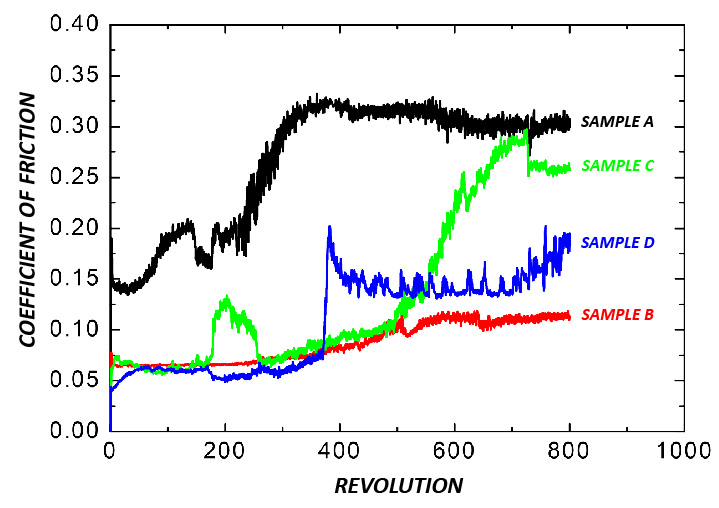
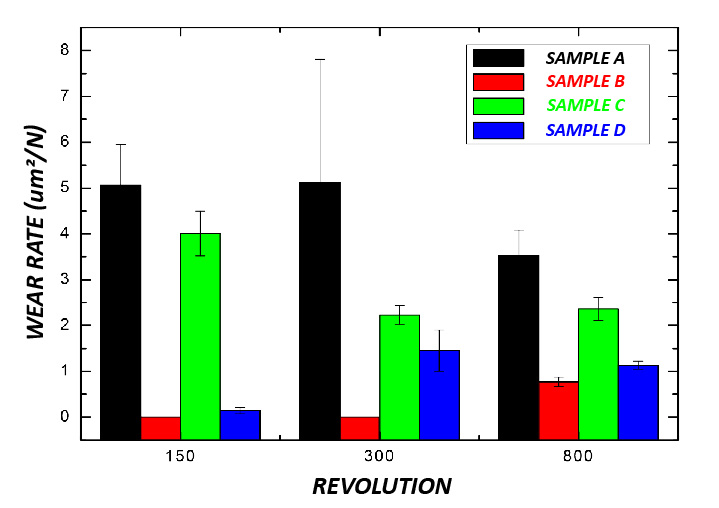
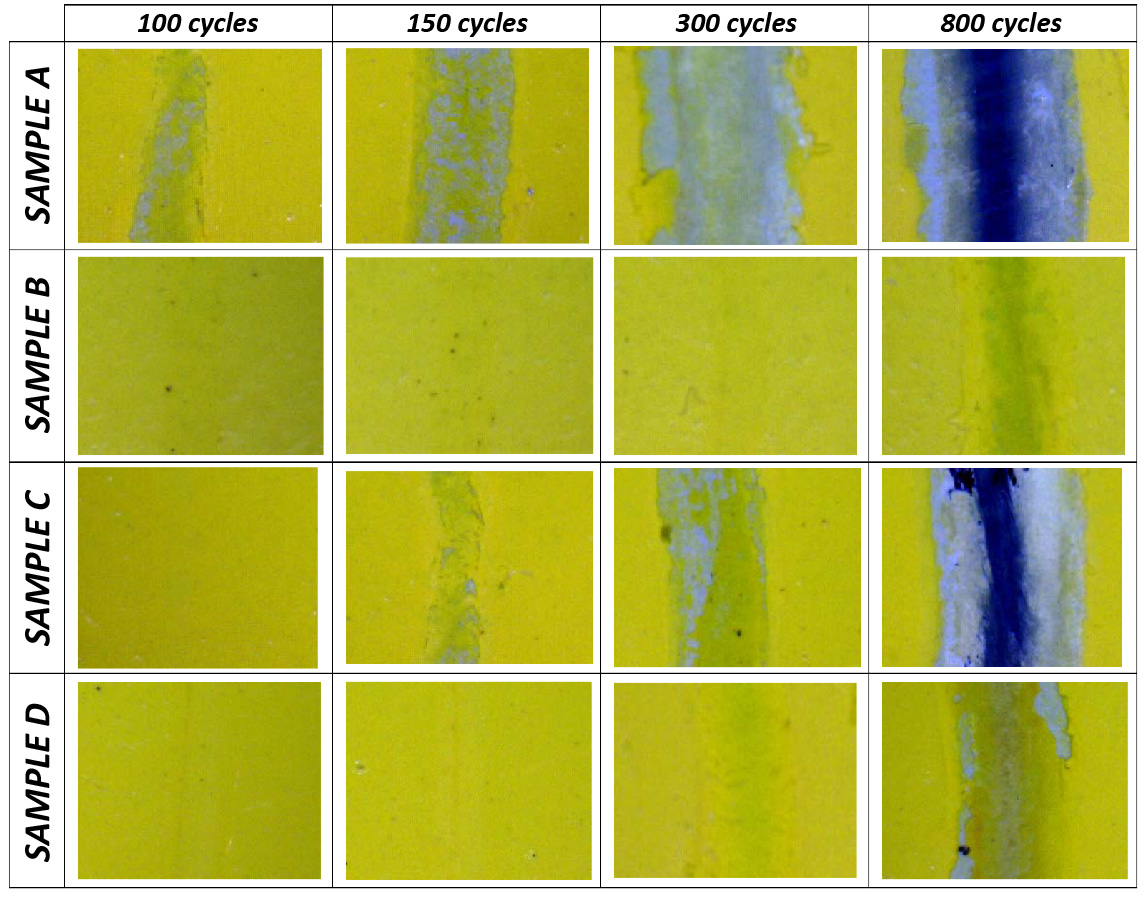
各試料について,異なる回転数(100,150,300,800サイクル)で4回のピンオンディスク摩耗試験を実施し,摩耗の進行を観察した。摩耗試験を行う前に,NANOVEA 3D非接触プロファイラで試料の表面形状を測定し,表面粗さを定量化した.図1に示すように、すべてのサンプルの表面粗さは約1μmと同等であった。COFは、図2に示すように、摩耗試験中にその場で記録されました。図4は、100、150、300、および800サイクル後の摩耗痕の変化を示し、図3は、摩耗プロセスの異なる段階での異なる試料の平均摩耗速度をまとめたものである。


他の 3 つのサンプルの COF 値が ~0.07 であるのに対して、サンプル A は初期に ~0.15 という非常に高い COF を示し、徐々に増加し 300 回の摩耗サイクルの後に ~0.3 で安定しました。このような高いCOFは摩耗プロセスを加速し、図4に示すように相当量の塗料カスを発生させます。サンプルAのトップコートは、最初の100回転で除去され始めています。図 3 に示すように、サンプル A は最初の 300 サイクルで ~5 μm2/N という最高の摩耗率を示し、金属基材の耐摩耗性が向上したため ~3.5 μm2/N にわずかに減少しています。サンプルCのトップコートは、図4に示すように、150摩耗サイクルの後に破損し始め、これは図2のCOFの増加によっても示されています。


これに対し、試料Bと試料Dは、トライボロジー特性が向上しています。試料Bは試験中ずっと低いCOFを維持しており、COFは~0.05から~0.1へとわずかに増加しています。このような潤滑効果は耐摩耗性を大幅に向上させ、800回の摩耗サイクルの後でもトップコートは下地のプライマーに対して優れた保護効果を発揮しています。サンプルBでは、800回の摩耗サイクルで、最小の平均摩耗量である〜0.77μm2/Nが測定されています。サンプルDのトップコートは、図2のCOFの急激な増加によって反映されているように、375サイクル後に剥離し始めます。サンプルDの平均摩耗量は、800サイクルで約1.1μm2/Nです。


ナノビアトライボメータは、従来のテーバー摩耗測定と比較して、再現性のある評価と市販の床・自動車塗料の品質管理を保証する、定量的で信頼性の高い摩耗評価を提供します。さらに、COFのその場測定が可能なため、摩耗プロセスのさまざまな段階とCOFの変化を関連付けることができ、さまざまな塗膜の摩耗メカニズムや摩擦特性に関する基礎的な理解を深める上で重要な役割を果たします。

図1: 塗料サンプルの3Dモルフォロジーとラフネス

図2: ピンオンディスクテスト時のCOF

図3: 塗料の違いによる摩耗速度の変化

図4: ピンオンディスク試験中の摩耗痕の推移

スクラッチテスト結果

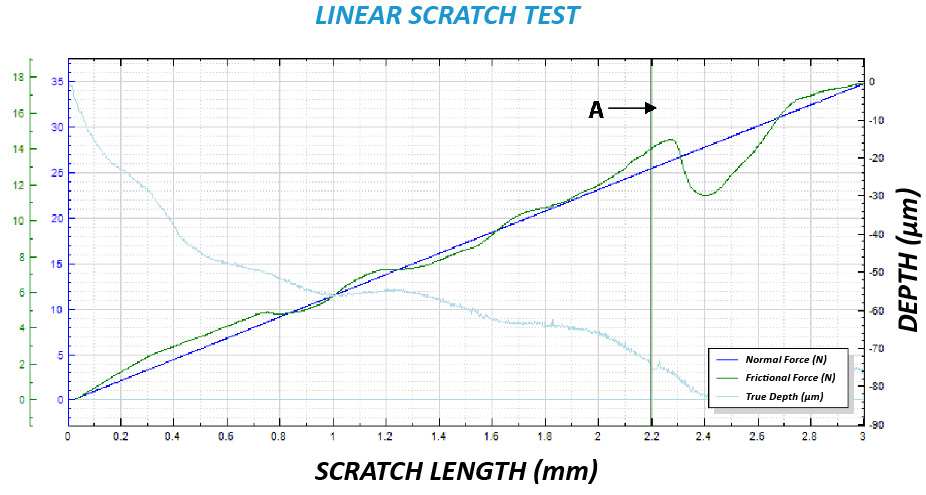
図5は例としてサンプルAのスクラッチ長さの関数として法線力、摩擦力、真の深さをプロットしたものです。オプションのアコースティックエミッションモジュールを取り付けることで、より詳細な情報を得ることができます。法線荷重が直線的に増加するにつれて、圧痕の先端は徐々に試験サンプルに沈み込み、真の深さが徐々に増加することが反映されています。摩擦力と真の深さの曲線の傾きの変化は、コーティングの破壊が起こり始めることを示唆するものの一つとして使用することができます。

図5: 試料Aのスクラッチ試験における法線力,摩擦力および真の深さのスクラッチ長さ依存性。 試料Aの最大荷重5Nのスクラッチ試験における法線力,摩擦力,真深さの関数。

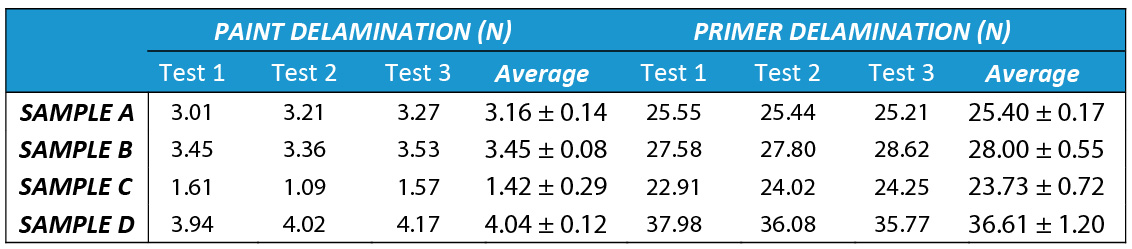
図6と図7は、それぞれ最大荷重5Nと35Nで試験した4つの塗料サンプルのフルスクラッチを示しています。サンプルDは、プライマーを剥離させるために50Nという高い荷重を必要としました。最終荷重5 Nのスクラッチ試験(図6)は上塗り塗料の凝集/接着破壊を評価し、35 Nのもの(図7)はプライマーの剥離を評価しています。顕微鏡写真中の矢印は、上塗り塗料または下塗り塗料がプライマーまたは下地から完全に剥離し始める時点を示しています。この時の荷重、いわゆる臨界荷重Lcは、表1にまとめたように、塗料の凝集性や接着性を比較するために使用されます。


塗料サンプルDが最も界面密着性が高く、塗料剥離で4.04N、プライマー剥離で36.61Nという最高のLc値を示していることがわかります。サンプルBは2番目に優れた耐傷性を示しています。スクラッチ分析から、塗料の配合の最適化が、アクリル系床用塗料の機械的挙動、より具体的には耐スクラッチ性と接着性に重要であることが示された。

表1: 重要な負荷のまとめ

図6: 最大荷重5Nのフルスクラッチの顕微鏡写真

図7: 最大荷重35Nのフルスクラッチの顕微鏡写真

まとめ

ナノビアメカニカルテスターとトライボメータは、従来のテーバー摩耗測定と比較して、商業用フロアコーティングや自動車用コーティングの評価と品質管理に優れたツールです。スクラッチモードのナノビアメカニカルテスターは、塗膜システムの付着性/凝集性の問題を検出できます。ナノビアトライボメータは、塗料の耐摩耗性と摩擦係数を定量的かつ再現性よく分析することができます。


本研究で試験した水性アクリル床用塗料の総合的なトライボロジーおよび機械的解析に基づき、サンプルBは最も低いCOFと摩耗率を持ち、2番目に優れた耐傷性を示す一方、サンプルDは最高の耐傷性と2番目に優れた耐摩耗性を示すことが示されました。この評価により,様々な使用環境下でのニーズに対応した最適な候補を評価・選定することが可能となります。


ナノベアメカニカルテスターのナノおよびマイクロモジュールには、ISO および ASTM に準拠した圧痕、スクラッチ、摩耗の各テスターモードがあり、1 つのモジュールで塗料評価に利用できる最も広範な試験法を提供しています。ナノベアトライボメータは、ISO および ASTM に準拠した回転およびリニアモードによる精密で再現性の高い摩耗および摩擦試験を提供し、オプションで高温摩耗、潤滑、トライボコロージョンの各モジュールを 1 つの統合済みシステムで利用できます。ナノベアの比類なき製品群は、硬度、ヤング率、破壊靭性、接着性、耐摩耗性など、薄いまたは厚い、柔らかいまたは硬いコーティング、フィルム、基材のあらゆる機械的/トライボロジー特性を測定するための理想的なソリューションとなっています。オプションのNANOVEA非接触光学式プロファイラを使用すると、粗さなどの表面測定に加えて、スクラッチや摩耗痕の高解像度3Dイメージングが可能です。

さて、次はアプリケーションについてです。

3Dプロフィロメトリーによる破壊面解析

フラクトグラフィー解析

3Dプロフィロメトリーによる

作成者

CRAIG LEISING

はじめに

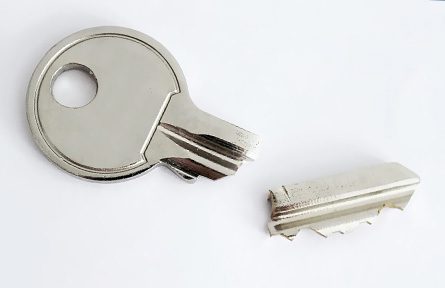
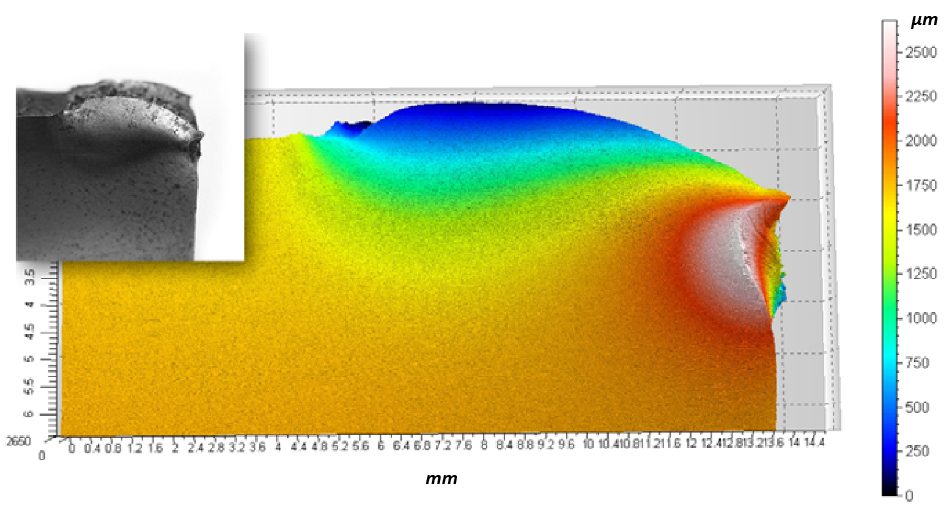
フラクトグラフィーは、破壊された表面の特徴を研究するもので、歴史的には顕微鏡または SEM を使用して調査されてきました。フィーチャのサイズに応じて、表面分析には顕微鏡 (マクロ フィーチャ) または SEM (ナノおよびマイクロ フィーチャ) が選択されます。どちらも最終的には破壊メカニズムのタイプを特定できるようになります。顕微鏡には効果的ではありますが、明らかな限界があり、SEM は原子レベルの分析を除いて、ほとんどの場合、破面測定には非実用的であり、広範な使用能力がありません。光学計測技術の進歩により、NANOVEA 3D非接触形状計 ナノスケールからマクロスケールまでの 2D および 3D 表面測定を提供する機能を備え、現在、最適な機器とみなされています

亀裂検査における3D非接触プロフィロメータの重要性

SEMとは異なり、3D非接触プロフィロメータは、SEMよりも優れた垂直・水平方向の寸法を提供しながら、ほぼすべての表面、サンプルサイズ、最小限のサンプル前処理で測定することができます。プロファイラでは、ナノからマクロレンジの形状を一度の測定で捉えることができ、試料の反射率の影響を受けることはありません。透明、不透明、鏡面、拡散、研磨、粗面など、あらゆる材質を簡単に測定することができます。3D非接触プロフィロメータは、SEMの数分の一のコストで、表面破壊研究を最大化するための広範でユーザーフレンドリーな機能を提供します。

測定目的

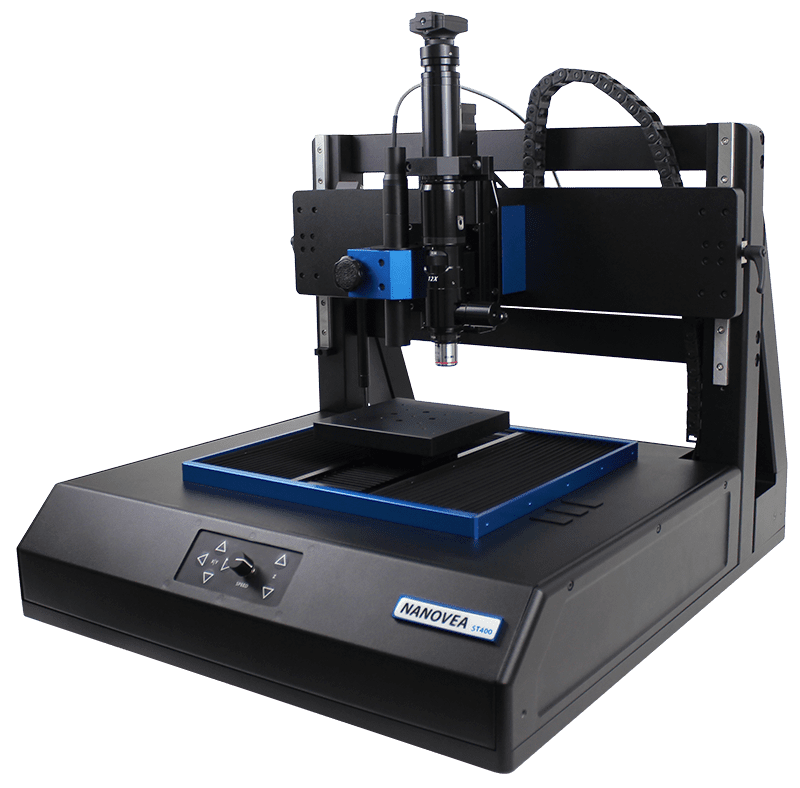
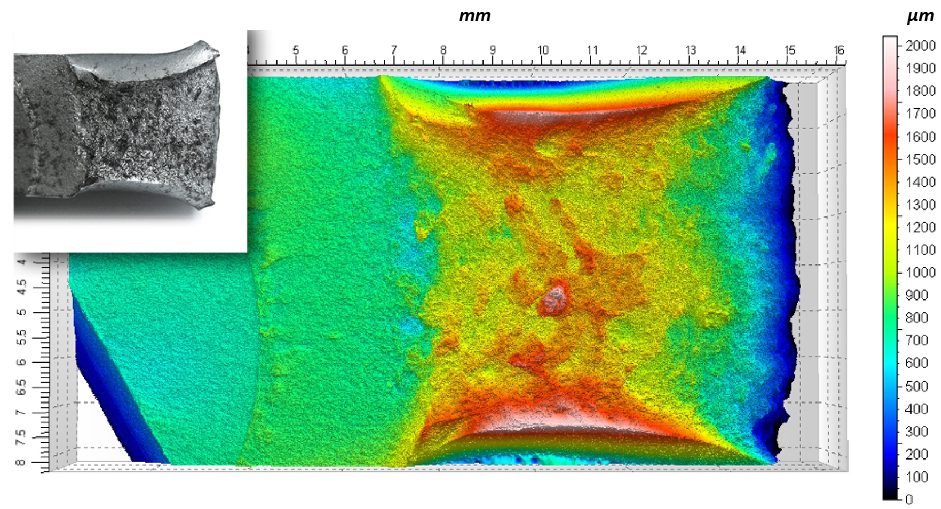
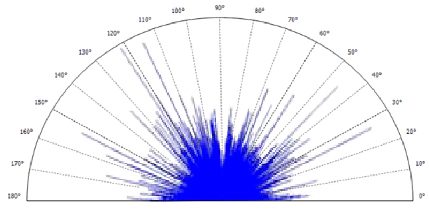
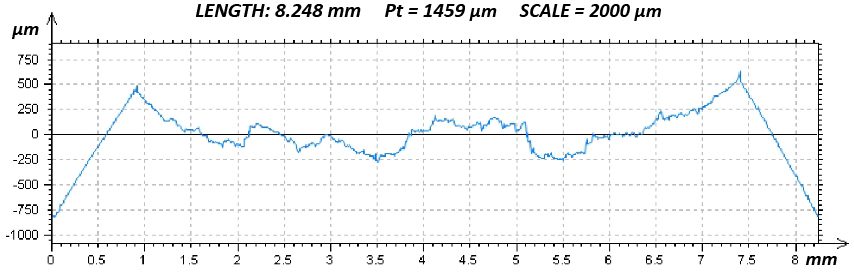
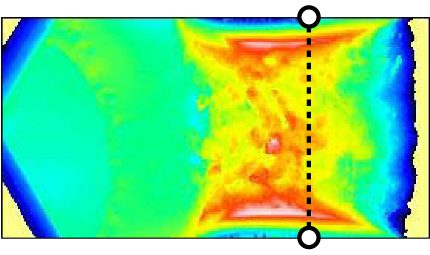
このアプリケーションでは、ナノビアST400を用いて鋼鉄サンプルの破断面を測定しています。3Dエリア、2Dプロファイル抽出、表面の方向性マップを紹介します。

ナノビア

ST400

結果

表面

3D表面テクスチャーの方向性

等方性51.26%
ファーストディレクション123.2º
セカンドディレクション116.3º
サードディレクション0.1725º

この抽出液から表面積、体積、粗さなどを自動計算することができます。

2Dプロファイル抽出

結果

側面

3D表面テクスチャーの方向性

等方性15.55%
ファーストディレクション0.1617º
セカンドディレクション110.5º
サードディレクション171.5º

この抽出液から表面積、体積、粗さなどを自動計算することができます。

2Dプロファイル抽出

まとめ

このアプリケーションでは、ナノビアST400 3D非接触プロフィロメーターが、破砕表面の完全な地形(ナノ、マイクロ、マクロの特徴)を正確に特徴付けることができることを示しました。3D領域から、表面を明確に識別し、サブ領域またはプロファイル/クロスセクションを迅速に抽出し、表面計算の無限のリストを使用して分析することができます。サブナノメートルの表面形状は、統合されたAFMモジュールでさらに分析することができます。

さらに、ナノベアーのプロフィロメーターにはポータブルタイプもあり、特に亀裂の表面が動かないようなフィールド調査には欠かせないものとなっています。このように幅広い表面測定機能を備えているため、1台の装置で亀裂表面の分析がより簡単に、より便利になりました。

同じようなアプリケーションをお持ちですか?

3Dプロフィロメトリーによるガラスファイバー表面形状測定

ファイバーガラス表面トポグラフィー

3Dプロフィロメトリーによる

作成者

CRAIG LEISING

はじめに

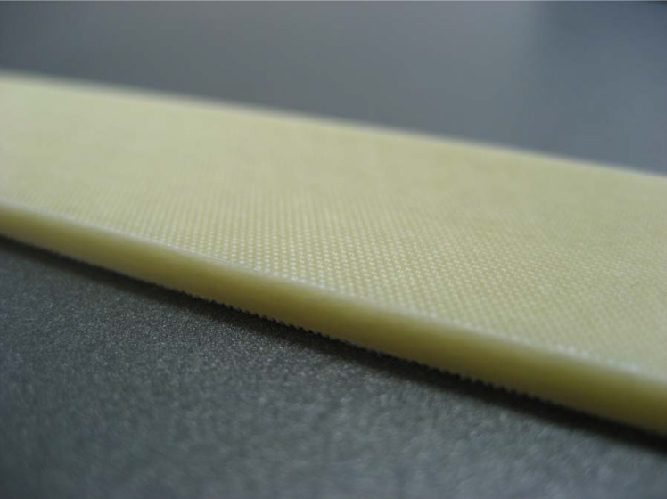
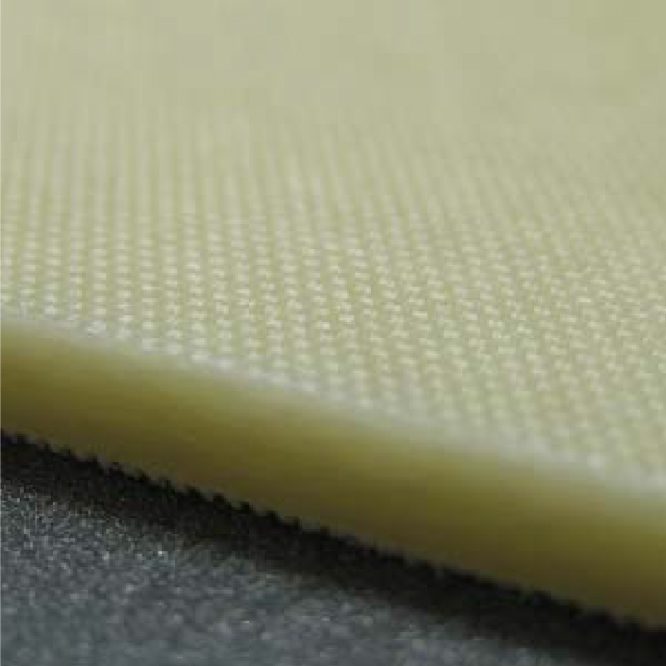
ガラス繊維は、ガラスを極細に加工した素材である。繊維強化ポリマー(FRP)、ガラス繊維強化プラスチック(GRP)などと呼ばれ、多くのポリマー製品の補強材として使用されている。

品質管理における表面形状検査の重要性

ガラス繊維強化材には多くの用途がありますが、ほとんどの用途において可能な限り強度を高めることが極めて重要です。ガラス繊維複合材料は、重量に対する強度が最も高い材料の一つであり、場合によっては鋼鉄よりも高い強度を持つこともあります。高い強度の他に、露出した表面積をできるだけ小さくすることも重要です。グラスファイバーの表面積が大きいとケミカル・アタックや材料の膨張に対して構造体がより脆弱になる可能性があります。そのため、表面検査は品質管理生産において非常に重要です。

測定目的

このアプリケーションでは、ナノビアST400 を使用して、ガラス繊維複合材料の表面の粗さと平坦さを測定しています。これらの表面特性を定量化することで、より強く、より長持ちするガラスファイバー複合材料の製造や最適化が可能になります。

ナノビア

ST400

測定パラメータ

プローブ 1mm
取得率300Hz
アベレージング1
測定面5mm×2mm
ステップサイズ5 µm x 5 µm
スキャンニングモード一定速度

プローブ仕様

測定範囲 RANGE1mm
Z RESOLUTION 25nm
Z軸正確性200nm
水平分解能 2 μm

結果

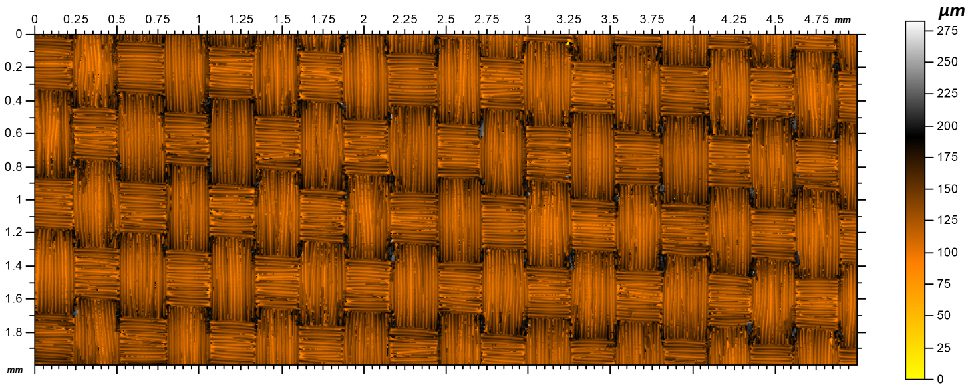
偽色表示

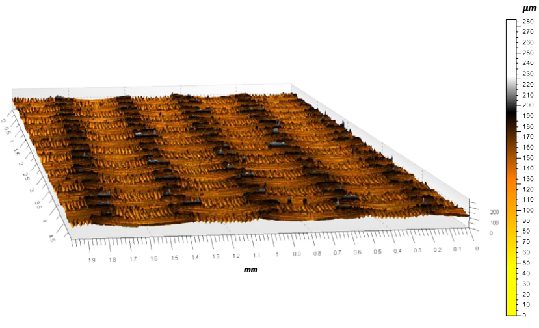
3次元表面平坦度

3次元表面粗さ

15.716 μm計算上平均高さ
スク19.905 μm平方根高さ
Sp116.74 μm最大ピーク高
エスブイ136.09 μmピットの最大高さ
エスエス252.83 μm最大高さ
エスケープ0.556歪度
3.654クルトーシス

まとめ

結果が示すように、NANOVEA ST400 Optical プロファイラー グラスファイバー複合材表面の粗さと平坦度を正確に測定することができました。データは、ファイバー複合材料の複数のバッチにわたって、または一定期間にわたって測定され、さまざまなファイバーグラス製造プロセスとそれらが時間の経過とともにどのように反応するかについての重要な情報を提供します。したがって、ST400 はグラスファイバー複合材料の品質管理プロセスを強化するための実行可能なオプションです。

同じようなアプリケーションをお持ちですか?