Mechanical testing · Instrumented scratch

Multi-Pass Scratch Wear Testing

A multi-pass scratch wear test runs a stylus over the same track many times at a load below the single-pass critical load. Instead of breaking the coating at once, damage accumulates pass by pass. Recording depth and friction on every pass shows how fast the surface wears and when it finally fails, at the micro scale of real abrasion and contact fatigue.

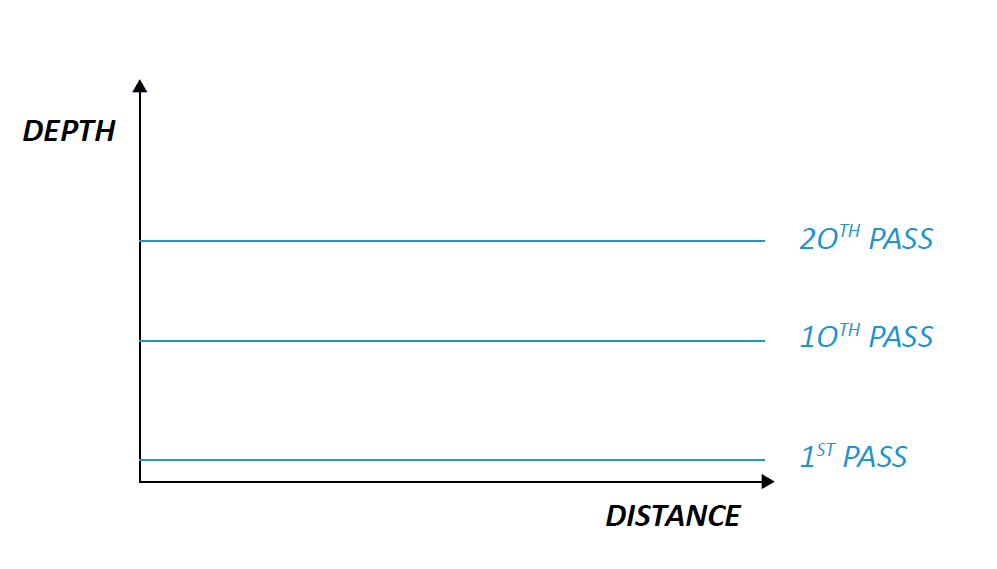
Multi-pass scratch wear track and depth evolution

At a glance

Principle
Repeated stylus passes in the same track at a constant, sub-critical load.
Results
Penetration and residual depth per pass, friction per pass, and the number of passes to failure.
Load range
Nano and micro modules, from thin films at mN loads to hard coatings at N loads.
Signals
Depth, friction and acoustic emission, with images of the track after testing.
Control
True closed-loop feedback keeps the load constant as the track deepens.
Use
Wear resistance of thin films and coatings at a scale too small for conventional wear tests.

What multi-pass wear tells you

A single progressive scratch finds the load that breaks a coating at once. In service, most coatings see many contacts at loads well below that, and fail gradually: they wear thinner, accumulate fatigue cracks, and eventually wear through. Multi-pass scratch wear reproduces that process at the micro scale, on films and coatings too thin or small for conventional wear tests.

How the test works

  1. The critical load is first established with a single progressive scratch.
  2. A load below it is chosen, and the stylus passes over the same track repeatedly at that load.
  3. On each pass, penetration depth, friction and acoustic emission are recorded; residual depth can be measured between passes.
  4. The track is imaged after testing, and depth and friction are plotted against pass number.

Reading the results

A wear-resistant coating shows depth growing slowly and friction staying stable. A change of slope in the depth curve, a step in friction or a burst of acoustic emission marks the pass at which the coating begins to fail or wears through to the substrate. The number of passes to failure, and the depth increase per pass before it, rank coatings by durability rather than by single-overload strength.

Where it fits

Multi-pass scratch wear sits between single-pass scratch testing, which measures critical loads, and macro-scale tribometer wear testing, such as linear reciprocating per ASTM G133, which measures wear rate over long sliding distances. It suits thin hard coatings, polymer films and small components where a tribometer contact would be too large.

Related tests

Instruments that run this test

Every instrument is built to order. Send us your samples and we run your test in our laboratory first, then configure the instrument around the result.

Published results

Measured in our own laboratory, on the instruments we design and build, and published with full test parameters.

All mechanical testing application notes →

Independent published research

NANOVEA instruments appear in 438 published studies on indentation, hardness and scratch, by researchers at universities and industrial laboratories worldwide.

All 438 studies →

NANOVEA materials testing laboratory

Thin-film wear resistance? Send us your samples.

Our laboratory runs multi-pass scratch wear, scratch adhesion and nanoindentation on the same mechanical testers we build, and reports depth evolution and failure with the full test parameters.

Your samples are tested by the people who design the instruments, so you get advice on the method as well as the numbers.

Indentation & scratch lab services

Frequently asked questions

What is a multi-pass scratch wear test?

A test in which a stylus passes repeatedly over the same track at a constant load lower than the coating's single-pass critical load. Depth and friction are recorded on each pass, so the test shows how wear progresses and how many passes the coating survives.

Why use a load below the critical load?

Real coatings rarely fail from one overload. They wear and accumulate fatigue damage under repeated contact at moderate loads. A sub-critical multi-pass test reproduces that gradual process, separating coatings that would rank the same in a single-pass scratch.

How does it differ from a tribometer wear test?

A tribometer wear test uses a ball or pin over a longer track and many cycles, usually at higher loads, and reports a wear rate from worn volume. Multi-pass scratch uses a fine stylus on a short track at the micro and nano scale, suited to thin films and small samples, and tracks depth pass by pass.

What is measured on each pass?

Penetration depth under load, residual depth after recovery, and friction. Plotting these against pass number shows the wear rate per pass and a clear change when the coating wears through.