

Application Note | Micro Indentation Testing
World-Leading Micro Mechanical Testing: Indentation and Scratch from 0.03 to 200 N
Instrumented Vickers Hardness, Elastic Modulus, and Scratch Testing Across a Wide Load Range on One Module

Research & Experimental Testing
Pierre Leroux & Duanjie Li
Visual Design & Editorial
Andrew Shore
Introduction
Standard Vickers Micro Hardness Testers have usable load ranges from 10 to 2000 gram force (gf). Standard Vickers Macro Hardness Testers load from 1 to 50 Kgf. These instruments are not only very limited in range of loads but they are also inaccurate when dealing with rougher surfaces or low loads when indents become too small to be measured visually. These limitations are intrinsic to older technology and as a result, instrumented indentation is becoming the standard choice due to the higher accuracy and performance it brings.
Why Instrumented Indentation Outperforms Conventional Vickers Testing
With NANOVEA’s world leading micro mechanical testing systems, Vickers hardness is automatically calculated from depth versus load data with the widest load range on a single module ever available (0.3 grams to 2 Kg or 6 grams to 40 Kg). Because it measures hardness from depth versus load curves, the NANOVEA Micro Module can measure any type of materials including very elastic ones. It also can provide not only Vickers hardness but also accurate elastic modulus and creep data in addition to other types of test such as scratch adhesion testing, wear, fatigue testing, yield strength and fracture toughness for a complete range of quality control data.
ℹ️ Learn more about micro indentation and scratch testing lab services.
Measurement Objective
In this application note, it will be explained how the Micro Module has been designed to offer the world’s leading instrumented indentation and scratch testing. The Micro Module’s wide range testing capability is ideal for many applications. For example, the load range allows for accurate hardness and elastic modulus measurements of thin hard coatings and can then apply much higher loads to measure the adhesion of these same coatings.
The capacity of the Micro Module is showcased with the NANOVEA CB500 Mechanical Tester by performing both indentation and scratch tests with superior precision and reliability using a wide load range from 0.03 to 200 N.
NANOVEA CB500 Advanced Compact
Mechanical Tester

Test Conditions
A series (3×4, 12 indents in total) of Microindentations were performed on a standard steel sample using a Vickers indenter. The load and depth were measured and recorded for the complete indentation test cycle. The indentations were performed to different maximum loads ranging from 0.03 N to 200 N (0.0031 to 20.4 kgf) to showcase the capacity of the micro module in performing accurate indentation tests at different loads. It is worth noting that an optional load cell of 20 N is also available to provide 10 times higher resolution for tests in the lower load range from 0.3 gf up to 2 kgf.
Two scratch tests were performed using the Micro Module with linearly increased load from 0.01 N to 200 N and from 0.01 N to 0.5 N, respectively, using conico-spherical diamond stylus with tip radius of 500 µm and 20 µm.
Twenty Microindentation tests were carried out on the steel standard sample at 4 N showcasing the superior repeatability of the Micro Module’s results that contrast the performance of conventional Vickers hardness testers.


Microindenter on the steel sample (left) and conico-spherical diamond scratch stylus (right).
Test Parameters of the Indentation Mapping
| Parameter | Value |
|---|---|
| Mapping | 3 by 4 indents |
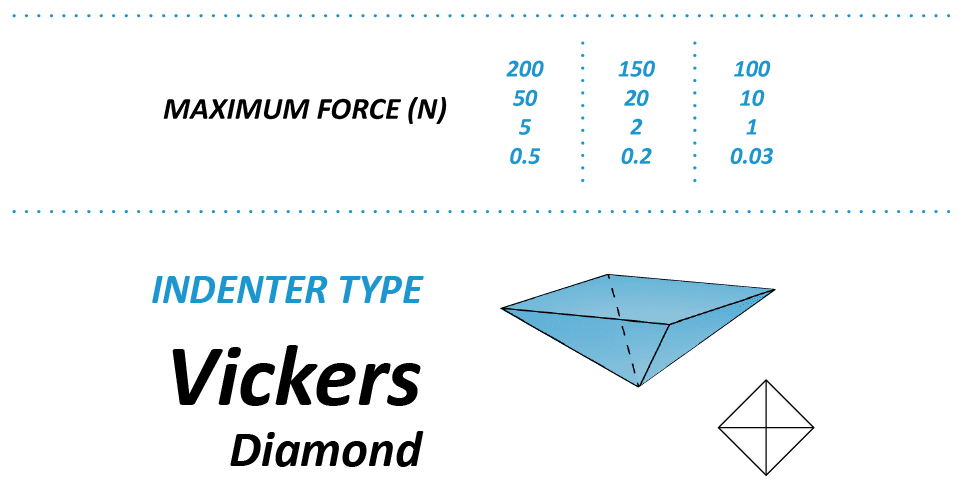
| Maximum force (N) | 200, 150, 100, 50, 20, 10, 5, 2, 1, 0.5, 0.2, 0.03 |
| Indenter type | Vickers diamond |
Indentation mapping parameters.
Results and Discussion
The new Micro Module has a unique combination of Z-motor, high-force load cell and a high precision capacitive depth sensor. The unique utilization of independent depth and load sensors ensures high accuracy under all conditions.
Conventional Vickers hardness tests use diamond square-based pyramid indenter tips that create square shaped indents. By measuring the average length of the diagonal, d, the Vickers hardness can be calculated.
In comparison, the instrumented indentation technique used by NANOVEA’s Micro Module directly measures the mechanical properties from indentation load & displacement measurements. No visual observation of the indent is required. This eliminates user or computer image processing errors in determining the d values of the indentation. The high accuracy capacitor depth sensor with a very low noise level of 0.3 nm can accurately measure the depth of indents that are difficult or impossible to be measured visually under a microscope with traditional Vickers hardness testers.
In addition, the cantilever technique used by competitors applies the normal load on a cantilever beam by a spring, and this load is in turn applied on the indenter. Such a design has a flaw in case a high load is applied – the cantilever beam cannot provide sufficient structural stiffness, leading to deformation of the cantilever beam and in turn misalignment of the indenter. In comparison, the Micro Module applies the normal load via the Z-motor acting on the load cell and then the indenter for direct load application. All the elements are vertically aligned for maximum stiffness, ensuring repeatable and accurate indentation and scratch measurements in the full load range.

Indentation from 0.03 to 200 N
The image of the indentation map is displayed in Fig. 1. The distance between the two adjacent indents above 10 N is 0.5 mm, while the one at lower loads is 0.25 mm. The high-precision position control of the sample stage allows users to select the target location for mechanical properties mapping. Thanks to the excellent stiffness of the micro module due to the vertical alignment of its components, the Vickers indenter keeps a perfect vertical orientation as it penetrates into the steel sample under a load of up to 200 N (400 N optional). This creates impressions of a symmetric square shape on the sample surface at different loads.
The individual indentations at different loads under the microscope are displayed alongside of the two scratches as shown in Fig. 2, to showcase the capacity of the new micro module in performing both indentation and scratch tests in a wide load range with a high precision. As shown in the Normal Load vs. Scratch Length plots, the normal load increases linearly as the conico-spherical diamond stylus slides on the steel sample surface. It creates a smooth straight scratch track of progressively increased width and depth.


Fig. 2: Indentations and scratches under the microscope.
The load-displacement curves during the indentation at different maximum loads are shown in Fig. 3. The hardness and elastic modulus are summarized and compared in Fig. 4. The steel sample exhibits a constant elastic modulus throughout the test load ranging from 0.03 to 200 N (possible range 0.003 to 400 N), resulting in an average value of ~211 GPa. The hardness exhibits a relatively constant value of ~6.5 GPa measured under a maximum load above 100 N. As the load decreases to a range of 2 to 10 N, an average hardness of ~9 GPa is measured.


Repeatability: Twenty Indentations at 4 N
Twenty Microindentation tests were performed at 4N maximum load. The load-displacement curves are displayed in Fig. 5 and the resulting Vickers hardness and Young’s modulus are shown in Fig. 6.


The load-displacement curves demonstrate the superior repeatability of the new Micro Module. The steel standard possesses a Vickers hardness of 842±11 HV measured by the new Micro Module, compared to 817±18 HV as measured using the conventional Vickers hardness tester. The small standard deviation of the hardness measurement ensures reliable and reproducible characterization of mechanical properties in the R&D and quality control of materials in both the industrial sector and academia research.
In addition, a Young’s Modulus of 208±5 GPa is calculated from the load-displacement curve, which is not available for conventional Vickers hardness tester due to the missing depth measurement during the indentation. As the load decreases and the size of the indent decreases, the NANOVEA Micro Module advantages in terms of repeatability compared to Vickers Hardness Testers increase until it is no longer possible to measure the indent through visual inspection.
The advantage of measuring depth to calculate hardness also becomes evident when dealing with rougher surfaces or when samples are more difficult to observe under standard microscopes provided on Vickers Hardness Testers.

Conclusion
In this study, we have shown how the new world leading NANOVEA Micro Module (200 N range) performs unmatched reproducible and precise indentation and scratch measurements under a wide load range from 0.03 to 200 N (3 gf to 20.4 kgf). An optional lower range Micro Module can provide testing from 0.003 to 20 N (0.3 gf to 2 kgf). The unique vertical alignment of the Z-motor, high-force load cell and depth sensor ensures maximum structural stiffness during measurements. The indentations measured at different loads all possess a symmetric square shape on the sample surface. A straight scratch track of progressively increased width and depth is created in the scratch test of a 200 N maximum load.
The new Micro Module can be configured on the PB1000 (150 x 200 mm) or the CB500 (100 x 50 mm) mechanical base with a z motorization (50 mm range). Combined with a powerful camera system (position accuracy of 0.2 microns) the systems provide the best automation and mapping capabilities on the market. NANOVEA also offers a unique patented function (EP No. 30761530) which allows verification and calibration of Vickers indenters by performing a single indent across the full range of loads. In contrast, standard Vickers Hardness Testers can only provide calibration at one load.
Additionally, the NANOVEA software enables a user to measure the Vickers hardness via the traditional method of measuring the indent diagonals if needed (for ASTM E92 & E384). As shown, in this document, depth versus load hardness testing (ASTM E2546 and ISO 14577) performed by a NANOVEA Micro Module is precise and reproducible compared to Traditional Hardness Testers. Especially for samples that cannot be observed/measured with a microscope.
In conclusion, the higher accuracy and repeatability of the Micro Module design with its broad range of loads and tests, high automation and mapping options renders the traditional Vickers hardness testers obsolete. But likewise with scratch and micro scratch testers still currently offered but designed with flaws in the 1980’s.
The continuous development and improvement of this technology makes NANOVEA a world leader in micro mechanical testing.
Frequently Asked Questions About Micro Indentation and Vickers Hardness
What are the limits of conventional Vickers hardness testers?
Standard Vickers micro hardness testers use loads of 10 to 2000 gf and macro testers 1 to 50 kgf. Besides their limited load range, they are inaccurate on rougher surfaces or at low loads, when indents become too small to be measured visually.
How does instrumented indentation measure Vickers hardness?
The NANOVEA Micro Module calculates hardness directly from load and displacement measurements, so no visual observation of the indent is required. This eliminates user or image-processing errors in measuring the diagonals, and a capacitive depth sensor with 0.3 nm noise measures indents too small to see under a microscope. Elastic modulus and creep are obtained from the same curves.
What load range does the NANOVEA Micro Module cover?
The study ran indentation and scratch tests from 0.03 N to 200 N (0.0031 to 20.4 kgf) on one module, with 400 N optional. An optional lower-range module with a 20 N load cell tests from 0.003 to 20 N (0.3 gf to 2 kgf) with 10 times higher resolution.
How repeatable is instrumented micro indentation compared with a Vickers tester?
Twenty indentations at 4 N on a steel standard gave 842 ± 11 HV with the Micro Module, compared with 817 ± 18 HV from a conventional Vickers hardness tester, plus a Young’s modulus of 208 ± 5 GPa that a conventional tester cannot provide.
Why does the Micro Module stay accurate at high loads?
The Z-motor, high-force load cell and depth sensor are vertically aligned, so the load is applied directly to the indenter with maximum stiffness. Cantilever designs can deform at high load and misalign the indenter; here the Vickers indents stayed symmetric squares up to 200 N.
Which standards does depth-versus-load hardness testing follow?
Depth versus load hardness testing follows ASTM E2546 and ISO 14577, and the NANOVEA software can also measure Vickers hardness from the indent diagonals when needed for ASTM E92 and E384.
